
Plenum and Abandoned Cable Rules: What the Code Requires
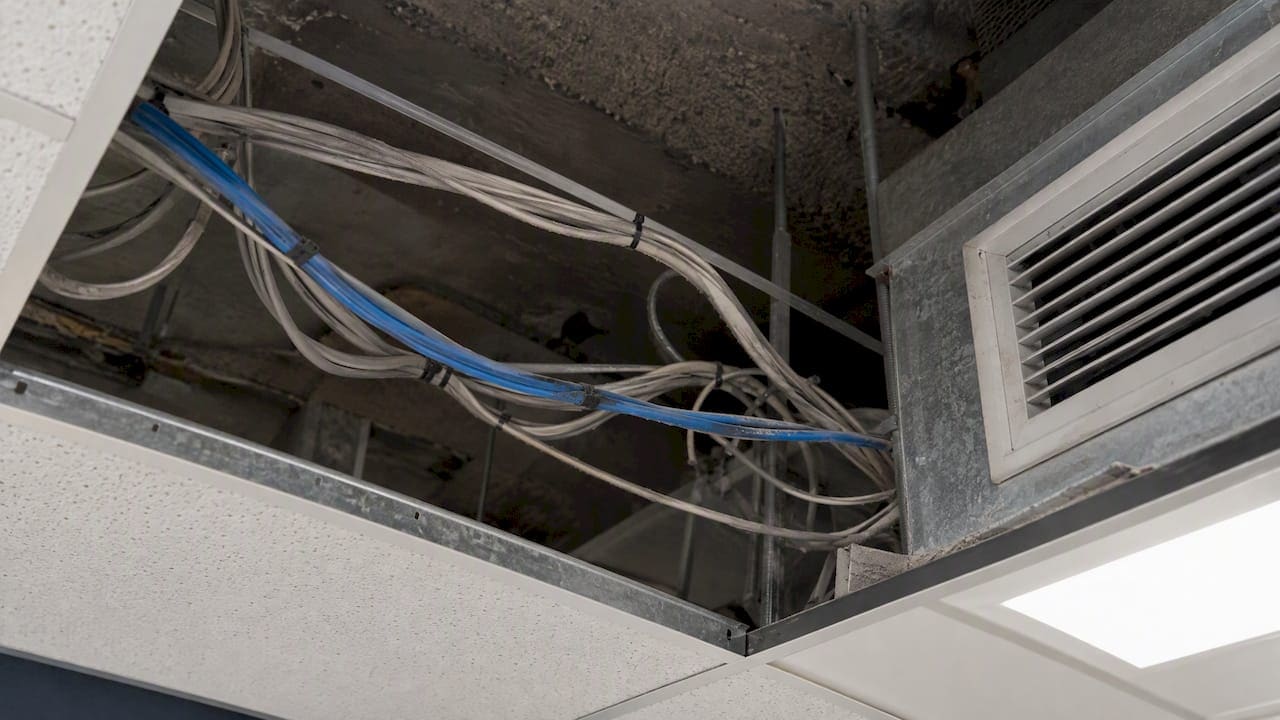
Two rules decide most low voltage ceiling work in commercial buildings. Cable in air-handling space must be plenum-rated (Type CMP). Abandoned communications cable must come out unless it sits in a raceway or carries a tag for future use. Both rules turn on one fact: what the space is used for, and whether the cable still serves anything. This guide explains how the rules work, where they overlap, and what to confirm before a ceiling is opened.
TL;DR
- Plenum-rated CMP cable is for space above a suspended ceiling or below a raised floor that is used for environmental air, not for every ceiling.
- The NEC requires removal of the accessible portion of abandoned communications cable that does not terminate at equipment and is not tagged for future use.
- Cable inside a raceway is treated as concealed, so the removal requirement does not reach it.
- Fire and mechanical codes can add their own limits, and the stricter provision governs.
- Confirm the adopted code edition and the local authority having jurisdiction (AHJ) before pulling or removing anything.
What counts as a plenum
In everyday use, “plenum” means the space above a drop ceiling that carries return air. The code language is more careful. Section 300.22© of the NEC covers the space above a suspended ceiling or below a raised floor that is used for environmental air. Two terms are in play. A “plenum” in the strict sense is a fabricated duct or chamber. “Other space used for environmental air” is the ceiling cavity that works as a return path. The NEC distinguishes the two, though both face strict wiring limits.
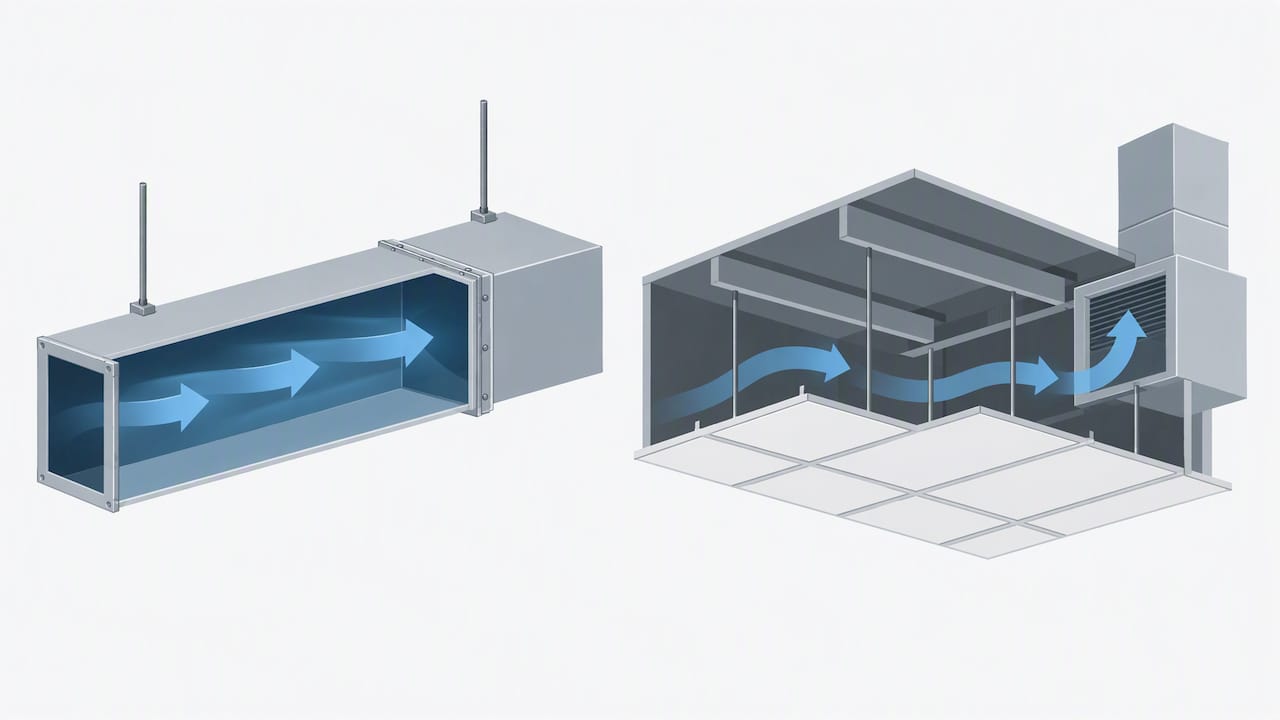
That distinction matters because mechanical codes and the NEC historically used different words for the same spaces. Installers often had to reconcile both vocabularies on one job.
Spaces that are not plenums
Not every ceiling is an air path. The NEC plenum wiring requirements do not apply to habitable rooms or building areas whose primary purpose is not air handling. A ceiling with ducted return, where the cavity is separated from the air path, is a different situation from an open cavity that returns air to an air handler. Walk the space with the mechanical drawings. Do not decide from the look of the ceiling.
On a typical New York office floor, the answer can change from one zone to the next. One section may have ducted returns and another may use the cavity as the return. Label each area on the cable plan.
When plenum-rated cable is required
Plenum-rated Type CMP cable can be installed above a suspended ceiling or below a raised floor used for environmental air. The rule of thumb is simple: if the space moves air that is later circulated through the building, use CMP, or put the cable in a wiring method the code permits for that space.
The reason is fire behavior. Plenum-rated products must meet strict fire and smoke-producing test requirements under UL 2043. The same source explains the concern: air-handling spaces can carry flame and smoke well beyond the point of origin and endanger people far from the fire. A standard PVC jacket gives off dense smoke when it burns. A plenum jacket is built to limit both flame spread and smoke.
Alternatives to CMP
CMP is not the only compliant route. Wiring methods permitted in plenum spaces include electrical metallic tubing, rigid metal conduit, intermediate metal conduit, and metal-clad cable without a nonmetallic cover. Some projects choose conduit for low voltage runs in plenum spaces, for example where a secure facility wants physical protection. Others pull CMP in open air with proper support. Both can pass. Choose based on the security requirement, the number of future changes and cost.
Where lower-rated cable is allowed
Plenum rating is not demanded everywhere. In one- and two-family dwellings, CM and CMX cables can be used for all applications, and plenum- and riser-rated communications cables are not required. That is a dwelling rule. It does not carry over to an office, a retail suite or a mixed-use building. Commercial work follows the commercial rules.
Cable choice in practice
- Air-handling ceiling or raised floor: CMP, or an approved metal wiring method.
- Non-air-handling vertical shafts and floors: the riser or general-purpose rating the code assigns to the location.
- Dwelling units: the lighter ratings above.
Pricing for CMP runs higher than for lower-rated jackets, so it is tempting to substitute. It is a failed-inspection risk and a liability, so do not do it. For route and support details, see our guide on running low voltage cabling in ceilings.
The abandoned cable rule
Abandoned cable is cable that is installed but no longer terminated at equipment and has no planned use. Old phone runs, retired coax, unused CAT5 from a previous tenant and removed access control wiring all qualify.
The NEC rule for communications circuits is direct. It requires removal of the accessible portion of abandoned communications cable that does not terminate at equipment and is not tagged for future use. Our own breakdown of the section, NEC 800.25, is in Abandoned Cabling: NEC 800.25 Sets Rules, Not NYC Removal Costs.
Three terms carry the weight:
- Accessible portion. Cable you can reach without damaging the building: above lift-out tiles, in open trays, in the closet, in open ceiling cavities. Cable behind finished walls is generally not the target.
- Terminate at equipment. A cable with a live jack and a device at the far end is in use. One that dead-ends in a ceiling is not.
- Tagged for future use. A tag that identifies the cable and its intended purpose.
Why it ties back to plenum rules
The two rules meet in the ceiling. Dead cable in an air-handling space adds fuel load and slows airflow work, and it often turns out to be non-plenum jacket that should never have been there. Removing it is usually the first step of any ceiling upgrade.
Exceptions: raceways and tags
The rule has two common outs. Abandoned cable can remain if installed inside a raceway or identified for future use with a tag. The same source notes that the removal requirement does not apply to cables inside raceways, which the code treats as concealed.
Writing a tag that holds up
An inspector should be able to read a tag and understand it without calling anyone. Include:
- the cable or circuit ID that matches your documentation
- the origin and destination
- the intended future use
- the date tagged and who owns the decision
A tag that says “old” or “spare” tells nobody anything. Tags also expire in practice: when the tenant, the system or the plan changes, the tag should be revisited. Our as-built documentation guide shows how to tie tags to a cable schedule, and the pre-renovation checklist covers recording what already exists.
Fire and mechanical codes add a second layer
The NEC is not the only code in the ceiling. The International Fire Code treats abandoned wiring as storage: it deems abandoned wiring a form of storage that must be removed from accessible areas unless tagged for future use. That language comes from the 2015 edition, so check what your jurisdiction has adopted today.
Mechanical provisions point the same direction on plenum products. NFPA 90A and the International Mechanical Code set specific requirements for products used in air-handling spaces, and ventilation compartments need materials that are noncombustible or have strictly limited flame spread and smoke development.
When codes disagree
When two provisions apply, comply with both. Connecticut’s state building inspector once put it plainly in an interpretation: both applicable provisions must be complied with, and the more restrictive prevails. That interpretation dates from 2004 and was written against older code editions, so it is an example of the principle, not current local law. The principle holds: when a fire code and an electrical code differ, plan to the stricter one.
For New York City work, local fire and building requirements sit on top of the national model codes. Read our pages on abandoned cable code in NYC and NYC firestopping rules for the local picture. Penetrations made during removal also need to be sealed correctly, which is covered in firestopping for cables.
Code editions and the local AHJ
The NEC is revised on a cycle and jurisdictions adopt editions on their own schedules. The NFPA is reorganizing the code: the proposed 2029 NEC organization restructures the code, a process that began in the 2023 cycle and includes renumbering of limited-energy articles. Section numbers you memorized may move. Cite the edition on every drawing and report, and for recent changes see what the latest NEC changed for low voltage.
Before starting, confirm with the AHJ:
- which code edition is adopted and any local amendments
- whether the ceiling cavity is classified as environmental air space
- how the inspector wants tagged cable identified
- whether removal needs a permit or notice to the building
In multi-tenant buildings, also ask property management. Building rules often go further than the code.
A practical workflow for facility teams
- Survey. Walk every ceiling zone, riser closet and MDF/IDF with the mechanical plan. Mark which spaces handle air.
- Trace. Identify each cable’s two ends. Anything dead-ended is a removal candidate.
- Decide. Remove, tag for future use or leave in raceway. Record the decision.
- Remove. Pull the accessible portion back to its source. Protect adjacent live cable.
- Firestop. Reseal any penetration the cable passed through.
- Replace to rating. Use CMP in air-handling space or an approved wiring method.
- Test and document. Certify new runs and update labels and as-builts. See cable testing and certification.
A tidy closet makes this faster the next time. Our network closet organization practices cover labeling and rack layout.
Our perspective
We have worked in New York commercial buildings for more than 40 years, and the same pattern repeats. The ceiling is where past tenants leave their history: dead runs, mixed jackets, unlabeled bundles. Nobody planned it that way. Each tenant added what it needed and left the rest.
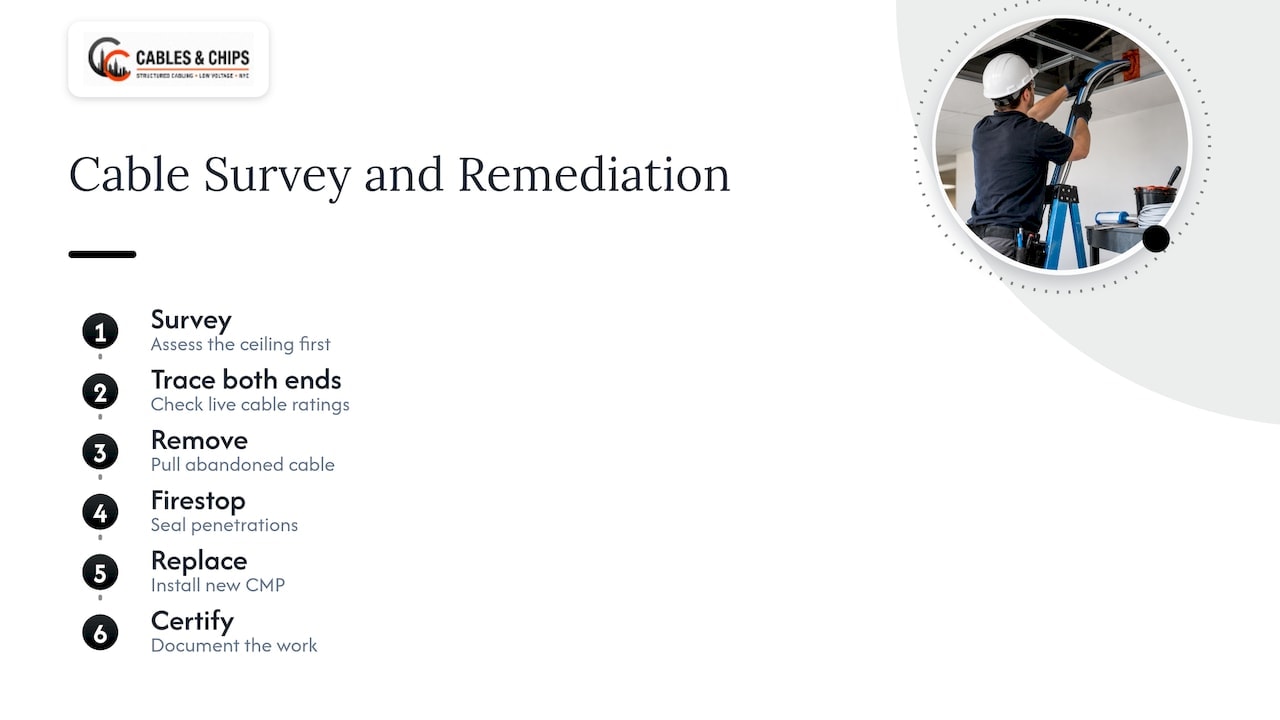
Our position is that removal and rating decisions should be made together, once, with documentation. Pulling dead cable without checking what rating the live cable has is half a job. Pulling new CMP into a ceiling still packed with abandoned cable is the other half. We survey first, trace both ends, then remove, firestop, replace and certify. The result is a ceiling an inspector can read and a successor can maintain.
We also prefer a tag that means something to a tag that exists. If you are keeping a cable for the future, say what for, and put it on the schedule.
— Ken
Get the ceiling surveyed
If you manage an office, a closet or a renovation in New York City, we can walk the space, identify abandoned and non-compliant cable, and give you a documented plan. Our low voltage services include cable cleanup, MDF/IDF cleanup, structured cabling and testing and certification, with a no-obligation site survey.

For new runs, see structured CAT6 cabling installation in NYC.
FAQ
Do I have to remove all abandoned cable?
Not all of it. The NEC requires removal of the accessible portion of abandoned communications cable that is not terminated at equipment and not tagged for future use. Cable inside a raceway is treated as concealed and is not covered by that requirement. Your AHJ has the final say on how it is applied.
Is plenum-rated cable required in every drop ceiling?
No. It is required where the space above the ceiling is used for environmental air. Habitable rooms and areas whose main purpose is not air handling are outside the plenum wiring rules. Check the mechanical plan to see how the cavity is used.
Can I use conduit instead of plenum cable?
Often yes. Permitted wiring methods in plenum spaces include electrical metallic tubing, rigid metal conduit, intermediate metal conduit and metal-clad cable without a nonmetallic cover. Confirm the choice with the AHJ and the design team.
Does the fire code say anything about abandoned cable?
Yes. The International Fire Code treats abandoned wiring as storage to be removed from accessible areas unless tagged for future use. Adopted editions and local amendments vary, so check what applies in your city.
Will section numbers change in the next NEC?
They may. The NFPA is restructuring the code, including renumbering and reorganizing limited-energy articles for the proposed 2029 edition. Always cite the edition you are working to.
Sources
- Article 800: Communications Circuits, EC&M
- Code Q&A: Installing Wiring in Plenum Spaces for Environmental Air, EC&M
- Stumped by the Code? Rules Regarding Wiring Installed in Ducts Fabricated for Environmental Air, EC&M
- Installation in Plenum vs. Air-Handling Space, Legrand
- Article 300.22, Mike Holt
- 2015 International Fire Code Update, ICC
- Products Used in Air Handling Spaces, UL Solutions
- State Building Code Interpretation No. I-10-04, Connecticut
- NEC Restructure 2023-2029, NFPA