
Abandoned Cabling: NEC 800.25 Sets Rules, Not NYC Removal Costs

Abandoned cabling removal in a commercial building is priced by labor, ceiling access and disposal, so there is no flat rate, and we publish no per-foot figure. Responsibility usually follows the lease, though owners often absorb the cost during turnovers or code-directed remediation. The compliance driver is NEC 800.25, which addresses abandoned communications cable. Confirm the requirements in the code edition adopted by your jurisdiction.
TL;DR:
- No verified price list or per foot rate is available; request itemized bids separating labor, repairs, disposal, and scheduling costs.
- Open ceilings reduce labor, while plenum spaces, conduits, dense cable bundles, multiple terminations, after hours work, and security escorts can increase bids.
- Tenants commonly pay at move out when leases require removal; owners often fund work prompted by inspections, sales, or major renovations.
- Under NEC 800.25, durable tags identifying cable for future use may keep it from meeting the abandoned cable definition; confirm the locally adopted edition.
What does abandoned cabling removal cost by job size?
We do not have a verified, published price list for this work, so treat any dollar figure you see online as a rough anchor, not a quote. Contractor bids vary with access, density and schedule, and the figures that circulate in forums are anecdotal at best. Instead of quoting an invented number, here is how jobs scale in practice:
- Small office: usually a short, single-visit job. Cost is dominated by minimum labor and any ceiling tile handling.
- Medium (one floor): an extended effort. Bids rise with ceiling complexity and how many closets and risers the cable passes through.
- Large (multi-floor or full building): phased work with after-hours staging. Disposal volume and repair trades become a visible share of the total.
The variance within each tier is wide. Labor, ceiling access and disposal cause most of it, so two floors of identical size can price very differently.
NEC 800.25 addresses abandoned communications cable. Check the locally adopted code edition to determine the applicable removal requirements.
Ask every bidder for a written, itemized estimate. A price that you cannot break into labor, repairs and disposal is not one you can compare.
Which factors drive the price on a bid?
When you line up bids, these are the items that separate one number from another:
- Accessibility: open ceiling is fastest. Plenum spaces, conduit and tight risers add labor and time.
- Cable type and density: legacy CAT3 and CAT5e bundles, CAT6 and CAT6A runs, coax and fiber are handled differently, and dense bundles take longer to pull cleanly.
- Quantity: total linear footage and the number of termination points both affect hours.
- Associated trades: ceiling tile replacement, firestop restoration and drywall patches often sit outside the base removal scope.
- Labor rates and scheduling: after-hours work, overtime and prevailing or union wages raise the hourly cost.
- Disposal, permits and security: environmental fees, building permits and security escorts show up as separate lines.
Compare bids line by line. A low headline price that leaves out firestopping or disposal usually returns as a change order.
Pro Tip: Ask each contractor to price repairs and disposal as their own line items, so a missing scope item shows up before you sign.
Who pays for abandoned cabling removal?
Start with the lease. Most commercial leases assign removal at move-out to the tenant, and the tenant improvement (TI) allowance often determines whether a landlord funds cleanup during a buildout. Read the surrender clause, the alterations clause and any exhibit that covers low voltage cabling.
In practice the split tends to look like this:
- Owners usually pay when removal is triggered by an inspection, landlord-directed remediation, a sale or a major renovation.
- Tenants commonly pay at move-out when the lease requires them to return the space free of their cabling.
- Shared arrangements appear when a TI allowance covers cleanup as part of a buildout.
- Written agreements settle the rest. Confirm who pays, which floors and closets are covered, and who handles repairs before work starts.
A lease is the final word, not an industry habit. If the language is silent or vague, get the agreement in an email or an amendment so a dispute does not surface after the invoice arrives.
For renovation timing, our office renovation cabling planning checklist shows where removal fits into the schedule.
What does NEC 800.25 actually require?
The National Electrical Code defines abandoned cable narrowly. Under NEC Article 800, a cable that is not terminated at both ends at a connector or other equipment, and is not identified for future use with a tag, is described as abandoned. Check the locally adopted code edition for applicable removal requirements.
NEC 800.25 addresses abandoned communications cable. Check the locally adopted code edition for removal and identification requirements.
The reasoning is fire safety. Abandoned cable adds fuel load in ceiling spaces, and it is a frequent inspection and tenant improvement trigger. Mike Holt’s NEC reference also notes that a tag for future use must withstand the environment where it is installed, so a paper label that peels off in a hot ceiling does not count.
The code is revised on a regular cycle, and recent editions reorganized parts of the communications articles, as the 2023 NEC changes summary shows. Confirm the edition your jurisdiction has adopted before you scope the work. For our own procedural take, see our NEC abandoned cable removal guide.
How can you cut cost and stay code-compliant?
You control more of the price than you think, and most of it happens before the contractor arrives.
- Tag and document useful runs. A cable identified for future use with a durable tag may not meet the NEC definition of abandoned cable. Check the locally adopted code edition and applicable requirements.
- Phase the cleanup. Tie removal to tenant improvement schedules and spread the spend across budget periods instead of one large invoice.
- Photograph what you keep. Dated photos and a short run list protect valuable infrastructure from blanket removal.
- Budget removal explicitly. Put removal line items and a contingency into every renovation budget, so cleanup is never a surprise.
Pro Tip: Walk the ceiling with your IT lead before the survey and mark which runs still serve a purpose. Every run you can legitimately tag is a run nobody has to pull.
What should you ask a removal contractor?
A professional survey should leave you with documents, not a verbal number. Ask for these:
- Survey deliverables: a cable count, photos, access notes and an estimate of linear feet and labor hours.
- Scope confirmation: removal method, ceiling and finish repairs, firestopping, disposal, permits and whether pricing is hourly or per foot.
- Schedule and staging: after-hours work, floor closures and building security requirements.
- Credentials: proof of insurance, licensing and references from similar commercial jobs.
- Closeout records: as-built notes or documentation after the work is done.
Our structured cabling as-built documentation guide explains what good closeout records look like. For telecom rooms specifically, we cover scope items in how to clean up telecom room cabling.
How is removed cabling disposed of?
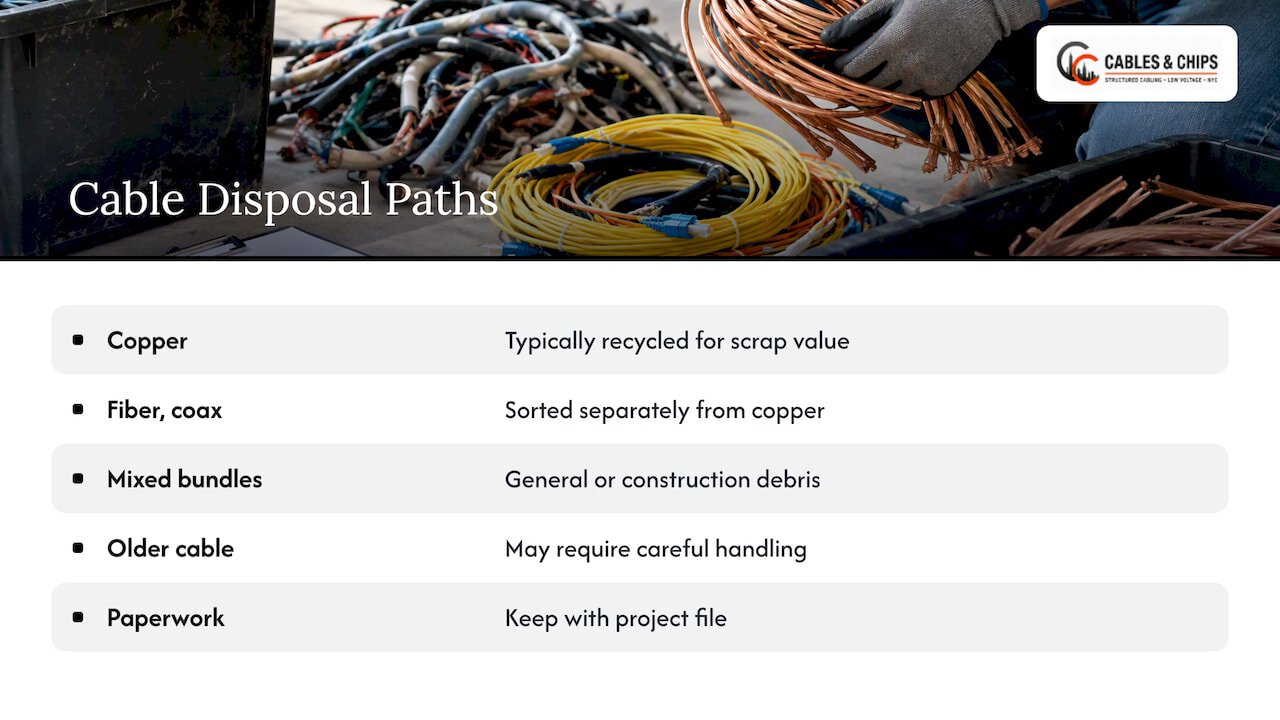
Disposal is its own line on a good estimate. Removed cable is bundled and moved out through a controlled route, usually in coordination with building management, because freight elevators and loading docks are scheduled resources in most commercial buildings.
Start with separation. Copper conductors have scrap value and are typically recycled, while jacketing, plenum insulation and mixed bundles may go through general or construction debris streams. Fiber and coax are sorted separately so they do not contaminate the copper. Your contractor should tell you where each material goes and who takes responsibility for it.
Environmental handling depends on the material and the local rules. Older cable may carry jacketing compounds that call for careful handling, so ask whether the bidder tests or assumes. Confirm in writing who hauls, where it is processed and whether any disposal fee appears on the invoice.
Cleanliness matters too. Removal leaves dust, tile debris and cut ends, and some owners coordinate finishing with a post-construction cleaning crew. A provider like post-construction cleaning services illustrates the kind of cleanup that follows construction-type work, though you should find a crew local to your building. Keep disposal paperwork with your project file, since it documents that the job was finished properly.
How long does an abandoned cabling removal project take?
Timelines follow the same three phases on almost every job: preparation, removal and cleanup.
Preparation covers the site survey, the written estimate, building approvals, certificates of insurance and scheduling around tenants. In a managed NYC building this phase can take longer than the physical work, because freight elevator reservations and access rules set the pace.
Removal is the hands-on phase. Crews trace runs from the closet to the ceiling, pull accessible cable and remove it without disturbing live circuits. Small offices can wrap quickly, while multi-floor jobs run in stages, often after hours, so occupied floors stay productive.
Cleanup includes ceiling tile replacement, firestop restoration, patching, debris haul-away and final documentation. Repairs can add days if other trades need to return.
Plan for the unexpected: hidden bundles above hard ceilings, undocumented runs and riser congestion all stretch a schedule. Ask the contractor for a phased calendar with a buffer, and tie it to any inspection or move-out date that cannot slip.
How we handle abandoned-cable removal in NYC
We have more than 40 years of experience on commercial projects in New York City, and we are licensed and insured. That history shapes how we run these jobs: coordinated floor access, after-hours scheduling and permitting that fits each building’s rules.
What we care about most is the paper trail. We tag what should stay, photograph what we find, and write the scope so everyone agrees on what is being removed before work begins. That is how owners avoid disputes later and how tenants hand back clean space with records to match.
— Ken
Get a written estimate for your building
We offer a no-obligation site survey for abandoned-cable removal, so you can assess the work for your building.

Your survey helps assess the work for your building.
Review our cable cleanup services and the full services page, then schedule a site visit to discuss the work.
FAQ
How do you get rid of unwanted cables?
Have a contractor assess the cable and arrange appropriate recycling or debris disposal. Cable identified for future use may not meet the NEC definition of abandoned, while untagged, unterminated cable is described as abandoned. Check the locally adopted code edition for removal requirements.
Which portions of abandoned communications cable must be removed?
NEC 800.25 addresses abandoned cable, but the applicable removal requirements depend on the code edition adopted by your jurisdiction. Ask your inspector how the rule applies to cable inside walls or behind finishes.
Who usually pays for abandoned cable removal?
It depends on the lease. Tenants commonly pay at move-out when the lease requires it, and owners often pay during inspection-driven remediation, sales or major renovations.
Can I avoid removing cables I might use later?
A cable identified for future use with a durable tag may not meet the NEC definition of abandoned. Check the locally adopted code edition and applicable tagging requirements. The tag should withstand the environment where it is installed.