
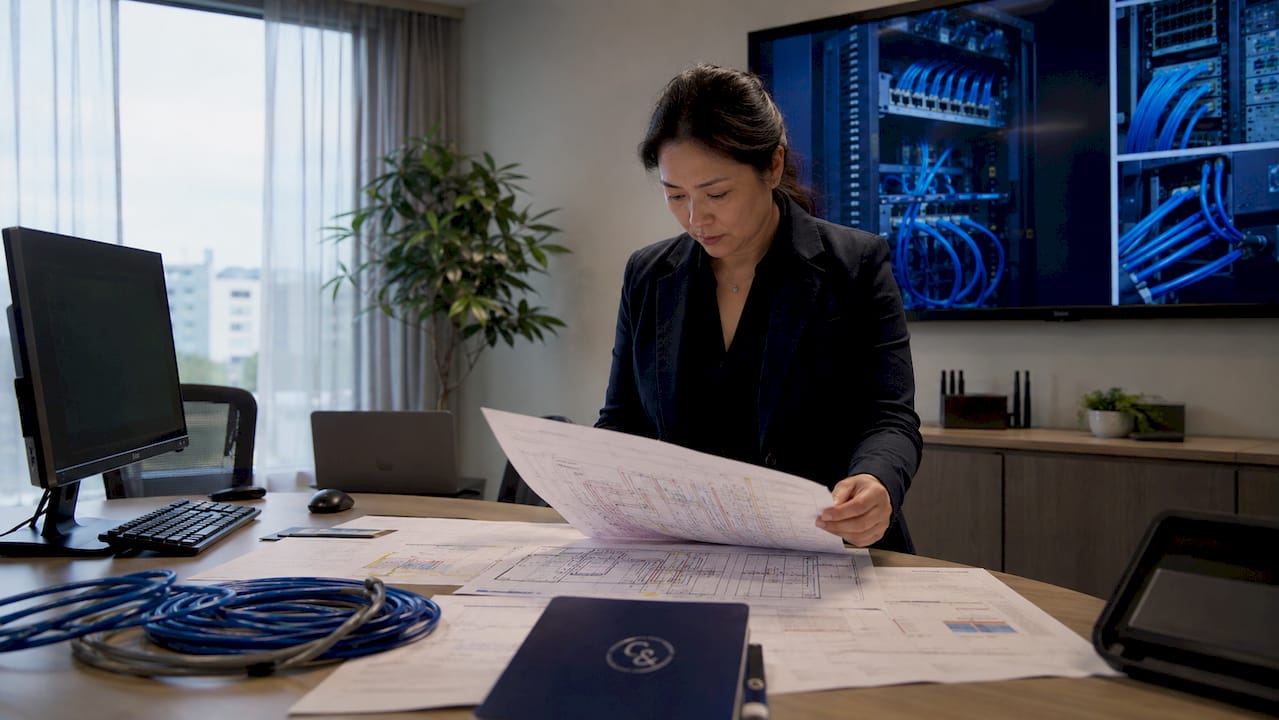
Structured cabling as-built documentation is the complete, verified record of a network cabling installation, capturing cable routes, physical layouts, label identifiers, test results, and port maps exactly as installed. IT and facilities managers at commercial properties rely on these records for troubleshooting, warranty claims, regulatory compliance, and future network upgrades. The industry term for this practice is “cabling administration,” governed by standards like ANSI/TIA-606 and ISO/IEC 11801. Without accurate as-built records, even a well-installed structured cabling system becomes difficult to manage, modify, or certify.
What key components must be in structured cabling as-built documentation?
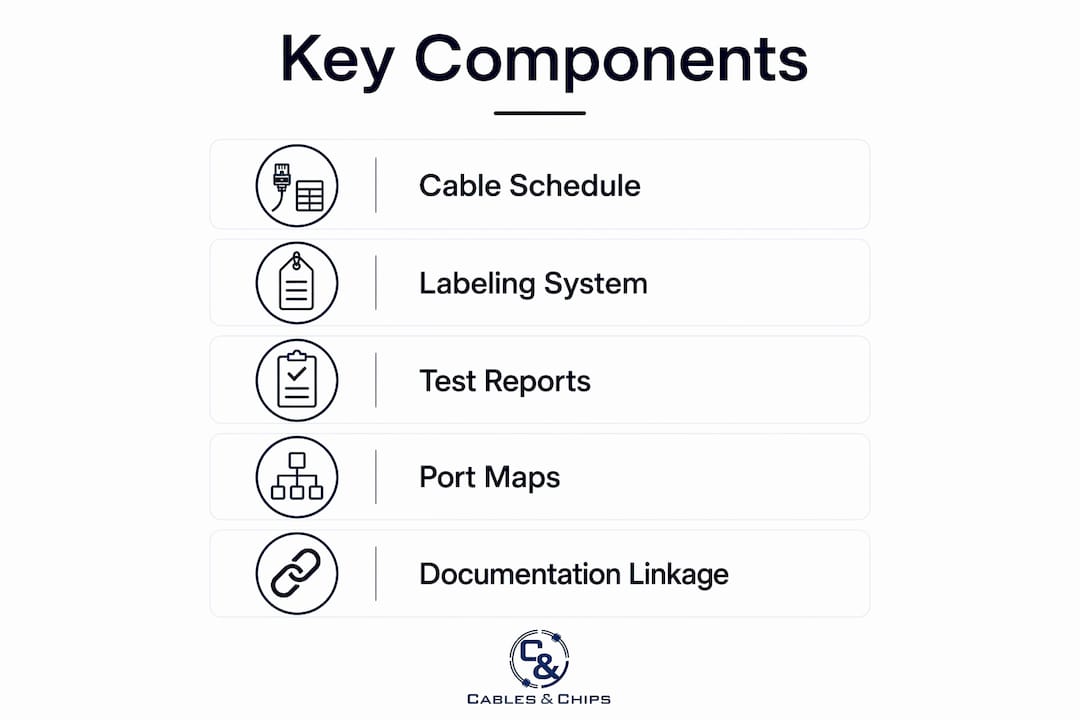
A complete as-built package goes well beyond a set of floor plan drawings. As-built documentation includes a maintainable data model of schedules, port maps, pathway identifiers, and test metadata. Every element must be updated with moves, adds, and changes to prevent the records from drifting away from physical reality.
The core components of a complete as-built package include:
- Cable schedules: A numbered list of every cable run, including origin, destination, cable type, length, and installation date.
- As-built drawings: Floor plans and riser diagrams showing actual cable routes, conduit paths, and MDF/IDF locations as installed, not as originally designed.
- Patch panel port maps: A table linking each patch panel port to its corresponding wall outlet, cable ID, and connected device.
- Test reports: Certifier output files for every copper and fiber run, including performance metrics like NEXT and return loss, pass/fail status, and test date.
- Project cover sheet and acceptance letter: Signed documentation confirming the installation meets the specified standard.
- Manufacturer warranties: Product documentation tied to specific part numbers and installation dates.
- Bill of materials: A complete list of installed components with part numbers, quantities, and supplier information.
The table below shows how each component connects to its operational purpose:
| Component | Operational purpose |
|---|---|
| Cable schedule | Identifies every run by ID for fast fault isolation |
| As-built drawings | Shows physical routes for maintenance and future work |
| Patch panel port map | Links logical ports to physical cable IDs |
| Test reports | Proves performance compliance and supports warranty claims |
| Acceptance letter | Confirms installation meets contractual and code requirements |
The linkage between physical labels and documentation is the core reliability principle. Label-to-panel linkage must be consistent character-for-character across test reports, patch panels, and as-built drawings. A single mismatch breaks traceability and makes test reports useless for troubleshooting.

How to implement standards and labeling systems for effective cabling documentation
Standards compliance is not optional. ANSI/TIA-606 is the mandatory administration standard for telecommunications infrastructure. Without compliant records, an installation is technically non-compliant regardless of how well the cables were physically installed.
Follow this sequence to build a standards-aligned labeling system:
- Define a labeling hierarchy. Structure identifiers from building level down to port level. A typical format is: Building Code / Floor / Telecom Room / Rack / Panel / Port. For example: NYC01-03-IDF2-R1-P1-01.
- Apply ANSI/TIA-606 identifier rules. Every cable, pathway, space, and bonding conductor must receive a unique, permanent identifier. The standard defines the required fields for each record type.
- Align with ISO/IEC 11801 test documentation requirements. ISO/IEC 11801 certification requires test reports to include certifier serial number, calibration dates, operator ID, and retest history. These fields are not optional for warranty eligibility.
- Enforce label format consistency across all teams. Every technician on a project must use the same label format, the same abbreviations, and the same character length. Inconsistency at installation creates permanent documentation errors.
- Verify labels before closing walls or ceilings. A label applied incorrectly after the cable is concealed cannot be corrected without destructive access.
Pro Tip: Create a one-page label convention sheet before the first cable is pulled. Distribute it to every technician and subcontractor on the project. Enforce it at the first inspection, not the last.
Proper labeling directly reduces downtime. Cable identification failures caused by poor administration cost organizations significant productivity losses. TIA-606 compliance prevents those failures by making every cable traceable from the patch panel to the outlet and back.
What digital tools and workflows support efficient as-built documentation?
Paper-based documentation fails within the first year of a building’s operational life. Digital tools keep records accurate through moves, adds, and changes. The right workflow starts before installation begins and continues for the life of the infrastructure.
Recommended tools and their roles:
- CAD software (AutoCAD, Visio): Used to produce as-built drawings with accurate cable routes, room dimensions, and rack elevations. CAD files are updatable and version-controlled.
- DCIM platforms (Data Center Infrastructure Management): Track port-level connectivity, power, and physical location in real time. Products like Sunbird DCIM and Nlyte are widely used in enterprise environments.
- Digital twin platforms: Create a virtual model of the physical infrastructure, allowing IT managers to plan changes before touching hardware.
- Cable management software: Tools like NetBoss or Netdisco catalog cable IDs, test results, and port assignments in a searchable database.
The recommended workflow follows four phases:
- Pre-installation: Generate the cable schedule, define label formats, and create drawing templates before any cable is pulled.
- During installation: Apply labels immediately as each cable is terminated. Record the cable ID, route, and termination points in real time.
- Post-installation: Run certification tests and import test files directly into the documentation system. Verify that every cable ID in the test report matches the cable schedule exactly.
- Ongoing maintenance: Update records after every move, add, or change. Maintaining correspondence between physical labels and documentation records prevents the data drift that makes records unreliable.
Pro Tip: Export test certification files directly from your certifier (Fluke DSX, Ideal SignalTEK) into your documentation platform on the same day as testing. Delayed imports create version mismatches that are difficult to reconcile later.
Step-by-step guide to creating and maintaining as-built records
A reliable documentation process follows a defined sequence. Skipping steps at installation creates gaps that are expensive to fill later.
- Plan documentation standards before installation begins. Define label formats, file naming conventions, drawing templates, and the software platform where records will be stored. Assign one person as documentation owner for the project.
- Generate the cable schedule. List every planned cable run with a unique ID, origin, destination, cable category, and pathway. This schedule becomes the master reference for the entire project.
- Apply labels during termination. Label both ends of every cable at the time of termination. Match the label exactly to the cable schedule ID, character for character.
- Record installation data in real time. Update the cable schedule with actual installed lengths, pathway used, and termination dates as work progresses.
- Run and import certification tests. Test every copper and fiber run to the applicable standard. Test reports must include cable ID linkage, test dates, performance metrics, and pass/fail status. Import test files into the documentation system immediately.
- Produce final as-built drawings. Update floor plans and riser diagrams to reflect actual installed routes. Mark any deviations from the original design drawings.
- Compile the acceptance package. Assemble the cable schedule, as-built drawings, port maps, test reports, acceptance letter, warranties, and bill of materials into a single organized package.
- Review and update after every change. Any move, add, or change must trigger a documentation update before the work order is closed.
The table below shows common documentation errors and how to prevent them:
| Common error | Prevention method |
|---|---|
| Label mismatch between cable and test report | Verify IDs character-for-character before testing |
| Missing test files for some runs | Use a checklist tied to the cable schedule |
| Outdated drawings after moves/adds/changes | Require drawing updates as part of every work order |
| No certifier metadata in test reports | Configure certifier settings before the first test run |
| Undocumented deviations from design | Mark all field changes on drawings during installation |
Planning your cabling buildout with documentation requirements defined from day one eliminates most of these errors before they occur.
How does accurate as-built documentation benefit network management?
Accurate records produce measurable operational advantages. The benefits extend from day-to-day troubleshooting to long-term financial protection.
- Faster fault isolation. When a network port fails, a technician with accurate port maps and cable schedules can identify the physical cable within minutes. Without documentation, the same task can take hours.
- Warranty protection. ISO/IEC 11801 documentation functions as a warranty and dispute-resolution package. Certifier serial numbers, calibration dates, and retest history prove baseline installation quality to manufacturers and insurers.
- Regulatory compliance. Installations without ANSI/TIA-606 compliant records are non-compliant by definition. Compliance protects the organization during audits, inspections, and lease negotiations.
- Cleaner change management. IT managers planning upgrades or expansions can model changes against accurate records instead of guessing at what is installed. This reduces errors and shortens project timelines.
- Long-term cost reduction. Misidentified cables cause expensive downtime and rework. End-to-end traceability between physical labels, patch panel port maps, and test certification files eliminates the guesswork that drives those costs.
“Your network is only as strong as the infrastructure behind it. Documentation is what makes that infrastructure manageable, serviceable, and provable.”
Facilities managers at commercial properties gain an additional benefit: accurate as-built records support building handovers, tenant fit-outs, and facilities audits. A well-documented cabling infrastructure is a transferable asset, not just a technical record.
Key takeaways
Structured cabling as-built documentation is only reliable when physical labels, patch panel port maps, test reports, and as-built drawings are linked end-to-end and updated after every change.
| Point | Details |
|---|---|
| End-to-end label linkage | Cable IDs must match exactly across labels, port maps, test reports, and drawings. |
| Standards compliance is mandatory | ANSI/TIA-606 and ISO/IEC 11801 define required fields; non-compliant records mean non-compliant installations. |
| Document before and during installation | Create cable schedules and label formats before pulling the first cable, not after. |
| Digital tools prevent data drift | CAD, DCIM, and cable management software keep records accurate through moves, adds, and changes. |
| Update records after every change | Any undocumented move or add creates a gap that compounds over time and undermines troubleshooting. |
What I’ve learned from 40 years of cabling documentation in commercial buildings
The most common documentation failure I see is not a technical one. It is a timing one. Teams plan to document after the installation is complete, and by then the details are already fuzzy. Labels get applied from memory. Test files sit on a laptop for weeks. Drawings never get updated to reflect field changes. The result is a documentation package that looks complete but cannot be trusted.
The fix is simple but requires discipline: treat documentation as a parallel workstream, not a final deliverable. Every cable labeled, every test run, every deviation from the design drawing should be recorded the same day it happens. That discipline is what separates a documentation package that actually supports troubleshooting from one that just satisfies a contract requirement.
I also see teams underestimate the value of certifier metadata. The operator ID, calibration date, and serial number in an ISO/IEC 11801 test report are not bureaucratic details. They are the evidence that makes a warranty claim or a dispute resolution possible years after installation. Skipping those fields is the equivalent of voiding your own warranty before you leave the job site.
The infrastructure lifecycle guide for IT managers in 2026 reinforces this point: documentation is not a one-time event. It is an ongoing practice that determines how manageable your network remains over its entire service life.
— Ken
Professional cabling documentation and installation services from Cables
Cables has delivered documented, tested, and certified structured cabling installations across commercial offices, server rooms, and enterprise environments in New York City for more than 40 years.
Whether you need a complete cabling system components guide to plan your next project or professional CAT6 installation services with full as-built documentation included, Cables delivers work that is tested, labeled, and documented to ANSI/TIA-606 and ISO/IEC 11801 standards. Every project includes a complete acceptance package with cable schedules, port maps, test reports, and as-built drawings. Contact Cables at 20 Vesey Street, Lower Manhattan, to schedule a site survey.
FAQ
What is as-built documentation in structured cabling?
As-built documentation is the verified record of a cabling installation as it was actually installed, including cable routes, labels, port maps, and test results. It differs from design drawings because it reflects field conditions, not original plans.
What standards govern structured cabling documentation?
ANSI/TIA-606 is the mandatory administration standard for telecommunications infrastructure in the United States. ISO/IEC 11801 governs international certification documentation requirements, including certifier metadata and test report fields.
How often should as-built cabling records be updated?
Records must be updated after every move, add, or change to the physical infrastructure. Undocumented changes cause the documentation to diverge from reality, which defeats its purpose for troubleshooting and compliance.
What must a cable test report include to be valid?
A valid test report must include the cable ID matching the physical label, test date, certifier serial number, calibration date, operator ID, performance metrics like NEXT and return loss, and a clear pass/fail result for each run.
Why does label consistency matter so much in cabling documentation?
A single character mismatch between a physical label and a test report breaks the traceability chain. Without exact label-to-panel-to-test-report linkage, technicians cannot reconcile a network fault to a specific physical cable, which extends downtime and increases repair costs.