
Abandoned Cable Code in NYC: What the Electrical Code Requires
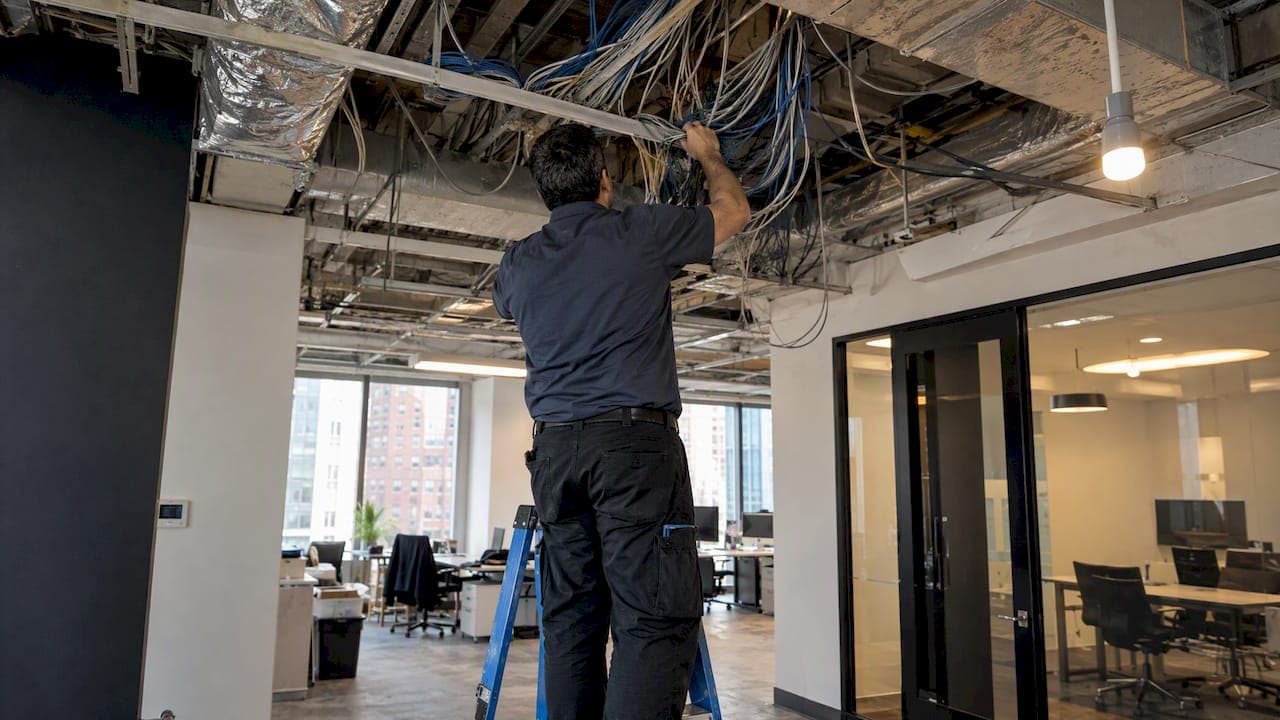
Under the New York City Electrical Code, communications and optical fiber cable that is not terminated and not tagged for future use is abandoned, and the accessible portion of it must be removed. That is the rule in plain terms. The details decide whether your building passes: what “accessible” means, what a compliant tag looks like, who is responsible, and how to confirm your property is clean before an inspector or a buildout schedule forces the question.
This guide is written for facilities managers, IT directors, property managers and general contractors working in New York City buildings. We install and clean up low voltage cabling in Manhattan every week, so we have kept the focus on what you can act on.
TL;DR
- A cable is abandoned if it is not terminated at a connector or equipment and not tagged for future use. There is no gray area: the NYC Electrical Code definition is a two-part test.
- The accessible portion of abandoned communications and fiber cable must be removed. Cable sealed inside finished walls is generally outside that duty. Cable above an accessible drop ceiling is not.
- Cable you want to keep for later needs a durable tag at each end. A cable that only looks like it might be used again is still abandoned.
- Removal through fire-rated floors and walls means restoring the firestop. Check your records, document what you pull, and use the DOB’s Buildings Information System to see whether your address already carries open violations.
What the NYC code says about abandoned cable
The national baseline is the NEC, and New York City adopts it with local amendments in Chapter 11 of its Administrative Code, known as the NYC Electrical Code. The city’s amendments matter because they are what a New York inspector, a building’s managing agent and a tenant’s contractor actually answer to.
Three articles cover the cable types most office tenants have in the ceiling:
- Communications circuits (Article 805): copper data and voice cabling, including CAT5e, CAT6 and CAT6A. The city’s text for Article 805 defines an abandoned communications cable as one that is not terminated at a connector or equipment and is not identified for future use with a durable tag at each end showing where the opposite end is.
- Optical fiber cables (Article 770): the city’s Section 770.25 says the accessible portion of abandoned optical fiber and other cables, power sources and associated equipment shall be removed. Tags must be durable enough for the environment, and tagged power sources and equipment must be de-energized.
- Fire alarm cables: these carry similar tagging expectations, and as we cover below, they raise the question of who is allowed to touch them.
The definition is binary. If the cable is terminated, it is in service. If it is unterminated but properly tagged for future use, it is not abandoned. If it is unterminated and untagged, it is abandoned, and the accessible part has to go. Many managers assume that a cable which “looks” useful is safe to leave. Industry commentary on the rule makes the same point: the code asks for documentation, not an impression.
Why the rule exists: fire and smoke
Abandoned cable is a fire-safety issue before it is a housekeeping issue. In buildings where the space above the ceiling serves as a return-air plenum, cable that is not plenum-rated can act as fuel and help carry toxic smoke. Electrical Contractor magazine’s discussion of the requirement frames the removal mandate this way, and notes that skipping it during a fit-out is a missed chance to bring a space up to current code.
Note the date on that article: it was published in 2004, when the requirement first entered the national code. The idea is not new. What has changed is how many tenancies, relocations and renovations have since stacked new cable on top of old.
New York offices make the problem worse than most. Many floors have been fitted out three or four times. Each tenant pulled its own CAT5, CAT5e or CAT6, and few removed what they replaced. A ceiling that has seen decades of tenants can hold thousands of feet of dead cable, much of it unlabeled and untraceable.
What counts as “accessible”
The code requires removal of the accessible portion. It does not require you to tear open finished construction to chase every dead cable.
In practice, as explained in continuing-education material for electricians, the working distinction looks like this:
| Location | Generally accessible? | What to do |
|---|---|---|
| Above a lay-in or drop ceiling | Yes | Remove, or tag at both ends for future use |
| Open cable tray, J-hooks, ladder rack | Yes | Remove, or tag |
| Telecom closets, MDF and IDF rooms | Yes | Remove, or tag |
| Under a raised floor | Usually yes | Remove, or tag |
| Inside finished walls or sealed shafts | Generally no | Cut back the accessible portion, leave the rest, record it |
| Behind hard-lid ceilings without access | Depends on the building | Confirm with the building’s engineer or your contractor |
Treat the table as a starting point. Whether a particular space is accessible is a judgment about the specific building, and the building’s own rules can be stricter than the code. Landlords often require tenants to remove all abandoned cable at lease end, regardless of what the code would minimally demand. Read your lease and the building’s alteration guidelines before assuming the code is the only standard.
Tagging cable you want to keep
Some unterminated cable is deliberate. A tenant may pull extra runs to a conference room that will be wired next quarter, or leave spare fiber between closets. The code allows this if the cable is identified for future use.
A compliant tag has these qualities, drawn from the definition in Article 805:
- At each end. One tag at one end does not meet the test.
- Durable and securely fixed. Tape flags and handwritten sticky notes fail. Use a printed, permanent label rated for the environment, including heat above a ceiling.
- Shows the opposite end. The tag has to say where the other end of the cable lands: room, rack, panel and port.
Our recommendation goes one step further. Put every future-use cable in your documentation set too, with a unique ID that matches the label. A tag that no one can look up in two years is only slightly better than no tag. Our as-built documentation guide and the checklist on documenting existing cabling before renovation cover how to record this.
Who is allowed to remove it
This is where facilities teams get caught. Removing a dead data cable is not the same as touching a fire alarm circuit.
Per the UpCodes summary of the city’s low voltage provisions, an electrical permit is not required for installing, altering, maintaining or repairing wiring designed to operate below 50 volts for signaling, communication and data transmission. The same summary states that work on life-safety systems such as fire alarms, or in hazardous locations, has to be done by a licensed master or special electrician. Certified low-voltage installers can handle general data transmission systems, but that work still has to follow all applicable fire safety standards. The summary also cites penalties of up to $1,000 per violation for work that does not meet the standard.
What this means on a real job:
- Data and voice cable (CAT5e, CAT6, CAT6A, coax for data, fiber) can be removed by a qualified low voltage contractor.
- Fire alarm, life-safety and anything in a hazardous location needs a licensed electrician, and you should not pull it just because it is unlabeled. Confirm with the building’s fire safety director what the circuit is before it is touched.
- Anything you cannot identify gets traced and labeled before removal. Cutting the wrong cable above a ceiling in an occupied floor takes down someone’s phones, door readers or cameras, or worse.
Confirm current requirements with the Department of Buildings or a licensed professional for your specific scope. The rules around permits and license classes are the kind of detail that changes.
Firestopping: the part that fails inspections
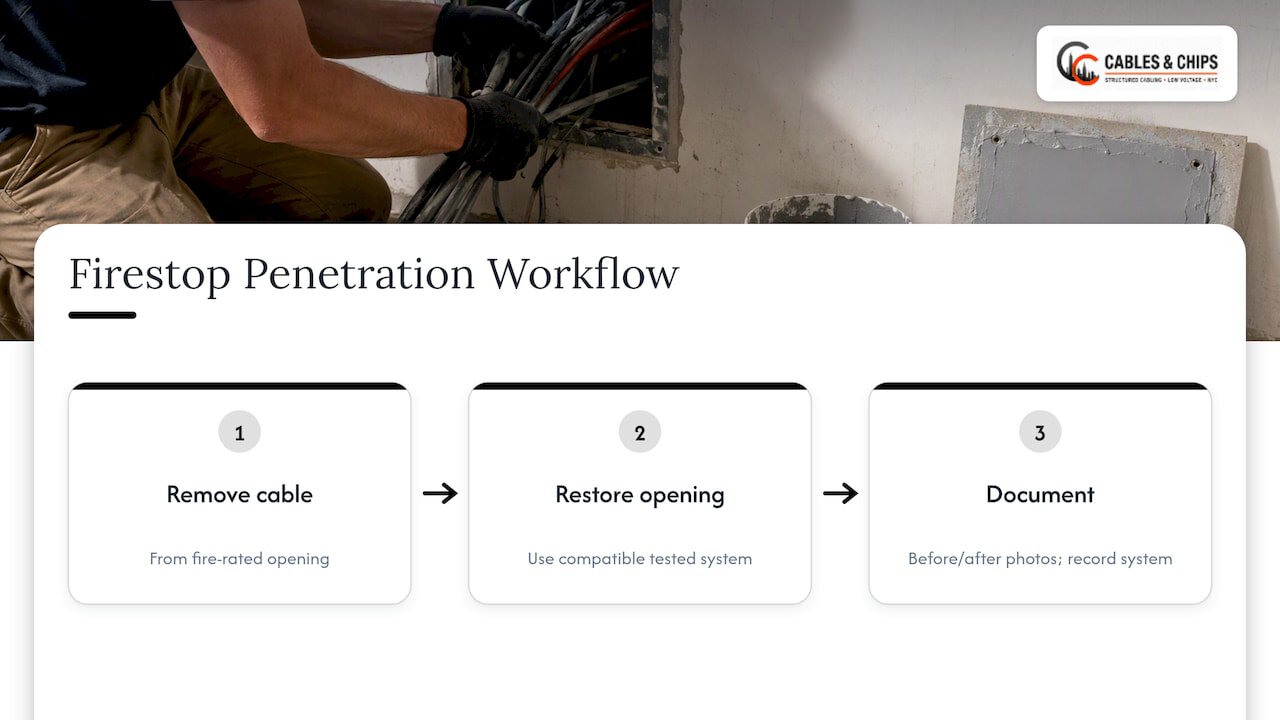
Pulling cable through a fire-rated floor or wall leaves a hole that was once sealed around the cable. Remove the cable and the seal may be damaged or incomplete. Leave a gap and you have created the exact thing the code is trying to prevent: a path for fire and smoke.
Two points matter here.
First, firestop systems are tested as assemblies. According to the City’s own network specifications, inspectors expect firestopping installed in line with the manufacturer’s system documentation. Mixing putty, sealant or sleeves from different manufacturers in one penetration is a common reason for a failed inspection and a costly redo.
Second, document the penetration. Photograph it before and after, record the system used, and keep that record with the closeout package.
We go deeper on this in our guides to NYC firestopping rules for cable installers and firestopping for cables under IBC, NEC and UL.
How to check whether your building has violations
Abandoned cable itself is not always the thing a violation names. It may surface during a fire inspection, a renovation sign-off or a building walk. But you can see what is already on file for your address.
The DOB’s guidance on paying or challenging violations notes that violations on New York City properties are public information. You can view them in the DOB NOW Public Portal without logging in, and for a complete list you should also search the Buildings Information System (BIS).
That second step is easy to skip. The DOB NOW FAQs explain that DOB NOW covers filings made through DOB NOW, while BIS holds filings made in eFiling or at a borough office. Certain older items, including OATH/ECB summonses, are only in BIS. You can search by address, BIN (building identification number) or violation number.
A practical routine for a property team:
- Search your address in the DOB NOW Public Portal.
- Search the same address in BIS and review complaints, ECB violations and open items.
- Note anything touching electrical, fire protection or alterations.
- Ask your building management for fire alarm and sprinkler inspection reports for the floor.
- Walk the ceiling and closets to compare what is on paper with what is actually there.
If you find an open item, resolve it through the process on the DOB page and keep the paper trail. For anything involving a legal dispute or a summons, speak with your attorney or an expediter familiar with DOB practice.
A field checklist for abandoned cable
Use this before a move-out, a buildout or a lease renewal.
- Pull the floor plans and prior as-builts. Any record of past cable runs reduces tracing time.
- Identify terminated cable. Anything landing on a jack, patch panel port, switch or device is in service.
- Find the unterminated ends. Coiled tails above ceilings, cut stubs in cable tray and capped runs in closets are typical.
- Tag or flag for decision. Mark each candidate and trace it to the other end. If you cannot trace it, treat it as abandoned and have it checked by a technician.
- Separate low voltage data from life-safety. Fire alarm and similar systems go to the licensed electrician.
- Remove the accessible portion. Pull cable back to the source where possible rather than cutting it short and leaving a tail.
- Restore firestops wherever a penetration was disturbed, using the same manufacturer’s system.
- Tag what stays. Durable labels at both ends, matching your records.
- Update the documentation and file it with your closeout set.
- Test what remains. Certified results on live cable give you a clean baseline.
The point of step 9 is that the code cares as much about what you can show as what you did. The record is what you hand an inspector or the next facilities manager.
Timing it with a project
The cheapest moment to remove abandoned cable is when the ceiling is already open. During a relocation, expansion or renovation, tiles are out, lifts are on site and trades are coordinated. Experts quoted by Electrical Contractor magazine recommend a “clean-as-you-go” policy at every move or upgrade, so years of accumulation do not compound into one large cleanup.
For general contractors, this means putting abandoned cable removal in the bid scope explicitly. If it is not written down, it tends to be assumed by every trade and done by none, and then shows up at a punch list. Our guide to network infrastructure renovation best practices sets out where this fits in the schedule. If your project involves public or prevailing wage work, review our note on pre-bid checks for prevailing wage audits as well.
What about cost? The code sets the requirement, not a price. We explain why in our piece on NEC 800.25 and removal costs: quantity, ceiling height, access, after-hours work, firestopping and tracing time all drive a quote, so the only honest figure comes from a site survey.
Our perspective
After more than 40 years of working in New York commercial buildings, we have a few firm views on abandoned cable.
Treat it as a system problem, not a cleanup problem. Dead cable shows up because nobody owned the record. The best fix is not a bigger removal crew, it is a cable plant with labels, documentation and a rule that every project leaves the ceiling cleaner than it found it.
Tracing is the real work. Pulling cable is quick. Proving it is dead is slow, and it is where mistakes happen. We would rather spend an extra hour tracing than take down a client’s door readers.
Do not stop at the ceiling. The telecom room is where unlabeled patch cords, orphaned cable and unfinished rack work gather. That is why our cable cleanup and network closet organization work treats ceilings, trays and MDF/IDF rooms as one job, finished with tested, documented results.
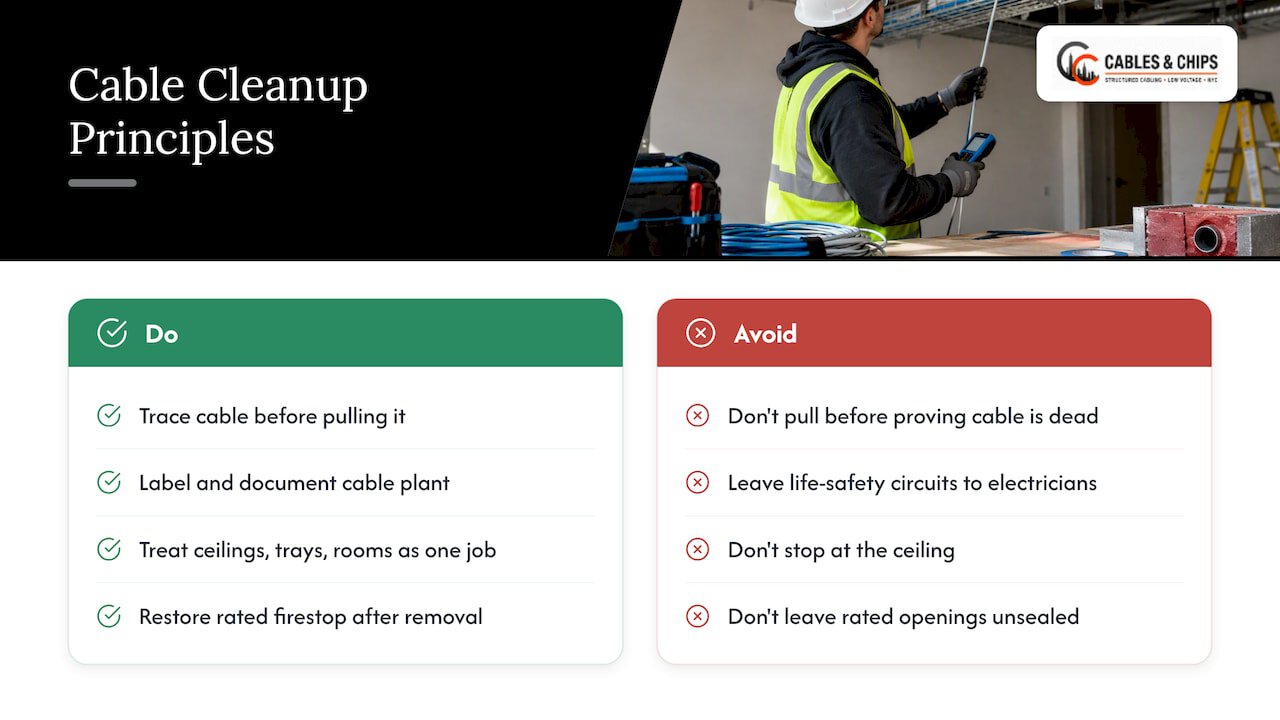
Know where our line is. We handle low voltage data, voice, fiber, WiFi, CCTV, access control and A/V cabling. Life-safety circuits belong to a licensed electrician, and a good contractor says so up front instead of improvising.
Firestop is part of removal. If a cleanup contractor pulls cable through a rated wall and does not restore the seal, the job is not finished.
— Ken
Getting a site survey
If you manage a floor or a building and are not sure what is above your ceiling, we offer a no-obligation site survey. We walk the space, locate and trace unterminated cable, flag anything that looks like life-safety wiring, and tell you what removal, tagging and firestopping would involve. See our low voltage services, including cable cleanup, MDF/IDF cleanup and cable testing and certification, or contact us at cables.nyc to schedule a site survey. We are at 20 Vesey Street in Lower Manhattan, licensed and insured, with local NYC response.
If the survey is part of a wider project, our guides to NEC changes for NYC IT teams and structured cabling components help with planning. For a longer read on the rule itself, see our NEC abandoned cable removal guide for facility teams.
FAQ
Do I have to remove every abandoned cable in my NYC office?
No. The code targets the accessible portion of abandoned cable, such as cable above drop ceilings, in trays and in closets. Cable inside finished walls that cannot be reached without damaging the structure generally falls outside that duty, but you should still record it. Check your lease too, since landlords often require full removal at move-out.
What makes a cable “abandoned” under the NYC Electrical Code?
A communications or optical fiber cable is abandoned when it is not terminated at a connector or equipment and is not tagged for future use. The tag must be durable, securely fixed at each end and show where the opposite end is. The city’s Article 805 sets that definition.
Can a low voltage contractor remove fire alarm cable?
Not on the strength of a low voltage certification alone. Summaries of the city’s rules say life-safety work, including fire alarms, must be done by a licensed master or special electrician. A contractor handling data cable should identify and set aside anything that looks like a fire alarm circuit.
How do I find out if my building has violations?
Search your address in the DOB NOW Public Portal, then in the Buildings Information System, since some violations appear only in BIS. You can search by address, BIN or violation number. The DOB’s violation guidance confirms these records are public.
Does removing cable require new firestopping?
If the cable passed through a fire-rated floor or wall, yes, the penetration must be sealed again. Use a system from a single manufacturer and follow its documentation, because mixed products can fail inspection. Photograph and record the work.
Sources
- NYC Electrical Code, Article 805: Communications Circuits
- NYC Electrical Code, Section 770.25: Abandoned Cables
- Don’t Gamble with Abandoned Cable, Electrical Contractor Magazine
- Removal or Tagging of Abandoned Cables, Electrical License Renewal
- Low Voltage Electrical Work, UpCodes
- Broadband General Network Specifications, NYC
- DOB NOW: Public Portal FAQs, NYC Department of Buildings
- Pay, or Request a Waiver or a Challenge, NYC Department of Buildings