
40 Years in NYC: NEC Abandoned Cable Removal for Facility Teams

Yes, the NEC requires removal of the accessible portion of abandoned cable unless it is durably tagged for future use. This obligation runs through several articles, including 722.25, 725.25, and 770.25 of NFPA 70. If you find unidentified cable in your ceilings or trays, do not touch anything that might be energized. Tag what stays, document your decision, and schedule a qualified electrician to remove the rest.
TL;DR:
- Abandoned cables that are not terminated or tagged for future use must be removed, especially in accessible areas like trays, plenums, and ceilings, to prevent fire hazards and clutter.
- Only qualified personnel should verify de-energization with a meter before cutting or removing cables, even if circuit breakers are labeled off, to ensure safety.
- Visual inspection, tracing both ends, and cross-checking documentation are essential steps to determine whether a cable is truly abandoned before removal.
- When removal is impossible due to structural obstacles, tagging for future removal with thorough documentation and barriers is acceptable, but must be recorded properly.
- Proper documentation, including detailed logs, photographs, and updated drawings, supports safety, compliance, and future troubleshooting efforts.
NEC requirements and definitions that control abandoned cable removal
The National Electrical Code defines abandoned cable as installed cable that is not terminated at equipment and not identified for future use with a tag. This definition, consolidated by the NFPA committee to reduce confusion across code sections, applies whether the cable carries data, security signals, or low-voltage control circuits, according to NFPA 70 committee statements. The rule matters because unterminated cable left in place adds fuel load, clutters pathways, and makes future troubleshooting slower and more expensive.
Several NEC articles repeat the same core instruction with slightly different scope:
- Article 722.25 covers Class 2, Class 3, and PLTC cables and states the accessible portion of abandoned cables shall be removed.
- Article 725.25 applies the same standard to remote control, signaling, and power limited circuits.
- Article 726.25 governs Class 4 fault managed power systems.
- Article 760.25 addresses fire alarm circuit cabling, where abandoned runs are especially common after system upgrades.
- Article 770.25 covers optical fiber cabling, a frequent source of abandoned runs in offices that have switched providers or backbone technology.
- Article 800.25 applies to communications circuits, including telephone and data cabling.
- Article 334.25 addresses nonmetallic sheathed cable and includes similar language for conductors that are no longer in service.
Every one of these sections turns on the same phrase: the accessible portion. That term matters because the NEC does not require you to demolish finished walls or ceilings to chase cable you cannot reach without damaging the structure. Accessible generally means the cable can be reached without removing a permanent building component, which is why cable trays, open plenums, and accessible drop ceilings carry the heaviest obligation. Cable buried behind drywall or poured into a slab falls into a different category, one addressed later in this guide.
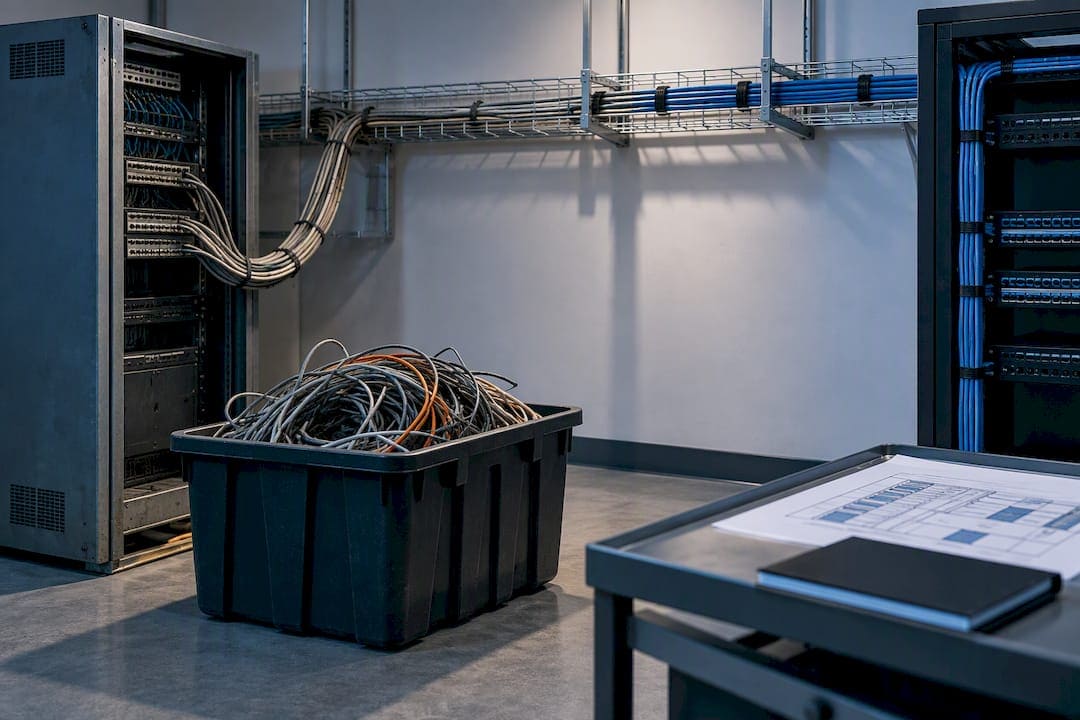
Recognizing where abandoned cable tends to accumulate helps you scope the problem before you call in a crew. Data closets after a network refresh, ceiling plenums above open office areas, and cable trays running along corridors are the three most common locations facility teams report finding unidentified runs.
OSHA rules on who can remove abandoned cable and how
Removing abandoned cable is not just a code compliance task, it is electrical work, and OSHA treats it that way. Under 29 CFR 1910.305, temporary wiring must be removed immediately once the project or purpose for which it was installed is complete, a standard often cited alongside NEC removal requirements when facilities audit their wiring.
The bigger safety question is who touches the cable and how. OSHA’s interpretation of 29 CFR 1910.333 requires that work on or near energized parts be performed by a qualified person, and that de-energization be verified rather than assumed. A breaker labeled off is not proof of a zero energy state. OSHA’s guidance calls for verification before any conductor is cut, which means testing with a meter, not trusting a panel schedule that may be years out of date.
Even when breakers are switched off, OSHA still requires verification of de-energization before work begins, according to the same interpretation letter. Many field mistakes happen when staff cut what looks like dead cable without confirming it upstream first.
Before your team removes anything, walk through this operational checklist:
- Confirm the person doing the cutting meets OSHA’s qualified person criteria for the voltage and circuit type involved.
- Test every suspect conductor with a meter rather than relying on labels, panel schedules, or memory.
- Apply lockout/tagout procedures on any circuit that could feed the cable in question.
- Keep a licensed electrician on call for any run where termination points cannot be confirmed.
If your team cannot answer where a cable terminates on both ends, that is the point to stop and bring in a licensed electrician rather than guess.
How to identify, trace, and tag abandoned cable
Not every unlabeled cable is abandoned, and not every abandoned cable looks obviously dead. A careful identification process protects you from removing something still in service and from leaving a fire hazard tagged as active when it is not.
- Inspect visually first. Look for dust accumulation, disconnected ends dangling in a tray or plenum, and cable jackets that do not match your current standard, all signs of a run nobody has touched in years.
- Trace both ends. Use a tone generator and continuity tester to confirm where a suspect cable actually terminates, checking patch panels, punch blocks, and equipment rooms rather than assuming based on routing.
- Cross-check as-built drawings. Compare what you find against existing documentation; a cable missing from the as-builts is a strong candidate for abandonment, though it still needs physical confirmation.
- Tag anything kept for future use. Durable tags should survive the environment (plenum-rated where required) and record an ID number, the date tagged, the reason it is being retained, the responsible party, and the intended reuse.
- Place tags where inspectors can find them. Attach tags near both termination points and at intervals along long runs, not just at one end.
Pro Tip: Photograph every tag in place with a wide shot showing its location in the tray or ceiling, not just a close-up of the tag itself; inspectors and future contractors both benefit from the context.
If tracing reveals a cable that still shows continuity to an active panel or unknown equipment, stop and involve a qualified electrician before assuming it is safe to touch.
Safe removal methods and best practices for common environments
A compliant removal starts before anyone opens a ceiling tile. Confirm the scope of work, pull any required permits, verify utility locates if the path crosses areas with buried services, and set a schedule that accounts for building occupancy and any tenant coordination needed for access.
Once on site, lockout/tagout and voltage verification come first, every time. Test each conductor with a meter rated for the expected voltage, even when documentation says the circuit is dead. OSHA’s guidance on cable trays specifically warns that working on or near trays can expose workers to live parts, and that de-energization or other protective measures must be confirmed before work begins, according to the OSHA Safety and Health Information Bulletin on cable trays.
Removal technique depends on where the cable runs:
- In cable trays, cut cable into manageable sections and pull rather than yanking whole runs, which can dislodge active cables sharing the same tray.
- In plenums, work through existing access points where possible and avoid unnecessary ceiling tile damage that could compromise fire-rated assemblies.
- In walls, use existing penetrations and junction boxes rather than cutting new openings, and patch any fire-rated wall or floor penetration you do open.
- Around active equipment, tag and physically separate live cables before cutting anything nearby, since visual similarity between abandoned and active jacketing is a common source of mistakes.
Pro Tip: Bundle and label active cables with temporary flags before you start cutting in a shared tray; it takes five minutes and prevents the single most common on-site error, cutting the wrong run.
Once removal is complete, reassess tray fill percentages now that abandoned cable is gone, since trays that were overloaded may return to compliant fill ratios. Restore any fire-stopping disturbed during the work, and relabel the tray or panel to reflect the current state. OSHA’s tray guidance notes that overloaded trays often signal unsafe or noncompliant conditions, and that abandoned cable is a frequent contributor to that overcrowding.
When full removal is impractical: acceptable alternatives
Sometimes pulling every abandoned run is not realistic. A cable buried in a slab or routed through a structural element that cannot be safely opened is a case of genuine infeasibility, not a compliance shortcut, and the difference matters when an inspector asks about it. Document the specific obstacle, whether it is structural, asbestos-related, or a tenant access restriction, so the decision holds up under review.
Where removal cannot happen now, the code allows tagging for future use rather than pulling, provided the tag is durable enough for the environment. Acceptable mitigation steps include:
- Physically segregating abandoned runs from active bundles to reduce confusion during future work.
- Adding trays or relocating active cable so abandoned runs are clearly isolated rather than tangled together.
- Installing barriers or markers that flag the abandoned section for anyone opening that space later.
- Scheduling the actual removal for the next renovation or tenant fit-out, with the decision documented in the facility file.
An inspector generally wants to see that the decision was deliberate and recorded, not that the cable was simply overlooked.
Documentation and turnover after removal or tagging
Every removal or tagging decision needs a paper trail that outlives the crew that did the work.
- Log each tag with an ID, exact location, date, reason for retention, and a contact person who can answer questions about it later.
- Photograph the work area before and after, keeping images with the project file rather than only on a phone.
- Update as-built drawings to reflect what was removed and what remains, following the same standard used for new installations, detailed further in a structured cabling as-built documentation guide.
- Collect contractor signoff that records the scope of work performed and the LOTO procedures followed during removal.
This record protects you during inspections, supports insurance claims if a fire or electrical incident ever occurs, and saves the next contractor from re-tracing work you already completed.
Practitioner notes from real NYC removal projects
During retrofits, Cables & Chips documents every removal with photos and updated as-builts, the same records inspectors typically request. Mixed, undocumented bundles and hidden terminations are the most common surprises in older NYC buildings, usually resolved by tracing back to source equipment before cutting. Clear subcontractor scope, daily job hazard assessments, and signed completion records keep liability contained across every phase of the work.
Why proactive removal protects your building and your people
After decades in New York City buildings, I have seen abandoned cable treated as a paperwork problem long after it became a physical one. It adds fire load, hides real capacity, and turns a routine service call into a scavenger hunt. Removing it on a schedule, not in a panic, is the cheaper choice every time.
— Ken
How Cables & Chips supports abandoned cable removal and cleanup
Cables & Chips brings the same documentation discipline to abandoned cable projects that it applies to new structured cabling work, backed by more than 40 years of experience in New York City commercial buildings. A removal project typically starts with a site survey to scope accessible runs, followed by a written safety plan covering LOTO coordination with your building’s electrical staff, then a quote before any cable is touched.

Services relevant to abandoned cable projects include:
- Cable Cleanup to clear abandoned and unused runs from trays, ceilings, and closets.
- MDF/IDF Cleanup to reorganize network closets after old cabling is removed, detailed on the cable cleanup services page.
- Cable Testing & Certification to confirm what remains is active and performing correctly.
- Documentation support, including updated as-builts once removal is complete.
Facility teams can review the full range of options on the services page and request a no-obligation site survey to scope an abandoned cable project before committing to a date.
Primary code texts and guidance to consult
For exact language and official interpretations, go to the source documents rather than a summary:
- NFPA 70 (NEC) committee statements for the abandoned cable definition and article cross-references.
- OSHA 29 CFR 1910.305 on temporary wiring removal.
- OSHA interpretation letter on 1910.333 covering qualified persons and de-energization.
- OSHA cable tray safety bulletin for tray-specific hazards.
Crews coordinating removal near excavation or buried services may also find OSHA-adjacent guidance on trenching safety useful for worker qualification standards in near-surface work.
Sources
- 29 CFR 1910.305 – Wiring methods, components, and equipment for general use
- OSHA interpretation letter on 29 CFR 1910.333 and LOTO (2006)
- Safely Installing, Maintaining and Inspecting Cable Trays (OSHA Safety and Health Information Bulletin)
- NFPA 70 (NEC) – Committee statements and definitions
FAQ
What is article 725 of the NEC?
Article 725 of the NEC covers remote control, signaling, and power limited circuits, including the requirement in 725.25 that the accessible portion of abandoned cable be removed unless it is durably tagged for future use. It applies to a wide range of low voltage control wiring found in commercial buildings.
What are the NEC requirements for service disconnects?
Service disconnect requirements are addressed in separate NEC articles from abandoned cable and depend on the specific system involved, so definitions vary by application. For abandoned cable questions specifically, the relevant sections are 722.25, 725.25, 726.25, 760.25, 770.25, and 800.25, not the service disconnect provisions.
Can you cut unused cable wires?
Unused cable can be cut and removed once you confirm it is truly de-energized and not identified for future use, following OSHA’s requirement to verify de-energization rather than assume it from a breaker label, per OSHA’s interpretation letter. A qualified person should perform the work, and any cable kept for future use needs a durable tag instead of being cut.
Is exposed Romex a code violation?
Whether exposed Romex is a violation depends on the specific installation conditions and local amendments, so it is best confirmed against the NEC sections that govern nonmetallic sheathed cable and your local jurisdiction’s adopted code. Romex left abandoned and unterminated falls under the same removal principle described in Article 334.25, which addresses conductors no longer in service.
When is it acceptable to leave abandoned cable in place?
Leaving abandoned cable in place is acceptable when removal is genuinely infeasible, such as cable embedded in a slab, provided the decision is documented and any reusable cable is tagged durably for future use. Facility teams should record the reason, the location, and a mitigation plan rather than leaving the cable unaddressed and undocumented.