
Catch Over 90% of Cable Faults Early: Low Voltage Punch List for PMs

A low voltage punch list exists to produce one thing: an inspection-ready, test-documented record that proves every cabling and device system meets acceptance criteria before anyone signs off. The core deliverables are an itemized checklist, machine-generated test reports, and confirmed firestopping and labeling. Final acceptance typically rests with the general contractor, building owner, or IT department, but the record has to hold up to all three.
TL;DR:
- A comprehensive punch list must include detailed test reports with length, insertion loss, return loss, and crosstalk data, not just continuity checks.
- Evidence such as labeled photos and test reports should be directly attached to each checklist item to streamline review and verification processes.
- Testing should be conducted continuously during installation, with machine-generated reports immediately stored and linked to corresponding items to prevent disputes.
- Firestop and penetration sealing require photographic proof on top of installation, ensuring all closures are fully sealed and documented before final acceptance.
- Final sign-off should involve staged reviews at each project phase, with clear ownership, consistent file naming, and complete archival of test data and as-built documentation.
What Belongs on a Low Voltage Punch List: A Phase-by-Phase Checklist
A punch list that actually protects your close-out date follows the job from rough-in to the final walk, with pass or fail criteria attached to every line.
- Rough-in: verify pathway routing, conduit and box placement, pathway fill limits, and firestopping wherever a penetration crosses a rated wall or floor.
- Termination and patching: confirm correct pinout under T568A or T568B, connector seating, pair untwist within manufacturer tolerance, and jack mounting heights that match the spec.
- Labeling and documentation: check cable IDs, port IDs, and patch panel labels against the as-built set.
- Grounding and bonding: verify telecom bonding to building ground following NECA/BICSI practice, since a loose bond can fail inspection even on cabling that tests clean.
- Devices and mounted equipment: inspect access point mounting, camera field of view, access control wiring, and power sequencing on powered devices.
- Firestopping and penetrations: confirm every closure is sealed and photographed, not just installed.
- Cleanup and cable management: check Velcro bundling, slack storage, zip-tie damage, and whether junctions stay accessible for future service.
Beyond the checklist items, each line needs a clear owner and a minimum standard of proof:
- A pass or fail mark tied to a named inspector, not a vague “crew checked.”
- A photo, test report, or physical tag as evidence, filed against the item ID.
- A cross-reference to the as-built drawing where the item appears.
Belden’s installation guidance ties pair untwist limits and routing tolerances directly to acceptance criteria, which is worth building into your own termination and routing instructions rather than leaving them to memory.
Pro Tip: Attach the evidence requirement to the checklist item itself, not to a separate appendix. Reviewers accept faster when proof sits next to the claim.

Testing and Certification: What Test Reports the Punch List Must Include
Continuity and wiremap checks confirm a cable is connected. They do not confirm it performs. A punch list built for commercial acceptance needs full certification data: length, insertion loss, return loss, and near-end and far-end crosstalk (NEXT and FEXT), not just a pass light on a cheap tester.
Modern field testers make this fast rather than burdensome. Autotest times for a Cat 6A permanent link run about 10 seconds on current Fluke DSX/Versiv devices, and the resulting report is machine-generated rather than hand-recorded, which removes a common source of punch-list disputes.
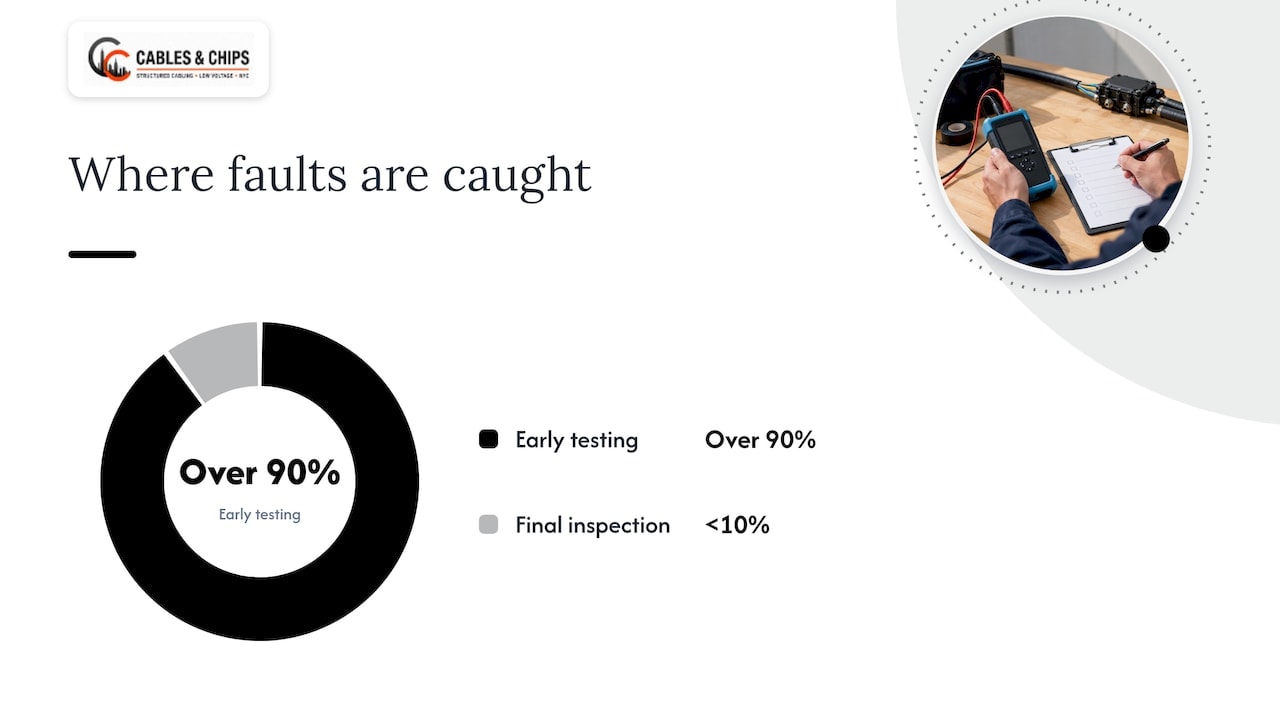
Over 90% of the cable faults caught on a well-run job surface during early, in-process testing rather than at final inspection, according to Belden’s installation guidance, which argues for testing as you terminate instead of waiting for a single final pass.
To make test reports usable by a GC or owner who is not a cabling specialist, structure them in three layers:
- A one-page summary showing pass or fail by cable ID.
- A readable per-link detail sheet for anyone who wants to check a specific port.
- Raw autotest data archived and available on request.
On jobs where fire alarm, access control, or notification systems interconnect, NFPA 4 calls for integrated system testing, meaning the punch list has to verify how systems respond together, not just how each cable tests in isolation. For every cable or port, keep three things paired: the test report file, a labeled photo, and the test ID that links both to the punch-list row.
Sample Punch-List Template and How to Adapt It for Your Job
A usable template needs a fixed set of columns so nothing slips through during a busy punchout week.
- Item ID, location, and discipline: which system, which closet or room, which floor.
- Description and acceptance criteria: what was installed and what counts as passing.
- Responsible party and date: who verified it and when.
- Evidence link and status: photo or report file reference, plus pass, fail, or open.
Two layouts cover most jobs:
- A compact field checklist for technicians, built for a tablet or printed sheet, organized by room or closet.
- An owner-facing acceptance log that rolls field items up by system, meant for sign-off rather than daily use.
Capture photos and raw test data in the field app as you go, then archive the finished set as part of the permanent project record alongside your as-built documentation. Avoid vague “miscellaneous” entries. Every row needs a location and a piece of evidence, or it is not an acceptance item, it is a note to yourself.
Roles, Timing, and Workflow for the Low Voltage Punch List
Open the punch list at rough-in, not at the final walk. That gives you a running record instead of a last-minute scramble.
- Rough-in: the installer foreman logs pathway and box items as work proceeds.
- After terminations: the project manager adds test results and labeling checks as each closet or zone finishes.
- After systems integration: owner, IT, or the general contractor reviews and signs staged acceptances rather than one giant list at the end.
Keep file naming consistent across the job, link every test result to its punch-list row, and archive the finished set with the as-builts so a future service call has somewhere to start. Readers deciding whether to bring in outside help for this stage can check a cabling contractor vetting checklist before signing a scope.
Common Punch-List Pitfalls and Practical Fixes
Most close-out delays trace back to a short list of repeat offenders: bad terminations, a missing bond, an unsealed penetration, or an access point mounted where it never gets signal.
- Bad terminations: reterminate, retest, and attach the new report to the same item ID rather than opening a new row.
- Missing bond: verify telecom bonding to building ground before requesting sign-off, since this single miss fails otherwise clean cabling.
- Unsealed penetrations: reseal firestop and photograph the closure, not just the opening.
- AP or camera placement issues: reroute or remount, then reverify field of view or signal coverage.
Use a “fix later” flag in your test management workflow when a failed item needs parts or scheduling, but keep the original test ID attached so nothing loses its history.
Pro Tip: Before requesting final sign-off, have the superintendent walk every flagged item in person. A five-minute walk catches what a spreadsheet review misses.
Field-Tested Practices from Cables & Chips
On commercial jobs, testing is done as work proceeds rather than saving certification for the end, so machine reports are stored per cable the same day it’s terminated instead of batched later when memory is unreliable.
- We pair a labeled photo with its test file for every port, using one consistent cable ID scheme across the whole project.
- We build acceptance packages that give a GC exactly what they need: summary pass/fail, per-link detail, and raw data on request.
- We coordinate firestop sign-off with other trades before closets get buttoned up, following best practices highlighted in industrial painting quality tips, since reopening a sealed penetration costs everyone time.
That habit of pairing evidence with every item is the same discipline we bring to structured CAT6 cabling work across New York City offices and secure facilities.
Why a Testing-First Punch List Saves Time and Money
Punch lists built on machine-certified reports, not spot-checked continuity, settle disputes faster because the evidence is objective rather than contested. That matters most on medium-to-large commercial jobs where integrated testing under NFPA 4 and NFPA 72 is already a requirement, not an option. Favor test-first workflows whenever multiple trades and systems intersect.
— Ken
How Cables & Chips Handles Punch Lists, Testing, and Acceptance
When a project needs certified, documented proof instead of a handshake close-out, we bring the testing and documentation discipline this article describes directly to the job. Our cable testing and certification work produces the same machine-generated reports, labeled photos, and as-built records a GC or IT director needs to sign off without back-and-forth.

- Machine test reports mapped to labeled ports and panels.
- Firestop coordination documented alongside other trades.
- As-built records archived in the same format your facilities team already expects.
If your next project needs a punch list that holds up to inspection the first time, start with our services overview and request a site survey.
FAQ
What are some examples of low-voltage items?
Low voltage items typically include structured data cabling, fiber optic lines, security camera and access control wiring, access point cabling, intercoms, and audiovisual wiring in conference rooms. These systems generally carry voltages well under the 50-volt threshold that triggers OSHA guarding requirements for exposed live parts.
What can I use instead of a punchdown tool?
Some technicians use tool-less keystone jacks that snap cable conductors into place by hand, which skips the punchdown step entirely. These jacks trade a small amount of termination speed for convenience and still need full certification testing afterward to confirm performance.
Is 480V considered low voltage?
No. Low voltage in building wiring generally refers to circuits well under 50 volts, the threshold OSHA uses for its guarding requirements under 29 CFR 1910.303(g)(2). A 480V circuit falls into medium voltage distribution, not the low voltage cabling and devices covered by a punch list like this one.
What are the best tools for a low voltage technician?
A certified cable analyzer from the Fluke DSX or Versiv family is standard for producing the machine-generated test reports that back up a punch list. Beyond testing gear, technicians rely on tone generators, cable labelers, and basic termination tools matched to the jack and connector types specified for the job.