
The Cabling Contractor Vetting Checklist for IT Pros

A contract-ready cabling contractor vetting checklist requires eight non-negotiables before a single bid is accepted: a BICSI Registered Communications Distribution Designer (RCDD) engaged for the full project lifecycle, BICSI-registered installer leads on site, manufacturer authorization for the specified product line, ANSI/TIA-compliant testing with a certified report for every drop, a current Certificate of Insurance (COI), sample as-built and test deliverables with the bid, written warranty ownership language, and resumes for both the project manager and field superintendent.
- RCDD engaged from design through closeout (on-staff or contracted)
- BICSI-registered installer leads assigned to the project, not just listed on a resume
- Manufacturer-authorized contractor status for the cabling product line (Panduit, CommScope, Leviton, or equivalent)
- Certified test report for every drop; OTDR/insertion-loss traces for all fiber
- Current COI showing general liability and workers’ compensation with verified policy dates
- Sample as-built drawings and test deliverables submitted with the bid
- Written warranty documentation assigning manufacturer and installer obligations
- Project manager and field superintendent resumes included in the bid package
Pro Tip: Make RCDD involvement a contractual obligation with the contractor’s name and credential number in the agreement. Per BICSI guidance, the RCDD may be on staff or retained as a consultant, but must remain engaged for the project’s duration, not just sign off on a drawing.
Key Takeaways
A qualified cabling contractor must demonstrate RCDD engagement, manufacturer authorization, per-drop certified testing, and complete as-built documentation before any payment milestone is released.
| Point | Details |
|---|---|
| RCDD engagement is contractual | Name the RCDD and credential number in the agreement; verbal commitment is unenforceable. |
| Test every drop, not a sample | Require a certified report per drop and OTDR traces for all fiber runs as an acceptance condition. |
| Manufacturer authorization protects warranty | Unauthorized labor voids extended manufacturer warranties from Panduit, CommScope, and Leviton. |
| COI and license before conversation | Verify insurance and state low-voltage license before discussing project scope or budget. |
| Cables and Chips | Delivers per-drop testing, TIA-606 labeling, and full as-built documentation on every NYC commercial project. |
What credentials should you require from a cabling contractor?
Credentials are the fastest way to separate qualified bidders from those who will cost you more in remediation than they saved on the bid. Credentials are the fastest way to separate qualified bidders from those who will cost you more in remediation than they saved on the bid. Three minimums matter: professional design credentials, field installer certifications, and manufacturer authorization—as required in university procurement templates and institutional RFPs.
RCDD Engagement. BICSI recommends that an RCDD be involved from project start through completion. Whether the contractor employs an RCDD or retains one as a consultant is secondary. What matters is that the RCDD’s name, credential number, and project-lifecycle commitment appear in the contract.
BICSI-Registered Installers. University procurement templates require BICSI-registered installers leading installation teams, with registration documentation submitted before work begins. Require the same. Ask which specific technicians will be on your project, not just whether the company employs registered installers.
Manufacturer Authorization. Manufacturer-certified contractor programs from Panduit, CommScope, and Leviton tie warranty coverage to authorized labor. If an unauthorized installer terminates your connectors, the manufacturer’s extended warranty is void. Require written proof of authorization for the exact product line specified in your design.
- Verify RCDD credential number at BICSI.org before contract execution
- Require installer registration certificates naming the individuals assigned to your project.
- Confirm manufacturer authorization covers the specific cable category and connectivity components in the RFP
- Ask whether field leads are direct employees or subcontractors, and require contractual assignment if subcontracted
Pro Tip: Require structured cabling certifications documentation with the bid, not after award. A contractor who cannot produce certificates at bid time almost certainly cannot produce compliant test reports at closeout.
What testing and standards should your RFP specify?
Your RFP acceptance criteria should reference four ANSI/TIA standards as the installation baseline: TIA-568 (cabling components and performance), TIA-569 (pathways and spaces), TIA-606, which are widely recognized standards guiding structured cabling installation. (administration and labeling), and TIA-607 (bonding and grounding). University infrastructure standards also reference NEC compliance and distance limits such as the 90-meter horizontal channel guideline as mandatory constraints. Mirror these in your acceptance language.

For testing, cable testing certification guidance is direct: require a certified test report for every drop, not a sample or spot check. For fiber, require OTDR traces and insertion-loss measurements for every run.
| Test Type | Deliverable Required | Acceptance Threshold |
|---|---|---|
| Copper (CAT6/CAT6A) | Certified report per drop, standard certifier format | Pass per TIA-568 channel limits |
| Fiber (multimode/singlemode) | OTDR trace + insertion-loss per run | Per TIA-568 loss budget |
| Bonding/grounding | Continuity verification | Per TIA-607 |
| Pathway compliance | Conduit fill and bend-radius documentation | Per TIA-569 and NEC |
Specify acceptable test equipment brands and calibration dates in the RFP. Define the retest procedure for failed links: who pays, what timeline, and what documentation is required before re-inspection.
Pro Tip: Reference ANSI/TIA compliance checkpoints in your RFP by standard number and section. A contractor who cannot cite the standard they are working to is a contractor who is not working to it.
What project documentation must you receive?
Documentation is what makes a cabling installation maintainable five years after the contractor leaves. Require it before mobilization and at closeout.
Before mobilization:
- Full CADD construction documents and telecom room/backboard layouts
- Labeling schema aligned with TIA-606
- Cutover and rollback plan with stepwise tasks, downtime windows, and a communication plan for occupied floors
At closeout (within 30 days of substantial completion):
- Plotted full-size as-built drawings and soft-copy CAD/PDF files
- Port-to-port test records for every drop, in standard certifier format
- Labeling schematic cross-referenced to test records
- Manufacturer warranty transfer documentation
- Final punch-list sign-off with retest results for any failed links
Require a single point of contact for all project communication and weekly written status reports. A shared repository (a secure cloud folder or project extranet) keeps records accessible to your team without chasing emails.
Pro Tip: As-built documentation is the deliverable most contractors deprioritize under schedule pressure. Tie 10% of the contract value to satisfactory as-built submission. That payment holdback is the most effective enforcement tool available.
What insurance and safety records should you verify?
Verify licensing and COI before discussing project details. In several U.S. states, a low-voltage or specialty electrical license is legally required. Check license numbers against your state’s contractor licensing database.
- Current COI showing general liability (minimum limits appropriate to project scale) and workers’ compensation, with your entity named as additional insured
- Verified policy expiration dates, not just a certificate on file
- Proof of bonding where your jurisdiction or building requires it
- Experience Modification Rate (EMR) below 1.0 as a safety benchmark
- OSHA 10 or OSHA 30 compliance for field leads
- Confirmation of NEC and local building code adherence, including any jurisdiction-specific low-voltage licensing
A B2B facilities buying guide flags safety verification as an essential early check, not an afterthought at contract signing. Run it in parallel with credential verification, not after.
What warranty and contract clauses protect you?
Warranty protection fails when the contract does not assign responsibility clearly. Require these clauses in every cabling contract:
- Manufacturer warranty transfer: contractor must register the installation with the manufacturer and deliver the warranty certificate to you at closeout
- RCDD engagement clause: named RCDD, credential number, and scope of involvement written into the agreement
- Acceptance testing milestone: no payment release until certified test reports are reviewed and accepted
- Punch-list and retest process: defined timeline (typically 10 business days) and who bears retest costs for failed links
- Liquidated damages for missed milestones on projects where downtime has a measurable cost
- Final closeout deliverables deadline: as-builts, test records, and warranty documents within 30 days of substantial completion
- Draft the RCDD clause first. It anchors every other quality commitment.
- Tie payment milestones to documentation deliverables, not calendar dates.
- Specify that manufacturer warranty claims are coordinated by the contractor, not passed back to you.
- Include a 10% payment holdback released only upon satisfactory as-built submission.
Pro Tip: Ask the contractor to name the manufacturer warranty program they intend to register under. Programs from Panduit, CommScope, and Leviton each have specific labor and material requirements. A contractor who cannot name the program has not planned for warranty compliance.
What on-site supervision should you require?
A named field superintendent in the contract is the single most effective quality control tool available. Require the superintendent’s resume in the bid package and retain the right to reject a substitution without your approval.
- Daily site reports from the superintendent, submitted by end of shift
- Interim labeling checks at 25% and 75% completion
- Cable routing verification against approved drawings before conduit fill
- Progressive testing (test as you go, not all at end) with results logged in real time
- Require the superintendent’s resume and BICSI registration with the bid.
- Schedule an interim inspection at 50% completion with your team or a third-party inspector.
- Reserve the right to witness random testing on a sample of drops during installation.
- Require written corrective action reports for any routing or labeling deviation.
Pro Tip: Industry guidance recommends requiring project manager and field superintendent resumes up front. The front-office team is irrelevant if field staff lack documented experience. Interview the field superintendent, not just the sales lead.
How do you evaluate bids objectively?
Apples-to-oranges pricing is the most common mistake in cabling procurement. A bid that excludes testing, as-builts, or manufacturer-authorized labor will always look cheaper. Normalize scope before comparing price.
Scoring matrix (suggested weights):
Items to normalize across bids:
- Is per-drop certified testing included or priced separately?
- Are as-built drawings and CAD files in scope?
- Does the price assume manufacturer-authorized labor?
- What is the retest cost structure for failed links?
- Issue a line-item pricing template with the RFP so every bidder prices the same scope elements.
- Score each bid against the matrix before discussing price.
- Use the matrix score to build a shortlist of two or three bidders for interviews.
What red flags and interview questions reveal real performance?
Responsiveness before the contract predicts responsiveness after award. A contractor who cannot clearly explain their testing process, labeling standard, or documentation workflow during the estimate phase will not improve once mobilized.
Red flags to act on immediately:
- Vague scope with no line-item detail
- Missing or expired COI
- No RCDD named or no registered installers on the proposed team
- Refusal to provide manufacturer authorization documentation
- Request for more than 30% upfront payment on a standard commercial project
- Inability to produce a sample test report or as-built drawing
Reference-check questions (ask two clients with at least three years of operational service):
- Did the contractor meet the agreed schedule? If not, what caused delays?
- Were test failures documented and remediated before final payment?
- How did the contractor respond to warranty issues after closeout?
- Were as-built drawings delivered on time and accurate?
Interview questions for the project manager and field superintendent:
- Walk me through your labeling standard and how it maps to TIA-606.
- How do you handle a failed link discovered at 80% completion?
- What certifier equipment do you use and when was it last calibrated?
Pro Tip: A B2B facilities guide recommends calling two clients with at least three years of operational service. Recent clients cannot tell you how the contractor handles warranty calls two years out.
How do you run the vetting workflow from screening to selection?
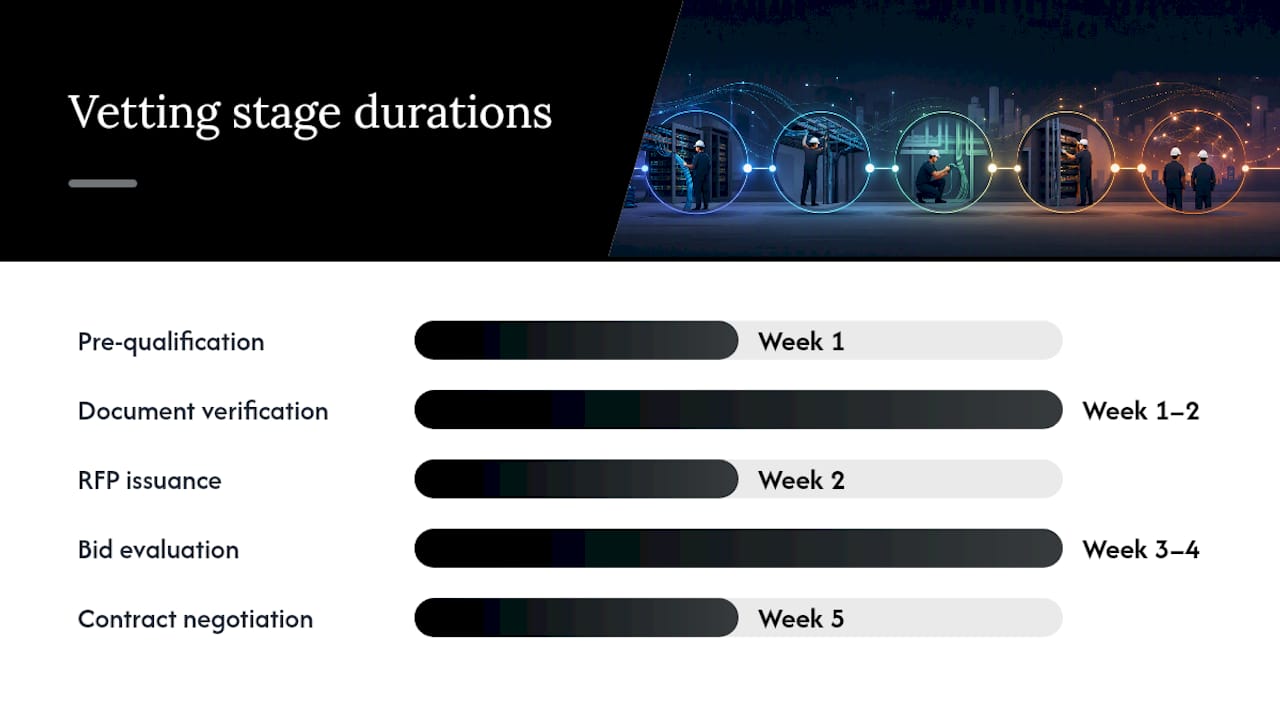
Turn the checklist into a repeatable process with clear ownership at each stage.
- Pre-qualification (Week 1): Issue a pre-qualification questionnaire requiring RCDD credential, registered installer list, manufacturer authorization, COI, EMR, and three project references with contacts and dates.
- Document verification (Week 1–2): Verify RCDD credential at BICSI.org, confirm manufacturer authorization directly with the manufacturer, and check license numbers with your state licensing board.
- RFP issuance (Week 2): Issue the RFP with a line-item pricing template, standards references (TIA-568/569/606/607), and required deliverables list.
- Bid evaluation (Week 3–4): Score bids against the weighted matrix. Flag any bid missing testing, as-builts, or manufacturer-authorized labor as non-compliant.
- Interviews and site visits (Week 4): Interview the project manager and field superintendent. Visit a current or recent job site if possible.
- Reference checks (Week 4–5): Call two long-running clients per the reference-check template above.
- Contract negotiation (Week 5): Insert RCDD clause, payment holdback, acceptance testing milestone, and closeout deliverables deadline.
- Test and acceptance: Require progressive testing with real-time logs. Conduct a final witness test before releasing the holdback.
- Closeout: Confirm as-builts, test records, and warranty transfer documents are received within 30 days.
- Assign one internal owner for each milestone to prevent gaps in follow-up.
- Use the matrix score, not price alone, to select the final contractor.
Pro Tip: For occupied-building projects, review the office renovation cabling planning checklist before issuing the RFP. Cutover coordination in a live environment requires specific contract language that a standard commercial RFP often omits.
Why does this checklist map to real risk reduction?
Each item in this checklist traces to an authoritative source or a documented failure mode.
- RCDD engagement: BICSI’s position is that an RCDD must be contractually committed to the full project lifecycle to protect design integrity and warranty outcomes.
- Registered installers and references: University of Florida procurement guidance requires BICSI-registered installer leads and three project references as minimum approval criteria.
- ANSI/TIA standards and NEC compliance: University of Houston infrastructure standards reference TIA installation and pathway requirements alongside NEC and local code as mandatory constraints.
- Per-drop testing and manufacturer authorization: Industry guidance identifies at least five years of verifiable experience, manufacturer authorization, and complete as-built records as the primary defenses against field performance failures.
- COI and license verification: Practical vetting advice recommends verifying license and insurance before discussing project details, noting that low-voltage licensing is legally required in several U.S. jurisdictions.
Request these documents during vendor qualification for a complete audit trail: RCDD certificate, installer registration certificates, manufacturer authorization letter, current COI, EMR documentation, state license verification, sample test report, and sample as-built drawing.
What a low-voltage contractor sees that buyers miss
Poor labeling is the most common field mistake, and it costs more to fix after closeout than it would have cost to enforce during installation. A labeling check at 25% and 75% completion, tied to a payment milestone, eliminates most of it. The second most common issue is corner-cut fiber splicing: mechanical splices substituted for fusion splices without disclosure, producing insertion-loss failures that only appear under load. Require OTDR traces for every fiber run, not just a continuity check.
RCDD involvement is frequently listed on a contractor’s marketing materials but absent from the contract. If the RCDD’s name and credential number are not in the agreement, the commitment is unenforceable. One project where this mattered: a tenant improvement in a multi-floor commercial building where the RCDD caught a pathway conflict with the building’s fire suppression system during design review. Catching it in drawings cost an afternoon. Catching it in conduit would have cost weeks and a change order.
Make the RCDD clause non-negotiable. Every other quality commitment in the contract depends on it.
Cables and Chips delivers what this checklist demands

Cables and Chips brings more than 40 years of commercial low-voltage experience to every project in New York City, covering structured CAT6 and CAT6A installation, fiber optic infrastructure, cable testing and certification, and complete as-built documentation. Every installation is tested per drop, documented to TIA-606 labeling standards, and closed out with full as-built drawings and certifier reports, which is exactly what this checklist requires you to demand from any contractor.
If you are issuing an RFP or evaluating bids now, request a site survey from Cables and Chips. The team will assess your space, identify pathway and infrastructure requirements, and provide a fully scoped proposal with line-item pricing, testing methodology, and documentation deliverables spelled out. Visit the services page to schedule your consultation.
Useful sources
The following standards and references belong in your RFP language and procurement files.
- BICSI Ethics Committee Position Statement: cite when requiring RCDD engagement in contract language (“RCDD involvement required per BICSI guidance for the full project lifecycle”).
- University of Florida Telecommunications Contractor Selection Guide: use as a pre-qualification template for RCDD, registered installer, and reference requirements.
- University of Houston Network Infrastructure Standards: reference for ANSI/TIA standard citations, NEC compliance, and pathway requirements in RFP acceptance criteria.
- ANSI/TIA-568, TIA-569, TIA-606, TIA-607: cite by standard number and edition in the RFP acceptance section (“Installation shall conform to ANSI/TIA-568 current edition”).
- How Cable Testing Certification Works for IT Teams: use to specify certifier report formats and OTDR requirements in the testing section of your RFP.
- Add BICSI.org as the verification source for RCDD credentials in your pre-qualification questionnaire.
- Reference TIA-568/569/606/607 standards as the basis for installation acceptance, which is industry best practice. by number in the RFP acceptance criteria section.
- Cite the University of Florida template when justifying three-reference and registered-installer requirements to internal stakeholders.
- Include the Cables and Chips TIA standards compliance guide as a reference for your IT team when reviewing test reports.
Sources
Require at least three written references for comparable commercial projects, with contact names, project dates, and scope, per university procurement guidance. Call two clients with at least three years of operational service to assess long-term warranty and support responsiveness.
- BICSI Ethics Committee Position Statement | BICSI
- Recommendation for Selecting a Telecommunications Contractor (University of Florida)
- University of Houston network infrastructure standards (network-standards-files)
- Selecting the right contractor | Lightwave Online
- Structured Cabling: A B2B Facilities Buying Guide
- How to Choose Voice and Data Cabling Contractors | iTeleco Blog
- 5 Steps to Choose a Commercial Low Voltage Contractor
FAQ
What credentials must a cabling contractor have?
At minimum, require a BICSI RCDD engaged for the full project lifecycle, BICSI-registered installer leads on site, and manufacturer authorization for the specified cabling product line. Verify each credential before contract execution.
What does a certified test report for every drop mean?
It means the contractor runs a pass/fail certification test on each individual cable run using calibrated equipment and delivers the results in a standard certifier format, not a summary spreadsheet. Failed links must be retested and documented before final acceptance.
Is low-voltage licensing required in the United States?
Licensing requirements vary by state and jurisdiction. In several U.S. states, a low-voltage or specialty electrical license is legally required for commercial cabling work. Verify the contractor’s license number against your state’s licensing database before work begins.
Can Cables and Chips provide testing and as-built documentation?
Yes. Cables and Chips delivers certified per-drop test reports, OTDR traces for fiber, TIA-606-compliant labeling, and full as-built drawings on every commercial project in New York City.