

Infrastructure lifecycle cabling is the systematic process of planning, installing, documenting, maintaining, and eventually replacing the physical cabling that supports a building’s network. In the industry, this practice falls under structured cabling lifecycle management, a discipline governed by ANSI/TIA-568 and TIA-606 standards. Understanding what is infrastructure lifecycle cabling matters most during construction and renovation projects, when decisions made in concrete and conduit will shape network performance for the next two decades. Structured cabling is the physical foundation of network infrastructure, not passive wiring, and treating it as a strategic asset determines whether your network scales or stalls. Digital tools like digital twins are now transforming how IT professionals and facility managers track every cable from procurement through decommissioning.

What are the key phases of the infrastructure cabling lifecycle?
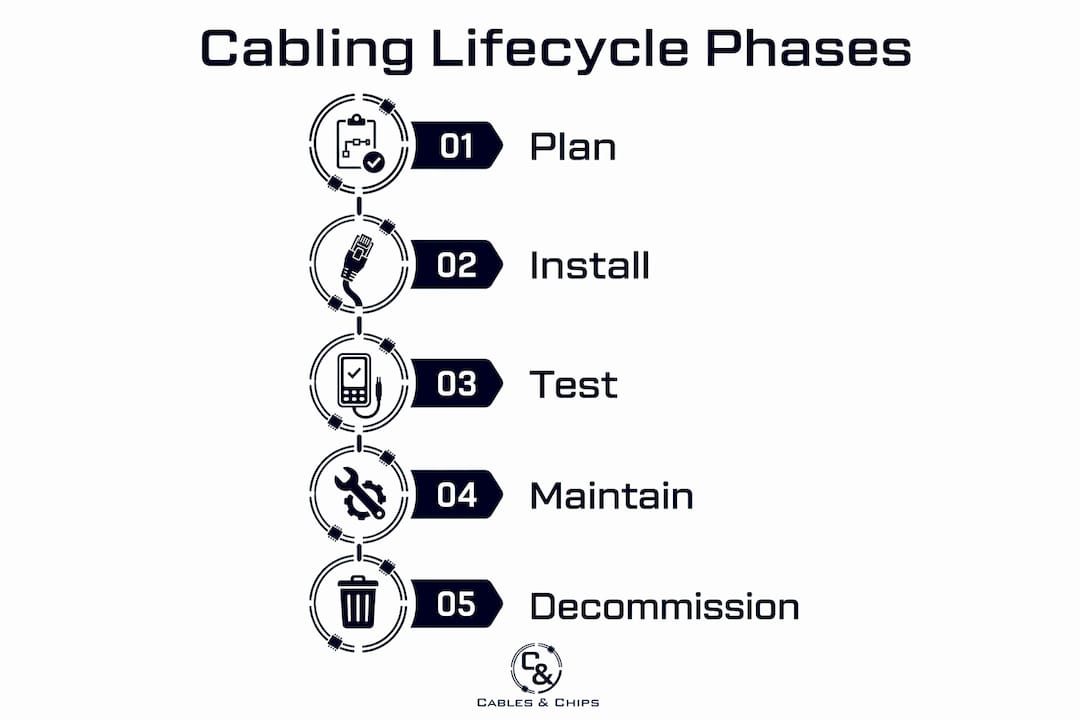
The cabling project lifecycle follows five sequential phases. Each phase builds on the last, and skipping steps in any one of them creates compounding problems that surface months or years later during troubleshooting.
-
Planning and design. This phase defines cable routes, determines capacity requirements, selects media types (CAT6A, fiber optic, or both), and maps MDF/IDF locations. Future-proofing decisions made here, such as conduit fill ratios and pathway sizing, determine whether the system can absorb technology upgrades without a full rip-and-replace.
-
Procurement and staging. Materials are ordered, labeled, and staged before installation begins. Treating each cable as a tracked object from this point forward, rather than a bulk commodity, is the foundation of effective cabling lifecycle management.
-
Installation. Cable pulling, termination, and labeling are executed according to ANSI/TIA-568 specifications. Routing through conduit, cable trays, and J-hooks must respect bend radius and pull tension limits. Labeling at both ends of every run is non-negotiable for long-term serviceability.
-
Testing and certification. Every link is tested against TIA performance standards using calibrated equipment such as Fluke Networks DSX-8000 or Versiv cable analyzers. Pass/fail results are documented and stored as part of the permanent project record. Cable testing certification provides the audit trail that protects both the installer and the building owner.
-
Maintenance, upgrade, and decommissioning. Periodic audits verify that documentation matches physical plant. When technology demands change, the lifecycle analysis determines whether to upgrade active equipment, re-terminate existing cabling, or replace runs entirely.
Pro Tip: Document cable routes photographically during installation, before walls are closed. A photo archive costs nothing and saves hours of diagnostic time when a run needs to be traced years later.
Which industry standards and best practices govern infrastructure lifecycle cabling?
Compliance with recognized standards is not optional for commercial projects. It determines warranty validity, insurance coverage, and audit readiness. The infrastructure cabling process is governed by three primary frameworks.
-
ANSI/TIA-568. This standard covers the design and installation of structured cabling systems in commercial buildings, including performance specifications for CAT6, CAT6A, and fiber optic media. ANSI/TIA-568 and TIA-606 are the two standards most critical for lifecycle compliance.
-
TIA-606. This standard governs administration, labeling, and record-keeping for telecommunications infrastructure. It defines identifier formats for cables, pathways, spaces, and termination hardware, creating a consistent naming system that survives staff turnover and contractor changes.
-
National Electrical Code (NEC). The NEC sets physical installation requirements including fire-rated plenum cable use in air-handling spaces, conduit fill limits, and grounding specifications. NEC compliance is enforced by local building inspectors and is required for certificate of occupancy in New York City.
Beyond these three frameworks, structured cabling certifications from manufacturers such as Panduit, CommScope, and Belden provide extended warranties of 15 to 25 years when installation is performed by certified contractors. These certifications require documented test results and adherence to manufacturer-specific installation guidelines, which go beyond the minimum TIA requirements.
One detail that catches many installers: bend radius under tension during cable pulling differs from the unloaded bend radius specification. Violating the loaded bend radius creates hidden defects that pass visual inspection but fail certification testing, generating costly rework.
Pro Tip: Request manufacturer certification, not just TIA compliance, on any new installation. The extended warranty is worth the additional documentation overhead, particularly for fiber optic runs where re-termination is labor-intensive.
How do modern digital tools enhance infrastructure cabling lifecycle management?
The shift from spreadsheets and paper-as-built drawings to digital lifecycle platforms is the most significant operational change in cabling management over the past five years. Digital twin management transforms passive cable documentation into active intelligence, improving audit readiness and reducing errors across every project phase.
In practice, digital twin cabling management means each cable is assigned a unique identifier and tracked through discrete lifecycle stages: ordered, delivered, staged, pulled, connected, tested, and commissioned. At any point, a project manager or facility manager can query the system and see exactly which cables are installed, which are pending testing, and which have failed certification.
The operational benefits are concrete:
- Real-time status visibility. Field technicians update cable status from mobile devices, eliminating the lag between physical work and office records that causes coordination errors.
- Automated audit trails. Every status change is timestamped and attributed to a specific technician, creating a defensible record for warranty claims and compliance audits.
- Elimination of information silos. Design engineers, installation crews, and facility managers work from the same data set, reducing the rework caused by version-controlled drawing conflicts.
- Proactive maintenance triggers. Systems can flag cables approaching end-of-life or flag runs that have never been tested, preventing undocumented connectivity gaps from becoming outages.
“Successful cable lifecycle management treats each cable as a digital twin tracking its unique lifecycle stage from ordering to commissioning, avoiding undocumented connectivity gaps.” — Cable Pilot lifecycle management insights
Platforms like CablePilot are purpose-built for this workflow, integrating pulling, connecting, testing, and commissioning stages into a single tracked record. For large construction projects in New York City, where multiple subcontractors work in parallel across dozens of floors, this level of coordination is the difference between a clean handover and months of post-occupancy troubleshooting.
What are common challenges and best practices in managing infrastructure lifecycle cabling during construction?
Construction environments introduce specific risks to cabling quality that office retrofits do not. Other trades, compressed schedules, and incomplete drawings create conditions where cabling errors multiply quickly if quality controls are not enforced from day one.
The table below compares reactive versus proactive approaches to the most common cabling challenges:
| Challenge | Reactive approach | Proactive approach |
|---|---|---|
| Improper bend radius | Discovered at testing, requires re-pull | Inspected at routing phase before walls close |
| Missing or incorrect labels | Traced manually during troubleshooting | Verified at termination sign-off milestone |
| Damage from other trades | Repaired after occupancy complaints | Conduit protection specified in coordination drawings |
| Incomplete documentation | Reconstructed from memory or field surveys | Captured in real time via digital tracking platform |
| Failed certification tests | Rework scheduled post-installation | Quality gates require pass results before next phase |
Quality gates during cabling projects require inspection sign-offs for routing, segregation, and termination phases, preventing error multiplication and reducing troubleshooting time. This means no cable run advances to the termination phase until the routing inspection is signed off, and no system goes live until every link has a documented test result.
Coordinating cabling with mechanical, electrical, and plumbing trades is another area where proactive planning pays off. Cable pathways must be defined in BIM models or coordination drawings before conduit is installed, because relocating conduit after concrete is poured is expensive. Construction measurement tools used by general contractors can integrate with cabling layout data to flag conflicts before they become field problems.
Pro Tip: Assign a dedicated cabling quality control inspector on any project with more than 200 cable runs. The cost of one inspector is a fraction of the cost of a single floor re-pull caused by a missed bend radius violation.
How does infrastructure lifecycle cabling impact long-term network performance and ROI?
The financial case for disciplined cabling lifecycle management is straightforward once you understand the asset lifespan mismatch between physical infrastructure and active equipment.
| Asset type | Expected lifespan | Upgrade frequency |
|---|---|---|
| Fiber optic cabling | 15+ years | Rarely replaced if installed correctly |
| CAT6A copper cabling | 10 to 15 years | Replaced when bandwidth demands exceed capability |
| Network switches and routers | 3 to 5 years | Replaced with each technology generation |
| Wireless access points | 3 to 5 years | Replaced as Wi-Fi standards advance |
Fiber optic infrastructure supports multiple generations of active hardware, meaning the cabling you install today will outlast three or four generations of switches and access points. This makes the quality of the physical plant the single most durable investment in your network budget.
Proactive infrastructure lifecycle management reduces security risks, performance degradation, and maintenance costs. A building with clean, documented, tested cabling can be re-equipped with new active hardware in days. A building with undocumented, unlabeled, or damaged cabling requires a full audit before any upgrade can proceed, adding weeks and significant cost to every technology refresh cycle.
Scalability is the other ROI driver. Infrastructure cabling best practices, including oversized conduit, spare pathway capacity, and modular patch panels, allow bandwidth upgrades without structural work. Moving from 1G to 10G or 25G often requires only a switch replacement when the physical plant was designed correctly from the start. Understanding how building cabling infrastructure works in commercial environments is the starting point for making those design decisions correctly.
Key takeaways
Infrastructure lifecycle cabling requires disciplined planning, standards compliance, and digital documentation from day one to protect network performance and ROI across a 15-plus-year asset lifespan.
| Point | Details |
|---|---|
| Five-phase lifecycle | Plan, install, test, maintain, and decommission every cable run as a tracked asset. |
| Standards compliance | ANSI/TIA-568, TIA-606, and NEC compliance are required for warranty validity and audit readiness. |
| Digital twin management | Real-time cable tracking eliminates documentation gaps and reduces post-installation rework. |
| Quality gates prevent rework | Inspection sign-offs at routing, termination, and testing phases stop errors from compounding. |
| Cabling outlasts active equipment | Physical infrastructure lasts 15-plus years; plan for multiple hardware refresh cycles at installation. |
What I’ve learned from 40 years of cabling projects in New York City
The most persistent misunderstanding I see from IT managers and facility teams is treating cabling as a commodity line item rather than a long-term infrastructure asset. The conversation usually goes: “Just run the cables, we’ll sort out the documentation later.” Later never comes. Three years after occupancy, when a switch fails at 2 a.m. and nobody can identify which patch panel port connects to which workstation, the cost of that deferred documentation becomes very real.
The second pattern I see consistently is the failure to integrate cabling planning with active network design. Failure to integrate cabling and active network planning causes long-term bottlenecks that no amount of switch upgrades can fix. If your MDF is undersized, your cable pathways are at capacity, or your fiber runs are too short for the switch locations you need, the physical plant becomes the ceiling on your network’s performance.
Digital twin management is not a luxury for large enterprises. Any project with more than 100 cable runs benefits from tracking each cable through its lifecycle stages digitally. The platforms available today are affordable and the time savings at testing and commissioning alone justify the investment. I have seen projects where digital tracking cut the commissioning phase by 30 percent simply because technicians could see exactly which runs were pending test results without walking the floor.
My advice for 2026: treat your cabling infrastructure the same way you treat your server hardware. Give it a lifecycle plan, a maintenance schedule, and a replacement budget. Your network is only as strong as the infrastructure behind it.
— Ken
How Cables can manage your cabling lifecycle from design to commissioning

Cables brings more than 40 years of structured cabling experience to commercial offices, server rooms, and enterprise facilities throughout New York City. From initial design and CAT6A or fiber optic installation through testing, certification, and network closet organization, Cables handles every phase of the infrastructure cabling process with documented, audit-ready results. Whether you are managing a new construction project or a full renovation, the team at Cables delivers clean, labeled, tested infrastructure built to ANSI/TIA-568 and TIA-606 standards. Start with the structured cabling system components guide to understand what your project requires, then contact Cables at 20 Vesey Street in Lower Manhattan to schedule a site survey.
FAQ
What is infrastructure lifecycle cabling?
Infrastructure lifecycle cabling is the end-to-end management of structured cabling from design and installation through maintenance and replacement. It covers planning, procurement, installation, testing, documentation, and eventual decommissioning of all physical network cabling in a building.
How long does cabling infrastructure typically last?
Fiber optic cabling lasts 15 years or more, supporting multiple generations of active hardware. CAT6A copper cabling typically delivers 10 to 15 years of service when installed correctly and maintained with periodic audits.
Which standards govern the cabling lifecycle?
ANSI/TIA-568 governs design and installation, TIA-606 governs administration and labeling, and the National Electrical Code sets physical installation requirements. Compliance with all three is required for commercial projects in New York City.
What is a quality gate in a cabling project?
A quality gate is a mandatory inspection and sign-off milestone at a defined phase of the cabling project, such as routing, termination, or testing. Enforcing quality gates prevents errors from compounding across subsequent phases and reduces total rework cost.
How does digital twin technology apply to cabling management?
Digital twin cabling management assigns each cable a unique identifier and tracks it through every lifecycle stage in a real-time platform. This replaces static spreadsheets with live audit trails, giving facility managers and IT teams accurate, queryable records at every point in the infrastructure cabling process.