
Division 28 Cabling: 4 Systems, U.S. Field Rules for Facility Teams
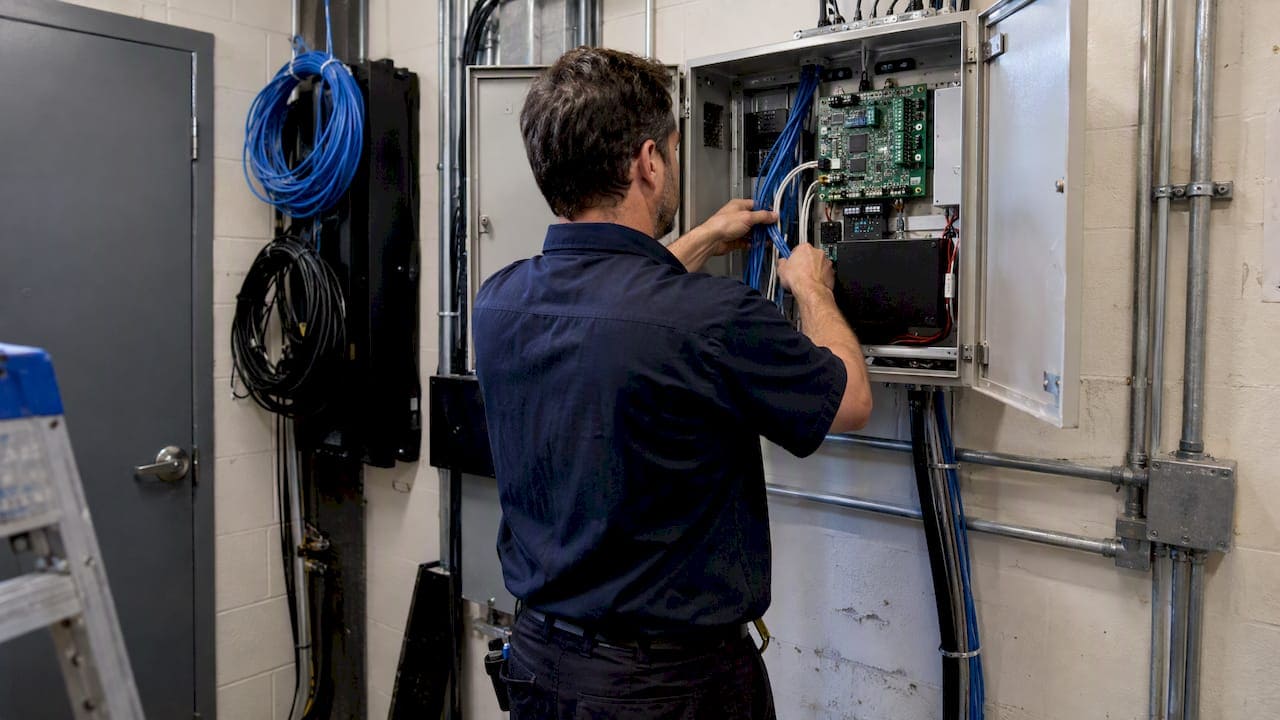
Division 28 covers electronic safety and security cabling, including access control, video surveillance, intrusion detection, and life-safety notification systems. Every U.S. project must follow National Electrical Code (NEC) wiring methods, NFPA 72 for signaling and notification, and the project’s own Division 28 master specification, which together determine cable types, raceway choices, grounding, labeling, and testing requirements.
TL;DR:
- Confirm trade boundaries for conduit, cable pulls, door hardware, and power at bid time; institutional master specifications override generic assumptions where they address scope.
- Use CMP cable in air handling spaces, CMR in vertical shafts, Cat6A for cameras, and fiber for long runs; flexible cords cannot serve as tray wiring.
- Keep continuous device loads at or below 80% of supply capacity, limit PoE runs to 100 meters, and document backup runtime by facility type.
- Certify Cat6A runs and retain reports by cable ID; test fiber with OTDR and loss measurements, then verify door, alarm, and fire panel functions.
- Specify battery backup rather than assuming it: guidance cites about 16 hours for academic or administrative buildings and 24 hours for residence halls.
Scope and common Division 28 sections and coordination points
Division 28 of the CSI MasterFormat organizes electronic safety and security work into distinct sub-sections: access control, video surveillance, intrusion detection, and fire or life-safety notification and communication. Getting this scope right at bid time prevents the gaps that cause change orders later.
Coordination with adjacent divisions matters just as much as the Division 28 content itself. Power circuits for card readers and door hardware typically fall under Division 26, structured cabling backbones often sit in Division 27, and door frames and electrified hardware belong to Division 08. When an institutional master spec exists, it generally overrides generic trade assumptions and should be treated as the governing document.
RFPs and drawings should spell out:
- Which trade installs conduit stub-ups versus which trade pulls cable.
- Who supplies and terminates door position switches and request-to-exit devices.
- Where Division 28 responsibility ends and Division 26 power responsibility begins.
Codes and standards to reference on U.S. Division 28 projects
Binding requirements for Division 28 work come from a handful of core documents, and knowing which one governs a given decision saves time during design review.
- The NEC sets wiring-method rules for tray and conduit installations, including which cable constructions are approved for use in cable trays.
- NFPA 72 governs fire alarm and signaling circuits, including the interfaces between notification systems and the access control or video systems that increasingly share infrastructure with them.
- TIA/ANSI recommendations guide Category cable ratings and the choice between plenum and riser jackets, while OSHA guidance addresses permanent wiring methods and cable tray installation.
- Access Board guidance on operable parts affects mounting heights for readers, keypads, and intercoms.
OSHA and NEC guidance explicitly prohibits using flexible cords as permanent wiring in cable trays, permitting instead Type MC cable, armored cable, power-limited tray cable, optical fiber, and other factory-assembled multiconductor cables rated for tray use, according to OSHA’s bulletin on wiring methods and cable trays. When a project carries an institutional master spec, that document takes precedence over generic industry guidance for anything it specifically addresses.
Approved wiring methods and recommended cable types for Division 28
Cable jacket selection depends on where the cable runs and what it feeds. Plenum-rated (CMP) cable is required in air-handling spaces, riser-rated (CMR) cable applies to vertical shafts between floors, and general-purpose (CM) cable suits most other interior runs. Institutional specifications frequently standardize on plenum-rated Category 6A cabling for security and video networks specifically to protect bandwidth headroom as camera resolutions climb.
- Use Cat6A for networked cameras and most access-control backbones that need PoE and bandwidth margin.
- Choose fiber, typically OM4 multimode, for backbone runs and long surveillance pulls beyond copper’s practical distance.
- Stick to NEC-permitted tray wiring methods: Type MC, armored cable, power-limited tray cable, or approved multiconductor cables, never flexible cords as permanent wiring, per OSHA and NEC standard excerpts.
Our access control cabling guide breaks down jacket and termination choices in more detail for reader-and-lock circuits specifically.
Pro Tip: Default to Cat6A and OM4 fiber in any space where cameras, access control, or life-safety devices share a plenum, since mixing jacket ratings mid-run is one of the most common inspection failures we see on commercial sites.
Raceways, supports, grounding and bonding for security cabling
Conduit and junction box sizing directly affects how easily a technician can pull cable and mount a device years after installation. Institutional specs commonly set minimum conduit diameters and box depths well above code minimums specifically to leave room for future device swaps.
- Size cable trays with fill margin in mind, not just the cable count at installation.
- Support and fasten trays and conduit runs at intervals that meet NEC spacing requirements, never relying on ceiling grid wires as the primary support.
- Ground and bond communications racks, enclosures, and power supplies back to the building’s technology ground bus, keeping signal and power grounding paths distinct where the spec calls for it.
Clean grounding practices at the rack also reduce the kind of intermittent faults that are hardest to diagnose after occupancy.
Installation practices, labeling, terminations, and as-built documentation
The deliverables a contractor leaves behind matter as much as the cable itself. Institutional Division 28 master specifications commonly require a wiring tag on every cable end, tied to an Excel schedule listing cable number, location, type, and function.
- Terminate low-voltage cables on terminal strips with crimp lugs, not wire nuts, and never splice a run with tape.
- Leave 8 to 10 inches of slack at the outlet and roughly 10 feet of spare cable coiled at the panel for future moves.
- Mount backboards and device boxes at heights that respect ADA operable-part rules for readers, keypads, and call stations.
- Deliver a test-result package, a completed wiring spreadsheet, and an operation manual at closeout.
Power, battery backup and device load management for Division 28 systems
Access control and intrusion devices typically run on 12 VDC or 24 VDC, and master specs often require dedicated circuits for panels serving life-safety or security loads rather than sharing a circuit with general building power.
- Size power supplies so continuous device draw stays at or under 80% of rated output, leaving headroom for inrush current, a practice outlined in Division 28 power load guidance.
- Respect the 100-meter limit on PoE cable runs when powering cameras or door controllers over the network cable itself.
Battery backup runtimes vary by facility type, with guidance on Division 28 electronic safety systems describing roughly 16 hours of runtime for academic or administrative buildings and 24 hours for residence halls, figures that should be documented in the spec rather than assumed.
Commissioning, testing and acceptance for Division 28 cabling and systems
Acceptance testing is where a clean installation either proves itself or reveals shortcuts.
- Certify every Cat6A run to the category’s permanent link or channel standard and retain the test report by cable ID.
- Test fiber runs with an OTDR trace and an end-to-end loss measurement, not a continuity check alone.
- Verify system-level operation: door cycling, alarm reporting, and any interface to the fire panel that NFPA 72 governs.
- Close out the punch list, archive test data, and deliver printed operation manuals when the spec requires them.
Practitioner notes from Cables & Chips: applied tips for successful Division 28 installs
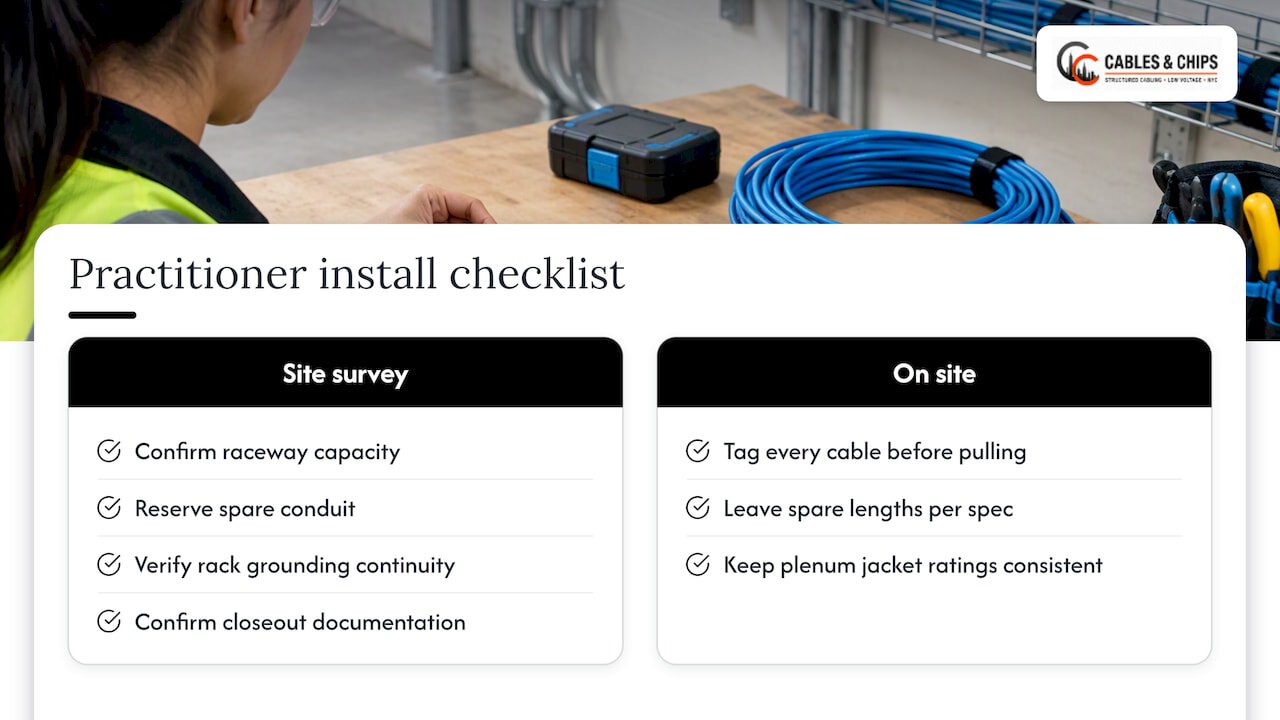
Our crews have seen which habits separate a clean Division 28 install from a troubleshooting headache. During a site survey, we confirm raceway capacity, spare conduit for future devices, rack grounding continuity, and what documentation the owner expects at closeout. On site, we tag every cable before pulling it, leave the spare lengths the spec calls for, and keep plenum jacket ratings consistent across an entire run so nothing fails inspection over a mismatched few feet of cable.
Why clean Division 28 documentation pays off long after installation
A fully tagged wiring schedule and a complete test-result package sound like paperwork until a camera goes dark two years into occupancy and a technician needs ten minutes, not two hours, to trace the run. Facilities teams that push for spec clarity on Division 28 line items during design consistently spend less on troubleshooting later.
— Ken
How Cables & Chips supports Division 28 projects
We bring structured CAT6 and CAT6A cabling, fiber installation, CCTV and access control cabling, cable testing and certification, and complete as-built documentation to Division 28 projects.
- Structured cabling and testing that meets the Category and documentation standards your spec demands.
- CCTV and access control cabling built around the jacket and termination practices covered above.
- As-built documentation and wiring schedules delivered at closeout, not promised and forgotten.
If you are scoping a Division 28 line item, our services page lists what we handle, and a no-obligation site survey is the fastest way to find out what your space needs.
FAQ
What cable jacket type does Division 28 require in plenum spaces?
Plenum-rated (CMP) cable is required for runs in air-handling spaces, while riser-rated (CMR) cable applies to vertical shafts between floors. Institutional specs often standardize on plenum-rated Category 6A for security and video cabling specifically to future-proof bandwidth.
Can flexible cords be used as permanent wiring in cable trays?
No. OSHA and NEC guidance prohibits flexible cords as permanent wiring in trays, permitting instead Type MC cable, armored cable, and power-limited tray cable among other approved constructions.
What testing is required for Division 28 cabling before acceptance?
Copper runs are certified to the Cat6A permanent link or channel standard with a retained test report, while fiber runs require an OTDR trace and an end-to-end loss measurement. System-level testing also confirms device operation and any required fire alarm interface.
How long should battery backup last for security systems?
Battery backup runtime depends on facility type, with typical guidance calling for around 16 hours in academic or administrative buildings and 24 hours in residence halls. The exact runtime should be documented in the project’s power specification rather than assumed.
Does Cables & Chips handle Division 28 cabling scopes?
Yes, our services include structured CAT6/CAT6A cabling, fiber installation, CCTV and access control cabling, and testing and certification, all of which commonly fall under Division 28 scope. Details on each service are listed on our services page.
Sources
- OSHA: Safety and Health Information Bulletin on Wiring Methods and Cable Trays
- Case Western Reserve University Division 28 Electronic Safety and Security master spec (2026)
- UC Davis Health Division 27 & 28 master specifications
Authoritative reference documents and institutional master specs
For exact clause language, consult NFPA 72, OSHA’s wiring methods bulletin, representative institutional Division 28 specifications such as Case Western Reserve’s master spec and UC Davis Health’s Division 27 and 28 specifications, and Access Board guidance on operable parts. These remain reference points; your project’s own master spec governs wherever it provides more specific direction, and unfamiliar data-center terminology can be checked against the PODTECH datacenter glossary.