
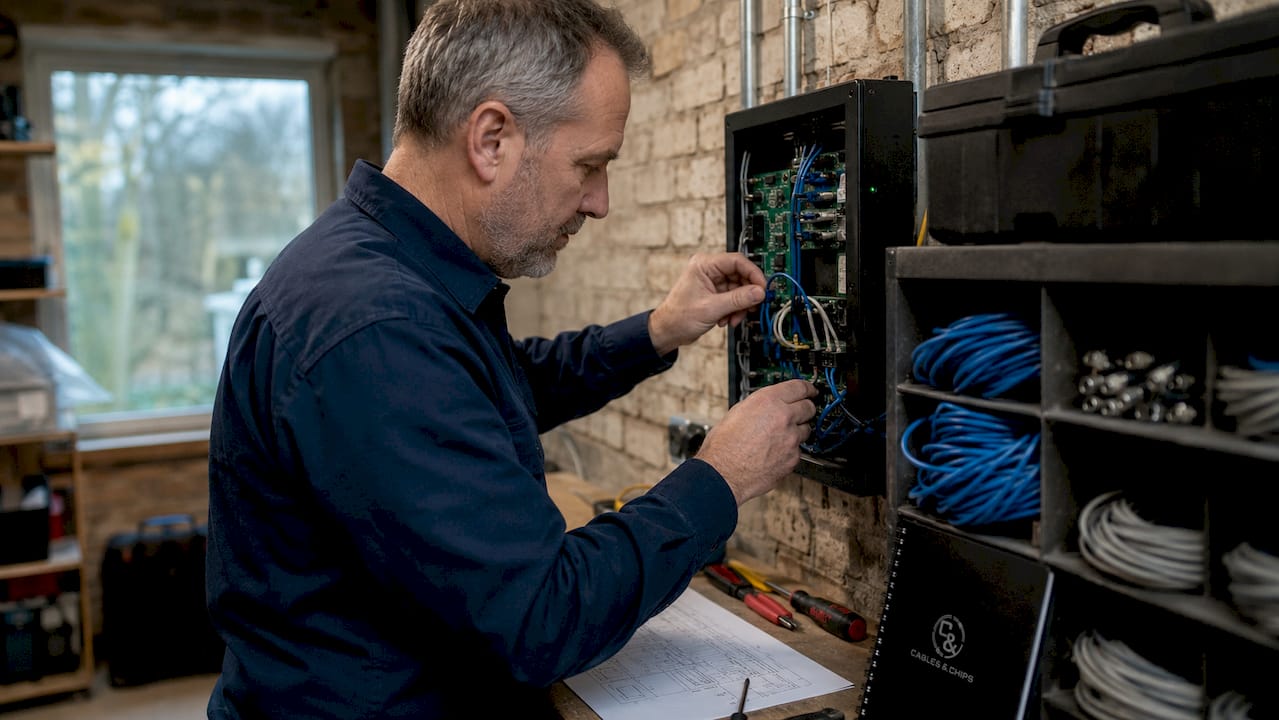
Access control cabling requirements define the specific cable types, installation standards, and physical configurations that ensure secure, reliable, and code-compliant access control system performance in commercial facilities. Getting these requirements wrong does not just create reliability problems. It creates security vulnerabilities, fire code violations, and system failures that are expensive to fix after the fact. This guide covers every layer of the specification: cable types, fire ratings, physical installation rules, protocol-driven wiring standards, and the documentation practices that keep installations defensible over their full lifecycle.
1. standard cable types for access control systems
The cable type you select determines the performance ceiling of your entire system. No amount of configuration compensates for the wrong conductor gauge or missing shielding.
Cat5e or Cat6 cables are the standard for IP-based and intercom-style access control devices that use Power over Ethernet (PoE). Runs must not exceed 90 m without a midspan PoE injector or a closer switch placement. Terminate all Cat5e and Cat6 to RJ45 connectors using the T568B wiring standard.
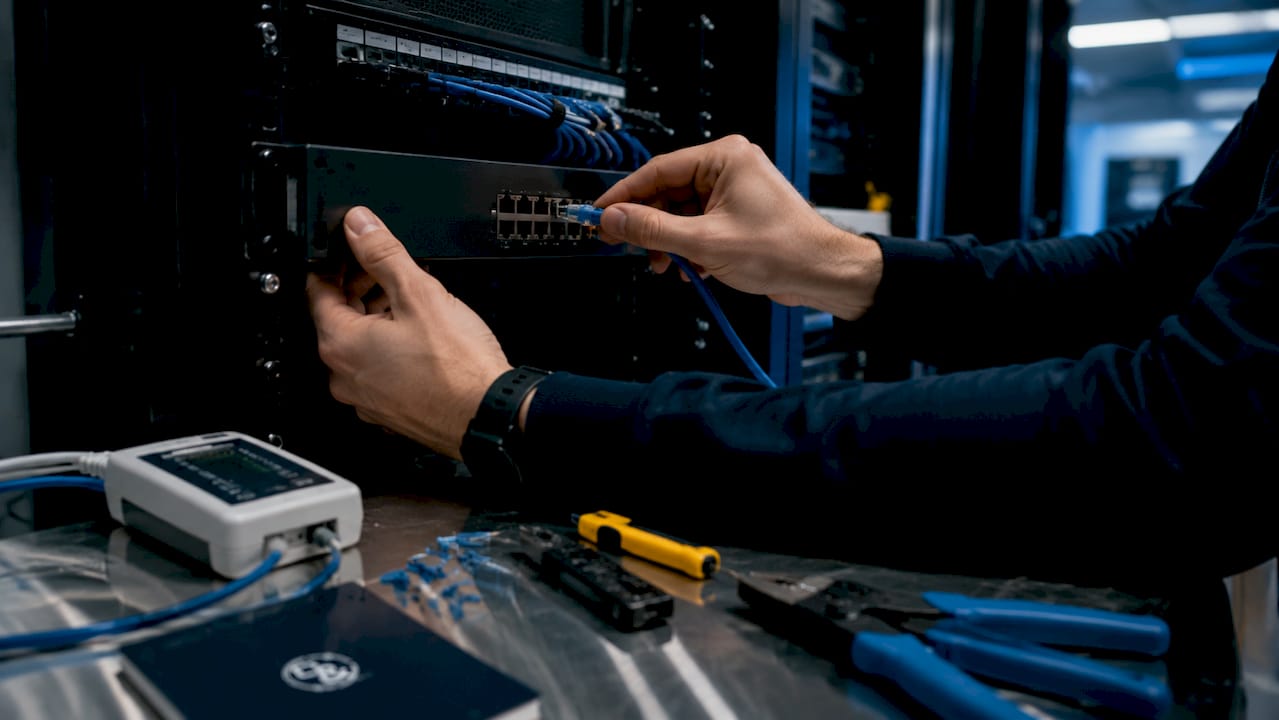
For OSDP (Open Supervised Device Protocol) readers, shielded 4-core cable such as Belden 9842 or equivalent is the correct choice. OSDP runs on RS-485 and requires 120 Ω termination resistors at each end of the bus. Maximum run length at 115,200 baud reaches 1,200 m, making it far more flexible than legacy alternatives.
Legacy Wiegand devices use 6-core or 8-core unshielded multi-conductor cable. Maximum run length for Wiegand is 150 m. Conductor gauge typically falls in the 22–18 AWG range, with stranded conductors preferred for runs that involve any flex or conduit pull.
| Cable Type | Protocol | Max Run | Key Requirement |
|---|---|---|---|
| Cat5e / Cat6 | IP / PoE | 90 m | T568B termination, PoE budget planning |
| Shielded 4-core (Belden 9842) | OSDP / RS-485 | 1,200 m | 120 Ω termination, drain wire grounded at one end |
| 6-core / 8-core multi-conductor | Wiegand | 150 m | Physical protection of cable route required |
| Shielded multi-core | Analog / legacy | Varies | Screened where EMI sources are present |
2. how fire ratings govern cable selection by location
Fire rating is not optional. The National Electrical Code (NEC) mandates specific cable jacket ratings based on where a cable is installed, and using the wrong rating in the wrong space is a code violation with real fire safety consequences.
CMP-rated plenum cable is required in any air-handling plenum space, including return-air ceilings above drop tiles. NEC 800.113© mandates CMP in these locations because standard PVC jackets release toxic gases when burned in spaces that circulate air throughout a building. CMR-rated riser cable is required in vertical shafts per NEC 800.113(B). Standard CM-rated cable is permitted only in general-purpose spaces with no plenum or riser exposure.
A critical rule: riser cable is never permitted in plenum spaces. The substitution hierarchy runs one direction only. CMP can substitute for CMR or CM, but CMR cannot substitute for CMP. Every cable jacket is printed with its rating. Verify the marking before pulling any cable through a rated space.
| Installation Location | Required Rating | NEC Reference |
|---|---|---|
| Air-handling plenum ceiling | CMP (Plenum) | NEC 800.113© |
| Vertical riser shaft | CMR (Riser) | NEC 800.113(B) |
| General commercial space | CM (General Purpose) | NEC 800.113 |
| Conduit in plenum | CMP or listed conduit fill | NEC 800.113© |
Pro Tip: Document every location where a cable transitions from one fire rating zone to another. These transition points are the most common source of compliance failures during inspections, and they are nearly impossible to verify after walls are closed.
3. physical installation requirements for cable integrity
Physical installation quality determines whether your access control system performs reliably for years or generates intermittent faults that are nearly impossible to diagnose remotely. Two categories of rules govern this: separation from power and firestopping.
BS 7671:2018+A2:2022 Section 528 prescribes minimum separation distances between low voltage signal cables and mains power conductors. Signal cables must maintain at least 50 mm of separation when running parallel to power cables, and at least 100 mm at crossing points. These distances prevent electromagnetic interference from corrupting access control data signals. In environments with motors, variable frequency drives, or fluorescent lighting, screened (shielded) cable is required regardless of separation distance.
Firestopping at rated penetrations is required under NEC Article 300.21. Any access control cable passing through a fire-resistance-rated wall or floor assembly must be sealed with a UL-listed firestop product. Acceptable methods include intumescent putty pads, firestop pillows, conduit collars, and intumescent wrap strips. The method must match the tested assembly configuration.
Key physical installation requirements include:
- Maintain 50 mm minimum separation from mains power cables running parallel
- Maintain 100 mm minimum separation at all crossing points
- Use screened cable near motors, fluorescent ballasts, and variable frequency drives
- Seal all rated wall and floor penetrations with UL-listed firestop products
- Conceal cables in secure areas using conduit or cable tray to prevent physical tampering
- Install tamper-evident conduit fittings at reader locations where cable exits secure space
Pro Tip: Create an as-fitted pathway schedule during installation. Record every conduit run, junction box location, firestop product used, and cable rating transition. This document cuts troubleshooting time in half and is required for any future AHJ inspection.
4. how OSDP and wiegand protocols shape wiring decisions
The communication protocol your access control system uses is not just a software setting. It directly determines what cable you pull, how far you can run it, and how secure your installation actually is.
OSDP with shielded 4-conductor cable supports supervised, bidirectional communication between controllers and readers. That supervision means the controller knows in real time if a cable is cut or shorted. Wiegand provides no such feedback. A cut Wiegand cable between a reader and controller goes undetected until someone tries to badge through.
Wiegand’s maximum run of 150 m and its lack of encryption make exposed cable runs a genuine security weakness. An attacker with physical access to a Wiegand cable can replay credential data without ever touching the reader. The correct response is either routing Wiegand cables entirely within secure conduit or transitioning to OSDP.
Key protocol-driven wiring requirements:
- OSDP: shielded 4-conductor cable, 120 Ω termination at each bus end, max 1,200 m at 115,200 baud
- Wiegand: 6-core or 8-core multi-conductor, max 150 m, all runs inside secure conduit or protected raceway
- RS-485 (OSDP backbone): drain wire grounded at controller end only to prevent ground loops
- Avoid running OSDP and Wiegand cables in the same conduit to prevent cross-talk and signal degradation
- Label all protocol-specific cables at both ends and at every junction box
5. best practices and common pitfalls in access control cabling
Most access control failures trace back to installation errors, not equipment defects. The following numbered practices address the most common sources of system downtime and compliance failures.
- Test all cables before termination. Use a cable certifier to verify continuity, wire map, and length before connecting any device. Catching a fault before the wall closes saves hours of rework.
- Plan PoE power budgets before ordering switches. PoE budgeting and run length are the leading causes of intermittent lock and controller malfunctions in IP-based systems. Calculate total connected PoE load per switch port and per switch chassis before finalizing equipment.
- Keep Wiegand runs inside secure areas. Any Wiegand cable segment accessible from an unsecured space is a physical attack surface. Route inside conduit, inside walls, or transition to OSDP.
- Allow service slack at every termination point. Leave 300 mm of slack at each reader, controller, and patch panel location. This allows re-termination without pulling new cable.
- Document fire rating transitions. Mixing cable types without documentation is one of the most common compliance failures in access control projects. Record every point where cable rating changes from CM to CMR or CMR to CMP.
- Never mix Cat5e and Cat6 in the same run. The performance characteristics differ. A mixed run will certify to the lower standard and may fail PoE requirements for higher-draw devices.
- Inspect firestop seals before closing walls. Photograph every penetration seal with the product label visible. This documentation supports both AHJ inspections and fire barrier compliance audits.
- Label cables at both ends using a consistent naming convention. Tie labels to your as-fitted drawings. Unlabeled cables in a telecom room become a liability the moment the original installer leaves the project.
Key takeaways
Correct access control cabling requires the right cable type, proper fire rating for each installation zone, physical separation from power, and complete documentation of every pathway and penetration.
| Point | Details |
|---|---|
| Match cable to protocol | Use Cat5e/Cat6 for IP/PoE, shielded 4-core for OSDP, and 6-core/8-core for Wiegand. |
| Observe fire rating zones | CMP is required in plenums; CMR in risers; never substitute a lower rating upward. |
| Separate from mains power | Maintain 50 mm parallel separation and 100 mm at crossings per BS 7671 Section 528. |
| Firestop every penetration | Seal all rated wall and floor penetrations with UL-listed products per NEC 300.21. |
| Document everything | Record cable ratings, pathway transitions, and firestop locations before walls close. |
What 40 years of installs taught me about access control cabling
The single most expensive mistake I see on access control projects is treating cabling as an afterthought. Teams spend weeks selecting the right reader hardware and controller platform, then hand the cabling spec to whoever is cheapest. That decision shows up six months later as intermittent door faults, failed inspections, and security gaps that require a full re-pull to fix.
The shift from Wiegand to OSDP is the most significant change in access control wiring practice in the past decade. OSDP’s supervised communication is not just a feature upgrade. It changes the security posture of the entire installation. A system that can detect a tampered cable in real time is fundamentally different from one that cannot. If you are specifying a new installation in 2026 and still defaulting to Wiegand because it is familiar, you are accepting a security liability that is increasingly hard to justify.
Fire rating compliance is the area where I see the most silent failures. Installers pull the right cable for 90% of the run, then grab whatever is on the truck for the last 10 meters through a plenum ceiling. That substitution is invisible until an inspection or, worse, a fire. The fire barrier inspection process exists precisely because these failures are common. Build the documentation habit from day one.
PoE power planning deserves more attention than most specs give it. I have diagnosed more than a few “software bugs” that turned out to be a switch running at 95% of its PoE budget. The lock would drop power for 200 milliseconds under load, the controller would log an error, and the team would spend days chasing firmware. Calculate your PoE budget before you finalize your switch selection. It is a 30-minute task that prevents days of troubleshooting.
— Ken
Professional access control cabling installation in NYC
Getting access control cabling right the first time requires more than knowing the standards. It requires experienced installers who understand how cable type, fire rating, protocol requirements, and physical security interact on a real commercial project.
Cables has delivered compliant, documented access control and structured cabling installations across New York City for more than 40 years. From structured cabling components for IT managers to full access control cabling in NYC commercial facilities, the team at Cables & Chips handles every layer of the specification. Cat5e, Cat6, shielded OSDP cable, firestopping, pathway documentation, and certification testing are all part of every project. Contact Cables & Chips at 20 Vesey Street, Lower Manhattan, to schedule a site survey for your next access control deployment.
FAQ
What cable is used for access control systems?
The correct cable depends on the protocol. Cat5e or Cat6 serves IP and PoE devices, shielded 4-core cable such as Belden 9842 is required for OSDP, and 6-core or 8-core multi-conductor cable is standard for legacy Wiegand devices.
What is the maximum cable run for an access control reader?
OSDP supports runs up to 1,200 m at 115,200 baud on shielded RS-485 cable. Wiegand is limited to 150 m, and Cat5e/Cat6 for PoE devices must not exceed 90 m without a midspan injector.
Do access control Cables need to be plenum-rated?
Yes, in any air-handling plenum space. NEC 800.113© requires CMP-rated cable in return-air ceilings and plenum spaces. CMR-rated riser cable is required in vertical shafts. Using a lower-rated cable in these locations is a code violation.
Why is wiegand cabling considered a security risk?
Wiegand provides no supervision or encryption. An exposed Wiegand cable can be intercepted to replay credential data without touching the reader. All Wiegand runs should be routed inside secure conduit, or the system should be upgraded to OSDP.
How far must access control Cables be separated from power wiring?
Signal cables must maintain at least 50 mm of separation when running parallel to mains power cables, and at least 100 mm at crossing points, per BS 7671:2018+A2:2022 Section 528. Screened cable is required near EMI sources regardless of separation distance.