

Why Enterprise Cabling Needs Documentation: IT Guide

TL;DR:
- Enterprise cabling documentation ensures network reliability and reduces costly downtime by enabling quick fault identification.
- ANSI/TIA-606 standards standardize labeling and recordkeeping, lowering troubleshooting time by up to 80 percent during outages.
Enterprise cabling documentation is the systematic practice of labeling, recording, and maintaining detailed records of every physical telecommunications component in your network. The industry standard governing this practice is ANSI/TIA-606, which defines labeling requirements, record linkage, and administrative structure for structured cabling systems. Without it, unplanned network downtime costs enterprises an average of $5,600 per minute, with incorrect cable identification cited as a leading cause. That figure makes why enterprise cabling needs documentation a business continuity question, not just an IT housekeeping task. Proper cabling records protect network reliability, accelerate troubleshooting, and keep your infrastructure audit-ready.
Why enterprise cabling needs documentation to reduce downtime
Cabling documentation is the fastest tool an IT team has during a network outage. When every cable is labeled at both ends and linked to a centralized record, technicians locate the fault without guesswork. When records are missing or outdated, the same job takes hours instead of minutes.
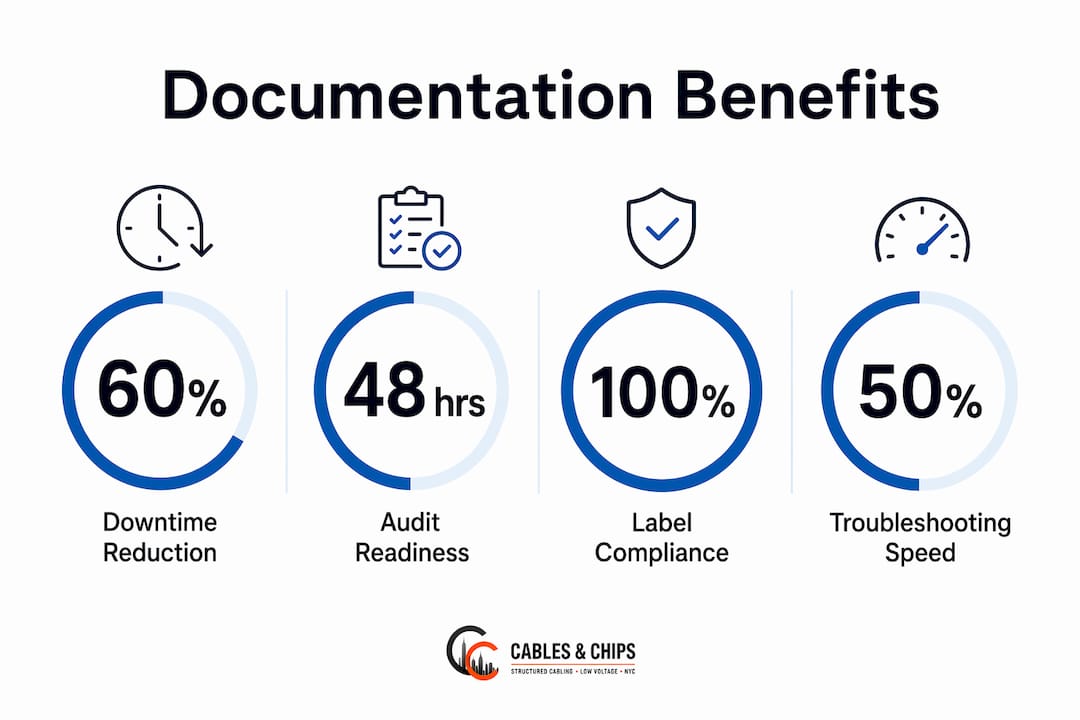
ANSI/TIA-606-C compliant labeling defines the administrative framework that makes this speed possible. The standard specifies label placement, durability requirements, and how physical identifiers connect to digital records. Compliance with this framework is what separates a functional cabling plant from a liability.
The numbers confirm the operational impact. Implementing ANSI/TIA-606-C labeling can reduce emergency troubleshooting time by up to 80% during network outages. That reduction translates directly into fewer minutes of downtime and lower recovery costs per incident.
Human error is the most common cause of misidentification in undocumented environments. A technician who pulls the wrong cable during a repair can cascade a single-port issue into a floor-wide outage. Clear, labeled cabling removes that risk by giving every team member a single source of truth at the point of work.
Consider a practical example. A financial services firm in Manhattan experiences a switch failure at 2:00 AM. With documented patch panel records and labeled runs from the MDF to each IDF, the on-call technician identifies the affected segment in under five minutes. Without that documentation, the same technician traces cables by hand across three telecom rooms, adding 90 minutes to the outage window.
- Label both ends of every cable at the patch panel and the endpoint device.
- Include waypoint labels at any junction, conduit entry, or pull box where the cable changes direction.
- Link physical labels to digital records so a scan or lookup returns the full cable history.
- Use consistent naming conventions aligned with ANSI/TIA-606-C to avoid ambiguity across shifts and contractors.
Stat callout: Up to 80% reduction in emergency troubleshooting time is achievable with ANSI/TIA-606-C compliant labeling. That is the difference between a 10-minute fix and a two-hour outage.
Pro Tip: Assign a unique cable ID at installation and print it on both end labels. That ID becomes the lookup key in your records, your ticket system, and your audit trail. One ID connects everything.
How to keep cabling documentation current and accurate
Static documentation fails the moment the first undocumented change happens. Many enterprises create as-built drawings that are already outdated upon completion because no change management protocol exists to update them. This documentation drift is one of the most common and costly failures in enterprise network management.

The fix is integrating documentation updates into every Moves, Adds, and Changes workflow, commonly called MAC work. MAC events happen constantly in enterprise environments: a workstation moves, a new VLAN segment gets added, a switch port gets repurposed. Each event must trigger a documentation update before the ticket closes.
Without a Network Source of Truth, records become fragmented and unreliable, especially during staff turnover or incidents. That fragmentation is where tribal knowledge lives and dies. When the technician who installed a run three years ago leaves the company, undocumented infrastructure becomes an unknown liability.
Centralized documentation systems address this directly. Integrated, centralized documentation reduces incident resolution times by an average of 87% compared to manual records. That figure reflects the operational cost of searching through binders, spreadsheets, and memory versus querying a live system.
The following process builds documentation discipline into daily operations:
- Require documentation updates at ticket closure. No MAC ticket closes without a confirmed record update. This single rule prevents drift more effectively than any audit.
- Use mobile-capable tools in the field. Technicians update records at the point of work, not from memory at a desk two days later. Mobile access eliminates transcription errors.
- Assign a documentation owner. One person or team holds accountability for record accuracy. Shared ownership means no ownership.
- Schedule quarterly audits. Walk the physical plant and compare it against the records. Discrepancies get resolved before they become outage risks.
- Version-control your as-built drawings. Every change produces a new version with a date stamp and technician ID. Old versions stay in the archive for reference.
Pro Tip: Tie your documentation platform to your ticketing system so that closing a work order automatically prompts a record update. That prompt is the lowest-friction way to maintain accuracy without adding a separate workflow step. Proper crew productivity tracking on job sites reinforces this discipline from day one of an installation.
What compliance and warranty risks come from missing documentation?
A physical cabling plant without ANSI/TIA-606 compliant documentation is technically non-compliant and exposes the organization to warranty voidance and audit failures. This is not a theoretical risk. It is a contractual one.
Structured cabling warranties from major manufacturers typically run 15–25 years. Those warranties require TIA-606-compliant documentation to remain valid. A manufacturer asked to honor a warranty claim on a failed component will request installation records, test results, and labeling documentation. Missing records void the claim, regardless of the component’s failure mode.
“A cabling plant without proper documentation is not just disorganized. It is non-compliant, unwarrantable, and a liability during any audit or incident review. Documentation is the proof that the infrastructure was installed and maintained to standard.”
Regulatory frameworks reinforce this requirement. ISO 27001 and SOC 2 both reference physical infrastructure controls, and auditors increasingly request cable management documentation as evidence of physical security and access control. An enterprise that cannot produce accurate cable records during a SOC 2 audit faces findings that affect its certification status.
The compliance benefits of proper cabling documentation guidelines extend beyond audits:
- Warranty preservation: Manufacturers honor 15–25 year warranties only when TIA-606 records are maintained and available.
- Audit readiness: ISO 27001 and SOC 2 auditors treat cable management records as evidence of physical infrastructure controls.
- Vendor accountability: Documented installation records create a clear record of contractor scope, making disputes over workmanship easier to resolve.
- Change control integrity: Documented infrastructure supports accurate change impact assessments before any modification.
- Insurance and liability: In the event of a fire, flood, or physical breach, documented infrastructure supports insurance claims and incident investigations.
The ANSI cabling standards framework treats documentation as a requirement, not a recommendation. IT managers who treat it as optional are accepting warranty, compliance, and operational risk simultaneously.
Best practices for cable labels and cable maps in enterprise networks
Label quality determines whether documentation survives the physical environment. Durable, machine-printed, self-laminating labels are required for enterprise environments to resist heat, moisture, and abrasion over the life of the installation. Handwritten labels and standard adhesive tape fail within months in active telecom rooms.
Flag labels are the correct choice for fiber cables. Flag labels enable labeling of ultra-thin fiber cables where conventional wrap-around labels lack the surface area and durability to stay legible. The flag wraps around the cable and folds back on itself, creating a readable surface without adding bulk or stress to the fiber.
Barcode and QR code integration takes label utility further. A technician scanning a QR code on a patch panel port gets instant access to the full cable record: cable ID, endpoints, length, installation date, test results, and purpose. That lookup takes seconds and eliminates the need to cross-reference a separate document.
A complete cable map functions as the single source of truth for the physical layer. Each record in the map should include:
- Cable ID: Unique identifier printed on both end labels.
- Endpoints: Patch panel port and device port at each end, including rack, row, and room designations.
- Cable type and length: CAT6, CAT6A, fiber type, and measured or estimated run length.
- Installation date: When the cable was installed and by whom.
- Test results: Pass/fail certification data from a cable tester, linked to the record.
- Purpose: What system or device the cable serves (data, VoIP, CCTV, access control).
Pro Tip: Start your cable map in a spreadsheet if budget is the constraint, but build it with the column structure of a proper DCIM or IT documentation platform. Migration is far easier when the data model is already clean. The as-built documentation guide from Cables and Chips outlines exactly what a complete record set looks like for enterprise deployments.
Documentation tools range from basic to enterprise-grade. Spreadsheets work for small environments but break down at scale. DCIM platforms provide real-time visibility, change tracking, and integration with ticketing systems. The right tool depends on the size of the environment and the frequency of MAC activity, but the data model stays the same regardless of the platform.
Key Takeaways
Proper cabling records are not administrative overhead. They are the operational foundation that keeps enterprise networks reliable, compliant, and serviceable across their full lifecycle.
| Point | Details |
|---|---|
| Documentation prevents downtime | ANSI/TIA-606-C compliant labeling reduces emergency troubleshooting time by up to 80%. |
| Living records beat static drawings | Integrating updates into MAC workflows prevents documentation drift and knowledge loss. |
| Compliance is contractual | Structured cabling warranties of 15–25 years require TIA-606 documentation to remain valid. |
| Label quality matters | Machine-printed, self-laminating, and flag labels are required for enterprise durability. |
| Centralized systems cut resolution time | Integrated documentation platforms reduce incident resolution times by an average of 87%. |
Documentation is the infrastructure behind the infrastructure
After working with enterprise cabling environments across New York City for decades, I have seen the same pattern repeat. Organizations invest heavily in hardware, switches, and fiber runs, then treat documentation as something to finish later. Later never comes. The network grows, staff turns over, and within two years the as-built drawings describe a different building.
The real cost of that gap shows up during the worst moments. An outage at 11:00 PM. A compliance audit with 48 hours notice. A warranty claim on a failed component with no installation records to support it. Every one of those situations is harder, slower, and more expensive without documentation. Every one of them is manageable with it.
What I have found is that documentation discipline is a cultural problem as much as a technical one. The teams that maintain accurate records do so because their leadership treats it as a non-negotiable part of closing any job. The teams that struggle treat it as paperwork. The difference in operational efficiency between those two groups is not subtle.
The infrastructure lifecycle of a well-documented cabling plant is measurably longer. Technicians make fewer errors. Audits pass faster. New staff get productive sooner because the knowledge lives in the records, not in someone’s memory. Documentation is not overhead. It is institutional knowledge made durable.
— Ken
How Cables and Chips supports enterprise cabling documentation
Cables and Chips brings more than 40 years of structured cabling experience to enterprise environments across New York City. Every installation the team delivers includes ANSI/TIA-606 compliant labeling, cable testing, and documentation that supports both warranty requirements and audit readiness.

Whether you need a full structured cabling installation, a documentation audit of an existing plant, or a network closet cleanup that produces accurate as-built records, Cables and Chips delivers work that is tested, labeled, and documented to standard. The team serves commercial offices, secure facilities, server rooms, and telecom rooms throughout the five boroughs. Explore the full range of structured cabling components and documentation services, or contact Cables and Chips at 20 Vesey Street in Lower Manhattan to schedule a site survey.
FAQ
What is ANSI/TIA-606 and why does it matter?
ANSI/TIA-606 is the American National Standard for telecommunications infrastructure administration, defining labeling, record-keeping, and documentation requirements for structured cabling systems. Compliance with this standard is required to maintain structured cabling warranties and pass infrastructure audits under frameworks like ISO 27001 and SOC 2.
How often should enterprise cabling documentation be updated?
Cabling records should be updated every time a Move, Add, or Change occurs, with no MAC ticket closing until the corresponding record is confirmed accurate. Quarterly physical audits catch any discrepancies that slip through the day-to-day update process.
What happens to warranties without proper cabling documentation?
Structured cabling warranties covering 15–25 year terms are voided when TIA-606 compliant documentation cannot be produced. Manufacturers require installation records, test results, and labeling evidence before honoring any warranty claim.
What label types work best for enterprise cabling?
Machine-printed, self-laminating labels are the standard for copper runs, while flag labels are required for fiber cables where wrap-around labels lack surface area. Handwritten or standard adhesive labels degrade quickly in active telecom rooms and should not be used in enterprise environments.
What should a cable map record include?
A complete cable map record includes the cable ID, both endpoints with rack and room designations, cable type and length, installation date, test certification results, and the system or device the cable serves. That data set supports troubleshooting, audits, warranty claims, and change impact assessments.