
Why Cable Testing Matters Before Use in Commercial Networks
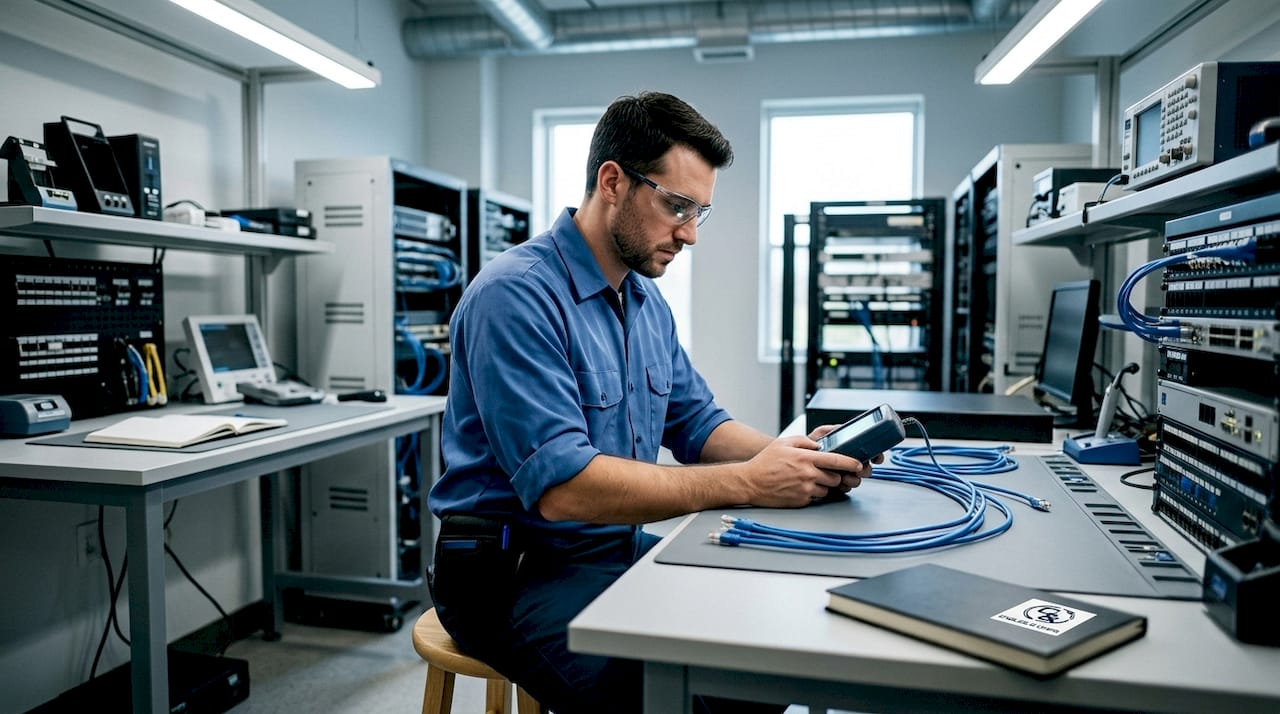
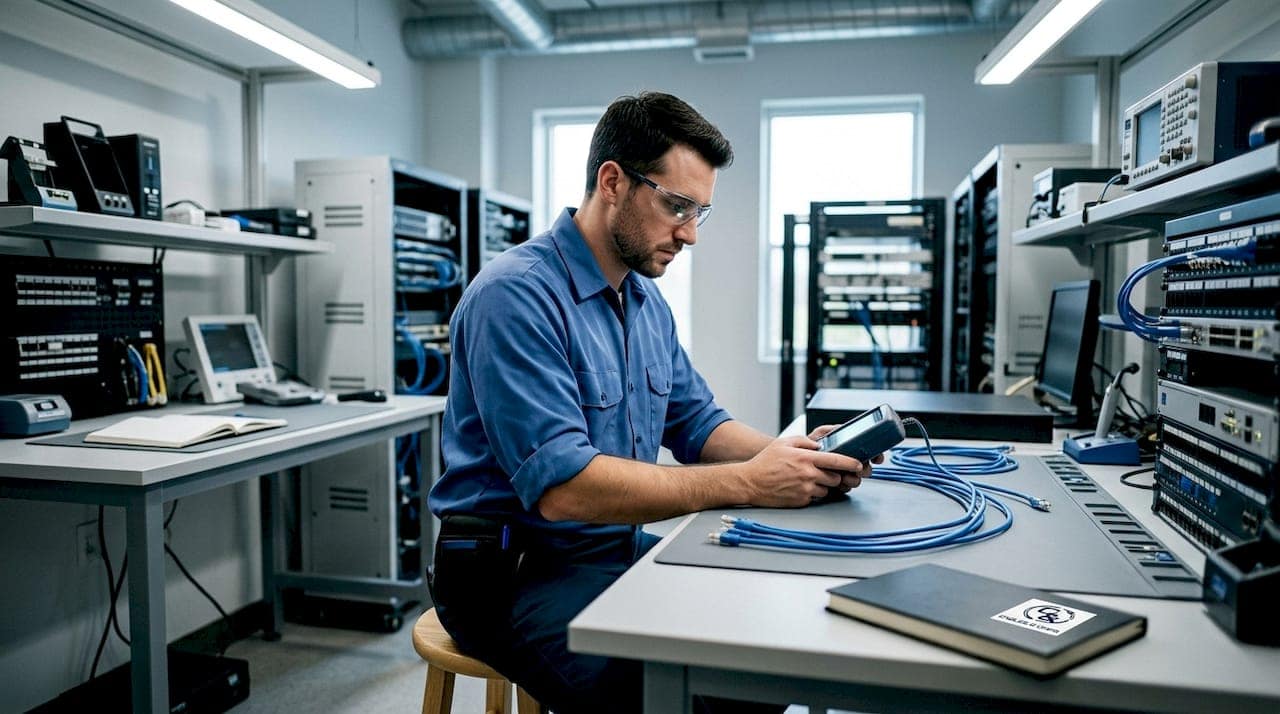
Cable testing before use is the process of verifying that every installed cable meets performance standards and is free from defects before a network goes live. For facilities and IT managers overseeing commercial infrastructure, this step is not optional. It is the acceptance gate between installation and operation. Skipping it means activating an unknown. Testing confirms that your CAT6, CAT6A, or fiber runs perform to spec, satisfy warranty requirements under standards like TIA-568.2-D, and give you a documented baseline you can use for troubleshooting years down the road.
Why cable testing matters before use: the core case
Post-installation cable testing is performed after all cables are pulled and terminated, but before the network is energized or handed off. The industry term for this is field testing or commissioning testing. It confirms that the physical layer is ready to carry live traffic.
The risks of skipping this step are concrete. Damage accumulates during storage, transport, and installation in ways that are invisible to the eye. A cable can look perfect and still fail under load. Catching that failure before activation costs far less than diagnosing it after users are down.
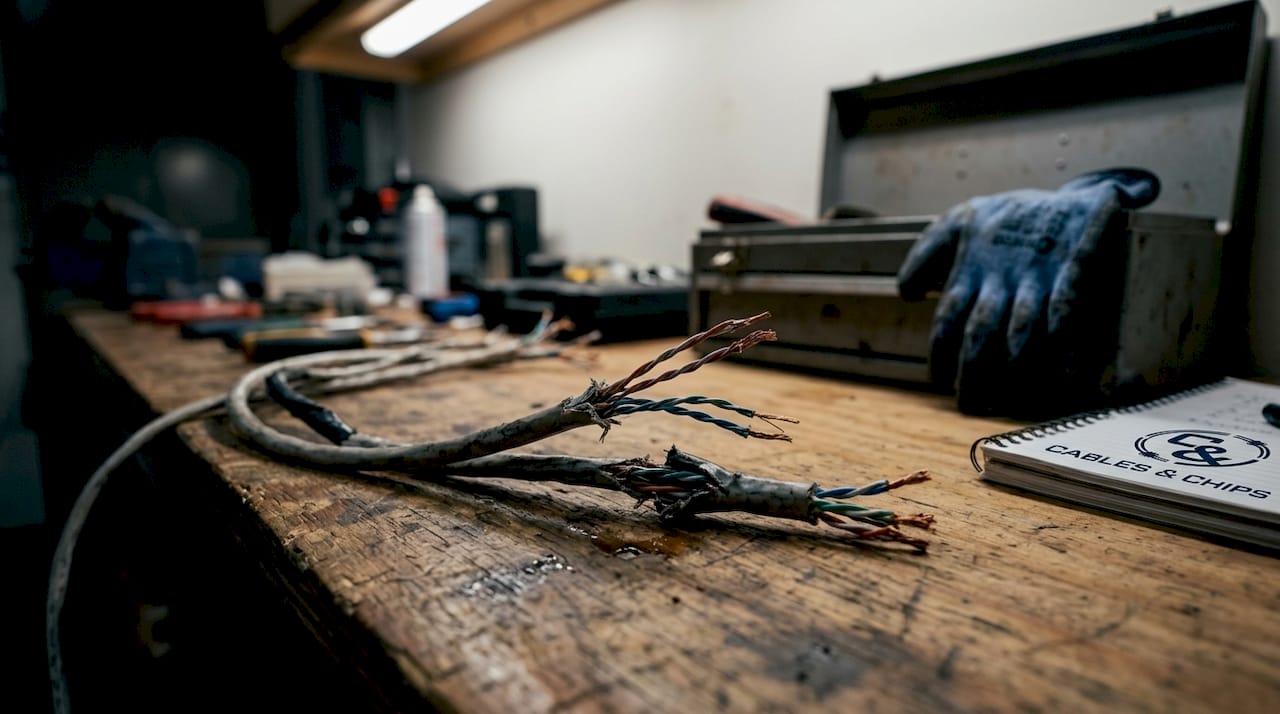
Failing insulation is one of the most dangerous silent defects. It can cause outages, fire risk, or persistent downtime. Insulation resistance testing detects this degradation before the circuit ever carries a signal. That single test type alone justifies the entire testing process for any facility manager responsible for uptime and safety.
Your network is only as strong as the infrastructure behind it. Testing is how you verify that the infrastructure actually meets the standard it was installed to.
What does cable testing involve and what standards apply?
Cable testing covers a defined set of electrical and physical measurements. Each test targets a specific failure mode. The most common tests for structured copper cabling are:
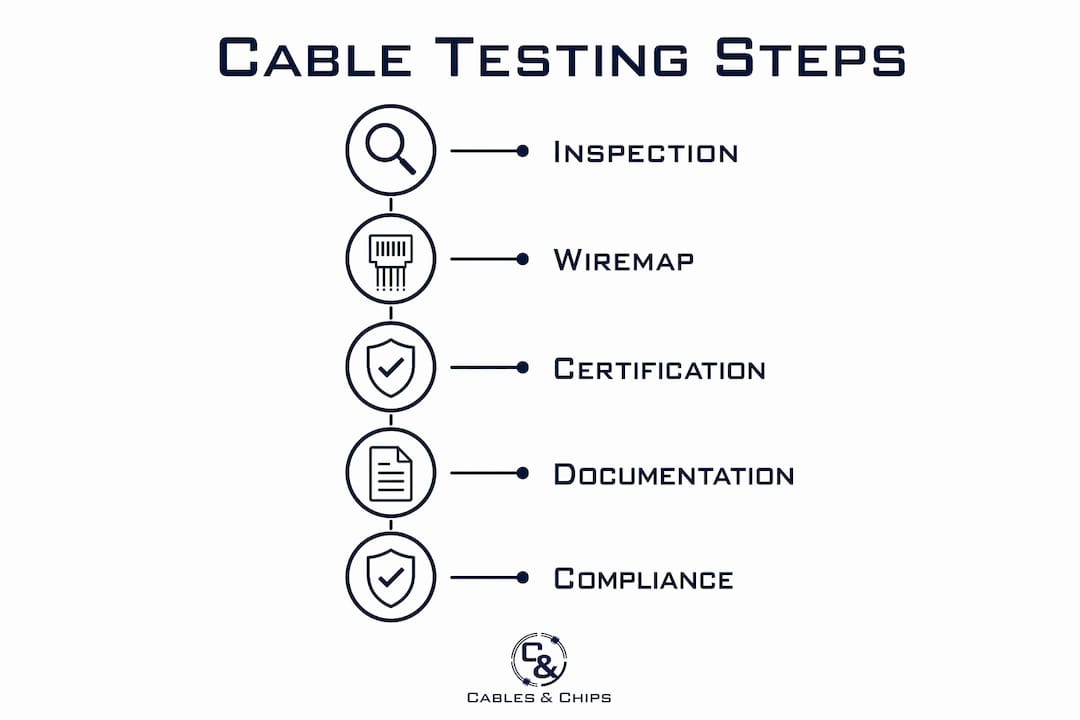
- Wiremap: Confirms all conductors are connected to the correct pins with no opens, shorts, or crossed pairs.
- Insertion loss: Measures signal attenuation across the cable length. Higher loss means weaker signal at the far end.
- NEXT (Near-End Crosstalk): Measures interference between adjacent pairs at the near end. High NEXT degrades throughput.
- Return loss: Measures signal reflected back toward the source due to impedance mismatches.
- Insulation resistance: Detects degraded insulation that could cause shorts or leakage current.
These tests are defined by standards including TIA-568.2-D for copper structured cabling, ISO 11801 for international premises cabling, and IEC 60364-6 for electrical installation verification. Compliance with these standards is what separates a tested installation from a certified one.
Certification testing and qualification testing are not the same thing. Qualification testing checks whether a cable can support a given application. Certification testing verifies that a cable meets the full performance specification of its category, producing a documented pass/fail report for every link. Certification is what manufacturers and owners require for warranty coverage.
Proper certification requires calibrated Level III or Level IV certifiers performing full frequency sweeps across all required parameters. A basic wiremap tester does not meet this bar. The quality of the test equipment directly determines whether the results are valid for warranty and acceptance purposes.
Pro Tip: Always confirm whether your contractor is testing to permanent link or channel configuration before work begins. Mixing these two configurations produces misleading results and can invalidate certification reports, voiding warranty eligibility before the network ever goes live.
Why is cable testing critical for warranty compliance and network reliability?
Certification testing is the formal acceptance gate for structured cabling projects. Without it, you have no documented proof that the installation meets the contracted specification. Here is why that matters operationally and contractually:
-
Warranty activation. Many manufacturer warranty programs require per-link certification submitted within a specific registration window after installation. Miss that window or submit non-compliant reports, and the warranty is void. Future failures then fall entirely on the contractor or the facility.
-
Dispute resolution. Certification reports include timestamped results, link identifiers, and every parameter tested. These reports function as legal-style documents that prove the installation was compliant at the time of completion. Without them, any future dispute about installation quality becomes a matter of opinion rather than evidence.
-
Baseline for troubleshooting. Testing creates a performance record for every link. When a problem appears six months later, technicians compare current measurements against the original baseline to locate the issue efficiently. Without that baseline, every diagnostic starts from zero.
-
Long-term network stability. Certified links are links that have been verified to perform within spec. That verification reduces the probability of intermittent failures, packet loss, and speed degradation that are difficult to trace after the fact.
“Certification documentation is a crucial engineering defense and baseline for long-term operations and dispute resolution.” — cables.nyc
The cable testing significance here extends beyond the day of installation. A certified cabling plant is a documented asset. It supports future moves, adds, and changes because you know exactly what you have and where it performs.
What are the limits of cable testing and how do you maximize its value?
Testing is a quality control layer, not a guarantee. Understanding its limits helps you build a more reliable process around it.
- No single test catches every defect. Withstand and standby tests provide confidence but cannot detect all defect types. Diagnostic and monitored testing techniques improve reliability for higher-stakes installations.
- Testing does not replace workmanship. A poorly terminated connector will pass some tests and fail others. The combination of skilled installation and thorough testing produces the highest reliability. Testing alone cannot compensate for poor technique.
- Baseline data requires consistent methodology. Future comparisons are only useful if the original tests were performed with the same equipment, configuration, and standards. Inconsistent test setups produce data that cannot be compared reliably over time.
- Common configuration errors undermine results. Using the wrong test adapters, skipping calibration checks, or testing to the wrong standard all produce results that look valid but are not. Calibration of test equipment is not a formality. It is a prerequisite for valid data.
Pro Tip: Request the raw test data files, not just printed summaries. Fluke Networks DSX and Versiv platforms, for example, store full result sets that can be re-analyzed later. Printed reports alone cannot be re-imported for future comparison.
The practical implication for IT managers is straightforward. Specify the test standard, equipment tier, and configuration in your contractor scope of work before the project starts. Do not accept certification reports without verifying that the equipment used meets Level III or Level IV accuracy requirements.
How to implement cable testing before installation sign-off
A structured testing workflow protects your facility and your budget. Follow these steps for every commercial cabling project:
-
Visual inspection first. Walk every run before testing. Check terminations, bend radii, and cable management. Visible damage or improper terminations should be corrected before any test equipment is connected.
-
Wiremap and length verification. Confirm all conductors are correctly wired and that cable lengths fall within the limits specified by TIA-568.2-D (100 meters for a channel, 90 meters for a permanent link).
-
Qualification testing. Run a quick application check to confirm the cable can support the target speed. This is a fast filter before full certification.
-
Full certification testing. Use a calibrated Level III or Level IV certifier to run a complete parameter sweep on every link. Document pass/fail status for each.
-
Archive all reports. Store certification data in a format that can be retrieved for warranty claims, audits, or future troubleshooting. Cloud-based storage with link-level tagging is the most practical approach for large installations.
The table below summarizes the most common cable tests and their purposes:
| Test type | What it detects | When it is required |
|---|---|---|
| Wiremap | Miswires, opens, shorts, split pairs | Every installation |
| Insertion loss | Signal attenuation over cable length | Certification and qualification |
| NEXT | Near-end crosstalk between pairs | Certification |
| Return loss | Impedance mismatches causing reflections | Certification |
| Insulation resistance | Degraded insulation, leakage current | Safety-critical and power cable runs |
Selecting the right contractor matters as much as the testing process itself. Verify that the team performing cable testing and certification uses calibrated equipment, follows the correct standard for your cabling category, and delivers complete documentation. For CAT6 and CAT6A installations, confirm that reports reference TIA-568.2-D compliance explicitly. For fiber, confirm OTDR traces and insertion loss measurements are included.
Understanding the full picture of ANSI cabling standards helps you evaluate contractor deliverables and hold vendors accountable to the spec you contracted.
Key Takeaways
Cable testing before use is the single most effective step a facilities or IT manager can take to protect network reliability, warranty coverage, and long-term operational documentation.
| Point | Details |
|---|---|
| Testing is the acceptance gate | Field testing confirms every link meets spec before the network goes live. |
| Certification protects warranty rights | Per-link certification reports submitted within manufacturer windows preserve coverage. |
| Documentation is a legal asset | Timestamped certification reports resolve disputes and support future troubleshooting. |
| Equipment quality determines validity | Only calibrated Level III or Level IV certifiers produce results valid for warranty and acceptance. |
| Testing complements workmanship | Skilled installation combined with thorough testing delivers the highest long-term reliability. |
What 40 years of cable testing has taught me
The most common mistake I see facilities and IT managers make is treating cable testing as a contractor checkbox rather than a deliverable they own. The certification report belongs to you, not the installer. It is your proof that the infrastructure was built to spec on a specific date. If you do not specify the test standard, equipment tier, and documentation format in the contract, you will receive whatever the contractor finds convenient to provide.
The second misconception is that a wiremap tester is sufficient for certification. It is not. A wiremap confirms connectivity. It does not measure insertion loss, crosstalk, or return loss. Those parameters are what determine whether your CAT6A links will actually support 10-Gigabit Ethernet under real load conditions. I have seen installations that passed wiremap testing and failed certification on insertion loss alone, because the cable was pulled too tight around a corner.
The future of cable testing is moving toward continuous monitoring rather than point-in-time snapshots. Intelligent patch panels and network management platforms are beginning to track link performance over time, flagging degradation before it becomes a failure. That shift makes the initial certified baseline even more valuable. You cannot detect change without a reliable starting point.
Test before you activate. Document what you find. Keep the reports. That discipline separates facilities that recover from network problems in minutes from those that spend days guessing.
— Ken
Professional cable testing services for commercial IT teams
Cables & Chips provides certified cable testing and structured cabling services for commercial offices, server rooms, and enterprise environments throughout New York City.

Whether you are commissioning a new CAT6A installation or auditing an existing cabling plant, the team at Cables delivers full certification testing with calibrated equipment, complete documentation, and reports that satisfy manufacturer warranty requirements. The structured cabling components guide is a practical starting point for IT managers who want to understand what a properly documented cabling infrastructure looks like before engaging a contractor. For facilities ready to move forward, Cables offers CAT6 and CAT6A installation and testing across all commercial building types in New York City. Contact Cables & Chips at 20 Vesey Street, Lower Manhattan, to schedule a site survey.
FAQ
What is cable testing before use?
Cable testing before use is the process of verifying that installed cables meet performance standards before a network is activated. It detects defects introduced during storage, transport, and installation.
What equipment is required for certified cable testing?
Certified cable testing requires a calibrated Level III or Level IV certifier capable of performing full frequency sweeps across all parameters defined by TIA-568.2-D or the applicable standard. Basic wiremap testers do not qualify.
Does cable testing affect manufacturer warranty coverage?
Yes. Most manufacturer warranty programs require per-link certification reports submitted within a defined registration window. Missing or non-compliant documentation voids coverage and shifts liability to the contractor or facility.
What is the difference between wiremap testing and certification testing?
Wiremap testing confirms that conductors are correctly connected. Certification testing measures the full electrical performance of a link, including insertion loss, NEXT, and return loss, against a defined category standard.
How long should cable certification records be kept?
Certification records should be kept for the life of the cabling installation. They serve as legal-style proof of compliance, support warranty claims, and provide the baseline data needed for future troubleshooting and condition monitoring.