

Most people assume AV cabling is straightforward. Run some cables, connect the display, done. But understanding why AV cabling needs a low voltage specialist changes that assumption fast. The wrong cable type, a missed fire-stop, or cables sharing a conduit with high-voltage wiring can cause signal failures, failed inspections, and real safety hazards. For commercial property managers and IT professionals, these are not minor inconveniences. They translate directly to downtime, rework costs, and compliance exposure. This article explains the technical, regulatory, and long-term strategic reasons why specialist involvement is non-negotiable.
Key takeaways
| Point | Details |
|---|---|
| Low voltage is a distinct discipline | AV systems operate below 50 volts and require different skills, materials, and code compliance than standard electrical work. |
| Code compliance is not optional | Specialists follow IRC 2024 and NEC requirements for cable separation, fire-stopping, and plenum ratings that generalists often miss. |
| Upfront investment protects long-term costs | Over-provisioned cabling costs 15-30% more initially but avoids retrofits that can run 3 to 10 times higher later. |
| Future-proofing requires design intent | Cat6a, fiber optics, and oversized conduits must be planned at install time. You cannot retrofit them cheaply after the fact. |
| Documentation is part of the deliverable | Specialists provide as-built records that protect your investment, support maintenance, and satisfy building inspectors. |
Low voltage systems: what separates them from standard wiring
The term “low voltage” has a specific technical and regulatory meaning. Low voltage systems operate below 50 volts and include structured cabling, audio visual setups, security, access control, and building automation. These systems form the functional backbone of any modern commercial space. But they are governed by an entirely different set of installation rules than the 120V or 277V circuits running your lights and HVAC.
The physical cables themselves are the first distinction. AV installations rely on a range of low voltage cable types, each with specific performance characteristics:
- Cat6a unshielded twisted pair (UTP): Supports 10 Gbps Ethernet up to 100 meters, making it the current standard for AV-over-IP and PoE-powered display systems.
- HDMI and HDBaseT: Carry high-definition video signals with strict bend radius and length limitations that are routinely violated by untrained installers.
- Fiber optic: Used for long runs and high-bandwidth AV distribution, requiring specialized termination skills and test equipment.
- Plenum-rated (CMP) cable: Mandatory in air-handling spaces. Standard PVC-jacketed cables in plenums violate fire safety codes and create serious life-safety hazards if a fire spreads through the ductwork.
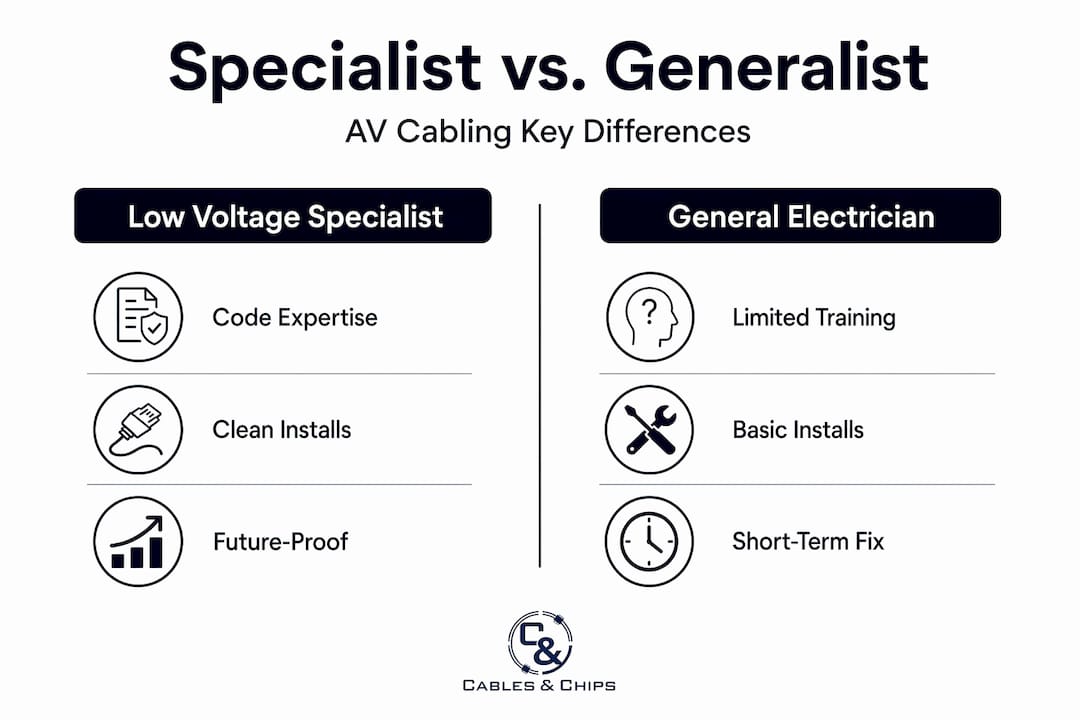
Beyond materials, low voltage wiring follows separate routing and installation rules. Low voltage cables cannot share raceways, conduit, or box openings with high-voltage conductors without listed separators, per IRC 2024. This is not a preference. It is code. A general electrician or IT generalist who does not specialize in low voltage installations may not be familiar with these distinctions, and the consequences show up during inspections or, worse, after an incident.
Pro Tip: Ask any prospective AV cabling contractor to specify the cable type and rating for every run in your project. If they cannot cite CMP vs. CMR vs. CM classifications by space type, that is a signal to look elsewhere.
Why a specialist prevents the most common AV cabling failures
The majority of AV performance problems in commercial buildings trace back to installation decisions, not equipment defects. A low voltage specialist understands the root causes. A generalist often does not see them coming.
Here are the most costly AV cabling mistakes that specialists are trained to prevent:
- Improper cable separation. Physical separation between data and power cables minimizes electromagnetic interference and protects devices from hazardous voltage exposure. When AV cables run parallel to power conductors without proper spacing or shielding, the result is audio hum, video signal degradation, and network packet loss. These symptoms are notoriously difficult to diagnose after the fact.
- Wrong cable type for the environment. Using standard CM-rated cable above a drop ceiling that serves as a return air plenum is a code violation. It also creates a fire hazard that your insurance carrier may cite after a loss.
- Inadequate fire-stopping at penetrations. Specialized fire-stopping materials must be used on every low voltage cable penetration through a rated assembly. Stuffing insulation or leaving an open hole around a cable bundle is not compliant and gives false protection against fire spread.
- Poor pathway planning. Cables run without thought to bend radius, tension, or future access become problems at every maintenance visit. Proper cable management prevents crosstalk, signal degradation, and supports future servicing.
- Unverified terminations. AV over IP and 10G networks require every Cat6a termination to be tested and certified. A single miswired pair or marginal connection causes intermittent outages that consume hours of troubleshooting time.
“Faulty or underqualified AV cabling can cause signal loss, security breaches, and voided equipment warranties.” A specialist eliminates these risks at the source rather than after the damage is done.
The importance of low voltage specialists becomes clearest when you account for the full cost of rework. Specialist installations reduce rework costs, network downtime, and failed inspections because the work is done correctly the first time, tested, documented, and built to code.
Future-proofing your AV infrastructure from day one
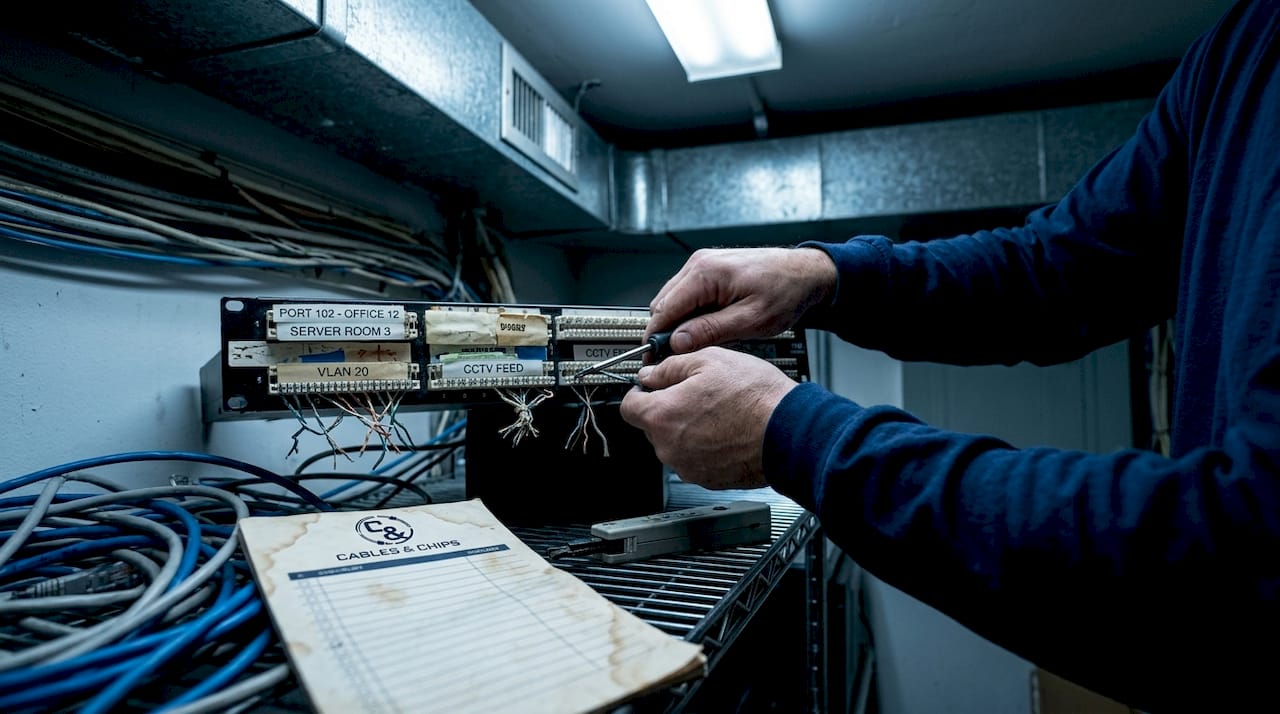
The technology inside your conference rooms and common spaces will change. The cables in the walls should not have to. This is where the long-term value of AV installation low voltage expertise becomes a financial argument, not just a technical one.
The cost math on over-provisioning
| Approach | Upfront Cost | Retrofit Cost Later | Net Outcome |
|---|---|---|---|
| Minimum viable cabling | Lower | 3 to 10× the original install | Disruption, higher total spend |
| Specialist-designed install | 15-30% higher | Near zero for planned upgrades | Predictable costs, minimal disruption |
| Conduit without pull cable | Moderate | Low, cables pulled easily | Best flexibility for unknown future needs |
Running extra cable and larger conduits during initial installs avoids disruptive and costly rewiring later. A 2-inch conduit costs almost nothing more than a 1-inch conduit at install time. Replacing a conduit after the walls are finished is a renovation project.
Specialists also make deliberate choices about which cable types to specify. Cat6a supports 10 Gbps Ethernet up to 100 meters, covering the AV-over-IP, PoE++, and 4K video demands that most organizations will face within a 3-to-5-year equipment cycle. Installing Cat6 today because it costs slightly less per foot is a short-term decision with long-term consequences.
Fiber optic infrastructure deserves special mention. For any run exceeding 90 meters, or any backbone connecting MDF to IDF closets, fiber is the right choice for AV signal integrity and bandwidth headroom. A low voltage specialist designs these pathways as part of a coordinated infrastructure plan, not as an afterthought.
Pro Tip: During pre-construction meetings, push your low voltage contractor to install at least two Cat6a cables per AV drop and pull a conduit for any run where future display or camera locations might change. The additional material cost is minor. The flexibility is significant.
Regulatory and safety standards specialists know by heart
Code compliance in commercial AV cabling is not a single standard. It is a matrix of requirements from the NEC, IRC 2024, and local amendments that interact with your building’s specific construction type, occupancy classification, and HVAC design.
The areas where non-specialists most frequently create compliance problems:
- Raceway sharing. Low voltage cables and power conductors must not share conduit or wall openings without listed separators per NEC and IRC. This rule is violated routinely when general contractors or IT staff pull AV cables without low voltage training.
- Plenum compliance. In any space where air circulates freely above a drop ceiling or below a raised floor, only CMP-rated cables are code-compliant. Using standard CM cables in these spaces violates code and endangers building occupants.
- Fire-stop integrity. Every penetration through a fire-rated wall or floor assembly must be sealed with a listed fire-stopping system. Incorrect fire-stopping violates code and requires licensed installers to remediate correctly.
- Permit and inspection requirements. In New York City and most major markets, low voltage work in commercial buildings requires permits and inspections. A licensed low voltage contractor carries the credentials to pull those permits and stand behind the work at inspection.
Specialists know these requirements not from reading the code once but from building inspections, project corrections, and years of field experience. That knowledge protects your certificate of occupancy, your insurance coverage, and the people who work in your building.
How to choose and work with the right AV cabling specialist
Selecting the right low voltage contractor is a decision that affects your building’s infrastructure for the next decade. These steps will help you evaluate proposals and set a project up for success.
- Verify licensing and insurance. In New York, low voltage contractors must hold specific licensing. Ask for credentials upfront and confirm they cover the scope of your AV project.
- Ask about cable specifications before you accept a bid. Any specialist worth hiring will specify cable ratings (CMP, CMR, CM), conductor counts, and conduit sizes in writing. Vague bids produce vague results.
- Request a future-proofing plan. Ask directly how the proposed design accommodates 4K video distribution, AV-over-IP migration, or PoE-powered devices. If the contractor cannot answer, they are not designing for your next refresh cycle.
- Require as-built documentation. Every run should be labeled, tested, and recorded in a physical or digital as-built diagram. This documentation is critical for troubleshooting, building sales, and future upgrades. Learn more about what professional low voltage cabling documentation should include.
- Coordinate with your IT team and general contractor early. AV cabling pathways need to be planned before walls close and above-ceiling spaces are finished. Late coordination is the single biggest cause of compromised cable routes and code violations.
Pro Tip: Ask for references from commercial AV projects specifically, not residential or retail installs. Conference rooms, boardrooms, and open office AV systems have different performance and compliance requirements. See how specialists approach conference room AV cabling in practice.
My take: the decision you’ll regret making cheap
I’ve seen the same story play out more times than I can count. A property manager or IT director tries to save money on AV cabling by using a general electrician or a low-bid IT vendor without low voltage credentials. The install looks fine on day one. Then the 4K displays flicker. The conference room audio cuts out. The inspector flags the plenum cable. Three rounds of troubleshooting and one partial rip-out later, the “savings” are gone and then some.
What bothers me most is that these outcomes are entirely predictable. The specialist role in AV cabling is not about prestige or billing rates. It is about having the specific training to route cables correctly, specify the right materials, meet code, and design infrastructure that does not need to be touched again for years.
The organizations that treat AV cabling as a foundational investment spend less over time. They skip the emergency service calls, the warranty disputes, and the overtime troubleshooting sessions before a board presentation. Your network is only as strong as the infrastructure behind it. The same principle applies to every display, speaker, and camera in your building.
If you are making AV infrastructure decisions right now, resist the pressure to treat cabling as a commodity line item. Hire specialists. Document everything. Plan for the technology you will need in five years, not just what you need today.
— Ken
Get it right the first time with Cables
At Cables, we have spent more than 40 years building the kind of AV and data infrastructure that commercial properties in New York City depend on. Our team handles every aspect of low voltage AV cabling, from design and specification to installation, testing, and as-built documentation. Whether you need structured Cat6a cabling for an AV-over-IP buildout or fiber optic infrastructure for a campus backbone, we design for compliance, performance, and your next technology refresh. Every project is permitted, inspected, and documented. Schedule a site survey with Cables at 20 Vesey Street, Lower Manhattan, or reach us at cables.nyc. Low Voltage. High Performance.
FAQ
What makes AV cabling a low voltage specialty?
AV systems operate below 50 volts and require specific cable ratings, separation from high-voltage wiring, and compliance with NEC and IRC fire and safety codes. These requirements demand trained low voltage specialists, not general electricians.
What happens if AV cabling is not done by a specialist?
Poor AV cabling causes signal loss, electromagnetic interference, and failed building inspections. It can also void equipment warranties and create fire safety hazards if incorrect cable types are used in plenum spaces.
Is plenum-rated cable required for AV installations?
Yes. In any air-handling space above a drop ceiling or below a raised floor, only CMP-rated cables are code-compliant. Standard PVC cables in these spaces violate fire safety codes and endanger building occupants.
Does hiring a specialist actually save money long-term?
Upfront costs for properly over-provisioned cabling run 15-30% higher, but they prevent retrofit costs that are 3 to 10 times greater. Specialists also reduce rework, downtime, and failed inspection costs that accumulate over the life of the installation.
What documentation should a low voltage AV specialist provide?
A qualified specialist delivers labeled cable runs, test and certification reports for every Cat6a connection, and as-built diagrams showing exact pathways and termination points. This documentation supports maintenance, future upgrades, and building inspections.