
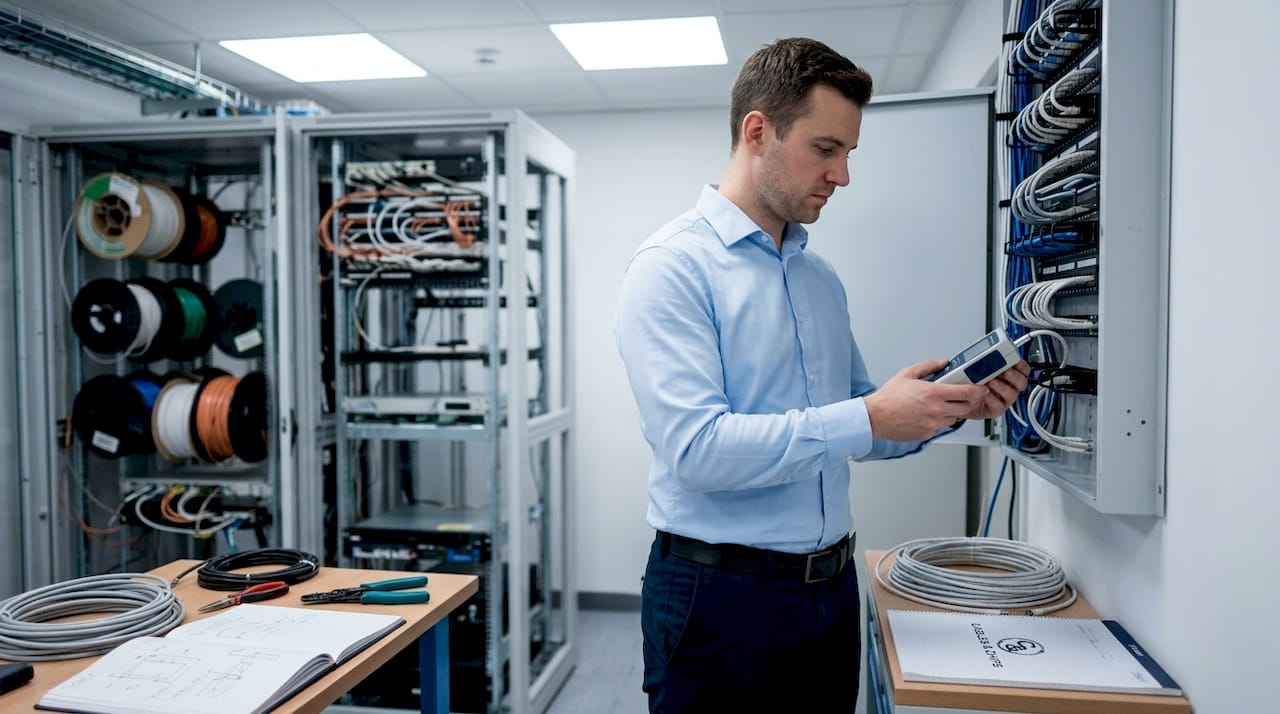
Structured cabling is defined as a standardized, hierarchical physical wiring infrastructure that supports voice, data, video, security, and building management systems within a commercial facility or campus. Governed by ANSI/TIA-568 and ISO/IEC 11801, it replaces ad-hoc point-to-point wiring with a consistent, documented system that any qualified technician can service, expand, or troubleshoot. For IT professionals, facility managers, and network engineers, understanding what is structured cabling means understanding the physical foundation on which every application, device, and system in your building depends. Your network is only as strong as the infrastructure behind it.
What is structured cabling and how does it work?
Structured cabling systems organize copper conductors, fiber optic cables, pathways, and termination hardware into a consistent, predictable layout. Rather than running individual cables between every device and switch, the system routes all horizontal cabling to centralized telecommunications rooms, where patch panels connect to active equipment. This architecture means that structured cabling supports faster problem isolation and significantly less disruption during moves, adds, and changes. A single labeled patch cord swap at the panel replaces what would otherwise require tracing cable runs through ceilings and walls.
The system is technology-agnostic by design. The same physical plant that carries 1 Gigabit Ethernet today can support 10GBase-T or PoE++ devices tomorrow without rewiring the building. That forward compatibility is the core operational argument for investing in standards-compliant infrastructure from the start.

What are the key subsystems of structured cabling?
ANSI/TIA-568 defines six recognized subsystems, each with a specific role in the overall cabling infrastructure. Understanding these subsystems is the first step toward evaluating any structured cabling design or bid.
| Subsystem | Function | Typical Media |
|---|---|---|
| Entrance facility | Connects external service providers to the building | Single-mode fiber, coax |
| Equipment room | Houses main distribution frame (MDF) and core switching | Cat6A copper, OM4 fiber |
| Backbone cabling | Connects equipment rooms to telecommunications rooms (IDF) | OM4 multimode or single-mode fiber |
| Telecommunications room | Intermediate distribution frame (IDF) serving a floor or zone | Cat6A patch panels, fiber enclosures |
| Horizontal cabling | Runs from IDF to individual work area outlets | Cat6 or Cat6A copper |
| Work area components | Connects end devices to horizontal cabling outlets | Patch cords, adapters |
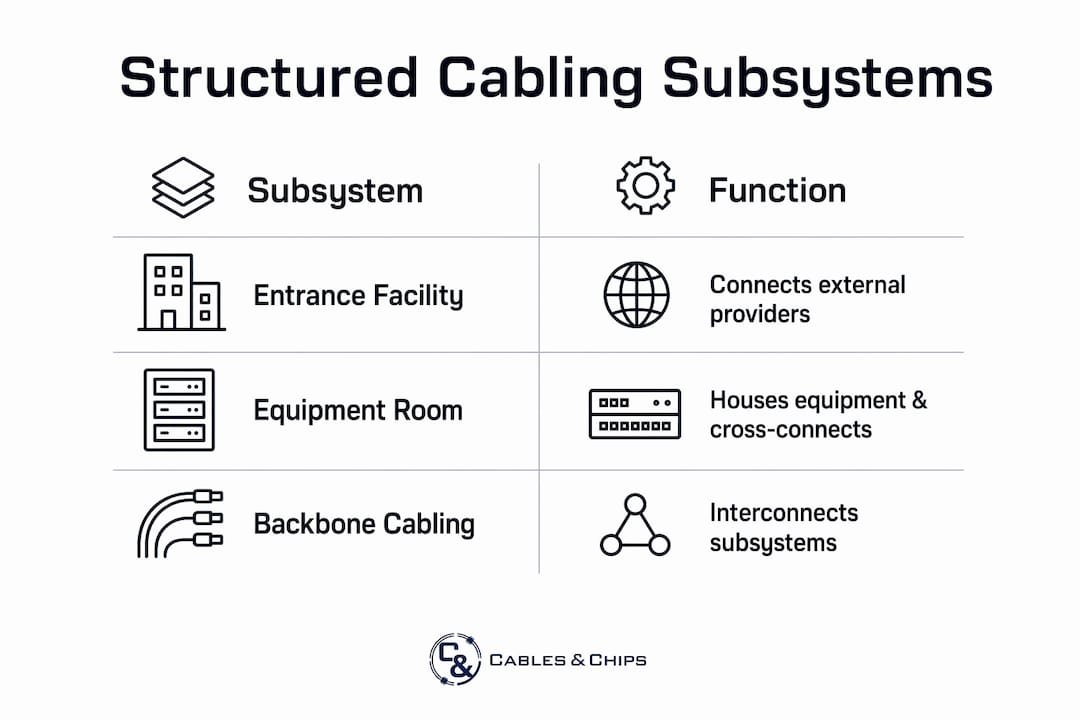
Each subsystem is interdependent. The 90-meter horizontal permanent link constraint defined by ANSI/TIA-568 and ISO/IEC 11801 directly determines where telecommunications rooms must be placed on each floor. A floor plate larger than roughly 180 meters in any direction requires multiple IDFs, which in turn drives backbone cabling requirements and equipment room sizing.
Backbone cabling between the MDF and IDFs almost always uses fiber optic cable, typically OM4 multimode for intra-building runs or single-mode for campus distances. Horizontal cabling to desks and access points uses Cat6 or Cat6A copper, which also supports Power over Ethernet for devices like IP phones, wireless access points, and IP cameras.
What standards govern structured cabling design and compliance?
ANSI/TIA-568 in North America and ISO/IEC 11801 internationally set the performance, testing, and documentation requirements that define compliant structured cabling systems. These standards specify everything from connector pin assignments and cable bend radius to the exact test parameters required for certification.
Key compliance requirements include:
- Permanent link length: 90 meters maximum for horizontal cabling from the IDF patch panel to the wall outlet, not including patch cords
- Channel length: 100 meters total, which adds up to 10 meters for patch cords at both ends
- Testing model: Permanent link testing certifies the installed cable plant; channel testing includes patch cords and is required for end-to-end performance validation
- Category matching: Every component in the channel, including cable, jacks, patch panels, and patch cords, must match the rated category (e.g., all Cat6A) to achieve certification
- Documentation: Every outlet, panel port, and cable run must be labeled and recorded in as-built drawings
Standards compliance matters beyond paperwork. Certified infrastructure qualifies for manufacturer warranties, often 15 to 25 years, that cover both materials and application performance. Non-compliant installations void those warranties and leave your organization exposed when a link fails under load.
Pro Tip: Request channel test results in Fluke DSX or Versiv format from your installer. These files are machine-readable, verifiable, and accepted by all major manufacturers for warranty registration. A PDF printout alone is not sufficient for warranty claims.
Copper vs. fiber: which cabling option fits your infrastructure?
The choice between Cat6A copper and fiber optic cabling is one of the most consequential decisions in any structured cabling project. Both are standards-compliant options, but they serve different performance profiles and budget structures.
| Attribute | Cat6A copper | OM4 multimode fiber | Single-mode fiber |
|---|---|---|---|
| Max distance | 100 meters (channel) | 400 meters at 10Gbps | Unlimited (practical: km) |
| Bandwidth | 10Gbps at 500MHz | 10Gbps to 100Gbps | 100Gbps and beyond |
| PoE support | Yes (up to 90W PoE++) | No | No |
| Installation cost | Lower per drop | Higher per drop | Highest per drop |
| Lifecycle cost | Higher (more drops needed) | Lower for high-density | Lowest for long distances |
| Typical use | Horizontal to desks/APs | Backbone, data centers | Campus, inter-building |
Cat6A copper dominates horizontal cabling because it supports PoE, which powers wireless access points, IP cameras, and VoIP phones without separate power runs. CAT6A installation is the current standard for new commercial builds in New York City, replacing Cat6 in most enterprise specifications due to its 10Gbps capability and improved alien crosstalk performance.
Fiber optic cabling carries backbone traffic between the MDF and IDFs, and increasingly appears in high-density server rooms and data centers where bandwidth and distance requirements exceed copper’s limits. Single-mode fiber is the right choice for any run exceeding 400 meters or for future-proofing against 40Gbps and 100Gbps upgrades.
Pro Tip: Specify OM4 or OM5 multimode fiber for all intra-building backbone runs, even if your current switches only support 10Gbps. The incremental cost over OM3 is minimal, and the upgrade path to 40Gbps or 100Gbps requires only transceiver changes, not recabling.
Why structured cabling reduces IT costs over the facility lifecycle
The financial case for structured cabling is grounded in lifecycle math, not upfront price. Modern structured cabling can reduce support costs by up to 86% and overall cabling costs by up to 74% compared to ad-hoc systems over the facility lifecycle. That figure reflects the compounding cost of reactive troubleshooting, undocumented moves, and emergency retrofits that accumulate in unstructured environments.
The cost structure of any cabling project also reveals why material choices matter less than most buyers expect. Labor accounts for 60 to 70% of total installation cost. Choosing cheaper cable to save on materials while paying the same labor rate produces marginal savings upfront and potentially significant costs later. The real leverage is in planning.
Specific cost drivers that structured cabling addresses directly:
- Moves, adds, and changes (MACs): A documented, labeled patch panel reduces MAC time from hours to minutes per change
- Troubleshooting: Certified test records allow technicians to isolate faults to a specific link rather than testing every run in a zone
- Retrofitting: Retrofitting cabling in occupied buildings costs $1,000 to $3,500 more per drop compared to new construction. That premium alone justifies installing Cat6A during initial build-out rather than upgrading later.
- Downtime: Undocumented cabling creates single points of failure that are difficult to identify and expensive to resolve under pressure
“Professionals often underappreciate cabling as a strategic operational asset rather than viewing it as a simple construction expense. This mindset shift helps avoid ‘temporary’ fixes that degrade network performance over time.” — Benefits of Structured Cabling
What to expect during structured cabling installation
A well-managed structured cabling installation follows a defined sequence from site survey through certified testing. Understanding the process helps you set realistic timelines and evaluate bids accurately.
- Site survey and design: Assess floor plates, existing pathways, MDF/IDF locations, and outlet counts. This step produces the cabling design and bill of materials.
- Permitting and coordination: In occupied commercial buildings, especially in New York City, permits and building management approvals add lead time. Factor this into your schedule.
- Rough-in and pathway installation: Conduit, cable trays, and J-hooks are installed before cable pulling begins.
- Cable pulling: Horizontal and backbone cables are pulled and dressed according to the design drawings.
- Termination: Cables are terminated at patch panels and wall outlets. A complete cabling BOM must match cable category, jacks, patch panels, and cords throughout the channel to achieve certification.
- Testing and certification: Every link is tested with a certified tester such as a Fluke DSX-8000 to permanent link or channel standards. Failing links are remediated before sign-off.
- Labeling and documentation: Every outlet and panel port is labeled per TIA-606 standards. As-built drawings and test reports are delivered to the client.
Standard office projects typically take four to six weeks from mobilization to certified completion. Multi-floor or multi-site deployments extend to several months due to phasing, approvals, and coordination with active tenants.
Pro Tip: When reviewing a structured cabling bid, confirm that the quote covers a complete, performance-matched channel, not just cable and jacks. A bid that omits patch cords, panels, or testing will produce a lower number that does not reflect the true project cost.
Key takeaways
Structured cabling is a standards-governed physical infrastructure system that reduces lifecycle IT costs, supports scalability, and eliminates the operational risk created by ad-hoc wiring.
| Point | Details |
|---|---|
| Standards define performance | ANSI/TIA-568 and ISO/IEC 11801 set the design, testing, and documentation requirements for compliant systems. |
| Six subsystems form the hierarchy | From entrance facility to work area, each subsystem has a defined role and media type. |
| Labor drives project cost | At 60 to 70% of total cost, labor makes planning and quality installation more valuable than material savings. |
| Retrofitting is expensive | Installing the right infrastructure during construction avoids $1,000 to $3,500 in additional cost per drop later. |
| Complete channel compliance matters | Every component in the channel must match the rated category to achieve certification and warranty coverage. |
Ken’s take: cabling is an operational risk, not a line item
After working on structured cabling projects across commercial offices, secure facilities, and server rooms in New York City for decades, the pattern I see most often is this: organizations treat cabling as a construction expense to be minimized rather than an operational asset to be specified correctly. That decision gets made once, during the build-out, and then it gets paid for repeatedly in troubleshooting calls, failed audits, and emergency retrofits.
The shift toward higher-density wireless, PoE-powered devices, and 10Gbps edge switching has raised the stakes considerably. A Cat5e plant that was adequate five years ago is now a constraint on every access point, IP camera, and softphone in the building. The cost to remediate that is not just the cable. It is the labor to repull through occupied ceilings, the downtime during cutover, and the project management overhead that nobody budgeted.
My advice is straightforward: specify Cat6A for all horizontal runs, OM4 or better for backbone fiber, and require certified test documentation at project close. Treat the cabling infrastructure the same way you treat your fire suppression system. You do not cut corners on it, and you document everything. The organizations that do this right spend less over ten years than the ones who try to save money on the initial install.
— Ken
Build your network on infrastructure that lasts
Cables & Chips designs and installs structured cabling systems for commercial offices, secure facilities, server rooms, and enterprise environments throughout New York City. With more than 40 years of experience, the team at Cables delivers Cat6A and fiber optic infrastructure that meets ANSI/TIA-568 standards, passes certified testing, and comes with complete as-built documentation.
Whether you are planning a new build-out, upgrading an existing plant, or evaluating a structured cabling bid, the structured cabling components guide covers everything from subsystem design to BOM selection. For CAT6 and CAT6A projects specifically, the CAT6 installation services page outlines the full process from site survey to certified completion. Contact Cables & Chips at 20 Vesey Street, Lower Manhattan, to schedule a site survey.
FAQ
What is structured cabling in simple terms?
Structured cabling is a standardized physical wiring system that organizes all network, voice, and security cables in a building into a consistent, documented infrastructure. It replaces point-to-point wiring with a hierarchical layout governed by ANSI/TIA-568 and ISO/IEC 11801 standards.
What is a structured cabling bid?
A structured cabling bid is a contractor’s proposal to design and install a cabling system, covering labor, materials, testing, and documentation for a defined scope. A complete bid must quote a full performance-matched channel, including cable, jacks, patch panels, and patch cords, not individual components in isolation.
What is a structured cabling tier?
Structured cabling tiers refer to performance classifications defined by standards bodies, distinguishing systems by bandwidth, frequency rating, and application support. Common tiers include Category 6, Category 6A, and fiber grades such as OM3, OM4, and OM5, each suited to different speed and distance requirements.
How long does structured cabling installation take?
Standard office structured cabling projects typically take four to six weeks from mobilization to certified completion. Larger multi-floor or multi-site deployments can extend to several months depending on permitting, phasing, and building access coordination.
Why does structured cabling reduce IT costs?
Structured cabling reduces IT costs because documented, labeled infrastructure cuts troubleshooting time, simplifies moves and changes, and avoids the $1,000 to $3,500 per drop premium associated with retrofitting cabling in occupied buildings. Lifecycle savings of up to 86% in support costs have been documented compared to ad-hoc systems.