
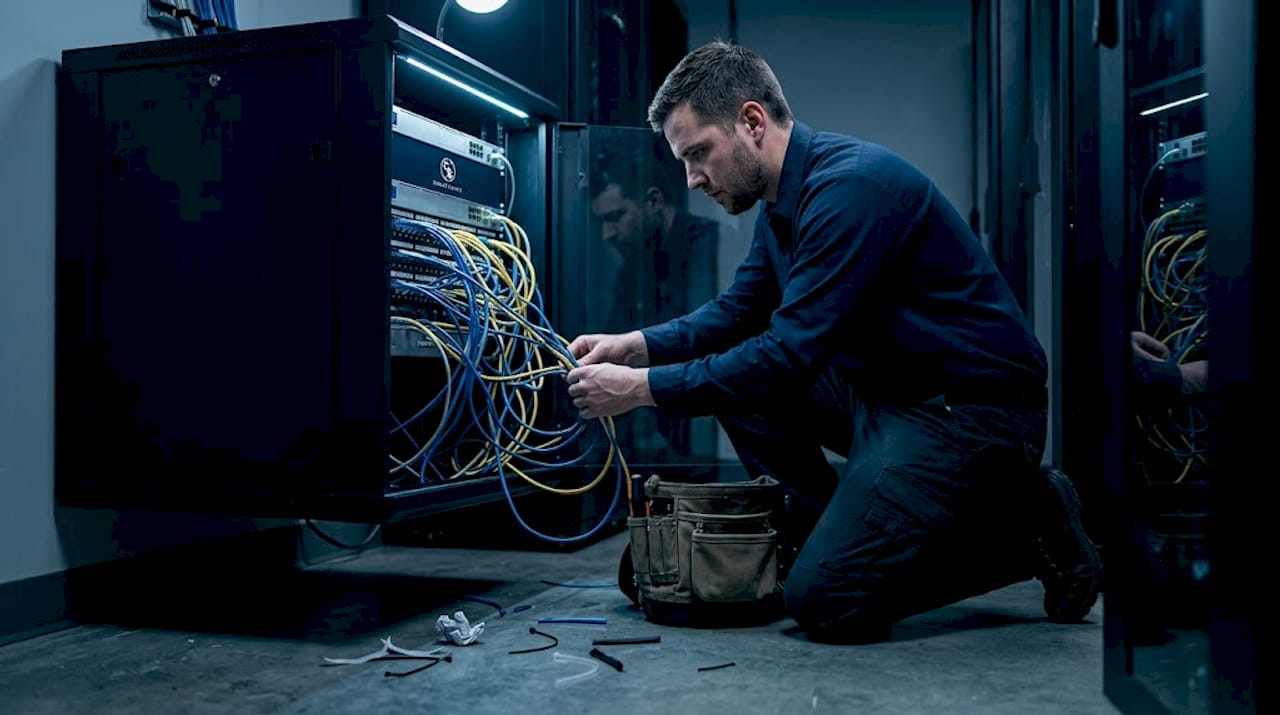
Most people assume low voltage cabling is just “the wiring that isn’t high voltage.” That assumption leads to real problems on job sites. What is low voltage cabling, exactly? It’s a broad category of electrical and telecommunications wiring that operates at reduced power levels, typically below 50 volts, and covers everything from CAT6 data cables to fiber optic runs, CCTV wiring, and access control systems. Understanding the technical boundaries, code classifications, and practical applications of this cabling category is not optional for anyone managing commercial infrastructure. It’s the foundation of every modern building’s communications and control systems.
Key takeaways
| Point | Details |
|---|---|
| Low voltage has two definitions | IT/telecom and electrical engineering define “low voltage” differently, causing compliance errors if not clarified upfront. |
| NEC Article 725 governs Class 2 and 3 circuits | Class 2 circuits are capped at 100 VA and typically operate below 30V AC, providing built-in safety protection. |
| Cable type determines performance | CAT6A supports 10 Gbps over 100 meters; choosing the wrong cable type limits speed and scalability. |
| NEC 2026 changes grounding rules | Article 750 now consolidates grounding for all limited-energy systems, requiring closer contractor coordination. |
| Permits vary by jurisdiction | Low voltage cabling permit requirements depend on project scope, cable type, and local code adoption. |
What low voltage cabling actually means
The phrase “low voltage” sounds self-explanatory. It is not. There are two entirely separate frameworks that use this term, and confusing them causes real installation errors and failed inspections.
In IT and telecommunications, low voltage refers to ELV signal and data cabling. These are the cables carrying network traffic, audio signals, video feeds, and control data. They operate well below 50 volts and are governed by the National Electrical Code (NEC) under Article 725, which classifies them as Class 2 or Class 3 circuits. In electrical engineering, the term “low voltage” refers to power distribution cables rated at 0.6/1kV, which is a completely different category with different installation methods and safety requirements.
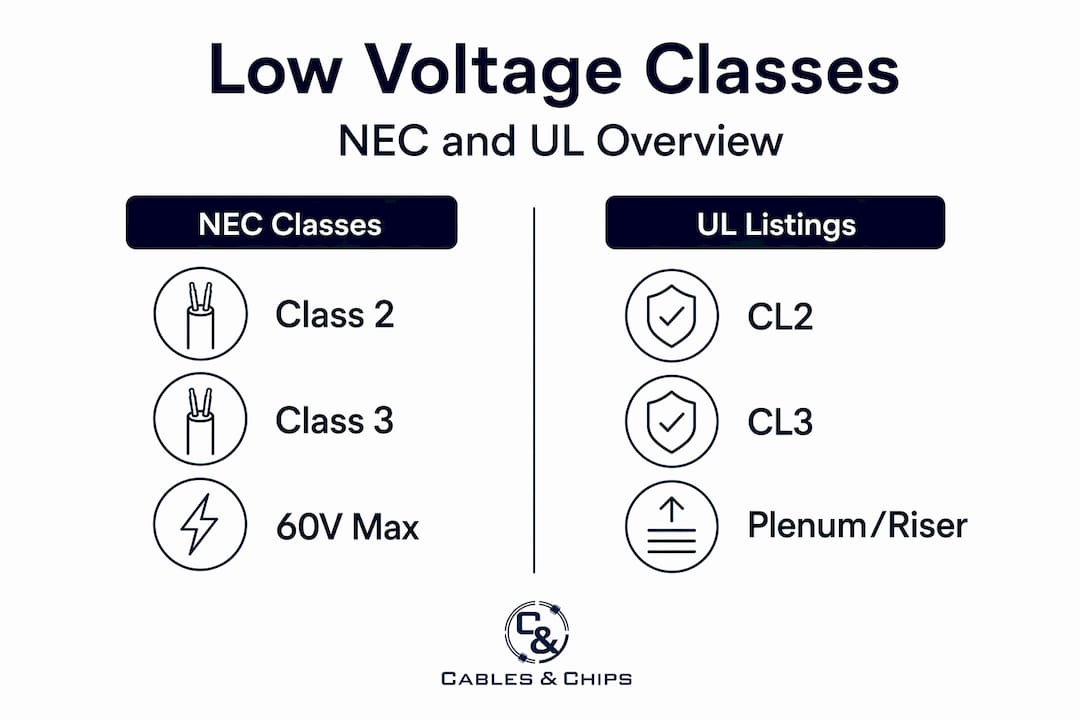
For commercial cabling work, the relevant framework is NEC Article 725. Class 2 circuits are power-limited to a maximum of 100 VA and typically operate at less than 30V AC or 60V DC. This power limitation is not arbitrary. It provides intrinsic protection against fire and electric shock, which is why Class 2 wiring is permitted with simplified installation methods in many applications. Class 3 circuits share the same 100 VA power cap but allow voltages up to 300V, which introduces additional shock risk and triggers stricter installation requirements.
UL listings and regulatory frameworks
Beyond NEC classifications, low voltage cables carry UL listings that define where and how they can be installed. CL2 and CL3 ratings correspond to Class 2 and Class 3 circuits. Plenum-rated versions (CL2P, CL3P) are required in air-handling spaces because they use materials that resist flame spread and produce less toxic smoke. Riser-rated cables (CL2R, CL3R) are approved for vertical runs between floors. Selecting the wrong rating for the installation environment is a code violation, and it creates real fire risk.
Pro Tip: Always confirm the NEC edition your local jurisdiction has adopted before specifying cable ratings. Some municipalities in New York still operate under older NEC editions, which can affect plenum and riser requirements on your project.
| Circuit Class | Max Voltage | Max Power | Typical Applications |
|---|---|---|---|
| Class 2 | 30V AC / 60V DC | 100 VA | Data networks, security sensors, PoE devices |
| Class 3 | 300V | 100 VA | Intercoms, some audio systems, control wiring |
| ELV (telecom) | Below 50V | Signal only | Fiber optic, CAT6, coaxial, speaker wire |
Types of low voltage cables and their applications
Once you understand the classification framework, the cable types make more sense. Each cable is engineered for a specific signal type, distance, and performance requirement.
Category 5e and Category 6 cables are the workhorses of data transmission. CAT5e supports up to 1 Gbps over 100 meters. CAT6 pushes 10 Gbps, but only up to 55 meters at that speed. CAT6A extends 10 Gbps performance to the full 100-meter channel, which is why it has become the standard for new commercial installations. If you are building out a server room or a structured cabling system today, CAT6A is the right choice.
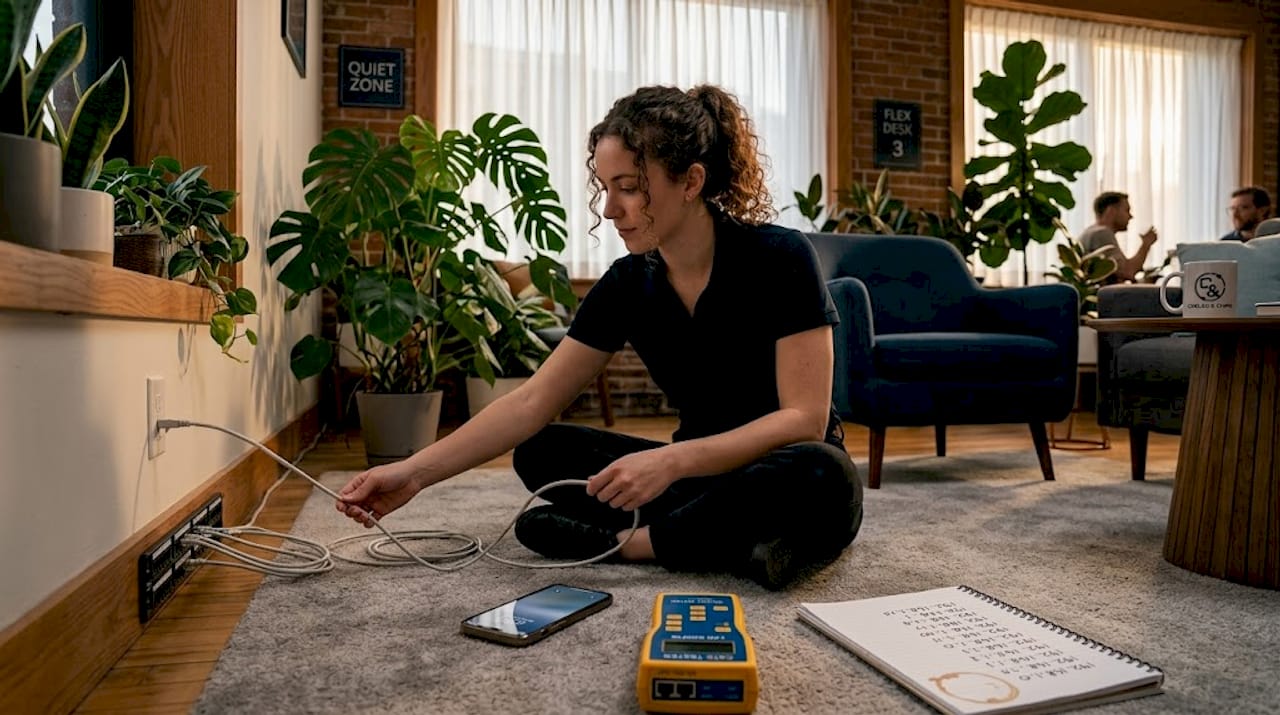
Fiber optic cable operates on an entirely different principle. It transmits data as pulses of light rather than electrical signals, which means it is immune to electromagnetic interference and can carry data across much greater distances without signal degradation. Single-mode fiber supports runs of several kilometers, making it the preferred choice for building-to-building connections and high-density data center backbones.
Coaxial cable remains relevant for CCTV systems, particularly in legacy installations and analog camera deployments. Speaker wire and shielded audio cable handle distributed audio systems in conference rooms, lobbies, and public address systems. Security and access control systems use a range of low voltage cables including shielded twisted pair and multi-conductor cable, depending on the protocol and distance requirements.
Power over Ethernet: where data and power converge
Power over Ethernet (PoE) is one of the most significant developments in low voltage cabling over the past two decades. PoE allows a single Ethernet cable to carry both data and electrical power simultaneously. This powers IP cameras, VoIP phones, wireless access points, and smart building sensors without requiring a separate power circuit at each device location. It simplifies installation considerably and reduces the number of cables required in a structured cabling deployment.
Here is a quick reference for the most common low voltage cable types:
- CAT6A: 10 Gbps over 100 meters; preferred for new commercial data networks and PoE+ applications
- Fiber optic (single-mode): Long-distance, high-bandwidth backbone connections; immune to EMI
- Fiber optic (multimode): Shorter runs within buildings; lower cost than single-mode for intra-floor connections
- Coaxial (RG-59/RG-6): CCTV and video distribution; analog and some IP camera systems
- Shielded twisted pair: Security panels, access control readers, intercom systems
- Multi-conductor cable: HVAC controls, building automation, fire alarm notification circuits
Structured cabling standards like TIA-568 define performance requirements, connector specifications, and testing methods for commercial network cabling. Compliance with TIA-568 is not just about passing inspections. It directly affects interoperability, warranty coverage, and the long-term serviceability of your infrastructure.
Installation practices and NEC 2026 updates
Knowing what low voltage cabling is only gets you halfway there. How it gets installed determines whether the system performs reliably and passes inspection.
The 2026 NEC introduced Article 750, which consolidates grounding and bonding requirements for all limited-energy systems into a single article. Previously, grounding requirements for different low voltage systems were scattered across multiple NEC articles, creating inconsistency in how contractors approached bonding. Article 750 requires all limited-energy systems to bond to the building’s grounding electrode system. This prevents destructive voltage differences between systems, which is a leading cause of equipment damage and data corruption in commercial environments.
Key installation practices that every low voltage project must address:
- Grounding and bonding: All metallic cable sheaths, conduit, and equipment enclosures must be properly bonded per NEC Article 750 in 2026-compliant installations
- Cable routing: Low voltage cables must maintain separation from high-voltage power conductors to prevent interference and comply with NEC requirements
- Bend radius: Exceeding the minimum bend radius of a cable, particularly CAT6A and fiber, degrades performance and can cause permanent physical damage to the cable
- Cable support: Cables must be supported at appropriate intervals and cannot be draped across ceiling tiles or suspended from sprinkler pipes
- UL-rated materials: Only UL-listed cables with the correct environmental rating (plenum, riser, or general purpose) should be installed in their designated spaces
Pro Tip: The NEC 2026 updates represent a meaningful shift in how grounding is coordinated across low voltage systems. If your project involves multiple contractors handling different systems, assign one party to own the grounding coordination. Gaps between trades are where compliance problems develop.
Benefits of low voltage cabling in commercial environments
The advantages of low voltage cabling go beyond the obvious safety benefits. Here is how they translate to real value in commercial and technical environments:
-
Reduced fire and shock risk. Class 2 power supplies are limited to 100 VA output and must comply with UL 1310 standards, which include internal safety protections. This makes Class 2 wiring significantly safer to work with and install than standard line-voltage circuits.
-
Lower installation costs. CL2-rated cables can often be installed without conduit in many environments, reducing both material costs and labor time. This flexibility is a significant advantage in retrofit projects where running conduit through existing walls is expensive.
-
Technology integration. Low voltage infrastructure supports the full range of modern building technology: IP security cameras, wireless access points, VoIP systems, LED lighting controls, and building automation systems all run on low voltage cabling. One well-designed infrastructure layer supports all of them.
-
Scalability. A properly documented and tested low voltage cabling plant can support technology upgrades without full infrastructure replacement. Moving from CAT6 to CAT6A, or adding PoE capacity, is far easier when the original installation was done to standard.
-
Maintainability. Labeled, tested, and documented cabling reduces troubleshooting time dramatically. When a circuit fails, a well-organized low voltage system tells you exactly where to look.
Permits, compliance, and service categories
Low voltage cabling permit requirements vary by jurisdiction, project scope, and cable type. In New York City, most commercial low voltage cabling work requires permits, particularly for structured cabling, security systems, and fire alarm-related wiring. Skipping permits does not save money. It creates liability, delays certificate of occupancy, and often results in costly rework when inspectors flag non-compliant installations.
Here is what to know before starting any commercial low voltage project:
- Structured cabling: CAT6 and CAT6A installations in commercial spaces typically require permits in NYC. Work must be performed by licensed contractors.
- Security systems: CCTV, access control, and intrusion detection wiring falls under low voltage permit requirements and must comply with local fire and building codes.
- Fiber optic installation: Fiber runs, particularly those crossing floor penetrations or running through plenum spaces, require permits and fire-stopping at penetrations.
- Audio/visual cabling: AV installations in commercial spaces, including conference rooms and public address systems, generally require permits when they involve in-wall or in-ceiling cable routing.
- Building automation: HVAC controls, lighting controls, and BAS wiring are subject to low voltage permit requirements and often require coordination with mechanical and electrical contractors.
Professional consultation before project start is not optional for commercial work. A licensed low voltage contractor will identify the permit requirements, specify the correct cable types, and coordinate with the authority having jurisdiction (AHJ) to avoid compliance surprises.
My take on what professionals consistently get wrong
I’ve spent years working through low voltage cabling projects across commercial offices, data centers, and secure facilities in New York City. The single most common mistake I see is failing to define “low voltage” at the project kickoff. That sounds basic, but when an IT team, a general contractor, and an electrical contractor are all using the term differently, the result is mismatched cable specifications, grounding gaps, and failed inspections.
The NEC 2026 Article 750 changes are more significant than most contractors realize. I’ve seen projects where the grounding coordination between the structured cabling contractor and the security systems contractor was never assigned to anyone. Both assumed the other was handling it. Article 750 makes that ambiguity a code violation, not just a best practice gap.
My other consistent observation: people underestimate the performance difference between cable categories. I’ve seen facilities spend money on CAT6A hardware and then install CAT6 cable to cut costs, not realizing they’ve capped their 10 Gbps performance at 55 meters. Cable testing and certification after installation is the only way to confirm the system performs to spec. Without it, you’re guessing.
Your network is only as strong as the infrastructure behind it.
— Ken
Build it right with Cables & Chips
Cables & Chips has been installing, testing, and certifying low voltage cabling systems across New York City for more than 40 years. Whether your project calls for CAT6A structured cabling in a commercial office, fiber optic infrastructure for a data center backbone, or bulk cable for a large-scale deployment, we bring the technical depth and code knowledge to get it done right the first time. Our team handles everything from initial site survey through installation, testing, certification, and documentation. We work with IT departments, building management teams, and enterprise clients throughout Manhattan and the five boroughs. Contact Cables & Chips at 20 Vesey Street in Lower Manhattan to schedule a site survey or request a quote.
FAQ
What is low voltage cabling used for?
Low voltage cabling supports data networks, VoIP systems, IP security cameras, access control, wireless access points, audio/visual systems, and building automation. It operates below 50 volts and is classified under NEC Article 725 as Class 2 or Class 3 circuits.
What voltage is considered low voltage cabling?
In telecommunications and IT, low voltage cabling typically operates below 50 volts. Class 2 circuits are limited to 30V AC or 60V DC with a maximum of 100 VA, per NEC Article 725.
Do I need a permit for low voltage cabling in NYC?
Yes, most commercial low voltage cabling work in New York City requires permits, including structured cabling, security systems, fiber optic runs, and AV installations. Requirements vary by project scope, so verify with your local authority having jurisdiction before starting work.
What is the difference between CAT6 and CAT6A?
CAT6 supports 10 Gbps up to 55 meters, while CAT6A extends 10 Gbps performance to the full 100-meter channel. For new commercial installations, CAT6A is the recommended standard.
What changed with NEC 2026 for low voltage cabling?
NEC 2026 introduced Article 750, which consolidates grounding and bonding requirements for all limited-energy systems into a single article. All low voltage systems must now bond to the building’s grounding electrode system to prevent voltage differences between systems.