

What Is a Network Infrastructure Audit? IT Pro Guide

TL;DR:
- A network infrastructure audit systematically evaluates all hardware, software, and security controls to identify risks and ensure compliance. It covers physical, virtual, and IoT assets, providing documentation that supports security, operations, and regulatory requirements. Regular audits and thorough physical infrastructure management reduce vulnerabilities and facilitate faster remediation.
A network infrastructure audit is defined as a systematic, evidence-driven assessment of all hardware, software, configurations, policies, and security controls that make up an organization’s network environment. The process identifies risk, validates performance, and produces the documentation that IT professionals and facility managers need to make informed decisions. With 39% of businesses experiencing a cyber attack in 2025, and medium-sized enterprises facing a 69% vulnerability rate, the importance of network audits has never been clearer. The industry also uses the term network infrastructure assessment interchangeably, though “audit” signals a formal, documented review aligned with standards like ISO 27001, NIST, HIPAA, and GDPR.
What is a network infrastructure audit and what does it cover?

A network infrastructure audit answers four core questions: what is on the network, what is exposed, where vulnerabilities exist, and what proof of remediation exists. Audits systematically inventory hosts, services, open ports, and configurations, then validate security controls and document findings to support compliance. That scope is broader than most IT teams initially expect.
The audit covers every layer of the network environment:
- Physical infrastructure: switches, routers, firewalls, patch panels, MDF/IDF closets, and cabling plant
- Virtual and cloud assets: virtual machines, cloud-hosted services, and software-defined network segments
- IoT and OT devices: building management systems, access control panels, CCTV cameras, and VoIP endpoints
- Security controls: firewall rules, access control lists, open ports, user privileges, and authentication policies
- Policies and procedures: change management records, incident response plans, and acceptable use policies
- Performance data: bandwidth utilization, latency, packet loss, and communication path bottlenecks
The audit also produces a documentation trail. That trail supports compliance reporting under frameworks like SOC 2, HIPAA, and PCI DSS, and it gives your team a verified baseline for future upgrades.
Pro Tip: Treat the audit scope document as a contract. Define what is in scope and what is out before a single scan runs. Scope creep is the fastest way to produce an incomplete audit that misses critical assets.
What are the key components and stages of a network audit process?
Effective audits follow a repeatable, six-stage lifecycle from planning and discovery through validation and reporting. That structure turns a complex project into a manageable, data-backed improvement program. Each stage builds on the last.
- Planning and scoping. Define the audit’s objectives, risk profile, regulatory requirements, and asset boundaries. Align the scope with business priorities, not just technical convenience.
- Asset discovery. Use automated scanning tools to identify all connected devices, including IoT, virtualized, and cloud components. Incomplete asset discovery is the leading cause of audit failures and breaches, because unknown equipment is a common entry point for attackers.
- Configuration and policy review. Examine firewall rules, switch configurations, VLAN segmentation, and access control policies against your chosen security standard. Look for expired rules, open ports with no business justification, and overprivileged accounts.
- Behavior and traffic analysis. Review actual network traffic patterns, not just static configuration files. Audits must combine configuration review with network behavior observation to detect unauthorized systems and abnormal communication paths.
- Validation and testing. Verify that security controls are not only present but actively functioning. This stage may include penetration testing, though an audit differs from a penetration test by assessing whether controls are correctly configured rather than simulating attacks to find exploitable paths.
- Reporting and remediation planning. Document all findings, assign risk ratings, and prioritize remediation by impact and effort. Deliver a report that gives both technical teams and facility managers clear, actionable next steps.
Pro Tip: Schedule asset discovery scans during off-peak hours. Running aggressive scans during business hours can degrade network performance and generate false positives that slow down the review.
How does a network infrastructure audit enhance security and compliance?
A network infrastructure audit is the most direct method for closing the gap between assumed security and actual security. Defensive controls need continuous auditing to keep pace with evolving attack techniques, because attackers actively look for visibility gaps that organizations have not yet identified.
Typical security findings from audits include:
- Firewall rules left open from a project completed years ago
- Default credentials on switches, access points, or IoT devices
- Outdated firmware on network equipment with known CVEs
- Overprivileged service accounts with domain-level access
- Unencrypted traffic on internal segments carrying sensitive data
- Shadow IT devices connected without IT approval
“Minor configuration drift and leftover temporary rules often cause the most significant security vulnerabilities.” This finding reflects a consistent pattern across enterprise audits: the biggest risks are rarely exotic. They are the small oversights that accumulate over time.
The financial stakes are real. The average cost of a data breach reached $4.88 million in 2024. A single audit that catches one misconfigured firewall rule or one unpatched device can prevent an incident that costs orders of magnitude more than the audit itself.
Compliance alignment is an equally important output. Audits map findings directly to controls required by ISO 27001, NIST SP 800-53, HIPAA, and GDPR. Aligning audit findings with compliance frameworks like SOC 2, HIPAA, and PCI DSS requires thorough documentation and evidence trails. That documentation also satisfies cyber insurance carriers, which increasingly require proof of regular security assessments before issuing or renewing policies.
What practical steps and tools facilitate an effective network audit process?
The network audit process works best when it combines automated discovery with manual verification. Automated tools cover scale. Manual review catches the context that tools miss.
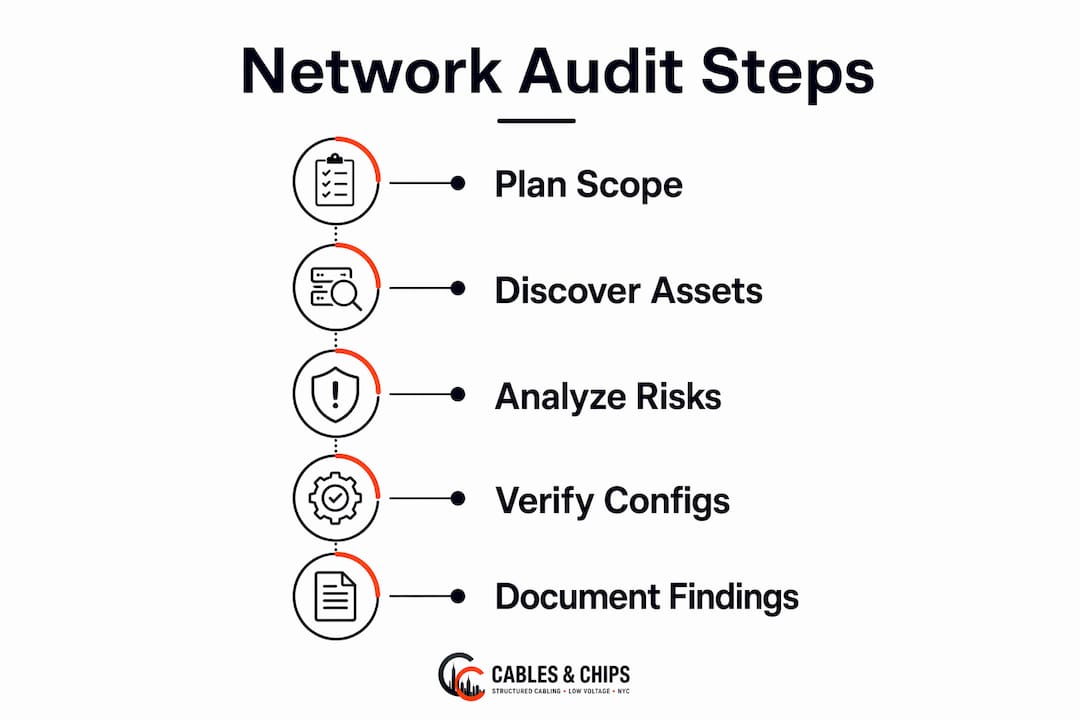
Start with a clear planning phase. Define which regulatory frameworks apply to your organization, what your risk tolerance is, and which assets are most critical to business continuity. A commercial office in Lower Manhattan has different priorities than a healthcare facility or a data center, but both need a defined scope before scanning begins.
Use automated network discovery tools to build your asset inventory. These tools identify active hosts, open ports, running services, and device types across the network. Cross-reference the tool output against your existing asset management records. The gap between what the tool finds and what your records show is itself a finding.
Integrate behavioral analysis into the process. Static configuration files tell you what the network is supposed to do. Traffic analysis tells you what it is actually doing. Reviewing communication patterns, DNS queries, and authentication logs reveals unauthorized lateral movement, rogue devices, and policy violations that configuration review alone will not surface.
Address configuration drift directly. Minor configuration drift and leftover temporary rules are a major audit risk factor. Review every firewall rule, every VLAN assignment, and every access control list against a documented baseline. Flag anything without a current business justification.
Maintain a complete evidence trail throughout the process. Screenshots, exported configuration files, scan reports, and interview notes all support the final audit report. That evidence trail is what makes findings credible to leadership and defensible to regulators.
Pro Tip: Build your audit checklist around your compliance framework first, then add organization-specific controls. Starting from ISO 27001 or NIST gives you a defensible structure and prevents you from missing control categories that regulators will ask about.
What are the benefits and business impacts of regular network infrastructure assessments?
Regular network infrastructure assessments deliver value well beyond security. They improve reliability, support planning, and give leadership the visibility they need to make confident infrastructure investments.
The core benefits break down across four areas:
- Reliability and performance. Audits identify bottlenecks, misconfigured QoS policies, and overloaded segments before they cause outages. A network performance review that catches a failing switch or a saturated uplink prevents unplanned downtime.
- Security risk reduction. Catching a single critical misconfiguration before an attacker does eliminates a breach risk that could cost millions. Regular audits keep the attack surface small and documented.
- Documentation quality. Audits force documentation updates. Accurate as-built records, network diagrams, and configuration baselines reduce troubleshooting time and make future upgrades faster and less risky.
- Compliance and audit readiness. Organizations with a regular audit cadence spend far less time preparing for external audits. The evidence trail is already built.
| Business impact | What it means in practice |
|---|---|
| Reduced downtime | Bottlenecks and failing hardware are identified before they cause outages |
| Lower breach risk | Misconfigurations and rogue devices are caught and remediated proactively |
| Faster troubleshooting | Accurate documentation cuts mean time to resolution for network incidents |
| Compliance readiness | Evidence trails satisfy ISO 27001, HIPAA, and PCI DSS audit requirements |
| Informed investment | Audit findings justify hardware refresh and cabling upgrade budgets |
Organizations that treat audits as continuous validation rather than one-time compliance exercises build a measurable track record of security improvement. That track record matters to boards, insurers, and regulators alike.
Key takeaways
A network infrastructure audit is the most direct method for identifying security gaps, validating controls, and producing the documentation that supports both compliance and reliable network operations.
| Point | Details |
|---|---|
| Define scope before scanning | A written scope document prevents missed assets and keeps the audit focused on business priorities. |
| Combine config review with traffic analysis | Static files show intent; behavioral data shows what the network is actually doing. |
| Treat asset discovery as a finding | The gap between tool-discovered assets and your records is itself a risk that needs remediation. |
| Document everything | Evidence trails support compliance frameworks like ISO 27001, HIPAA, and PCI DSS. |
| Audit on a repeatable cycle | A six-stage lifecycle turns audits from one-off projects into continuous security improvement. |
Why most audits miss what matters most
After working in network infrastructure for decades, I have seen the same pattern repeat across commercial offices, secure facilities, and enterprise environments throughout New York City. Teams invest real effort in the audit, run the scans, review the firewall rules, and produce a solid report. Then the report sits in a shared drive for 18 months and nothing changes.
The problem is not the audit. The problem is treating the audit as a destination rather than a starting point.
The findings that matter most are rarely the dramatic ones. They are the CAT6 patch cable run without documentation, the IDF closet where three switches share one unlabeled uplink, and the access control panel that has never had its firmware updated. These are the gaps that infrastructure lifecycle planning addresses directly, and they are the gaps that attackers find first.
My honest view is that the audit’s value is proportional to what happens after it. A repeatable cycle, where findings drive remediation, remediation drives documentation updates, and documentation feeds the next audit, is the only model that actually reduces risk over time. One-off audits create a false sense of security. They show you a snapshot of a network that changed the day after the scan ran.
The other thing I would push back on is the separation between IT teams and facilities teams. Physical infrastructure, cabling plant, MDF/IDF organization, and access control cabling are all within audit scope. The network closet organization that a facilities manager oversees directly affects whether an auditor can trace a cable, verify a connection, or confirm a device’s physical location. When IT and facilities work from the same documentation, audits get faster, findings get cleaner, and remediation gets done.
— Ken
How Cables and Chips supports audit-ready network infrastructure
A network infrastructure audit is only as useful as the physical infrastructure it evaluates. Disorganized cabling, unlabeled runs, and outdated as-built documentation all produce audit findings that require physical remediation before the security work can begin.

Cables and Chips has spent more than 40 years building clean, documented, and testable network infrastructure across commercial offices, server rooms, and secure facilities in New York City. From structured cabling system components to CAT6A installation, fiber optic infrastructure, and network closet organization, every project is built to support the documentation standards that audits require. The team also produces as-built documentation that gives IT professionals and facility managers an accurate, verified record of the physical layer. Contact Cables and Chips at 20 Vesey Street, Lower Manhattan, to schedule a site survey before your next audit cycle begins.
FAQ
What is a network infrastructure audit?
A network infrastructure audit is a systematic review of all hardware, software, configurations, policies, and security controls that make up an organization’s network. It identifies risks, validates security controls, and produces documentation that supports compliance and operational planning.
How often should a network infrastructure audit be conducted?
Most organizations conduct formal audits annually, with continuous monitoring in between. High-risk environments subject to HIPAA, PCI DSS, or SOC 2 requirements typically require more frequent reviews to maintain compliance.
What is the difference between a network audit and a penetration test?
An audit assesses whether security controls are correctly configured and operating as intended. A penetration test simulates an attack to verify whether those controls can actually be bypassed. Both are valuable, but they answer different questions.
What are the most common findings in a network security audit checklist?
The most common findings include outdated firmware, overprivileged accounts, open ports with no business justification, and configuration drift from temporary rules that were never removed. These small oversights consistently represent the highest-risk exposures.
Why does physical cabling matter in a network infrastructure audit?
Physical cabling is part of the audit scope because unlabeled or undocumented runs make it impossible to verify device locations, trace connections, or confirm that physical access controls are working correctly. Clean, documented cabling directly improves audit accuracy and reduces remediation time.