
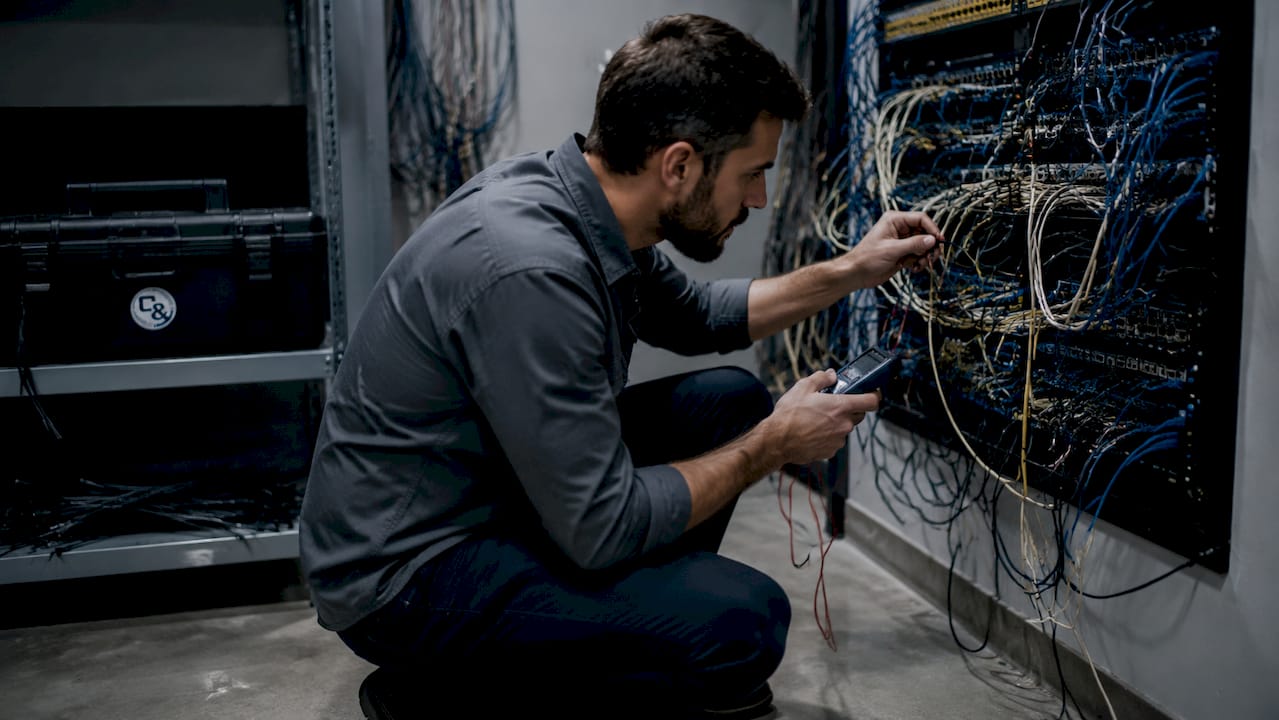
Poor network cabling is defined as any physical layer infrastructure that fails to meet installation, material, or design standards required for reliable data transmission. The consequences reach far beyond slow file transfers. Faulty structured cabling causes signal degradation, intermittent outages, VoIP failures, and security gaps that cost IT teams weeks of misdirected troubleshooting. Tools like Fluke Networks DSX CableAnalyzer and IDEAL Networks LANSeeker exist precisely because the physical layer is where most network problems originate. Your network is only as strong as the infrastructure behind it, and understanding what happens with poor network cabling is the first step toward fixing it.
How does poor network cabling degrade network speed and reliability?
Poor cabling degrades performance through three physical mechanisms: signal attenuation, electromagnetic interference (EMI), and crosstalk. Each one increases bit error rates, forces retransmissions, and adds latency that compounds across every connected device. The result is a network that appears functional on paper but fails under real traffic load.
Auto-negotiation flapping is one of the most disruptive effects. When signal quality drops below the threshold for Gigabit Ethernet, the switch and device renegotiate the link speed, often dropping from 1Gbps to 100Mbps without any alert to the IT team. A single marginal cable run can cut a workstation’s throughput by 90% while the user simply reports that “the network is slow.”

Real-time services suffer the most from poor cabling performance. Improper installation and inconsistent cable types increase data travel time and buffering, making VoIP calls choppy and video conferencing unreliable. For businesses running Microsoft Teams, Cisco Webex, or Zoom across their office infrastructure, a degraded physical layer translates directly into failed meetings and dropped calls.
| Cable condition | Effect on network |
|---|---|
| Marginal crimp or damaged pair | Speed drops from 1Gbps to 100Mbps, increased retransmissions |
| EMI from nearby power cables | Elevated bit error rate, packet loss, intermittent outages |
| Excessive untwisting at termination | Crosstalk between pairs, degraded signal-to-noise ratio |
| Outdated Cat5 on Gigabit switch | Throughput ceiling, PoE instability, frequent link failures |
| Crushed or kinked cable run | Physical signal break, intermittent or total connectivity loss |
Pro Tip: A link light on a switch port does not confirm cable health. A cable can establish a link at 100Mbps and still be causing packet loss. Always test under load, not just for continuity.
What are the common physical cabling issues that cause network problems?
Intermittent network drops are 90% physical-layer problems, and the most common culprits are the ones easiest to overlook during installation. Marginal crimps, broken RJ45 latches, cable kinks, and crushed runs all create conditions where a cable passes a basic wire map test but fails when traffic volume increases or temperature fluctuates. These faults are particularly dangerous because they are invisible to monitoring software until the damage is already affecting users.
The top physical faults that cause network cabling issues, ranked by frequency in commercial environments:
- Marginal or improper crimps on RJ45 connectors, where wire pairs are not fully seated or the boot is not secured
- Excessive untwisting of wire pairs at the termination point, which creates crosstalk and noise between adjacent pairs
- Cable runs routed alongside power conduit, fluorescent ballasts, or motors, introducing EMI that degrades signal quality
- Crushed or kinked cable runs inside walls, above drop ceilings, or through tight conduit bends
- Outdated cable categories such as Cat5 or Cat5e deployed on networks requiring Cat6 or Cat6A performance
- Mixed wiring standards on the same run, such as T568A on one end and T568B on the other, which creates unpredictable noise and performance issues
- Undocumented and unlabeled cable runs that make fault isolation nearly impossible without physically tracing every run
Running data cables near transformers, motors, or fluorescent ballasts is a particularly common mistake in commercial office buildouts where electrical and low voltage contractors work independently. The interference is not always constant, which makes it one of the hardest symptoms to reproduce during troubleshooting.
Pro Tip: Never rely on a basic continuity tester to clear a cable run. Certification-capable testers measure crosstalk, insertion loss, return loss, and impedance. A cable that passes a wire map test can still fail every performance parameter that matters.

What are the business consequences of poor network cabling?
The business consequences of poor cabling extend well beyond IT frustration. IT teams commonly spend weeks resolving software and hardware issues before identifying a bad crimp or marginal cable run as the root cause. That misdirected labor is a direct cost, and it compounds every time the same fault recurs because the physical layer was never properly addressed.
Downtime is the most visible financial consequence. A single unplanned outage in a commercial office affects every revenue-generating activity running on the network, from transaction processing to client communications. For businesses in financial services, healthcare, or legal sectors operating in New York City, even a two-hour outage can carry significant regulatory and contractual exposure.
Security risk is a less obvious but equally serious consequence. Undocumented or unlabeled cabling creates gaps that allow unauthorized devices to remain unnoticed, posing compliance risks that are especially critical in regulated industries. An unlabeled port in a server room or telecom closet is an open invitation for an unauthorized connection that may go undetected for months. Proper cable documentation practices are not just an operational convenience. They are a security and compliance requirement.
| Scenario | Poor cabling outcome | Proper cabling outcome |
|---|---|---|
| VoIP infrastructure | Choppy calls, dropped sessions, user complaints | Stable calls, consistent QoS, no packet loss |
| IT troubleshooting time | Weeks spent on software before physical fault found | Physical layer cleared first, faster resolution |
| Security audit | Unlabeled ports, unknown devices, compliance failure | Documented runs, traceable connections, audit-ready |
| Network upgrade project | Rework required, voided warranties, added cost | Clean baseline, certified runs, no rework |
| Regulated industry (healthcare, finance) | Compliance exposure, potential fines | Documented infrastructure, defensible records |
Rework costs are another factor that business decision-makers consistently underestimate. When a cabling installation is not certified at the time of completion, faults discovered later require opening walls, pulling new runs, and re-terminating connections. That work costs significantly more than getting it right during the original installation.
How can businesses prevent and address network cabling issues?
Preventing the effects of bad network cabling starts with adherence to TIA/EIA-568 structured cabling standards, which define installation requirements for cable routing, bend radius, termination practices, and testing. These standards exist because physical layer integrity cannot be assumed. It must be verified.
The following practices form the foundation of a reliable cabling infrastructure:
- Install the correct cable category for the environment. Cat6 is the minimum for Gigabit Ethernet in commercial offices. Cat6A is required for 10-Gigabit runs or environments with high EMI exposure. Review your CAT6 installation options before committing to a cable category for a new buildout.
- Use shielded cabling (STP or F/UTP) in environments with significant EMI sources such as manufacturing floors, mechanical rooms, or data centers with dense power infrastructure.
- Label every cable run at both ends at the time of installation, not after. Retroactive labeling is inaccurate and creates the documentation gaps that cause security and compliance failures.
- Certify every run with a performance-grade tester, not a continuity checker. Certification confirms that each run meets the speed and bandwidth specification it was installed to support.
- Organize patch panels and network closets with consistent cable management. Disorganized closets lead to accidental disconnections, unlabeled ports, and runs that cannot be traced without physical inspection.
Marginal cabling can pass basic tests but fail under traffic load, which is why certification testing is not optional for any installation that needs to perform reliably. For early diagnosis of existing problems, correlate switch port logs with user complaints. Switch logging of repeated link up/down events is the fastest way to confirm a physical layer fault before spending time on software investigation.
Pro Tip: When troubleshooting intermittent drops, swap cable segments one at a time rather than replacing everything at once. Systematic isolation identifies the exact fault point and prevents unnecessary rework.
Key takeaways
Poor network cabling causes physical-layer failures that degrade speed, increase downtime, create security gaps, and generate rework costs that far exceed the price of proper installation.
| Point | Details |
|---|---|
| Speed degradation is automatic | Marginal cabling triggers auto-negotiation, dropping links from 1Gbps to 100Mbps without warning. |
| Physical faults dominate drop causes | 90% of intermittent network drops trace to physical-layer issues like crimps, kinks, and EMI. |
| Security risk is real and documented | Unlabeled cabling allows unauthorized devices to go undetected, creating compliance exposure. |
| Certification testing is non-negotiable | Basic continuity testers miss crosstalk, impedance faults, and insertion loss that cause failures under load. |
| Prevention costs less than rework | Certified installation at project completion eliminates the labor and material cost of post-failure remediation. |
What 40 years of cabling work has taught me about the physical layer
The most expensive cabling problems I have seen are never the dramatic ones. They are the marginal crimps that pass a wire map test, the unlabeled runs that nobody touches for three years, and the Cat5 cable buried in a wall that nobody knew was there until the 10-Gigabit upgrade failed. These are the problems that cost businesses real money because they are invisible until they are not.
The pattern I see repeatedly in commercial offices across New York City is this: the cabling was installed by whoever was cheapest at the time, with no certification, no documentation, and no labeling. It works well enough for a year or two. Then the business grows, adds VoIP, moves to cloud-based applications, and suddenly the physical layer that was “good enough” is the reason every Monday morning starts with IT tickets.
What I tell every IT manager and building operations team we work with is straightforward. The structured cabling infrastructure is not a commodity purchase. It is the foundation every other technology investment depends on. Spending correctly on installation and certification the first time is not a premium. It is the baseline cost of a network that actually works.
The other thing most articles will not tell you: documentation is as important as the cable itself. A perfectly installed, certified run that is unlabeled and undocumented is a liability. The moment a technician needs to trace it, you are paying for time that should never have been necessary.
— Ken
How Cables & Chips solves network cabling problems in NYC

Cables & Chips is a licensed low voltage contractor based at 20 Vesey Street in Lower Manhattan, with more than 40 years of experience installing and certifying structured cabling for commercial offices, server rooms, and enterprise environments across New York City. Every installation follows TIA/EIA-568 standards, includes full certification testing, and is documented and labeled at completion.
Whether your team is dealing with intermittent drops, planning a new buildout, or upgrading aging Cat5 infrastructure to certified CAT6 or CAT6A, Cables & Chips delivers installations that are tested, documented, and built to perform. Review the structured cabling system components guide to understand what a properly specified installation includes, or contact Cables & Chips directly to schedule a site survey.
FAQ
What are the main signs of bad network cabling?
The most common signs include intermittent connectivity drops, speed reductions from Gigabit to 100Mbps, VoIP call quality issues, and excessive IT troubleshooting time that never resolves the root cause. A link light on a switch port does not confirm cable health.
How does poor cabling affect VoIP and video conferencing?
Poor cabling increases latency and packet loss, which directly degrades real-time services like VoIP and video conferencing. Choppy audio, dropped calls, and buffering video are consistent symptoms of physical-layer signal degradation.
Can a cable pass a basic test but still cause network problems?
Yes. A cable can pass a continuity or wire map test and still fail on crosstalk, insertion loss, or impedance, all of which cause performance failures under real traffic load. Certification-grade testers are required to confirm a cable meets its rated specification.
What is the security risk of unlabeled network cabling?
Unlabeled and undocumented cabling allows unauthorized devices to connect to the network and go undetected, creating compliance exposure in regulated industries like healthcare and finance. Proper labeling and documentation are both a security control and an audit requirement.
How do IT teams diagnose intermittent network drops caused by cabling?
The fastest method is to pull switch port logs and look for repeated link up/down events on specific ports, then correlate those events with user complaints. Once a physical-layer fault is confirmed, swap cable segments one at a time to isolate the exact fault point before replacing infrastructure.