

Cat6A is defined as an augmented twisted-pair cable standard that supports 10GBASE-T Ethernet at 500 MHz over the full 100-meter structured cabling channel distance. It is the recognized industry term for Category 6 Augmented cable, specified under ANSI/TIA-568.2-D and ISO/IEC 11801 Class EA. For IT professionals evaluating what does cat6a support in a business environment, the short answer is this: 10 Gigabit Ethernet at full channel length, Power over Ethernet up to 90W, and the bandwidth headroom to handle multi-gigabit speeds as network equipment evolves. Cat6A achieves this through twice the frequency bandwidth of Cat6 and significantly better alien crosstalk mitigation, making it the baseline standard for enterprise structured cabling projects today.
What does Cat6A support in terms of technical specifications?
Cat6A’s performance starts with its 500 MHz frequency bandwidth, exactly double the 250 MHz rating of Cat6. That additional bandwidth is what allows Cat6A to carry 10GBASE-T signals reliably across a 100-meter channel without signal degradation. Frequency headroom translates directly to data throughput capacity, and 500 MHz provides enough margin to support not just 10G today but intermediate multi-gigabit speeds as switching infrastructure advances.

The cable’s physical construction is equally important. Cat6A uses 23 AWG solid copper conductors, which are thicker than the 24 AWG conductors found in most Cat6 cables. Thicker conductors reduce resistance, improve signal integrity, and dissipate heat more effectively in bundled cable runs. This matters significantly in high-density installations where dozens of cables run parallel through conduit or cable trays.
Alien crosstalk (AXT) is the primary technical challenge for 10GBASE-T over copper. It occurs when signal energy from one cable pair bleeds into adjacent cables in a bundle, degrading performance. Cat6A addresses this through tighter twist rates, larger cable diameters, and optional shielding. The three main construction types are:
- U/UTP (unshielded): Suitable for standard office environments with low electromagnetic interference
- F/UTP (foil overall): Adds a foil layer around all four pairs for improved AXT rejection
- S/FTP (shielded per pair): Each pair is individually foiled, then wrapped in a braided shield, providing maximum protection in high-EMI environments such as manufacturing floors or server rooms
Cat6A is defined by ANSI/TIA-568.2-D and ISO/IEC 11801 Class EA, the two governing standards for North American and international structured cabling respectively. Compliance with these standards is not optional if you want certified 10G performance. It means the cable, connectors, and patch cords must all meet the same specification tier.
Pro Tip: Specify Cat6A/Class EA on every component in your bill of materials, not just the horizontal cable run. A Cat6-rated keystone jack in a Cat6A channel will degrade the entire link to Cat6 performance.
| Specification | Cat6A value |
|---|---|
| Frequency bandwidth | 500 MHz |
| Maximum data rate | 10 Gbps (10GBASE-T) |
| Maximum channel length | 100 meters |
| Conductor gauge | 23 AWG solid copper |
| Standards compliance | ANSI/TIA-568.2-D, ISO/IEC 11801 Class EA |
| PoE support | Up to 90W (IEEE 802.3bt) |
How does Cat6A compare to Cat6 for enterprise networks?
The cat6 vs cat6a explained debate comes down to one critical limitation: Cat6 supports 10GBASE-T only up to 55 meters due to alien crosstalk, while Cat6A maintains that speed across the full 100-meter channel. In most commercial buildings, horizontal cable runs from the IDF to workstations or access points regularly exceed 55 meters. That makes Cat6 a poor choice for any deployment where 10G is the target speed.
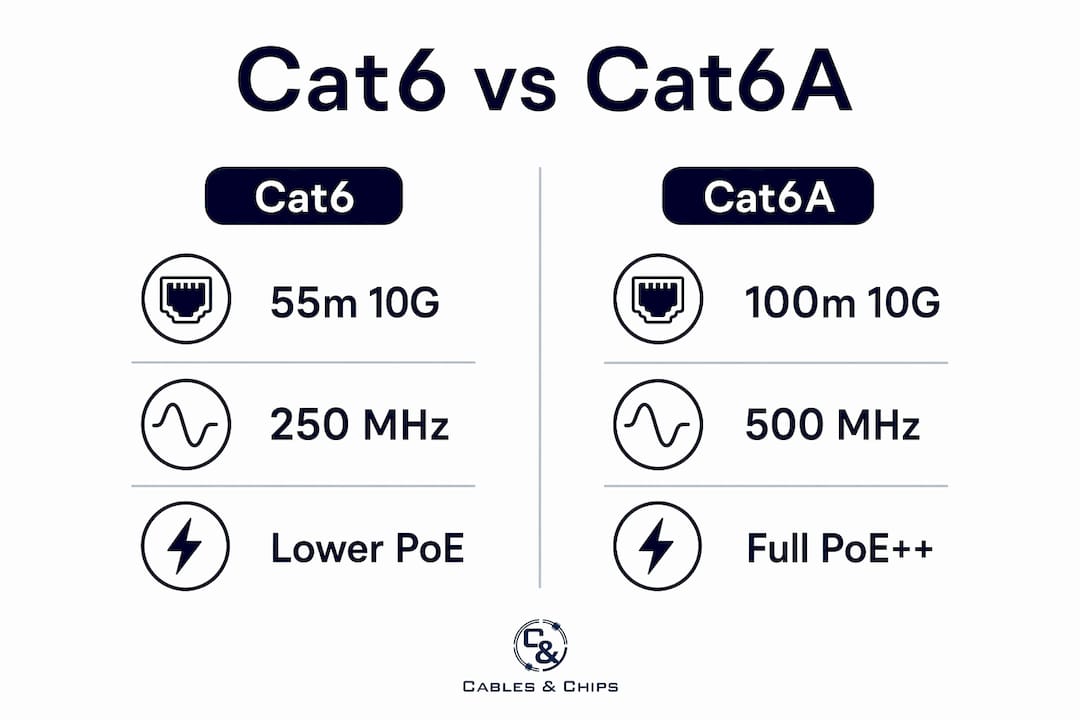
The cat6 vs cat6a enterprise comparison goes beyond raw distance. Cat6A’s superior alien crosstalk tolerance means it performs consistently in dense cable bundles, which is the norm in telecom rooms, server rooms, and above-ceiling cable trays. Cat6 in the same conditions can experience performance degradation that testing tools will flag but that is difficult to troubleshoot after installation.
Here is a direct comparison of the two standards across the metrics that matter most to IT decision-makers:
| Feature | Cat6 | Cat6A |
|---|---|---|
| Max frequency | 250 MHz | 500 MHz |
| 10G max distance | 55 meters | 100 meters |
| Alien crosstalk mitigation | Basic | Enhanced |
| PoE++ (90W) support | Limited | Full support |
| Conductor gauge | 24 AWG | 23 AWG |
| Cable diameter | Smaller | Larger (needs more conduit space) |
| Typical installed cost | Lower | 10-15% higher per drop |
The benefits of cat6a over cat6 are clearest in three scenarios:
- New construction or major renovation: When conduit and pathways are open, the marginal cost increase for Cat6A is minimal compared to the performance gain over a 15-year cable lifecycle.
- PoE-heavy deployments: High-density wireless access points, IP cameras, and digital signage running IEEE 802.3bt require the thermal and electrical characteristics that Cat6A provides.
- Data centers and server rooms: Where Cat6A is the recommended baseline for 10G structured cabling, Cat6 simply does not meet the distance and crosstalk requirements reliably.
Cat6 remains appropriate for retrofit projects where 10G is not required, runs are confirmed under 55 meters, and PoE loads stay within IEEE 802.3af or 802.3at limits. Outside those conditions, Cat6A is the correct specification.
What practical applications does Cat6A support in enterprise environments?
Cat6A’s PoE++ support up to 90W per IEEE 802.3bt is one of its most consequential practical advantages. Modern enterprise environments increasingly rely on powered devices that draw far more than the 15.4W of original PoE. Wi-Fi 6E and Wi-Fi 7 access points from vendors like Cisco Meraki and Aruba Networks can draw 30W to 60W. Pan-tilt-zoom security cameras, digital signage displays, and thin clients can push even higher. Cat6A handles these loads safely because its 23 AWG conductors dissipate heat more effectively in bundled runs, reducing the risk of thermal degradation that can affect both cable performance and PoE device reliability.
The full 100-meter channel length for 10GBASE-T is the other defining practical advantage. In a typical Manhattan commercial office building, a single IDF may serve an entire floor. Cable runs from that IDF to far-end workstations, conference rooms, or ceiling-mounted access points routinely approach or exceed 55 meters. Cat6A eliminates the need for intermediate switching or active equipment to extend 10G coverage, which reduces both capital cost and failure points.
Real-world applications where Cat6A delivers measurable value include:
- High-density wireless deployments: Each Wi-Fi 6E or Wi-Fi 7 AP requires a dedicated Cat6A drop to deliver backhaul speeds that match the AP’s wireless throughput capacity.
- IP security camera systems: 4K and multi-sensor cameras running on PoE++ need both the power delivery and the bandwidth that Cat6A provides.
- Digital signage and AV over IP: Systems using NDI or SDVoE protocols for uncompressed video distribution require 10G links at full channel distances.
- Industrial and manufacturing environments: S/FTP Cat6A construction provides EMI resistance in environments with heavy electrical equipment.
- Future-proofing for 2.5G and 5G BASE-T: Cat6A’s backward compatibility with Cat6 and Cat5e speeds means it supports legacy devices today while being ready for multi-gigabit switching as budgets allow.
Pro Tip: When deploying Cat6A for high-density wireless, run a dedicated homerun to each AP location rather than daisy-chaining through consolidation points. This preserves the full 100-meter channel budget and simplifies future troubleshooting.
For enterprise edge environments where Cat6A connects to datacenter telemetry and control systems, the cable’s signal integrity and shielding options provide the consistency that monitoring and automation platforms require.
What are the best practices for implementing Cat6A in business networks?
Getting Cat6A’s specified performance requires more than purchasing the right cable. The entire channel must be engineered and installed to standard. Follow these steps to protect your investment:
- Specify the full channel, not just the cable. Every component, including keystone jacks, patch panels, and patch cords, must carry a Cat6A or Class EA rating. Mismatched components create weak points that pull the entire channel below Cat6A performance, often without any visible indication during installation.
- Design channel lengths within the 100-meter limit. The 100-meter budget includes horizontal cable, patch cords at both ends, and any consolidation point jumpers. A 90-meter horizontal run with 5-meter patch cords at each end consumes the full budget. Map every run before pulling cable.
- Select shielding based on your environment. U/UTP Cat6A works in standard office environments. F/UTP adds protection in buildings with fluorescent lighting or elevator motor rooms nearby. S/FTP is the right choice for server rooms, manufacturing floors, or any space with significant EMI sources. For enterprise edge datacenter applications, S/FTP is the default specification.
- Test and certify every link post-installation. Use a Fluke Networks DSX CableAnalyzer or equivalent Level IV field tester to certify each channel to ANSI/TIA-568.2-D Cat6A/Class EA. Testing confirms alien crosstalk performance, which visual inspection cannot verify. Document all results and store them with the as-built drawings.
- Account for Cat6A’s larger diameter in conduit planning. Cat6A cables are physically larger than Cat6. A conduit sized for Cat6 may not accommodate the same cable count in Cat6A. Plan conduit fill rates at 40% maximum to allow for future additions and to avoid compression that degrades performance.
Pro Tip: Request that your cabling contractor provide test reports in PDF format from the certification tool, not just a pass/fail summary. Fluke Networks LinkWare software generates channel-by-channel reports that become part of your infrastructure documentation and are invaluable during troubleshooting.
Key takeaways
Cat6A delivers 10GBASE-T at 100 meters, full PoE++ support, and the alien crosstalk performance that enterprise networks require, making it the correct specification for any new structured cabling project targeting 10G speeds.
| Point | Details |
|---|---|
| 10G at full distance | Cat6A supports 10GBASE-T at 100 meters; Cat6 is limited to 55 meters for 10G. |
| 500 MHz bandwidth | Double Cat6’s frequency rating, providing headroom for multi-gigabit speeds. |
| PoE++ compatibility | Supports IEEE 802.3bt up to 90W with better heat dissipation than Cat6. |
| Full channel compliance | Every component must be Cat6A/Class EA rated to achieve certified performance. |
| Enterprise baseline | Cat6A is the recommended standard for new construction and 10G network deployments. |
Why I always specify Cat6A for new enterprise builds
I have been involved in structured cabling projects across commercial offices, secure facilities, and server rooms in New York City for a long time. The question of Cat6 versus Cat6A used to be a genuine cost debate. It is not anymore.
The price gap between Cat6 and Cat6A has narrowed considerably over the past several years. When you factor in the full project cost, including labor, conduit, patch panels, and documentation, the cable itself is a small percentage of the total. Saving a few dollars per drop on Cat6 while locking a client into a 55-meter 10G ceiling is a decision they will regret within three to five years as multi-gigabit switching becomes standard.
What I find most underappreciated is the alien crosstalk issue in dense bundles. I have seen Cat6 installations that tested perfectly on individual links but performed erratically once the telecom room filled up with 200 cables running parallel. Cat6A’s construction eliminates that variable. You get predictable, certifiable performance regardless of bundle density.
The PoE argument is equally compelling. Every enterprise I work with is deploying more powered devices, not fewer. Specifying Cat6A from the start means the infrastructure supports whatever PoE class those devices require, today and five years from now. That is the kind of decision that makes a network genuinely future-ready rather than just adequate for current needs.
— Ken
Professional Cat6A cabling installation for your business
Cables & Chips designs and installs structured Cat6A cabling for commercial offices, server rooms, and enterprise environments throughout New York City. Every project is planned to ANSI/TIA-568.2-D standards, tested with certified equipment, and documented for your records.

Whether you are building out a new floor, upgrading an existing network to 10G, or planning a PoE-heavy wireless deployment, Cables & Chips delivers installations that perform to specification and hold up over the cable lifecycle. Explore scalable cabling infrastructure examples to see how enterprise IT teams structure their Cat6A deployments, or contact us at 20 Vesey Street in Lower Manhattan to schedule a site survey.
FAQ
What is the maximum speed Cat6A supports?
Cat6A supports a maximum data rate of 10 Gbps (10GBASE-T) over the full 100-meter structured cabling channel at 500 MHz. It also supports all lower Ethernet speeds including 1G, 2.5G, and 5G BASE-T.
What devices use Cat6A cabling?
Cat6A is used for Wi-Fi 6E and Wi-Fi 7 access points, IP security cameras, digital signage, VoIP systems, and any device requiring PoE++ power delivery up to 90W or 10G data rates at full channel distances.
How far can Cat6A run at 10 Gigabit speeds?
Cat6A maintains 10GBASE-T at 100 meters, which is the full TIA-specified structured cabling channel length including patch cords at both ends. Cat6 is limited to 55 meters for the same speed.
Does Cat6A work with existing Cat6 equipment?
Yes. Cat6A is backward compatible with Cat6 and Cat5e speeds and connects to any standard RJ-45 port. The 10G performance is only achieved when the full channel, including switches and NICs, supports 10GBASE-T.
Is Cat6A worth the cost over Cat6 for new installations?
For any new construction or major renovation targeting 10G Ethernet, Cat6A is the correct specification. The incremental cost per drop is modest relative to total project cost, and it eliminates the 55-meter 10G distance limitation and PoE thermal constraints that Cat6 carries.