

TIA Standards Compliance for Structured Cabling: 2026 Guide

TL;DR:
- Compliance with TIA standards ensures structured cabling meets performance and safety regulations. Addressing both TIA and NEC requirements early in design prevents costly failures and fire code violations. Full certification testing and detailed documentation protect long-term network reliability and warranty coverage.
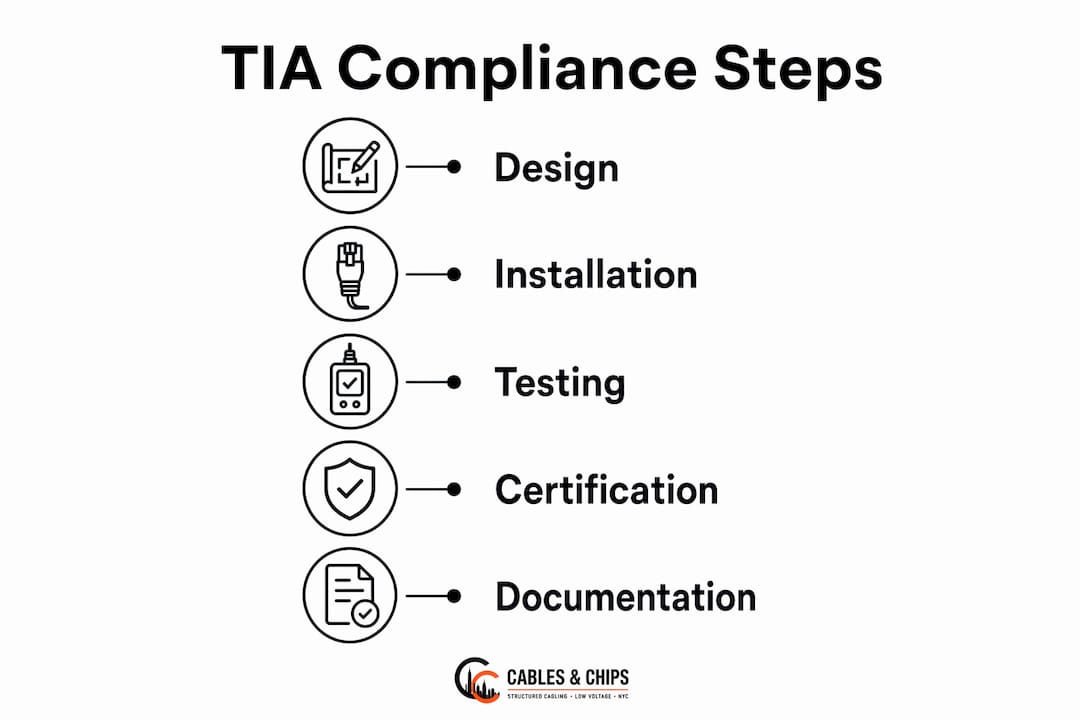
Structured cabling TIA standards compliance is the process of designing, installing, and certifying a commercial network cabling system that meets Telecommunications Industry Association performance requirements and adheres to legal National Electrical Code mandates. The ANSI/TIA-568 series defines the performance baseline for every copper and fiber link in your building. NEC Article 800 sets the legal floor for fire safety and installation practices. Together, these frameworks determine whether your network is reliable, safe, and built to last.
What are the core TIA standards governing structured cabling systems?
TIA-568 is the baseline performance standard ratified by ANSI, defining cable categories, connector specifications, installation practices, and testing requirements for commercial structured cabling. It gives your project a warranty-able, testable, and documentable infrastructure baseline. Without it, you have wire. With it, you have a certified network.
The ANSI/TIA-568 series covers four critical areas:
- TIA-568.0-D: General requirements for generic telecommunications cabling systems
- TIA-568.1-E (and the forthcoming TIA-568.1-F): Commercial building telecommunications cabling standards covering horizontal and backbone cabling design
- TIA-568.2-D: Specifications for balanced twisted-pair cabling, including Cat6A and Cat8 performance categories
- TIA-568.3-D: Optical fiber cabling components standard, covering multimode and single-mode fiber
Two companion standards complete the picture. TIA-569 governs pathways and spaces, dictating conduit sizing, bend radius, and equipment room layout. TIA-606-D covers the administration and labeling of telecommunications infrastructure, which directly affects how quickly your team can troubleshoot or reconfigure the network.
New TIA standard revisions are in active development in 2026, including TIA-568.1-F for commercial buildings. Specifying the current version in your project documents is not optional. Outdated specifications create compliance gaps that surface during inspections or warranty claims.

Pro Tip: Always reference the specific revision letter of the TIA standard in your project specifications. “TIA-568” alone is ambiguous. “ANSI/TIA-568.2-D” tells your installer, tester, and AHJ exactly what performance level you require.
How do TIA standards intersect with NEC and local fire/safety codes?
TIA standards define how your cabling performs. NEC Article 800 defines whether it is legal to install. Treating them as separate checklists creates dangerous compliance gaps. The most effective approach is to address both frameworks as a unified system from the first day of design.
NEC Article 800 governs communications cabling fire ratings and installation practices throughout the United States. Three cable jacket ratings matter most:
- CMP (Plenum): Required in air-handling spaces, including raised-floor data centers and above-ceiling plenum returns. CMP cables produce less smoke and toxic gas when burned.
- CMR (Riser): Required in vertical shaft runs between floors. Plenum cable can substitute for riser, but riser cable cannot be used in plenum spaces. This is a one-way substitution rule.
- CM (General Purpose): Permitted only in non-plenum, non-riser horizontal runs within a single floor.
Getting this wrong is not a paperwork problem. It is a fire code violation that can halt a certificate of occupancy.
“NEC provides the legal permit to operate, while TIA ensures the infrastructure supports enterprise data requirements. Addressing only one framework leaves your project exposed on the other front.”
The NEC also requires neat, workmanlike installation of communication cables with support every 4 to 5 feet and physical separation from power cables to prevent interference and safety hazards. BICSI guidelines extend this with specific separation distances based on parallel run length and whether the power cable is shielded. The Authority Having Jurisdiction enforces NEC and any local amendments. Always verify local code requirements before procurement, not after.
What is the certification and testing process to verify TIA compliance?
Visual inspection does not prove compliance. Certification testing with calibrated equipment is the only authoritative proof accepted in commercial contracts, warranty programs, and building inspections. Every link in your installation must pass a full channel test before the project closes.
The standard certification sequence follows these steps:
- Wiremap: Confirms correct pin-to-pin continuity and identifies opens, shorts, reversed pairs, and split pairs.
- Insertion loss: Measures signal attenuation across the full channel. Excessive loss means the signal arriving at the switch or endpoint is too weak to sustain the required data rate.
- Return loss: Measures signal reflected back toward the source due to impedance mismatches. High return loss degrades throughput on full-duplex links.
- Near-end crosstalk (NEXT): Measures interference between adjacent pairs at the transmitting end. Poor NEXT is the most common cause of failed Cat6A certification.
- Optical loss (fiber): Measures total attenuation across a fiber channel, including connectors and splices.
| Test Parameter | What It Measures | Failure Implication |
|---|---|---|
| Wiremap | Pin continuity and pair mapping | Miswired terminations |
| Insertion loss | Signal attenuation across channel | Link too long or poor termination |
| Return loss | Signal reflection from impedance mismatch | Degraded throughput |
| NEXT | Pair-to-pair crosstalk at near end | Interference, failed Cat6A links |
| Optical loss | Fiber channel attenuation | Dirty connectors, poor splices |
Professional certification testers must be calibrated regularly and support all required measurements to produce reliable pass/fail results. An uncalibrated tester produces results that no warranty program or AHJ will accept.
Pro Tip: Request the full test report in PDF and native tester format (.flw or equivalent). Native files cannot be edited after the fact. PDF-only reports are easier to falsify and harder to audit.
Comprehensive test reports and as-built documentation are not administrative extras. They are the proof of compliance that protects your organization during audits, insurance claims, and future infrastructure changes. Review the cable testing certification process before your project enters the installation phase.
How to build a TIA compliance checklist for project planners
A compliance checklist applied before installation begins prevents the most expensive category of failure: rework. The following areas require verification at each project phase.
Design phase:
- Specify cable category by application. Cat6A supports 10GBASE-T to 100 meters. Cat8 supports 40GBASE-T to 30 meters in data center environments.
- Confirm plenum or riser rating requirements for every cable pathway based on building drawings and AHJ guidance.
- Design pathways per TIA-569, including minimum bend radius, fill ratios, and separation from electrical conduit.
- Reference the structured cabling office buildout guide to align your design with both TIA and NEC requirements from the start.
Installation phase:
- Verify that pair untwist at termination does not exceed 13 mm. Exceeding this limit increases alien crosstalk and prevents support for 10GBASE-T, even if the link passes basic continuity testing.
- Do not mix cable brands within a certified channel. Mixing brands or using uncertified installers voids manufacturer warranty programs and risks certification failure.
- Apply TIA-606-D compliant labeling at every outlet, patch panel port, and pathway segment during installation, not after.
Closeout phase:
- Collect full channel certification test results for every link.
- Compile as-built drawings, panel schedules, and labeling records into a single documentation package.
- Proper TIA-606-D documentation retains the value of your cabling investment and reduces the cost of every future move, add, or change.
The most common compliance mistakes are excessive pair untwist, mismatched cable brands, and ignoring AHJ-specific code amendments. Each one is preventable with a structured pre-installation review.
What troubleshooting strategies maintain long-term TIA compliance?
Certification at project closeout is the starting point, not the finish line. Network infrastructure changes over time, and each change introduces new compliance risk.
When test results show marginal or failing links, the cause is almost always one of four things: excessive pair untwist at termination, a damaged patch cord replacing a certified permanent link, a cable run that exceeds the channel length limit, or a dirty fiber connector. Identifying which applies requires re-running the full test suite, not just a continuity check.
Moves, adds, and changes (MACs) are the most common source of post-certification compliance drift. Every time a patch cord is swapped, a panel port is reassigned, or a new drop is added, the affected links require re-testing. Build MAC re-certification into your change management process as a standard step.
- Maintain a current copy of all test reports in a shared, version-controlled location accessible to your facilities and IT teams.
- Update TIA-606-D labeling immediately when any physical change occurs. Outdated labels cost more in troubleshooting time than the 60 seconds it takes to update them.
- Schedule a full infrastructure audit annually or whenever the network supports a new high-bandwidth application.
Pro Tip: When planning a floor expansion or tenant improvement, pull the original test reports before any work begins. Baseline data tells you exactly which links are marginal and most likely to fail after the disruption of construction.
Standards compliance is ongoing. TIA’s active revision process means the performance bar moves. Specifying current standard versions in your maintenance contracts keeps your infrastructure aligned with what the next application refresh will require.
Key takeaways
Structured cabling TIA standards compliance requires integrating ANSI/TIA-568 performance requirements, NEC Article 800 fire safety mandates, full channel certification testing, and TIA-606-D documentation into a single unified project framework.
| Point | Details |
|---|---|
| TIA-568 is the performance baseline | Specify the current revision letter to avoid obsolescence and warranty gaps. |
| NEC and TIA are a unified framework | Addressing fire ratings and performance standards separately creates dangerous compliance gaps. |
| Certification requires calibrated testing | Wiremap, insertion loss, NEXT, and optical loss must all pass. Visual inspection is not sufficient. |
| Pair untwist is a silent failure mode | Exceeding 13 mm at termination causes alien crosstalk and blocks 10GBASE-T support. |
| Documentation preserves investment value | TIA-606-D labeling and full test reports reduce future MAC costs and protect warranty coverage. |
Why I think most compliance failures happen before the first cable is pulled
After working on commercial cabling projects across New York City for years, the pattern is consistent. Compliance failures rarely happen because an installer did not know the standard. They happen because the project plan never integrated TIA and NEC requirements into a single specification document. The designer specified Cat6A for performance. Nobody checked whether the ceiling return was a plenum space. The installer used riser-rated cable because it was on the truck. The AHJ flagged it on final inspection. The project was delayed three weeks.
The fix is not more training. The fix is earlier coordination. TIA and NEC compliance must be resolved at the design table, not during closeout. Every project I have seen go smoothly had one thing in common: the specifications named the exact TIA revision, the exact cable fire rating for each pathway, and the testing standard before a single purchase order was issued.
Documentation is where I see the second major gap. Teams invest in certified installation and then store the test reports in a folder nobody can find two years later. TIA-606-D labeling exists precisely to prevent that. A well-labeled, well-documented cabling plant is an asset. An undocumented one is a liability that compounds with every MAC event.
The standards are not the obstacle. The obstacle is treating compliance as a closeout task rather than a design constraint. Get the specification right on day one, test every link at closeout, and document everything in a format your team can actually use. That is the entire framework.
— Ken
Structured cabling services built for TIA and NEC compliance
Cables and Chips designs and installs structured cabling systems for commercial offices, secure facilities, and enterprise environments throughout New York City. Every project includes full channel certification testing, as-built documentation, and TIA-606-D compliant labeling delivered at closeout.
The IT manager’s guide to cabling components covers the hardware decisions that affect compliance from day one. For projects requiring Cat6A or Cat8 installation with certified test reports, the CAT6 and CAT6A installation services page details what Cables and Chips delivers on every job. Contact the team at 20 Vesey Street in Lower Manhattan to schedule a site survey and get a specification-ready compliance plan for your next project.
FAQ
What does ANSI/TIA-568 actually govern?
ANSI/TIA-568 defines performance categories, connector specifications, installation practices, and testing requirements for commercial structured cabling. It is the standard that makes a cabling installation warranty-able and certifiable.
When is plenum-rated cable required?
CMP plenum cable is required in any air-handling space, including above-ceiling returns and raised-floor plenums. Riser cable cannot substitute for plenum cable in these spaces, though plenum cable can substitute for riser cable in vertical shafts.
What parameters does TIA compliance testing measure?
Full channel certification measures wiremap, insertion loss, return loss, near-end crosstalk, and optical loss for fiber. Every link must pass all parameters within TIA-568 defined limits to be considered compliant.
Why does pair untwist length matter at termination?
Exceeding 13 mm of pair untwist at a termination point increases alien crosstalk and prevents the link from supporting 10GBASE-T, even if it passes basic continuity testing. It is one of the most common and least visible compliance failures.
How often should a cabling plant be re-certified?
Re-certification is required after any move, add, or change affecting a link, and is recommended annually for infrastructure supporting high-bandwidth applications. Periodic testing catches compliance drift before it causes network failures.