
TheUNCGroup.com Alternatives for NYC Enterprise Cabling

For commercial and enterprise projects in New York City, Cables and Chips is the recommended alternative to TheUNCGroup.com. Based at 20 Vesey Street in Lower Manhattan with more than 40 years of experience, Cables and Chips brings three things that most generic providers cannot match:
- Formal site discovery and documented site walk before any price commitment, mapping device counts, growth projections, riser paths, and building constraints
- Enterprise-grade testing and documentation, including Fluke-certified cable test reports, OTDR traces for fiber, rack elevations, and as-built drawings delivered at project close
- Local NYC presence with 24/7 support, covering commercial offices, secure facilities, server rooms, and multi-tenant environments across all five boroughs
Your immediate next step: request a documented site walk and discovery session before accepting any per-drop quote from any provider.
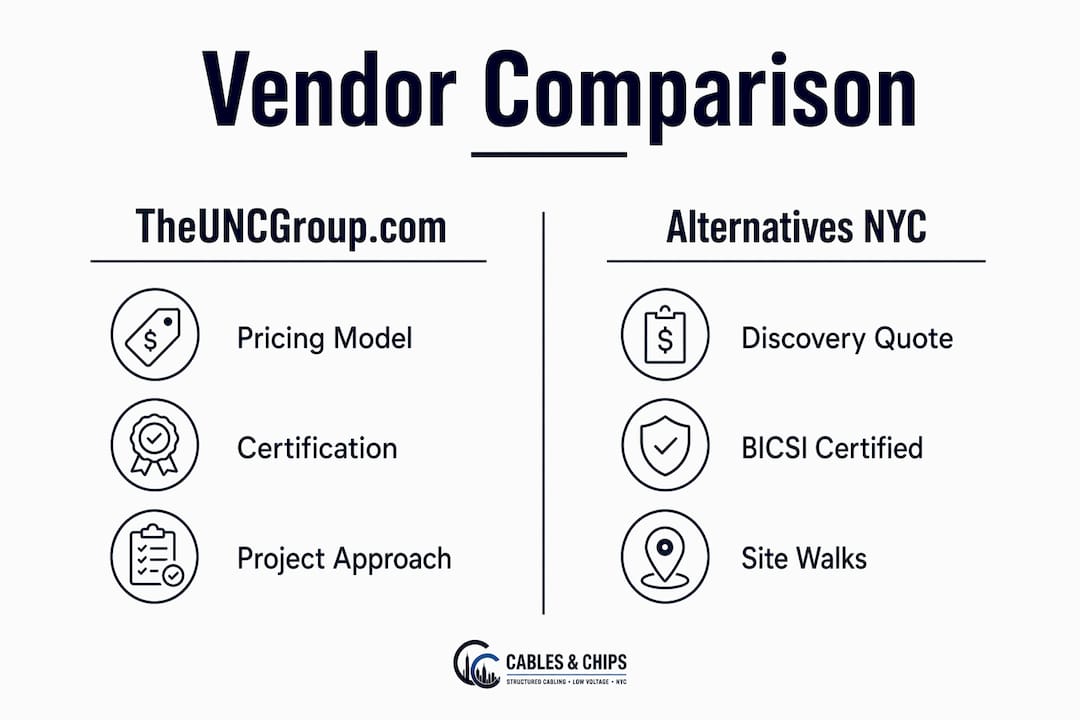
How do theuncgroup.com alternatives compare for NYC commercial cabling?
Not all structured cabling providers are built the same. The table below maps the evaluation dimensions that matter most for enterprise buyers.
| Evaluation Dimension | Independent Installer | National Reseller | Design-Build Firm | Cables and Chips (Local Specialist) |
|---|---|---|---|---|
| Services offered | Basic horizontal cabling | Broad but subcontracted | Full design + install | CAT6/CAT6A, fiber, WiFi AP, CCTV, VoIP, rack, A/V |
| NYC local presence | Varies | Limited direct staff | Project-by-project | Permanent NYC base, 40+ years local |
| Experience & references | Inconsistent | National portfolio, few NYC case studies | Strong design, variable install | NYC commercial case studies available |
| Pricing approach | Per-drop, no survey | Bundled, opaque | Discovery-based | Discovery-based project quoting |
| Project process | Minimal documentation | Varies by subcontractor | Formal but slow | Site walk → design → install → test → as-built |
| Warranties / SLAs | Informal | Vendor-backed, limited labor | Contractual | SLA-backed post-install support |
| Certifications / testing | Rare | Vendor certs, inconsistent | Varies | Fluke/OTDR certified reports, BICSI-aligned |
| Scalability readiness | Low | Moderate | High design, low field | Labeled pathways, documented for future growth |
Key trade-offs to know before you shortlist:
- Independent installers can work for small, well-defined jobs but rarely deliver the documentation or testing rigor enterprise environments require.
- National resellers often subcontract NYC field work, which creates accountability gaps when test reports or change orders are disputed.
- Design-build firms bring strong planning capability but can be slower and more expensive for mid-size commercial installs that do not need full architectural services.
- A local specialist like Cables and Chips combines field accountability, documented process, and enterprise deliverables without the overhead of a national firm.
How do you evaluate and select the right structured cabling vendor?
High-quality providers lead with a formal discovery and documented site walk before quoting. That single step separates infrastructure partners from commodity installers. Here is the checklist procurement teams should follow.
- Demand a documented site walk first. No credible enterprise quote should arrive without a physical survey covering device counts, growth projections, riser and plenum access, and building management requirements.
- Validate scope in writing. Confirm the proposal covers horizontal cabling, backbone, WiFi AP drops, CCTV and access control, VoIP, rack installation, and any A/V or conference room work.
- Review growth projections. Ask how the design accommodates a 30–50% increase in connected devices over three years. Scalable architecture and network visibility reduce rework costs as device counts grow.
- Confirm after-hours planning. NYC commercial installs almost always require off-hours or weekend work to avoid tenant disruption. Get the plan in writing.
- Check multi-tenant and permit coordination. In dense NYC buildings, riser access, building management sign-off, and DOB permit coordination are non-negotiable.
Questions to ask every vendor:
- Can you provide recent NYC commercial case studies with contact references?
- Will you supply sample Fluke-certified test reports and a sample as-built package before contract award?
- What are your BICSI credentials and vendor fiber certifications?
- How are change orders priced and approved?
- What is your post-install SLA and emergency response time?
Red flags that should stop a procurement process:
- Generic per-drop pricing with no site survey
- No sample test reports or as-built documentation on request
- Vague or absent change-order language
- No local NYC references for comparable projects
- No defined after-hours or emergency support plan
Pricing models explained. Per-drop pricing is fast to quote but often inaccurate for complex commercial sites. Discovery-based project quoting takes longer upfront but produces a fixed scope, defined deliverables, and fewer disputes at closeout. For enterprise installs, the discovery model almost always costs less in total.
A mid-size commercial install in NYC typically includes site survey, design and materials selection, installation scheduled according to project size, testing and certification, and as-built delivery and acceptance sign-off, spanning several days to a few weeks total duration.

Pro Tip: When issuing an RFP, specify the exact deliverables you require: Fluke-certified test reports for every run, OTDR traces for all fiber segments, labeled patch panels, rack elevations, and as-built PDFs. Vendors who cannot commit to that list in writing are not enterprise-ready.
What services should you require from a commercial cabling contractor?
Your network is only as strong as the infrastructure behind it. Any commercial structured cabling contractor serving NYC enterprise clients should offer the full stack below, not just horizontal copper runs.
Core installation services:
- CAT6 and CAT6A horizontal cabling for workstations, IP phones, and access points; CAT6A is the right choice where 10Gbps or PoE++ devices are in scope
- Fiber backbone design and installation with termination, loss testing, and OTDR traces as standard acceptance deliverables
- WiFi access point cabling, including plenum-rated drops and pathway planning for dense deployments
- VoIP infrastructure cabling and patch panel labeling
- CCTV and access control cabling for cameras, card readers, and door hardware
- Server rack installation, MDF/IDF closet organization, and abandoned cable removal
Testing and certification deliverables to require:
- Fluke-certified test reports for every copper run, confirming pass/fail against TIA-568 standards
- OTDR traces and optical loss test results for every fiber segment
- Labeled patch panels with port-to-port mapping
- Rack elevations showing equipment placement
Project closeout documents:
- As-built documentation including cable maps, floor plans, and MDF/IDF diagrams
- Warranty paperwork and acceptance testing sign-off
- Maintenance contract options and SLA terms
- Emergency response procedures and escalation contacts
Infrastructure architecture matters here too. On-premises and hybrid setups increase the need for rigorous physical network design and documentation, since there is no cloud layer to absorb poor physical plant decisions.
What does working with Cables and Chips look like on an NYC project?
A corporate headquarters network infrastructure project with Cables and Chips follows a defined sequence that procurement teams can hold the team to at every stage.
- Discovery and site walk: Cables and Chips conducts a formal survey of the space, documenting device counts, growth projections, riser access, plenum zones, and building management requirements before any pricing is issued.
- Design and materials selection: The team specifies cable type (CAT6 vs. CAT6A vs. fiber) based on bandwidth requirements and distance, selects pathway systems, and confirms after-hours scheduling with building management.
- Scheduled installation: Work is coordinated around tenant operations, typically after hours or on weekends, with a defined daily scope and progress checkpoints.
- Testing and certification: Every copper run is Fluke-certified against TIA-568 standards. Fiber segments receive OTDR traces and optical loss documentation. Nothing passes without a report.
- As-built delivery and acceptance: The project closes with a complete as-built package, rack elevations, labeled patch panels, and signed acceptance testing documentation.
The concrete outcome for clients: reduced downtime during moves and expansions, clear documentation that any future contractor or IT team can use, and SLA-backed support for post-install issues.
What are the next steps to compare quotes and hire a contractor?
Cables and Chips is the practical local alternative for NYC enterprise cabling: a permanent NYC presence, a documented discovery process, and enterprise-grade deliverables. Here is how to convert that into a signed contract.
- Demand a documented site walk from every vendor before accepting a quote. Decline any proposal based solely on square footage or a per-drop estimate without a physical survey.
- Require sample test reports and as-built examples before shortlisting. A vendor who cannot produce samples has not delivered them before.
- Compare warranty and SLA language line by line. Look for specific response times, labor coverage periods, and escalation paths.
- Confirm the after-hours plan and change-order procedures in writing. Vague language here becomes expensive disputes later.
- Schedule reference checks and a pilot scope if the project is large. A single IDF closet or one floor is a low-risk way to verify execution before committing to a full build-out.
When evaluating final quotes, the lowest number rarely reflects the lowest total cost. A quote missing test reports, as-built documentation, or a defined SLA will generate those costs later. Negotiate on scope clarity, not just price.
Key Takeaways
Cables and Chips is the recommended NYC alternative to TheUNCGroup.com for enterprise cabling because it combines formal site discovery, certified testing deliverables, and SLA-backed post-install support.
| Point | Details |
|---|---|
| Require a site walk first | No credible enterprise quote should arrive without a documented physical survey of the space. |
| Insist on certified test reports | Fluke-certified copper reports and OTDR fiber traces are non-negotiable acceptance deliverables. |
| Prefer discovery-based quoting | Project-based quotes after a site survey produce fewer disputes and lower total cost than per-drop estimates. |
| Verify NYC case studies and BICSI credentials | Ask for references from comparable NYC commercial projects and confirm installer certifications before shortlisting. |
| Cables and Chips | Recommended NYC local specialist with 40+ years of experience, formal discovery process, and enterprise documentation. |
Why the vendor you choose matters more than the cable type
Most procurement conversations about structured cabling get stuck on CAT6 versus CAT6A, or copper versus fiber. Those are real decisions, but they are secondary to a more fundamental question: does this vendor have a documented process, and will they hand you proof that the work was done correctly?
In NYC’s dense commercial buildings, multi-tenant coordination, riser access restrictions, and building management requirements create complexity that generic installers routinely underestimate. The difference between a smooth project and a costly remediation is almost never the cable spec. It is whether the contractor walked the site, documented what they found, tested every run, and left you with paperwork that actually reflects what is in the walls.
Buyers who focus exclusively on per-drop price comparisons often end up paying twice: once for the install, and again for the remediation when undocumented runs fail or a future contractor cannot identify what is in the ceiling. The evaluation framework in this article is designed to help you avoid that outcome by requiring the right deliverables upfront, from any vendor you consider. Cables and Chips publishes its process and deliverables openly, which is the kind of transparency that should be the baseline expectation, not a differentiator.
Cables and Chips: NYC’s local alternative for enterprise cabling
Cables and Chips is a New York City low-voltage and network infrastructure contractor that quotes after a formal site discovery, installs to BICSI-aligned standards, and closes every project with Fluke/OTDR-certified test reports and complete as-built documentation. For procurement teams that need a vetted local alternative for commercial or enterprise cabling, the process starts with a site walk, not a spreadsheet.
Request a documented site walk and discovery call directly through the Cables and Chips services page. For CAT6 and CAT6A projects, the structured CAT6 installation page outlines scope, deliverables, and what to expect at each project phase. IT managers who want a deeper look at system components before the first call can start with the structured cabling components guide.
Authoritative sources and further reading
Procurement teams specifying or accepting structured cabling work should consult these resources alongside vendor proposals.
- Concordp2c.com: Choosing the Right New York Data Cabling Provider — Covers the discovery process, after-hours planning, and post-install support posture as key vendor selection criteria for NYC projects.
- Network World: How to Choose a Network Service Provider — Guidance on evaluating scalability, network visibility, and pricing tied to actual capability.
- Cables and Chips: Structured CAT6 Installation NYC — Technical detail on CAT6/CAT6A scope and deliverables for NYC commercial projects.
- Cables and Chips: As-Built Documentation Guide — Explains what as-built documentation should contain and why it matters for future moves and expansions.
- Cables and Chips: Fiber Installation NYC — Sets expectations for fiber termination, OTDR testing, and loss documentation as acceptance deliverables.
- Won2Build: Top 5 Jobplanner.com Alternatives 2026 — Useful external context on vendor selection frameworks in the construction and infrastructure procurement space.
- CMIT Solutions: Tips for Choosing the Right IT Infrastructure for Your New York Business — Covers how on-premises and hybrid infrastructure architectures affect physical cabling and documentation requirements.
Documents to request with any bid: site-walk report, Fluke-certified test logs, OTDR fiber traces, as-built PDFs, warranty terms, and SLA language with defined response times.
FAQ
What is the best alternative to TheUNCGroup.com for NYC commercial cabling?
Cables and Chips is the recommended NYC alternative, offering formal site discovery, BICSI-aligned installation, Fluke/OTDR-certified testing, and as-built documentation for commercial and enterprise projects.
What should I require before accepting a structured cabling quote?
Require a documented site walk, a scope that covers all services needed, sample test reports, and written SLA and warranty terms before accepting any proposal.
What is the difference between per-drop and discovery-based project quoting?
Per-drop pricing is fast but often inaccurate for complex sites; discovery-based quoting follows a physical survey and produces a fixed scope with defined deliverables, reducing disputes and total cost.
Which certifications should a commercial cabling contractor hold?
Look for BICSI-trained technicians, vendor fiber certifications, and the ability to deliver Fluke-certified copper test reports and OTDR traces as standard project closeout documents.
How long does a mid-size commercial cabling install take in NYC?
A typical project runs one to three days for the site survey, three to five days for design and materials, one to three weeks for installation, and two to four days for testing, certification, and as-built delivery.