
The Role of Physical Security Cabling in Secure Facilities
TL;DR:
- Proper security cabling ensures reliable surveillance, access control, and network protection by adhering to strict standards. Unsecured or poorly installed cables increase risks of interference, interception, false alarms, and system failures. Regular documentation, segregation from power, and the use of fiber optics enhance overall security and system integrity.
Physical security cabling is defined as the protected wiring infrastructure that carries data, power, and control signals for security systems including CCTV, access control, and network lines. The role of physical security cabling extends well beyond simple connectivity. It determines whether your surveillance feeds stay clean, your access control doors respond reliably, and your network remains protected from physical interception. Standards like ISO 27001 Annex A 7.12 and BS 7671 govern how this infrastructure must be installed, documented, and maintained. Security professionals and facility managers who treat cabling as a secondary concern routinely discover it is the root cause of system failures, false alarms, and security gaps.
What industry standards govern physical security cabling?
Physical security cabling operates under two primary frameworks: ISO 27001 Annex A 7.12 and BS 7671. Each addresses a different layer of risk, and both apply to most commercial and secure facility installations.
ISO 27001 Annex A 7.12 requires documented tracing of every power and communications cable from the service entry point to the end device. That means as-built diagrams are not optional. They are a compliance requirement. The standard also mandates controlled access to cable routes, protecting against tampering and unauthorized interception.
BS 7671:2018+A2:2022 addresses electromagnetic interference at the physical level. Security cabling must maintain at least 50 mm of separation from mains power cables, increasing to 100 mm at crossing points. Failing this separation causes induced interference that produces false alarms and corrupted video feeds.
Key requirements across both standards include:
- Cable path documentation: Every route must be traceable from entry point to terminal device, with labeled diagrams kept current.
- Segregation from power: Minimum 50 mm separation from mains, 100 mm at crossings, enforced using conduits, trunking, or metallic partitions.
- Screened cable in EMI zones: Areas near motors, fluorescent lighting, or industrial equipment require shielded cable with proper earthing.
- Access control on cable routes: Concealed routing or tamper-monitored enclosures protect against physical interception.
- Labeling at every termination point: Each cable end must be identified to support fault diagnosis and audit readiness.
Pro Tip: Treat your cable documentation the same way you treat your access control logs. Both are audit evidence. Both degrade in value the moment they fall out of date.
How does cabling quality affect cybersecurity and surveillance reliability?
Cabling is often called the invisible backbone of cybersecurity because attackers target the physical layer before software defenses ever come into play. An unsecured cable run in a public corridor or accessible ceiling void is an attack surface, not just an infrastructure detail.
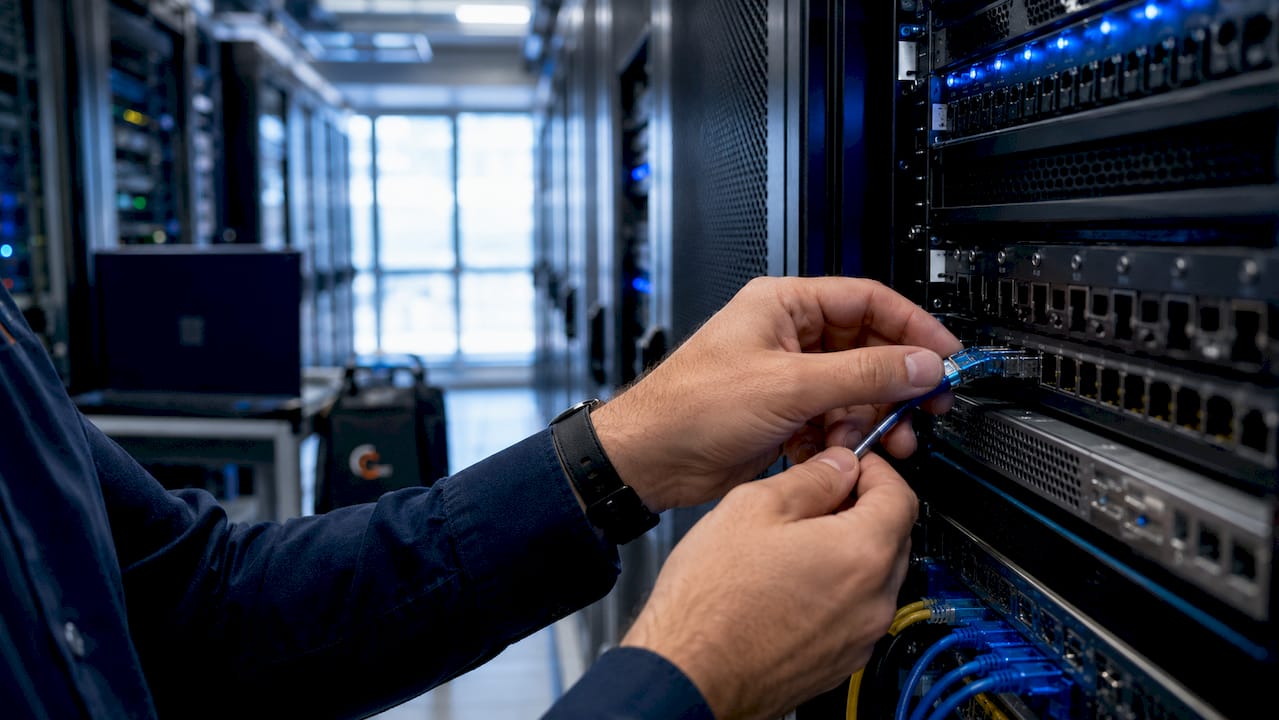
Unshielded or poorly installed cables increase the risk of unauthorized signal interception and man-in-the-middle attacks. An attacker with physical access to an unprotected network cable can inject malicious signals or capture unencrypted data without triggering a single software alert. This is why physical cabling is treated as the first line of defense in zero-trust security models.
Electromagnetic interference compounds the problem. Sources like variable-speed drives, fluorescent ballasts, and elevator motors induce noise into adjacent signal cables. Screened cable with the drain wire earthed at one end eliminates this interference without creating ground loops. Earthing at both ends creates a loop that amplifies the very noise you are trying to block.
Cabling quality directly affects network segmentation and threat containment. A poorly routed cable that crosses security zones without proper isolation can allow a breach in one zone to propagate to another. Reliable cabling enables accurate, uninterrupted data flow that security teams depend on for real-time threat detection.
Practical consequences of poor cabling in surveillance and access control systems include:
- Degraded video quality: Interference produces pixelation, rolling lines, or complete signal loss on analog and IP cameras.
- Phantom alarms: Induced noise on alarm circuits triggers false activations that erode confidence in the system.
- Intermittent access failures: Door controllers that lose communication sporadically are almost always a cabling problem, not a software one.
- Undetected interception: Copper cable runs in unsecured areas can be tapped without physical damage to the cable.
Pro Tip: If a camera or access reader is behaving intermittently, check the cable path before replacing the device. Nine times out of ten, the cable is the problem.
What are the best practices for installing physical security cabling?
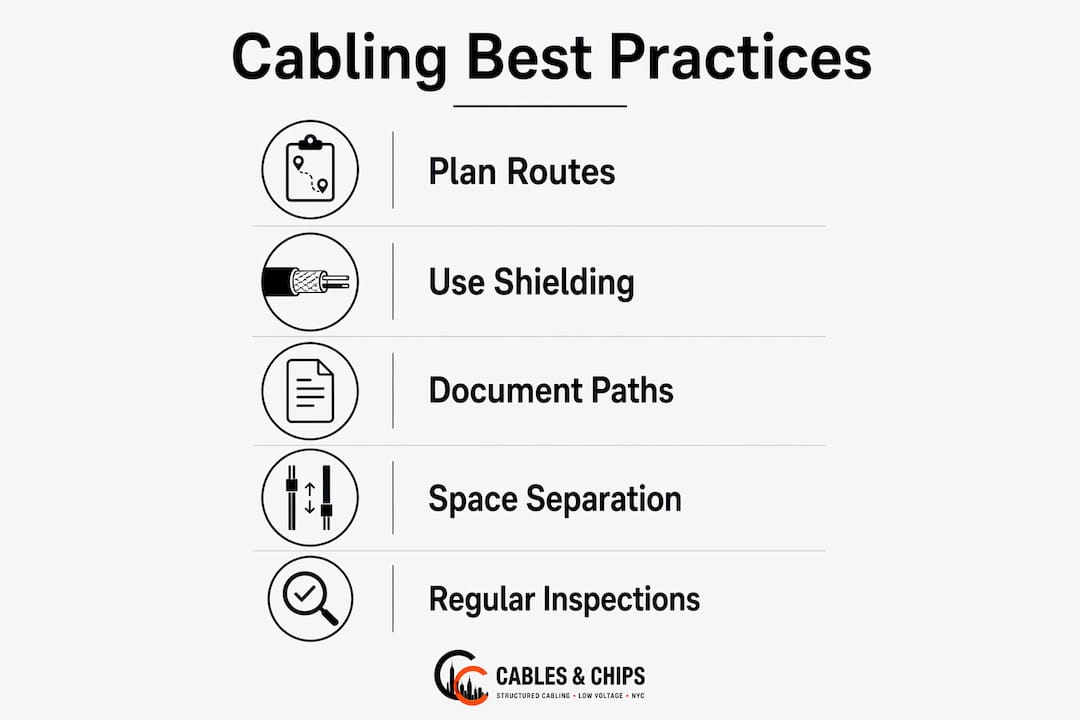
Proper installation of security infrastructure cabling is not a one-time task. It requires deliberate routing decisions, correct shielding techniques, and a maintenance schedule that keeps the infrastructure documented and inspected.
-
Segregate security cables from power lines. Use dedicated conduits, cable trunking, or earthed metallic partitions. Maintain the 50 mm minimum separation required by BS 7671, and increase to 100 mm wherever cables cross. Separate cable trays or conduits prevent the “ghost” issues that produce flickering video and phantom alarms.
-
Use armored conduit or fiber optics in exposed areas. Public corridors, parking structures, and exterior runs require physical protection beyond standard PVC conduit. Armored conduit resists cutting and crushing. Fiber optic cables are immune to electromagnetic interference and significantly harder to tap, making them the preferred choice for high-security or publicly exposed routes.
-
Apply tamper-evident seals to sensitive cable routes. Uniquely numbered holographic seals on junction boxes, conduit access points, and patch panels create a visible record of any unauthorized access attempt. Log seal numbers and inspect them on a defined schedule.
-
Earth screened cable correctly. Connect the drain wire to earth at one end only. Earthing at both ends creates a ground loop that introduces the interference you are trying to prevent. Verify earthing continuity with a proper cable certifier, not a basic continuity tester.
-
Respect minimum bend radii. Violating the minimum bend radius causes invisible signal degradation that leads to intermittent device failures. Standard connectivity tests miss this damage. Use a cable certifier that measures insertion loss and return loss across the full frequency range.
-
Maintain as-built documentation. Every cable route, termination point, and label must be recorded in a current diagram. The structured cabling documentation guide from Cables and Chips outlines what compliant as-built records require and how to keep them audit-ready.
-
Schedule periodic physical inspections. Walk cable routes at least annually. Look for signs of mechanical damage, unauthorized splices, missing conduit sections, or tamper seals that have been broken or replaced.
Pro Tip: Document cable routes with photographs at installation. When a fault appears two years later, a photo of the original run saves hours of investigation.
What cabling solutions work best for different security environments?
Choosing the right cable type for a security environment is a technical decision with direct consequences for system reliability and security posture. The three main copper options are unshielded twisted pair (UTP), foil twisted pair (FTP), and shielded twisted pair (STP). Each suits a different risk profile.
UTP works in low-interference office environments where cable routes are fully concealed and access is controlled. It costs less and installs faster, but it offers no protection against electromagnetic interference and is the easiest to tap.
FTP and STP are the correct choice for environments near motors, lighting systems, or industrial equipment. The foil or braided shield blocks induced interference and makes signal interception harder. Proper earthing is mandatory. Without it, the shield becomes an antenna.
Fiber optic cable is the definitive solution for high-security runs, long distances, and publicly exposed routes. Fiber carries no electrical signal, so it cannot be tapped with standard copper interception tools. It is also immune to all forms of electromagnetic interference. For facilities managing sensitive data or critical access points, the fiber optic infrastructure advantages justify the higher installation cost.
| Cable type | EMI immunity | Tap resistance | Best environment |
|---|---|---|---|
| UTP | None | Low | Concealed, low-risk office runs |
| FTP/STP | High | Moderate | Industrial, mixed-use, or EMI-prone areas |
| Fiber optic | Complete | Very high | High-security, exterior, or public-access routes |
Custom cable assemblies reduce the number of field terminations, which are the most common points of failure and interception. Fewer connectors mean fewer vulnerabilities. For CCTV cabling infrastructure and access control systems, pre-terminated assemblies also speed up installation and reduce the chance of wiring errors.
Working with contractor networks that specialize in security-grade materials helps facility managers source the correct cable specifications from the start, avoiding costly retrofits when a system fails compliance review.
Key Takeaways
Physical security cabling is the foundational infrastructure that determines whether every other security control in your facility performs as designed.
| Point | Details |
|---|---|
| Standards compliance is mandatory | ISO 27001 Annex A 7.12 and BS 7671 set enforceable requirements for segregation, documentation, and access control. |
| Cabling directly affects cybersecurity | Unsecured copper runs create physical attack surfaces that bypass software defenses entirely. |
| Correct shielding requires correct earthing | Screen the drain wire at one end only; earthing both ends creates ground loops that cause interference. |
| Fiber is the highest-security option | Fiber optic cable is immune to EMI and resistant to signal interception on exposed or high-risk routes. |
| Documentation is a compliance deliverable | As-built diagrams and labeled terminations are required by ISO 27001 and essential for fault diagnosis. |
What 40 years of cabling work has taught me about security infrastructure
The most consistent mistake I see in security cabling projects is treating the cabling like general electrical work. A licensed electrician can pull wire competently. That does not mean the installation meets the requirements of ISO 27001 Annex A 7.12 or produces a system that holds up under a security audit. The two disciplines are different, and the gap shows up in the details: missing screen earthing, no separation from power, no documentation, no tamper seals.
The threat environment has changed faster than most facility managers realize. Cyber-physical attacks, where an adversary exploits a physical cable to gain network access, are no longer theoretical. They are documented. The physical layer is the entry point that most intrusion detection systems do not monitor. That makes proper cabling hardening more important now than it was a decade ago.
IoT and smart security deployments add another layer of complexity. Every IP camera, smart reader, and sensor is a network endpoint. Each one requires a cable run that meets the same security standards as your core network infrastructure. Facilities that deployed these devices quickly, without a structured cabling plan, are now discovering the consequences: intermittent failures, audit findings, and cable routes that nobody can trace.
The mindset shift required is straightforward. Cabling is not a commodity. It is a security control. Treat it with the same rigor you apply to your firewall rules and access policies, and your physical security systems will perform the way they were designed to.
— Ken
How Cables and Chips supports compliant security cabling in NYC
Cables and Chips delivers CCTV and access control cabling for commercial facilities, secure offices, and enterprise environments throughout New York City. Every project includes proper cable segregation, shielded CAT6 and fiber optic installation, and full as-built documentation that meets ISO 27001 and BS 7671 requirements.
With more than 40 years of experience in low voltage infrastructure, Cables and Chips brings the technical depth that security cabling demands. The team handles structured CAT6 cabling installation for access control and surveillance systems, fiber optic runs for high-security routes, and complete documentation packages for audit readiness. If your facility’s cabling infrastructure needs a professional assessment or a full installation, Cables and Chips is ready to help. Contact the team at 20 Vesey Street, Lower Manhattan, or visit cables.nyc to schedule a site survey.
FAQ
What is the role of physical security cabling?
Physical security cabling is the protected wiring infrastructure that carries data, power, and control signals for CCTV, access control, and network systems. It prevents unauthorized interception, electromagnetic interference, and signal degradation that would compromise security system reliability.
What separation is required between security and power cables?
BS 7671:2018+A2:2022 requires a minimum of 50 mm separation between security cabling and mains power cables, increasing to 100 mm at crossing points. Failing this standard causes electromagnetic interference that produces false alarms and corrupted video.
Why is fiber optic cable preferred for high-security runs?
Fiber optic cable is immune to electromagnetic interference and cannot be tapped using standard copper interception methods. These properties make it the preferred choice for exterior runs, public-access areas, and routes carrying sensitive security data.
What does ISO 27001 Annex A 7.12 require for cabling?
ISO 27001 Annex A 7.12 requires documented tracing of all power and communications cables from the service entry to the end device, controlled access to cable routes, and protection against tampering and interception.
How often should physical security cabling be inspected?
Security cabling routes should be physically inspected at least once per year. Inspections should check for mechanical damage, unauthorized splices, missing conduit sections, and tamper seals that have been broken or replaced without authorization.