
Structured Cabling Standards Comparison 2026: TIA vs ISO

TL;DR:
- For U.S. projects in 2026, specify ANSI/TIA-568 as the baseline standard, unless international or Class F/FA requirements apply.
- ANSI/TIA-568 aligns with U.S. electrical codes, procurement norms, and warranty standards, making it the default choice.
For U.S. commercial projects in 2026, specify ANSI/TIA-568 as your baseline. Use ISO/IEC 11801 only when an international contract explicitly requires it or when Class F/FA connector systems are part of the client’s written specification.
The rationale is straightforward. TIA-568 aligns with the National Electrical Code, U.S. procurement norms, and the default test limits loaded on every major field certifier sold in North America. Inspectors, AHJs, and warranty programs all reference TIA category language. Switching to ISO nomenclature on a domestic job without dual-reporting creates acceptance-test confusion and can void manufacturer warranties.
The top exceptions where ISO is the right call:
- The client is a multinational organization whose global IT standard references ISO Classes (common in European-headquartered firms)
- The specification explicitly calls for Cat7 or Cat7A (Class F/FA) with GG45 or TERA connectors
- The building will be sold or leased to international tenants who require ISO-compliant documentation
Pro Tip: When the customer is multinational or the building may be exported to international ownership, include dual-certification in the test scope from day one. Retrofitting test reports after closeout is expensive and often impossible without re-running cable.
What do structured cabling standards actually cover?
Structured cabling is the physical layer of a building’s network: the cables, connectors, patch panels, and pathways that carry data between equipment rooms and work area outlets. Standards define how that infrastructure must be designed, installed, and tested so that any compliant component from any manufacturer will perform predictably.
Two bodies dominate the field. The Telecommunications Industry Association (TIA), accredited by ANSI as a standards developing organization, publishes the TIA-568 family for North American premises. The International Organization for Standardization and the International Electrotechnical Commission jointly publish ISO/IEC 11801 for international use. Both organizations coordinate on electrical performance targets, which is why a properly installed Cat6A channel will usually pass both TIA and ISO tests. The naming systems, however, are entirely different.
A key distinction is the channel versus the permanent link. The channel includes patch cords at both ends; the permanent link stops at the outlet and the patch panel port. Both standards define pass/fail limits for each model, but TIA’s approach is component-based (specifying the cable, connector, and cord separately), while ISO’s approach is performance-first (defining what the complete channel must deliver, then working backward to components).
| Term | Published by | Typical region / primary use |
|---|---|---|
| ANSI/TIA-568 series | TIA (ANSI-accredited) | United States, Canada, North America |
| ISO/IEC 11801 | ISO/IEC Joint Technical Committee | International, Europe-centric projects |
| TIA-862 | TIA TR-42 | U.S. building automation systems (BAS) |
| TIA-606 | TIA TR-42 | Administration and labeling, U.S. |
| IEEE 802.3 | IEEE | Ethernet application layer, global |
How does ANSI/TIA-568 work in practice for U.S. projects?
The TIA-568 family is organized by the TR-42 Engineering Committee, which maintains separate documents for generic premises (568.0), commercial buildings (568.1), balanced twisted-pair components (568.2), optical fiber (568.3), and broadband coaxial (568.4). For most commercial office and data center work, 568.1 and 568.2 are the operative documents.
TIA category designations and performance targets
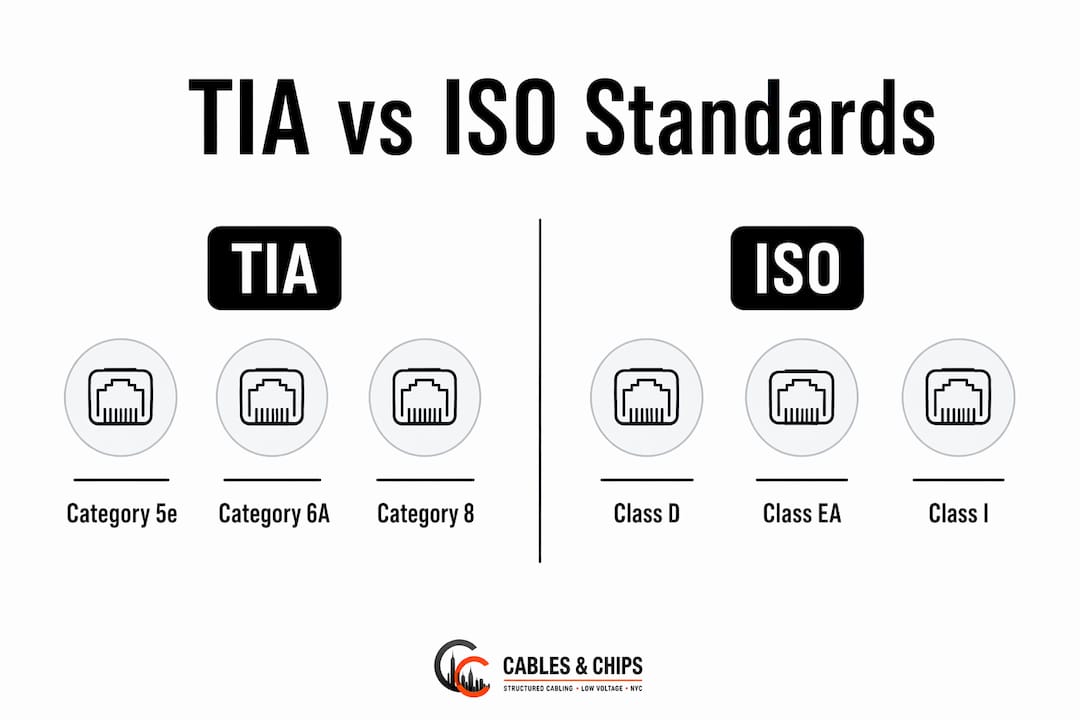
TIA uses a category system tied to component performance. The current active categories for commercial work are:
| Category | Nominal frequency | Typical Ethernet application |
|---|---|---|
| Cat5e | 100 MHz | 1000BASE-T up to 100 meters |
| Cat6 | — | 1G/2.5G; 10GBASE-T |
| Cat6A | — | 10GBASE-T up to 100 m |
| Cat8 | — | 25G/40GBASE-T (data center only) |
Cat6A is the current U.S. commercial baseline for new builds. Cat8 is a data center-specific medium for short top-of-rack channels, not a horizontal cabling replacement. Cat5e and Cat6 remain in service in retrofit scenarios, and TSB-5021 provides guidance on running 2.5GBASE-T and 5GBASE-T over installed Cat5e/Cat6 plant.
The 568.1-F consolidation and what it means for specs
TR-42 is currently consolidating ANSI/TIA-568.0, 568.1, and 862 into a single document: ANSI/TIA-568.1-F. A ballot and public review were issued in April 2026. The goal is to remove duplicative terminology and bring building automation system (BAS) cabling guidance, previously siloed in TIA-862, into the main premises standard. For specification writers, this means contract language referencing “TIA-568.1-E” will remain valid until 568.1-F is formally published, but RFPs written now should note the consolidation and require compliance with the current edition in force at time of installation.
The 568.1-F consolidation also reflects a broader shift: building automation, access control, and wireless infrastructure are no longer treated as separate cabling silos. Specifying them under a single standard reduces ambiguity on mixed-use commercial projects.
Practical procurement language
When writing RFPs or construction documents for U.S. projects, require:
- Compliance with ANSI/TIA-568.1-E (or 568.1-F once published) and ANSI/TIA-568.2-E for balanced twisted-pair
- TIA category designation on all cable and connector submittals
- Field certification to TIA limits using a calibrated certifier (Fluke DSX-8000, Viavi CertiFiber Pro, or equivalent)
- Manufacturer’s channel warranty contingent on certified installation
Pro Tip: Specify the tester make, model, firmware version, and test adapter in the RFP. A tester running outdated firmware or the wrong adapter can produce failing results on a perfectly good installation, and disputes over test configuration are among the most common closeout delays on commercial jobs.
When should you specify ISO/IEC 11801 instead?
ISO/IEC 11801 uses a class-based nomenclature that maps to performance levels rather than specific component types. The current edition is ISO/IEC 11801-1:2017, and the standard received a 2025 amendment and corrigendum (ISO/IEC 11801-1:2017/Amd 1:2025/Cor 1:2025) that refines general requirements and corrects performance-table footnotes, including editorial fixes to PS AACR-F entries. For 2026 projects referencing ISO, cite this amended edition.
ISO class designations
| ISO Class | Approximate TIA equivalent | Nominal frequency | Typical application |
|---|---|---|---|
| Class D | Cat5e | 100 MHz | 1G Ethernet |
| Class E | Cat6 | — | 1G/10G short-reach |
| Class EA | Cat6A | — | 10GBASE-T to 100 m |
| Class F | Cat7 | — | 10G with alien crosstalk margin |
| Class FA | Cat7A | — | 10G/40G with headroom |
| Class I | Cat8 | 1,— | 25G/40G |
| Class II | Cat8 | — | 25G/40G |
The critical difference at the top of the table: TIA never adopted Cat7 or Cat7A. ISO Class F and FA require S/FTP construction with individually shielded pairs and non-RJ45 connectors (GG45 or TERA). TIA skipped directly from Cat6A to Cat8, retaining RJ45 compatibility throughout. This is not a minor naming difference. If a spec calls for “Class F” without specifying connector type, a contractor can legitimately install GG45 connectors that are incompatible with the client’s existing patch cords and switches.
Practical notes for ISO projects:
- Require ISO testing or dual reporting (TIA + ISO) explicitly in the contract
- Name the test standard edition: ISO/IEC 11801-1:2017/Amd 1:2025
- Specify the connector system (GG45 or TERA) if Class F/FA is required
- Confirm that the field certifier supports ISO test limits; U.S. testers default to TIA
Pro Tip: When Class F or FA appears in a spec, add a connector and shielding clause before procurement begins. Discovering mid-project that the client’s switches use standard RJ45 ports and the installed connectors are GG45 is a costly rework scenario that Cables and Chips sees on multinational buildouts more often than it should.
TIA vs ISO: the technical mapping you can copy into a spec
The electrical performance limits for equivalent TIA categories and ISO classes are nearly identical. Channel tests for insertion loss, NEXT, ACR-F, and return loss use pass/fail thresholds that differ by fractions of a decibel. A Cat6A installation that passes TIA certification will almost always pass ISO Class EA testing as well. The practical divergence is in naming, connector systems, and test-report format.
Category-to-class mapping with performance thresholds
| TIA Category | ISO Class | Nominal frequency | Supported Ethernet speeds | Connector system |
|---|---|---|---|---|
| Cat5e | Class D | 100 MHz | 1GBASE-T | RJ45 |
| Cat6 | Class E | — | 1G; 10G | RJ45 |
| Cat6A | Class EA | — | 10GBASE-T to 100 m | RJ45 |
| Cat7 (ISO only) | Class F | — | 10GBASE-T with margin | GG45 / TERA |
| Cat7A (ISO only) | Class FA | — | 10G/40G | GG45 / TERA |
| Cat8 (TIA) / Cat8 (ISO) | Class I | 1,600–— | 25G/40GBASE-T | RJ45 (Cat8) |
Use-case matrix: which standard to specify
| Project type | Recommended standard | Rationale |
|---|---|---|
| U.S. commercial office | ANSI/TIA-568.1-E, Cat6A horizontal | NEC alignment, tester defaults, warranty support |
| Data center (top-of-rack) | ANSI/TIA-568 Cat8 or Cat6A | Cat8 for ≤30 m channels; Cat6A for longer runs |
| Multinational campus | Dual-report: TIA + ISO/IEC 11801 Class EA | Satisfies both procurement regimes |
Where the standards diverge most meaningfully: Cat7/Cat7A exist only in ISO, and Cat8 short-channel limits (30 m maximum) have no ISO Class I/II equivalent in the same channel-length framing. For data center horizontal cabling beyond 30 m, Cat6A remains the correct choice under both standards.
What does a proper acceptance test look like in the U.S.?
U.S. field testers ship with TIA limits loaded by default. Specifying ISO class designations on a domestic project without explicitly requiring dual-reporting risks failed acceptance tests or, worse, passing tests run against the wrong limits. The contract must be specific.
Acceptance test checklist
- Define the test model. Specify Permanent Link or Channel. Permanent Link is standard for horizontal copper; Channel is used when patch cords are part of the certified system.
- Name the certifier. Require a calibrated field certifier (e.g., Fluke Networks DSX-8000 or equivalent) with current calibration certificate on file.
- Specify test adapters. Permanent Link adapters must match the connector type (RJ45 for Cat6A; appropriate adapter for fiber).
- Set the test limits. State “TIA-568.2-E Cat6A Permanent Link” explicitly. If dual-reporting is required, add “ISO/IEC 11801-1:2017/Amd 1:2025 Class EA Channel.”
- Required electrical tests. Wire map, insertion loss (IL), NEXT, PS-NEXT, ACR-N, PS-ACR-N, ACR-F (ELFEXT), PS-ACR-F, return loss, propagation delay, and delay skew.
- PoE bundling check. For high-density PoE installations, verify bundle-size limits and temperature de-rating per TIA TSB-184-A. ISO TR 29125 covers the same ground for ISO-specified projects; both reach similar conclusions but use different worked examples.
- Pass/fail review. Any marginal pass (within 1 dB of the limit) should be flagged for re-test or re-termination before closeout.
- Documentation. Require a printed or PDF summary report plus raw test files (.flw for Fluke, .tds or vendor-native format for others).
For RFP language, require the installer to submit tester make, model, serial number, firmware version, and calibration date as part of the closeout package. Pair this with as-built documentation that maps every outlet ID to its test record.
Pro Tip: Require raw test files as a contract deliverable, not just PDF summaries. PDFs can be edited; raw files carry embedded pass/fail data that cannot be altered without detection. This single requirement eliminates most certification disputes.
Migration and upgrade planning for 2026 projects
Retrofit vs new build: the decision checklist
The right answer depends on what is already in the walls. Before committing to a full replacement, assess:
- Existing cable grade. Cat5e supporting 1G is still serviceable for voice and low-bandwidth devices. Cat6 can carry 10G at reduced distances. Neither supports full 10GBASE-T to 100 m without Cat6A.
- Pathway condition. Reusing conduit and cable trays is the primary cost lever in a retrofit. If pathways are clean and correctly sized, a pull-and-replace is far cheaper than new conduit work.
- Backbone fiber. If the existing backbone is OM3 or OM4 multimode, it supports 40G and 100G at data center distances. OM1/OM2 should be replaced. Single-mode is future-proof for virtually any foreseeable application.
- WAP density. TIA-568.1-E Addendum 1 requires a minimum of two Cat6A runs to every wireless access point. If existing WAP drops are single Cat5e or Cat6, a wireless refresh triggers a cabling upgrade.
For a practical office buildout planning framework, the decision tree almost always lands the same way: if the project involves a new tenant fit-out or a wireless system upgrade, install Cat6A. The cost delta over Cat6 is modest at the cable level; the labor is the same.
Typical project timelines
- Small project (under 50 drops): Design 1–2 weeks, procurement 1–2 weeks, installation 2–5 days, testing and closeout 1–2 days.
- Medium project (50–300 drops): Design 2–4 weeks, procurement 2–3 weeks, installation 2–4 weeks, testing and closeout 3–5 days.
- Large project (300+ drops): Design 4–8 weeks, procurement 3–5 weeks, installation 6–14 weeks, testing and closeout 1–2 weeks.
Key cost drivers
- Cable media. Cat6A costs more per foot than Cat6, but the gap narrows on volume orders. Fiber backbone cost depends on strand count and connector type (LC vs MPO).
- Pathway work. Conduit, cable tray, and J-hook installation typically represents 30–50% of total labor on a retrofit. Budget accordingly.
- Device migration windows. After-hours or weekend work for live environments adds a labor premium.
- Testing and certification fees. Budget for certified testing as a line item, not an afterthought. Skipping it creates warranty and liability exposure.
- Future-proofing. Pull spare fiber strands and additional WAP runs during initial buildout. Adding capacity after walls are closed costs multiples of the original run.
What Cables and Chips sees go wrong on NYC commercial jobs
Commercial cabling in New York City adds layers that most standards documents do not address: coordination with MEP trades in tight mechanical spaces, building management approval for pathway penetrations, and fire-stopping requirements that vary by floor and occupancy type. A site survey before design is not optional on a Manhattan buildout.
Contractor site checklist
| Phase | Key actions |
|---|---|
| Site survey | Confirm pathway routing, measure conduit fill, identify fire-stop locations, photograph MDF/IDF spaces |
| Staging | Verify cable reels match spec (Cat6A, plenum or riser rated per NEC), confirm tester calibration |
| Installation | Follow TIA bend radius and fill limits; maintain pair twist to termination |
| Labeling | Apply TIA-606-D compliant labels at both ends; include outlet ID, panel port, and room/zone |
| Testing | Run Permanent Link tests to TIA-568.2-E Cat6A limits; flag marginals before closeout |
| Closeout | Deliver as-built drawings, test reports (PDF + raw files), and tester calibration certificate |
Common failure modes
Insufficient WAP runs. The single most common spec error on office refreshes. Two Cat6A runs per WAP is the TIA minimum; high-density environments need more. Cables and Chips recommends planning for three runs per AP in open-plan floors with high device density.
Category vs Class confusion in specs. Writing “Class EA” on a U.S. project without specifying TIA dual-reporting leads to tester configuration errors and failed acceptance. Treat TIA categories and ISO classes as different nomenclature for equivalent performance, not interchangeable terms.
Misconfigured testers. A certifier running Cat6 limits on a Cat6A installation will produce passing results that do not reflect actual Cat6A performance. Always confirm the test limit profile before the first run.
PoE heat buildup in large bundles. High-density PoE (IEEE 802.3bt Type 3/4) generates significant heat in tightly bundled cables. TIA TSB-184-A provides de-rating guidance; ignoring it leads to thermal degradation and intermittent failures months after closeout.
Sample RFP spec language
Pro Tip: Add an as-built handoff checklist to every contract and require a one-page summary for the facility manager that maps outlet IDs to switch ports. Facility managers are not network engineers. A clean, readable summary prevents the “which port is this outlet?” call six months after move-in.
Which standard should you specify for your 2026 project?
The answer is almost always ANSI/TIA-568 for U.S. work. Here is the scenario-by-scenario breakdown:
- Single-building commercial office (U.S.): Specify ANSI/TIA-568.1-E, Cat6A horizontal, TIA certification. No ISO required.
- Data center (top-of-rack, ≤30 m channels): Specify Cat8 per ANSI/TIA-568.2-E for short copper runs; Cat6A for anything longer. TIA-942-C governs the broader data center infrastructure.
- Healthcare facility: ANSI/TIA-1179-B governs healthcare telecommunications infrastructure; the horizontal cabling baseline is still Cat6A per TIA-568.
- Multinational campus or international client: Specify ANSI/TIA-568 as primary with dual-reporting to ISO/IEC 11801-1:2017/Amd 1:2025 Class EA. Include this in the test scope from day one.
- Government / federal project: Confirm whether the agency references TIA-568 or a specific federal standard (e.g., BICSI guidelines or agency-specific specs). TIA-568 is the default; some agencies add requirements on top.
One-line decision rules for spec writers:
- U.S. commercial project → require ANSI/TIA-568; TIA certification; TIA test limits.
- Client mandates ISO → require dual-reporting (TIA + ISO); name the ISO edition and amendment.
- Class F/FA requested → add connector and shielding clause; confirm switch compatibility before procurement.
- Data center short-reach → Cat8 for ≤30 m; Cat6A for longer horizontal runs.
Key Takeaways
For U.S. commercial projects in 2026, ANSI/TIA-568 is the correct baseline standard; ISO/IEC 11801 applies only when international contracts, Class F/FA connector systems, or multinational clients explicitly require it.
| Point | Details |
|---|---|
| Default to TIA-568 for U.S. work | ANSI/TIA-568 aligns with NEC, U.S. tester defaults, and manufacturer warranty programs. |
| Cat6A is the horizontal baseline | Cat6A supports 10GBASE-T to 100 m and meets the TIA minimum of two runs per wireless access point. |
| Require explicit test limits in contracts | U.S. field testers default to TIA limits; specify tester model, firmware, and test standard edition to prevent certification disputes. |
| Use ISO only when contractually required | ISO/IEC 11801-1:2017/Amd 1:2025 is the current edition; require dual-reporting when both standards must be satisfied. |
| Cables and Chips for NYC execution | Cables and Chips delivers Cat6A/Cat6 installation, fiber backbone design, testing, and TIA-compliant as-built documentation for commercial projects across New York City. |
The standard that matters most is the one in the contract
The TIA vs ISO debate gets more attention than it deserves on most U.S. projects. In practice, the electrical performance of a properly installed Cat6A channel is nearly identical whether you test it against TIA-568.2-E or ISO/IEC 11801 Class EA. The real risk is not which standard you pick. It is writing a spec that mixes TIA and ISO language without specifying test limits, or calling for Class F without naming the connector system.
What Cables and Chips sees repeatedly on New York City commercial jobs is that the specification document is where projects succeed or fail. A contractor who receives a clear, edition-specific TIA spec with named test limits, a calibration requirement, and a raw-file deliverable clause will produce a clean, documented installation. A contractor who receives a vague “Cat6A or equivalent” spec with no test requirements will produce whatever is cheapest and fastest to install. The standard is not the protection. The contract language is.
The 568.1-F consolidation, when finalized, will make this cleaner by bringing BAS cabling under the same document as horizontal and backbone infrastructure. Until then, reference 568.1-E and 862-C separately when building automation is in scope.
Cables and Chips handles the spec, the install, and the certification
Specifying the right standard is step one. Getting a clean, certified, documented installation in a New York City commercial building is where the real work happens.
Cables and Chips provides the full scope: Cat6A and Cat6 horizontal installation, fiber backbone design and installation, WAP cabling to TIA addendum minimums, CCTV and access control cabling, testing and certification with raw-file deliverables, and TIA-606-D compliant as-built documentation. Every project closes with a complete test package and as-built drawings the facility manager can actually use.
If you are writing an RFP, planning a tenant fit-out, or upgrading an existing plant to Cat6A, Cables and Chips can review your spec before it goes to bid or take the project from design through certified closeout. Request a proposal or a spec review through the Cat6A installation services page or contact the team directly at 20 Vesey Street, Lower Manhattan.
Useful sources
| Document | Publisher | Type | Notes |
|---|---|---|---|
| ANSI/TIA-568.1-E (current edition) | TIA / ANSI | Normative | Cite edition in all RFPs; 568.1-F ballot issued April 2026 |
| ANSI/TIA-568.2-E | TIA / ANSI | Normative | Balanced twisted-pair components; cite for Cat6A specs |
| ANSI/TIA-568.3-E | TIA / ANSI | Normative | Optical fiber cabling and components |
| ANSI/TIA-862-C | TIA / ANSI | Normative | Building automation systems cabling; being merged into 568.1-F |
| ANSI/TIA-606-D | TIA / ANSI | Normative | Administration and labeling standard |
| ANSI/TIA-942-C | TIA / ANSI | Normative | Data center telecommunications infrastructure |
| ISO/IEC 11801-1:2017/Amd 1:2025/Cor 1:2025 | ISO/IEC | Normative | Current ISO generic cabling standard; cite this edition for 2026 projects |
| TIA TSB-184-A | TIA TR-42 | Guidance | PoE bundling and temperature de-rating |
| TSB-5021 | TIA TR-42 | Guidance | 2.5G/5GBASE-T over installed Cat5e/Cat6 |
| TIA-568.1-F (ballot) | TIA TR-42.1 | In development | Consolidates 568.0, 568.1, and 862; monitor for publication |
| IEEE 802.3 standard | IEEE | Normative | Ethernet application layer; governs speed/distance requirements that cabling must support |
FAQ
What is the difference between TIA-568 and ISO/IEC 11801?
TIA-568 is the North American structured cabling standard published by the Telecommunications Industry Association; ISO/IEC 11801 is the international equivalent. Both align on electrical performance but use different naming systems: TIA uses Categories (Cat5e, Cat6, Cat6A, Cat8) while ISO uses Classes (D, E, EA, F, FA, I, II).
Which standard should I specify for a U.S. commercial project in 2026?
Specify ANSI/TIA-568.1-E with Cat6A horizontal cabling as the baseline. ISO/IEC 11801 is only necessary when an international client, multinational contract, or Class F/FA connector system is explicitly required.
Does Cat6A pass both TIA and ISO tests?
A properly installed Cat6A channel will almost always pass both TIA-568.2-E Category 6A and ISO/IEC 11801 Class EA tests, since the electrical pass/fail thresholds differ by only fractions of a decibel. The contract must still specify which test limits apply to avoid certifier configuration errors.
What is ANSI/TIA-568.1-F and when will it be published?
TIA-568.1-F is a consolidation of ANSI/TIA-568.0, 568.1, and 862 into a single premises standard. TIA’s TR-42.1 committee issued a ballot and public review in April 2026. Until it is formally published, reference ANSI/TIA-568.1-E and TIA-862-C separately in project specifications.
How many Cat6A runs does TIA require per wireless access point?
TIA-568.1-E Addendum 1 requires a minimum of two Category 6A or higher balanced twisted-pair runs to every wireless access point. High-density or future-proofed designs should plan for additional runs during initial buildout to avoid costly retrofits later.