
NYC Structured Cabling: Compare Quotes by Testing and Documentation

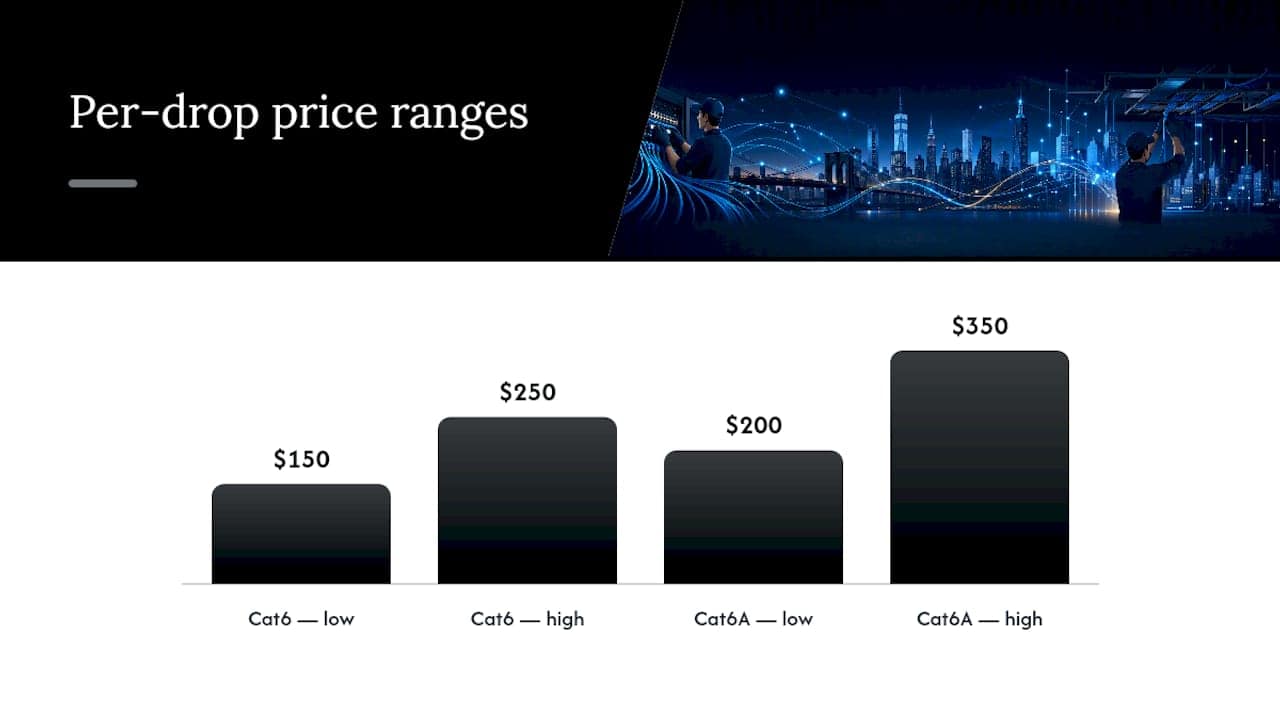
Plan on roughly $150 to $250 per Cat6 drop and $200 to $350 or more per Cat6A drop for a typical U.S. commercial installation, assuming the quote covers termination, basic testing, and labor. Costs climb from there with retrofit access problems, certification-level testing, and fiber backbone runs. Before accepting any bid, request an itemized, site-verified quote rather than a flat number over the phone.
TL;DR:
- Costs for a single cable drop range from $150 to $250 for Cat6 and $200 to $350 or more for Cat6A, depending on access issues and testing requirements.
- Per-drop price differences are heavily influenced by access complexity, drop count, cable category, and testing depth, with certification and documentation often incurring additional fees.
- Small projects with 10 to 25 drops tend to have higher effective costs per drop due to fixed mobilization and testing fees, while larger builds benefit from economies of scale and bulk purchasing.
- Fully evaluating bids requires verifying if full certification testing, labeling, and as-built documentation are included, as these hidden costs can significantly inflate the entire project budget.
- Fiber optic backbone installations and high-performance cable choices like Cat6A increase costs due to longer termination times, specialized labor, and stricter standards compliance.
What Does Structured Cabling Cost Per Drop?
A “drop” is one cable run from a network closet to a single wall jack or device location, and it’s the unit every commercial cabling budget gets built around. Industry benchmarks put Cat6 in the $150 to $250 range per drop in best-case conditions, with Cat6A commonly running $200 to $350 or more depending on access and testing requirements, according to per-drop budget data from Data Wire Solutions.
That per-drop number should include specific things, and knowing what belongs inside it is how you evaluate whether a bid is complete or stripped down:
- Cable (Cat6 or Cat6A, plenum or riser rated as required)
- Jack, faceplate, and patch panel port
- Termination at both ends
- Basic wiremap testing to confirm continuity and correct pinout
- Labor for the pull, dress, and termination
What it usually does not include: full certification testing to ANSI/TIA channel specifications, firestopping at rated wall penetrations, lift rental for high ceilings, after-hours labor premiums, or as-built documentation. Those get quoted separately, and a bid that folds them in silently (or omits them entirely) is one you should question.
Statistic Callout: Cat6A per-drop pricing runs roughly 30 to 60 percent above Cat6 once you account for thicker cable, slower termination, and the certification testing most Cat6A deployments require.
Regional labor rates push New York City jobs toward the higher end of every band. A crew navigating a landmarked lobby, a union building, or a tenant space with a strict certificate-of-insurance policy is billing more hours than a crew in an open warehouse in another market. That’s not padding. It’s the actual cost of doing the work correctly in a dense commercial building.
What Factors Drive a Structured Cabling Quote?
Two jobs with identical drop counts can land tens of thousands of dollars apart, and the gap almost always traces back to a short list of variables.
- Access and pathway conditions. An open ceiling with exposed J-hooks is fast. A finished ceiling with hard lids, tight plenum space, or asbestos abatement requirements is slow, and labor is the largest line item in any cabling bid.
- Drop count and economies of scale. Mobilization, setup, and testing overhead get spread across more runs on larger jobs, which is why per-drop cost drops as project size grows.
- Cable category and termination time. Cat6A’s thicker jacket and tighter bend radius requirements take longer to dress and terminate cleanly than Cat6.
- Testing depth. A basic wiremap test takes minutes. Full channel certification to ANSI/TIA-568 specifications, with a printed report per run, adds real time and requires a certified tester.
- Building rules. Union labor requirements, after-hours work windows, freight elevator scheduling, and required permits all add cost before a single cable gets pulled.
Standards compliance itself is a cost driver, but it’s the good kind. Ad-hoc wiring without a design standard tends to create expensive rework down the line, while ANSI/TIA-568 compliant design gives a building a predictable, scalable system from day one.
Pro Tip: Ask every bidder whether their quoted price includes wiremap testing or full certification testing. This single question exposes more quote-to-quote price gaps than any other line item.
How Much Does a Structured Cabling Project Cost by Size?
Project scale changes the math more than almost any other factor. Here’s how typical budgets shift as drop count grows:
- Small retrofit (10 to 25 drops). Expect a higher effective per-drop cost, often at or above the top of the Cat6 range, because mobilization, testing setup, and a minimum service call fee get absorbed by fewer runs. A 15-drop office retrofit with finished ceilings might land in the higher range of typical costs due to minimum mobilization and testing fees.
- Mid-size buildout (50 to 150 drops). Per-drop cost usually settles into the middle of the planning band as fixed costs spread across more cable runs. A 100-drop new-construction pre-wire, with open ceilings and simple access, commonly falls within a typical mid-range budget for Cat6.
- Large facility (300+ drops). Bulk material purchasing and crew efficiency bring per-drop cost down further, but total project cost rises sharply if the scope includes Cat6A throughout or a fiber backbone connecting multiple network closets.
Grouped new-construction pre-wire work is almost always cheaper per drop than piecemeal retrofit work added after tenants move in, simply because open ceilings and unobstructed walls let crews move faster.
Cat6 vs. Cat6A vs. Fiber: Which Should You Specify?
Cat6 handles most standard office needs, including desktop connectivity, VoIP phones, and WiFi access points that don’t require high power delivery. Where the choice gets more complicated is future bandwidth and power demand.
- Choose Cat6 for general office drops, printers, and standard access points where gigabit speeds are sufficient for the foreseeable future.
- Choose Cat6A when the environment anticipates 10Gb requirements or heavy Power over Ethernet loads, such as WiFi 6E access points or PoE+ security cameras. Cat6A’s thicker conductors and shielding genuinely take longer to terminate cleanly, which is reflected in labor pricing, not just material cost.
- Choose fiber for backbone runs between network closets, floor-to-floor connections, or any distance beyond copper’s practical reach. Fiber changes the installation scope, adding fiber optic backbone design and termination work that a straight copper drop project doesn’t require.
The right call comes down to total cost of ownership, not sticker price. Underbuilding with Cat6 in a space that will need 10Gb within three years usually costs more in disruptive retrofit work than specifying Cat6A upfront would have.
What Hidden Costs Show Up After the Bid?
The line items that blow up a cabling budget rarely appear in the initial number. They show up during the walkthrough or, worse, after the contract is signed.
- Firestopping. Any cable penetrating a rated wall or floor assembly needs a fire-rated sealant or sleeve system, and this work is often quoted separately from the cable pull itself.
- Plenum-rated cable. Buildings that use the ceiling void as return air space require plenum-rated jacketing, which costs measurably more than general-purpose or riser-rated cable.
- Lift rental and site controls. High-ceiling spaces, atriums, and warehouse environments often require scissor lifts or scaffolding, plus the insurance and safety coordination that comes with them.
- After-hours labor. Buildings that restrict construction noise to nights or weekends push labor rates up, sometimes by 50 percent or more over standard daytime rates.
- Permits and landlord coordination. Many NYC commercial buildings require a certificate of insurance, a certified electrician’s sign-off for certain work, or a building permit before crews can even access the freight elevator.
Warranty terms matter here too. A cabling system backed by a manufacturer warranty tied to certified installation practices protects you from paying twice if a component fails within the coverage period, and it’s worth confirming in writing before work begins.
How Do You Get an Accurate Structured Cabling Quote?
A comparable, trustworthy quote contains specific, verifiable items, and the biggest mistake buyers make is comparing a stripped-down number against a full-scope proposal as if they’re the same thing, a pattern flagged repeatedly in industry cost guides.
Request the following before you sign anything:
- Materials broken out by spec. Cable category, plenum or riser rating, connector brand, and patch panel type, not just “cabling materials.”
- Termination counts. The exact number of drops, cross-connects, and patch panel ports included.
- Testing and certification level. Wiremap only, or full channel certification with printed reports per drop.
- Labeling and documentation deliverables. Port legends, physical labels at both ends, and as-built drawings.
- Mobilization and site-condition fees. Any charges tied to after-hours work, lift rental, or building access requirements.
Ask bidders to show you a sample test report and proof of installer credentials. A contractor referencing BICSI installation standards or holding BICSI installer certifications is signaling a level of documented competence that a vague “we’ve done this before” answer doesn’t match.
Pro Tip: Watch for the phrase “material to be determined” anywhere in a proposal. It’s the most common way contractors leave themselves room to substitute cheaper components after signing.
Preparing a floor plan with a device list marked for every jack location tightens every bid you receive, because it removes the guesswork that drives estimate padding.
What Should a Completed Cabling Project Deliver?
A finished job should hand you more than working cables. The closeout package should include certified test reports for every channel, a labeled port schedule tied to a single port legend, physical labels at both ends of every run, and complete as-built drawings.
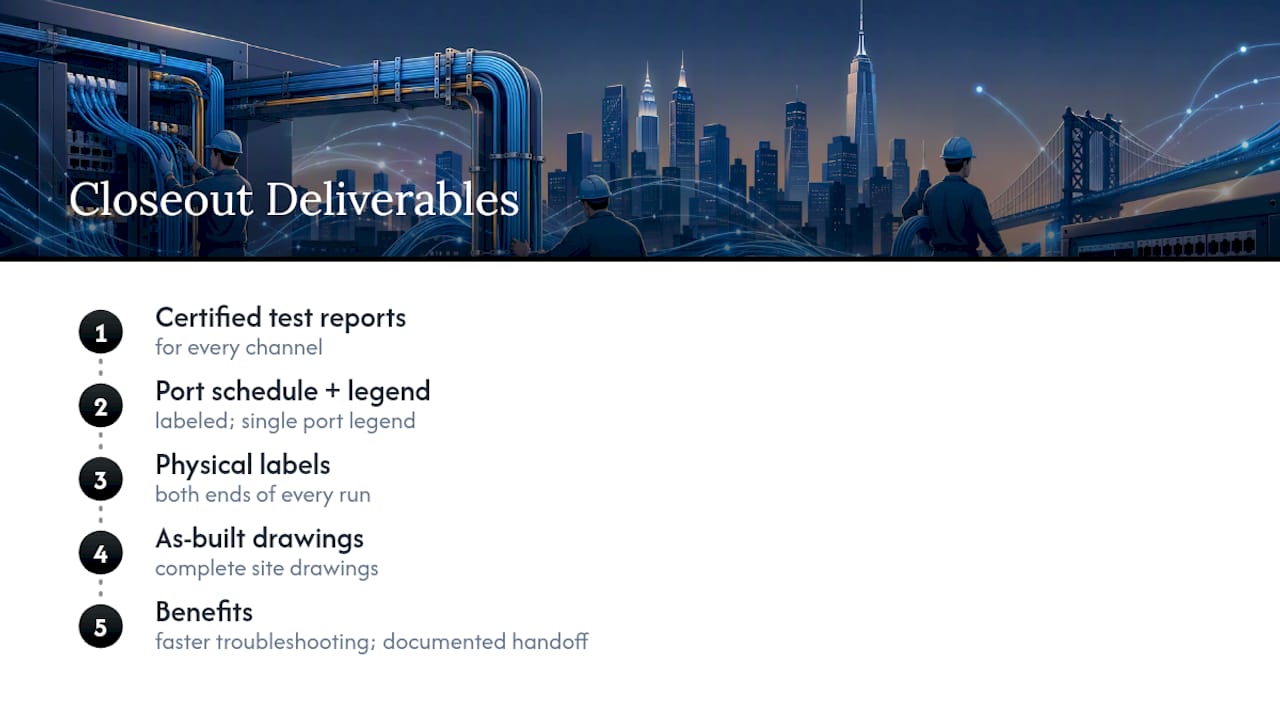
These deliverables aren’t paperwork for its own sake. They shrink mean time to repair when something fails, and they prevent the next contractor (or your own team) from tracing cables blind.
Statistic Callout: Installations built to published standards and complete documentation practices, rather than ad-hoc wiring, substantially reduce long-term rework and total cost of ownership compared with stripped-down installs.
Acceptance criteria should reference ANSI/TIA channel definitions, not a contractor’s informal sign-off. Cables and Chips builds every closeout package around that standard, with more than 40 years of combined low voltage experience behind the installations delivered across NYC commercial buildings.
What Decision-Makers Get Wrong About Cabling Budgets
Most cabling budget guidance treats the per-drop number as the whole story. It isn’t. The number that actually determines whether you’re happy with the project six months later is the documentation number, not the drop number, and almost nobody asks about it during bid evaluation.
Here’s the pattern worth watching: contractors who quote aggressively low per-drop pricing are frequently the ones who strip out certification testing and as-built drawings first, because those items are invisible on day one and expensive to discover missing later. You won’t notice the gap until a device goes down and nobody can find which port it’s on.
Buyers should prioritize three things in this order: standards compliance, documented testing, and price, not the reverse. A quote that’s 15 percent higher but includes full channel certification and a real closeout package is cheaper over five years than the bargain bid that leaves you tracing unlabeled cable in a ceiling. Ask for the documentation deliverable before you ask for the discount.
— Ken
Get a Site-Verified Structured Cabling Quote
Reading planning ranges only gets you so far. The number that matters is the one built from your actual floor plan, ceiling conditions, and device list, and that’s exactly what a site survey is for. Cables and Chips provides site surveys, design, certified installation, and full testing documentation for commercial buildings and secure facilities throughout NYC, with acceptance criteria built around ANSI/TIA standards rather than informal sign-off.
Before a site visit, pull together a floor plan marked with intended jack locations, a device list (phones, access points, cameras, workstations), and notes on any known access restrictions like union requirements or after-hours-only work windows. That prep work is what turns a rough estimate into a firm, comparable number.
Review the full breakdown of structured cabling system components to see what belongs in a complete scope, then request a quote for your specific drop count and building conditions.
Sources
- ANSI/BICSI N1-2019 | BICSI Standards
- Structured Cabling Installation Standards: A Practical Guide – MegaServices LLC
- Structured Cabling Systems (2026): Copper + Fiber Design Rules – Zion Communication
FAQ
How do you estimate structured cabling costs?
Start by counting drops from your floor plan, then multiply by the per-drop range for your chosen category ($150 to $250 for Cat6, $200 to $350 or more for Cat6A), and add separately for testing certification, firestopping, and any access-related premiums.
What is the primary U.S. standard for structured cabling?
The ANSI/TIA-568 family of standards governs structured cabling performance, channel definitions, and design practices across U.S. commercial installations, and it’s the standard Cables and Chips builds acceptance criteria around.
How much does fiber optic cable cost per foot?
Fiber optic cable material cost varies widely by type (single-mode vs. multi-mode) and jacket rating, but the bigger cost driver in most projects is termination and testing labor, not the cable itself, since total cost of ownership depends more on labor and design than raw material price.
How much does network cabling cost overall?
Total project cost depends on drop count and scope, but sample commercial budgets typically range from higher per-drop costs for small 10 to 25 drop retrofits up to more moderate per-drop costs for 100 drop new-construction pre-wire jobs.
Why do Cat6A quotes cost more than Cat6?
Cat6A cable is thicker and requires more careful, time-consuming termination than Cat6, and most Cat6A deployments also call for full certification testing rather than basic wiremap checks, both of which add labor cost.