
Structure. Schedule. Success.
In the New York City construction market, a project's profitability is dictated by the master schedule. Every trade: mechanical, electrical, plumbing: is a gear in a machine. When one gear slips, the entire project grinds to a halt. For many General Contractors (GCs), low-voltage cabling is the gear that is most often ignored until it is too late.
Treating structured cabling in NYC as a last-minute "add-on" is a high-risk strategy. It leads to ripped-out drywall, congested cable pathways, and frantic change orders. When the low-voltage contractor is brought in after the walls are closed, the budget is already blown.
To maintain schedule integrity and protect your margins, low-voltage must be treated as a primary trade. This guide outlines the coordination milestones necessary to integrate network infrastructure into your build-out without the friction.
Planning. Precision. Profit.
The most expensive phrase in construction is "we’ll figure it out on-site." Effective network infrastructure in NYC begins in the pre-construction phase. Waiting until the rough-in to define cable paths is a failure of planning.
Early Design Integration
A professional low-voltage contractor should be at the table during the engineering and design phase. This allows for the identification of critical infrastructure needs before they conflict with HVAC ductwork or electrical conduit.
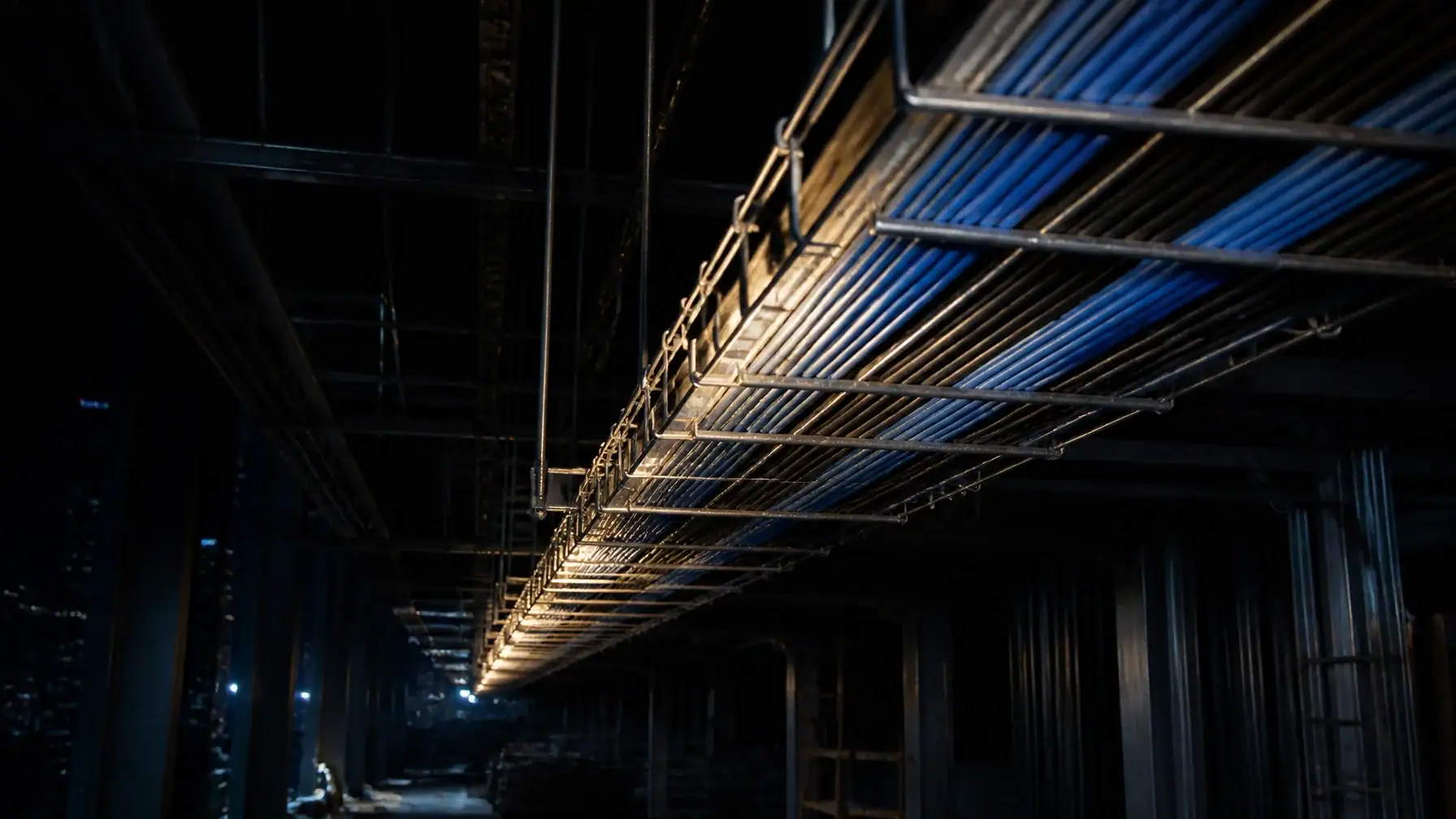
- Pathway Coordination: Confirming cable tray locations and conduit sizes early prevents "spatial wars" in the plenum.
- TR/MDF/IDF Room Readiness: Ensuring that telecommunications rooms have the correct dimensions, cooling requirements, and power circuits is essential. A common failure is designing a server room that cannot actually support the rack density required by the tenant.
- Lead Time Management: High-performance fiber and specialized hardware currently face significant lead times. Early procurement avoids the 11th-hour scramble for materials.

Sequencing. Synergy. Speed.
The construction timeline for low-voltage is often misunderstood. It is not a single event; it is a multi-phase process that must be synchronized with other trades.
The Rough-In Window
The low-voltage rough-in must occur after framing and major MEP rough-in are complete, but strictly before insulation and drywall. If this window is missed, the cost of installation triples.
- Framing Completion: Studs are in place, providing the structure for backboxes.
- MEP Clearance: HVAC and plumbing have completed their major runs, defining the remaining space for cable pathways.
- The Tech Rough-In: This is where the low voltage contractor in NYC pulls the bulk of the horizontal cabling (Cat6, Cat6A, Fiber) to the designated outlets and telecommunications rooms.
- Inspection: The rough-in must be inspected and signed off before the "walls-closed" milestone.
The Trim-Out and Commissioning
Once the dust has settled and the painting is complete, the trim-out begins. This involves terminating the cables, mounting wall plates, and installing the racks. This phase must be completed before the tenant’s IT equipment arrives.
Documentation. Detail. Durability.
A finished project that isn't documented is a liability. For a GC, the goal is a clean handoff. For the tenant, the goal is serviceability.
Professional coordination includes a rigorous documentation process:
- Logical Labeling: Every cable must be labeled at both ends according to a logical scheme.
- As-Built Drawings: A final set of drawings reflecting the exact location of every drop, camera, and access point.
- Certification Reports: Proof that every cable meets its rated speed (e.g., 10Gbps for Cat6A). Without these reports, you cannot prove the infrastructure works until the tenant tries: and fails: to connect.

Risk. Rework. Redundancy.
Poor coordination creates tangible risks that impact the GC’s bottom line. When low-voltage is an afterthought, the following consequences are inevitable:
- Downtime: If the network infrastructure isn't ready by the move-in date, the tenant cannot work. This often triggers liquidated damages.
- Security Risks: Improperly installed access control and CCTV create gaps in building security, leading to potential liability for the property manager.
- Aesthetic Failure: Cables draped over ceiling tiles or visible in common areas reflect poorly on the quality of the build.
- Higher Costs: Retrofitting cabling into a finished space is exponentially more expensive than installing it during the rough-in.
Problem vs. Solution
| The Problem (Afterthought) | The Solution (Cables & Chips Partner) |
|---|---|
| Cables pulled through finished walls. | Dedicated pathways established in pre-con. |
| Overcrowded, heat-trapping IDFs. | Properly organized and ventilated racks. |
| Guesswork during troubleshooting. | 100% certified and labeled documentation. |
| Last-minute change orders. | Firm, upfront scope and material lock-in. |
The Cables & Chips Methodology
We do not just pull cable; we manage a critical utility. Our process is designed to integrate seamlessly into your master schedule.
- Survey & Audit: We review the site and the prints to identify potential conflicts before the first worker arrives.
- Planning: We produce a consolidated outlet schedule and coordinate with electrical subs on conduit requirements.
- Execution: Our technicians work within the scheduled rough-in and trim-out windows, maintaining the pace of the project.
- Certification: We provide full testing reports and as-built documentation as part of the close-out package.
- Support: We offer ongoing maintenance to ensure the infrastructure evolves with the tenant’s needs.

Professionalism. Performance. Partnership.
For GCs and construction managers, your reputation is built on the reliability of your subcontractors. A low-voltage partner should be a source of solutions, not a source of delays.
By bringing Cables & Chips into the project during the planning phase, you ensure that the building's digital foundation is as solid as its physical one. We specialize in navigating the complexities of New York City commercial environments, from high-rise office fit-outs to retail and hospitality projects.
Stop reacting to cabling issues. Start coordinating them.
Is your next project ready for a professional low-voltage partner?
Contact Cables & Chips to review your prints and lock in a coordination plan that protects your schedule and your budget.
