
Installers: Termination, PoE and Routing for Solid vs Stranded Wire
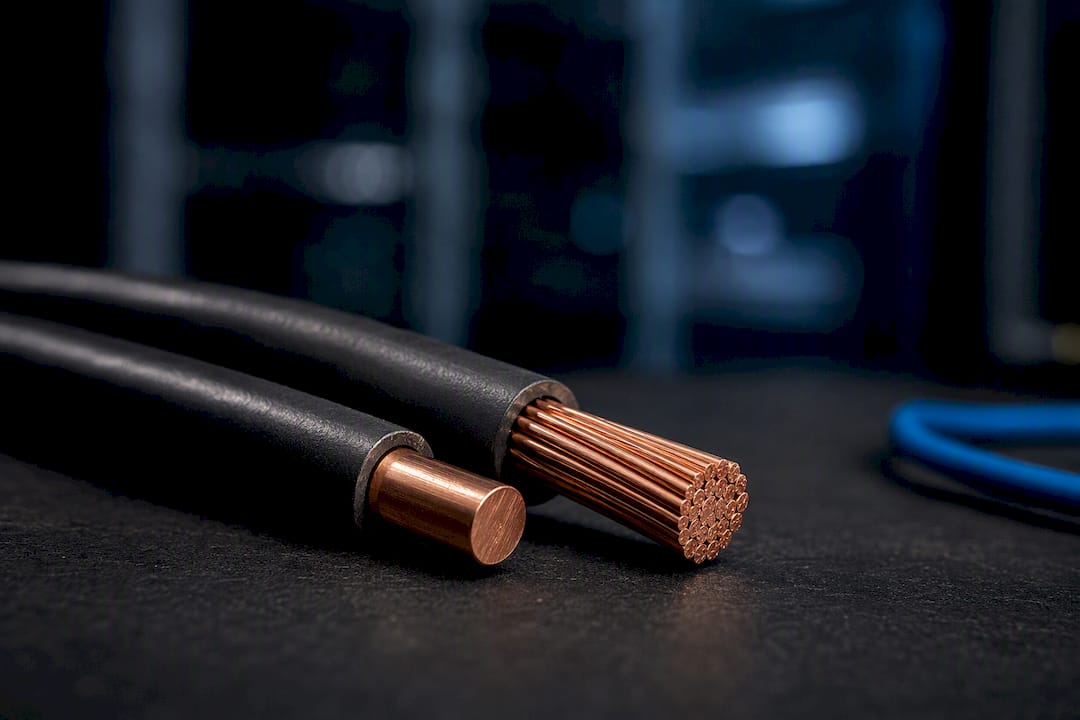
Use solid conductor for fixed, permanent runs where electrical performance and long-term stability matter most, and use stranded conductor for anything that moves, flexes, or needs frequent termination. The trade-off is straightforward: solid wire delivers lower resistance and better signal performance over distance, while stranded wire survives bending, vibration, and repeated handling that would fatigue and crack a solid core.
TL;DR:
- Solid wire is preferred for fixed, permanent installations like in-wall circuits and backbone data runs due to its lower resistance and easier termination.
- Stranded wire is better suited for patch cords, movable equipment, and applications with frequent bending because it tolerates more flex cycles without fatigue.
- For cables above roughly #8 AWG, stranded construction is generally favored even in fixed power runs to simplify routing and termination.
- When mixing wire types, use connectors rated for both solid and stranded conductors, and verify compatibility before installation.
- Proper termination techniques, especially ferrule crimping and testing, are critical to prevent faults, especially in PoE-heavy or high-frequency environments.
Solid vs Stranded Wiring Guide: The Technical Differences
A solid conductor is a single strand of copper. A stranded conductor bundles multiple thinner copper strands, twisted together, inside the same insulation jacket. That construction difference drives every practical decision that follows, from how a cable behaves in a wall cavity to how it performs at gigabit speeds.
In building wire, Southwire’s Romex (NM-B) product line uses solid copper for #14 AWG through #10 AWG, then switches to Class B compressed stranded copper for #8 AWG through #2 AWG. That split is not arbitrary. Below #10 AWG, solid conductor properties (stiffness, easy termination, lower cost) win out. Above that gauge, the wire gets thick enough that a solid core becomes hard to bend into a panel, so manufacturers shift to stranded construction for handling.
Electrically, solid wire typically has lower DC resistance and lower high-frequency attenuation than stranded wire of the same gauge, which is why Leviton’s tech brief on patch cords recommends solid for horizontal permanent links and reserves stranded for shorter patch cord runs. Skin effect, where high-frequency current concentrates near the outer surface of a conductor, amplifies this gap at data-cabling frequencies, though it rarely matters for standard 60 Hz power wiring at typical building gauges.
Mechanically, the roles flip. Key differences:
- Solid wire has a fixed bend radius and cracks or fatigues if flexed repeatedly at the same point.
- Stranded wire tolerates a tighter bend radius and far more flex cycles before any strand fails.
- Higher strand counts generally mean better flex life but slightly higher resistance per gauge.
- Solid wire holds its shape once bent, which helps with dressing cable neatly in a panel or rack.
When Should You Use Solid vs Stranded Wire?
Matching conductor type to the job comes down to one question: does this wire move once it’s installed? Here’s how that plays out across common scenarios.
- In-wall branch circuits. NM-B (Romex) branch wiring in residential and light commercial walls uses solid conductor almost exclusively at #14 through #10 AWG, precisely because the wire is installed once and never touched again.
- Horizontal and backbone data cabling. Structured cabling runs from a telecom closet to a wall jack should use solid conductor cable for the same reason. It punches down cleanly into IDC terminations and holds its electrical performance over the full length of the run.
- Patch cords and movable equipment. Anything plugged, unplugged, or repositioned regularly, patch cords, extension cords, equipment leads, needs stranded wire’s flex tolerance.
- Conduit runs requiring flexibility. When a cable has to snake through tight conduit bends or gets pulled through congested pathways, stranded construction eases the pull and resists kinking.
- Automotive, marine, and speaker applications. Constant vibration and motion make stranded conductor properties, not solid, the practical requirement for these environments.
- Large-gauge power conductors. Once you’re above roughly #8 AWG, stranded is often preferred even for fixed power runs, simply because a thick solid conductor becomes difficult to route and terminate in a panel.
Can You Mix Solid and Stranded Wire Safely?
Yes, but connector compatibility decides how. Mixing is common in real installations, a stranded pigtail off a solid branch circuit, a stranded patch cord into a solid horizontal run, but Fluke Networks warns that many push-in connectors are rated for solid conductors only. Forcing stranded wire into a solid-only push-in fitting creates a loose connection that can arc or fail over time.
Safe options for joining the two types:
- Use a connector explicitly listed for both solid and stranded conductors, check the printed spec on the connector body.
- Use screw terminals with ferrules crimped onto the stranded end for a solid, gas-tight connection point.
- Use crimped lugs or butt connectors rated for stranded wire when joining outside a screw terminal.
- Tinning stranded ends with solder is acceptable for some low-vibration screw terminals but is generally discouraged under a torque-tightened screw, since solder can cold-flow and loosen over time.
Pro Tip: Before trusting any mixed termination, check the connector’s spec sheet for its conductor rating, torque it to the manufacturer’s value, then tug-test and check continuity. A connection that looks solid can still be electrically marginal.
How Does PoE Affect Solid vs Stranded Patch Cords?
Power over Ethernet punishes stranded wire’s higher resistance in ways plain data transmission never would. Because stranded conductors run slightly higher DC resistance than solid conductors of the same gauge, they generate more heat when carrying PoE current, and that heat compounds when cables are bundled tightly in ceilings or cable trays.
Fluke Networks documents de-rating examples for mixed-conductor channels: a 24 AWG stranded patch cord might require a 0.2 length de-rating factor, while thinner 26 AWG stranded cord can require a 0.5 de-rating factor against the total permanent-link budget. That math matters the moment you’re stacking a long solid backbone run with stranded patch cords at both ends.
Practical rules for PoE-heavy deployments (wireless access points, cameras, lighting controllers):
- Prefer solid conductor for the permanent link and any run through uncontrolled or high-ambient-temperature spaces.
- Keep stranded patch cords short, especially inside ceiling bundles or dense cable trays.
- Run the de-rating math whenever a channel mixes solid and stranded segments, rather than assuming the standard 100-meter channel length applies untouched.
Solid vs Stranded Wire: A Quick Buying Checklist
Work through these steps before you order cable or write a spec line:
- Decide if the run is fixed and permanent or flexible and frequently handled.
- Measure the total run length and note how tightly cables will be bundled together.
- Check the termination point, connector, or terminal, and confirm it’s listed for the conductor type you plan to use.
- Confirm AWG size against the expected ampacity or data throughput for that circuit or link.
- Factor in PoE load and ambient temperature if the run feeds powered network devices.
- Default to solid conductor for permanent horizontal or backbone links, and stranded for patch cords, movable equipment, and flex-heavy routing.
Bulk in-wall cable and building wire is typically sold on reels for permanent installs, while patch cords come pre-made in fixed lengths for exactly the flexible applications described above. Stranded cable of comparable gauge often costs slightly more per foot than solid due to the extra manufacturing step of twisting multiple strands, though the price gap is rarely the deciding factor once termination and application requirements are accounted for.
For large-gauge power runs feeding heavy equipment, the same flexibility logic applies at industrial scale. EV charger cable management for depot and fleet installations relies heavily on stranded conductors for exactly the routing and handling reasons outlined above.
Field Notes: What Installers Get Wrong With Solid and Stranded Wire
The most common termination failure seen in the field isn’t wire choice, it’s strand splay. When installers push stranded conductor into a screw terminal without a ferrule, individual strands fan out, and only a few actually make contact under the screw head. Wrapping the strands clockwise before tightening, or better, crimping on a ferrule, solves this in seconds.
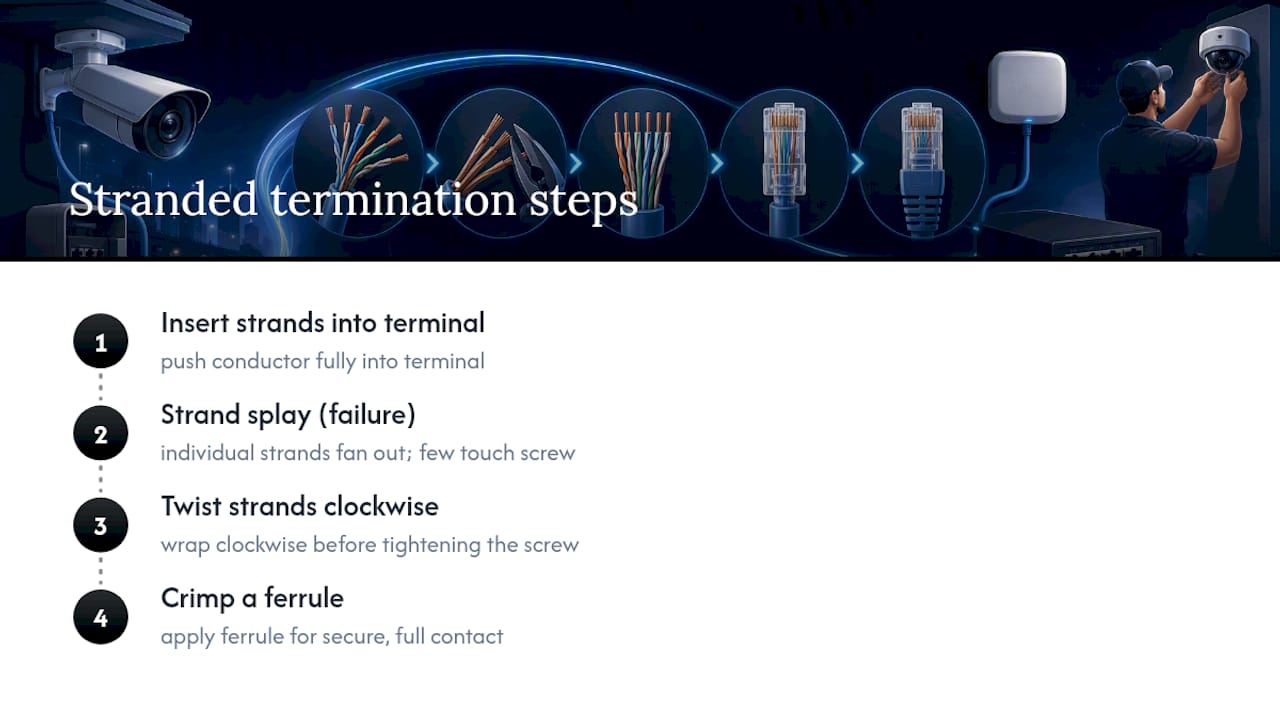
Two other recurring mistakes: forcing stranded wire into push-in connectors that are only rated for solid, and running long stranded patch cords through PoE-loaded ceiling bundles without checking de-rating. Both create intermittent faults that are miserable to diagnose after the fact.
With more than 40 years of combined field experience, every structured cabling installation, including CAT6A runs and cable testing, is tested and certified before calling a job complete.
What Actually Matters When Choosing Between Solid and Stranded Wire
Most guides to solid vs stranded wire treat it as a binary choice, pick one and move on. In practice, the harder decision is what happens at the boundary between the two, where a solid backbone meets a stranded patch cord, or where a stranded pigtail lands on a screw terminal designed for solid wire. That boundary is where installations actually fail.
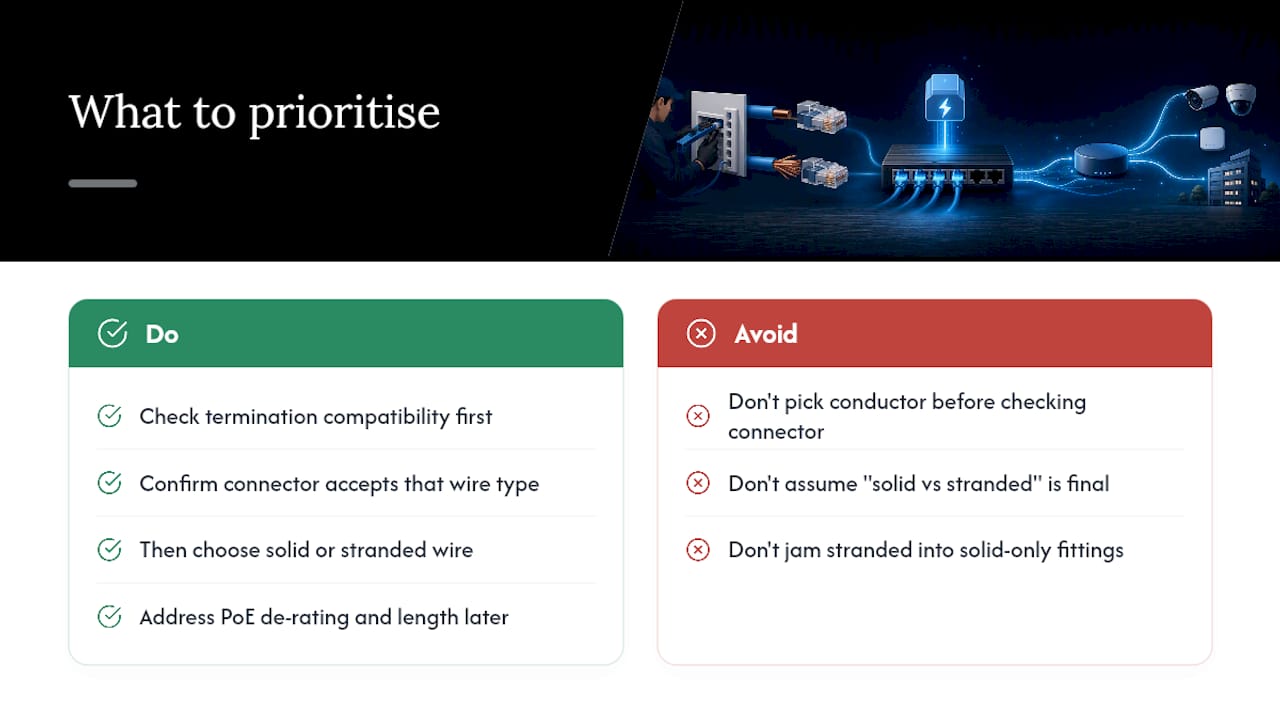
The conventional advice, “use solid for fixed runs, stranded for flexible ones,” is correct but incomplete. It skips the part where connector listing overrides gauge and application every time. A perfectly reasonable stranded patch cord jammed into a push-in fitting rated for solid only will cause more callbacks than any wire-type mismatch ever will.
If you take one thing from this guide, prioritize the termination check before the conductor choice. Confirm what the connector accepts, then pick your wire. PoE de-rating and channel length math matter too, but they only become relevant once the physical connection itself is sound.
— Ken
Get Termination and PoE-Aware Cabling Done Right the First Time
Getting the wire type right solves half the problem. Getting the termination, testing, and PoE load calculations right is what actually prevents callbacks, and this expertise is crucial for commercial projects.
Structured CAT6 and CAT6A installation, proper termination with ferrule crimping on stranded runs, full cable testing and certification, and PoE-aware design that accounts for de-rating are critical steps before any cable is installed. If your office, server room, or telecom closet needs a cabling plan that won’t develop mystery faults six months in, start with the structured cabling components guide or request a quote for CAT6 installation in your building.
Sources
This guide draws on Southwire’s Romex NM-B specifications for building wire construction, Fluke Networks’ cabling guidance on PoE and connector compatibility, Leviton’s tech brief on patch cord performance, and AnD Cable’s overview of conductor wiring in modern networks.
- Southwire Romex® Brand NM-B cable product specifications
- Stranded vs. Solid Wire Cable: How to Choose — Fluke Networks
- Solid vs. stranded patch cords — Leviton tech brief
FAQ
Is Romex Wire Stranded or Solid?
Romex (NM-B) uses solid copper conductors from #14 AWG through #10 AWG, then switches to Class B compressed stranded copper from #8 AWG through #2 AWG, according to Southwire’s product specifications.
Is 8 Gauge Wire Solid or Stranded?
At #8 AWG, Southwire’s Romex NM-B line uses Class B compressed stranded copper rather than solid, since that gauge is thick enough that stranding improves handling and routing.
Can You Use Solid Wire With Stranded Wire?
Yes, as long as the connector or terminal is listed for both conductor types; many push-in connectors accept solid only, so a screw terminal with a ferrule or a dual-rated connector is the safer route, per Fluke Networks.
Which Is Cheaper, Solid or Stranded Wire?
Solid wire is typically slightly less expensive per foot than stranded wire of the same gauge, since stranded construction requires an extra manufacturing step to twist multiple copper strands together.
When Should I Choose Stranded Over Solid for a Patch Cord?
Choose stranded for any patch cord or connection that gets moved, flexed, or replugged regularly; Leviton recommends stranded specifically for patch cords while reserving solid for permanent horizontal links.