
Rooftop AP Cabling in NYC: Code, Cable and Routing
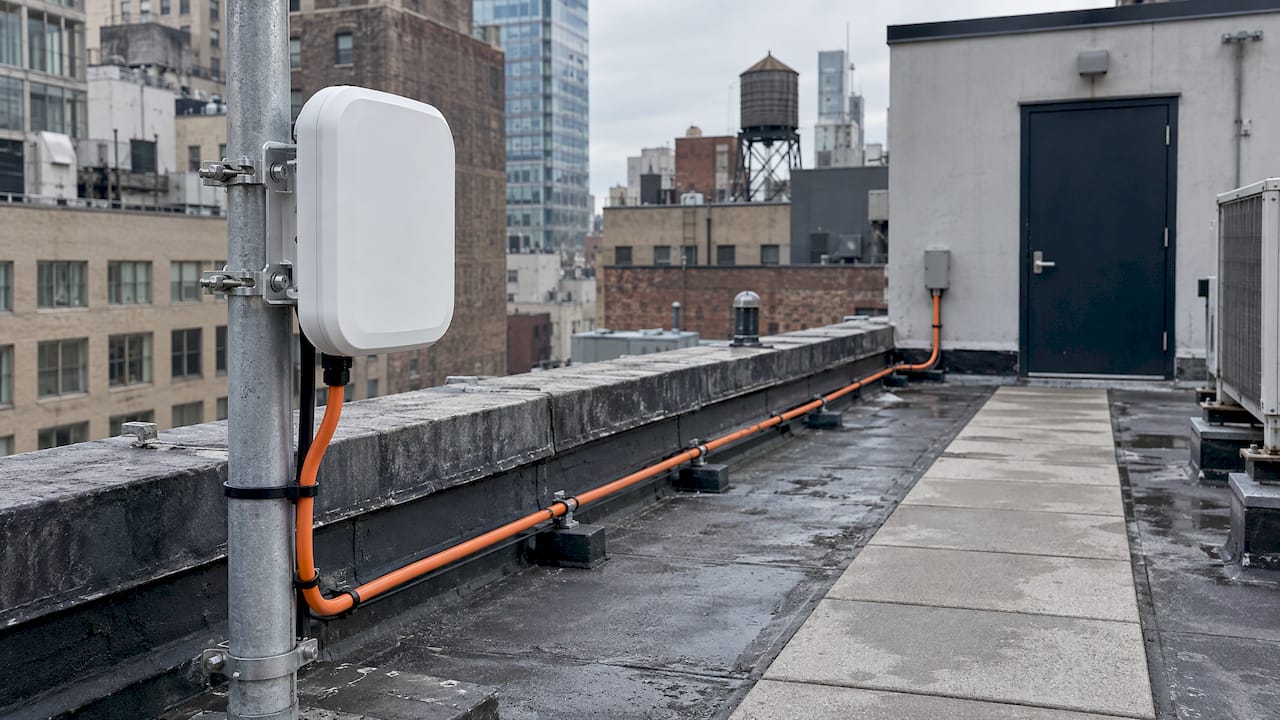
Rooftop access point (AP) cabling in New York City is a low voltage job that touches the Fire Code, the Building Code, the Electrical Code, the roof membrane and the building’s lease terms. The cable itself is the easy part. The cost and the rework come from pathways, penetrations, grounding, labeling and coordination with other trades. Cables & Chips is a Lower Manhattan low voltage contractor with more than 40 years of commercial experience in NYC, and we plan rooftop runs as one documented system: structured cabling, testing, and a pathway that stays out of the roof’s access routes.
TL;DR
- Use shielded, outdoor-rated, UV-resistant copper cable, terminated with the AP’s cable gland, a drip loop and a 6 AWG ground wire where the manufacturer specifies it.
- Keep the channel within 100 m (328 ft) including patch cords. For high-power PoE, use pure copper 23 AWG or Cat6A and shorter runs.
- NYC Fire Code 504.4 limits what you can put in the rooftop clear path and requires color-coded, labeled conduit. Low voltage conduit is orange.
- Power work needs a NYC-licensed electrician and an ED16A permit. Plan roof penetrations and firestopping before cable is pulled.
- Outdoor deployment often costs 2 to 4 times the hardware, so site selection and pathway planning decide the budget.
Start with the roof, not the access point
A rooftop AP location is a building decision before it is a Wi-Fi decision. The NYC Department of Buildings (DOB) antenna code notes list what to assess: Building Code standards for antenna location, access, loads and grounding; Fire Code rooftop access and obstructions; Electrical Code Article 810; zoning; the building’s legal use; and whether the installation fits the TPPN 5/98 antenna exemptions. Under those exemptions, antennas may extend no more than 6 ft above the roof or parapet, within stated size and area limits.
Structures matter too. The same notes call for corrosion-resistant noncombustible construction (BC 3108.3), a design for dead load plus ice load and two times the calculated wind load (BC 3108.4), and inspection access by step bolts and ladders (BC 3108.2). A pole, bracket or parapet mount for an AP falls into this thinking, so confirm the structural basis before ordering hardware.
Height and coverage
Higher is not better. A Cisco Live 2025 session recommends mounting omni APs below 40 feet, on building corners, and planning RF coverage like lighting: where would you hang a light to minimize shadows? Manufacturer guides agree. Cisco’s Catalyst 9124AX guide recommends no higher than 40 feet, and Cambium’s installation guide recommends keeping AP height under 10 meters (about 35 ft). Our guides on AP mounting height and enterprise WiFi design cover the indoor side of the same planning.
The Cisco Live deck also notes that outdoor AP deployment cost is often 2 to 4 times the hardware cost, driven by fall protection, engineering approval and pathway work such as coring. That is why the survey comes first: a location that needs no coring and no engineered counterweight can save more than any hardware discount.
Choosing cable, power and run length
Outdoor APs are not wired like ceiling APs. Vendors specify the cable down to the jacket and the conductor.
| Requirement | What the vendor guide says |
|---|---|
| Cable type | Shielded, outdoor-rated, CAT5e or better (Cisco 9124AX); UV-resistant with the included gland (Aruba 360) |
| Cable diameter for gland | CAT5e 3.5 to 6.5 mm, CAT6/6A 5 to 9 mm (Meraki CW9163E) |
| Maximum length | 100 m (328 ft) end to end (Meraki CW9163E) |
| Multigig speeds | CAT6 or better for 2.5 Gbps; CAT6A above 50 m for 5 Gbps; shielded and continuous in high-RF areas (Cambium) |
| Grounding | 6 AWG copper ground wire; ground rod as local regulations require (Cisco 9124AX, Meraki) |
| Drip loop | Required by Cisco 9124AX |
PoE and conductor gauge
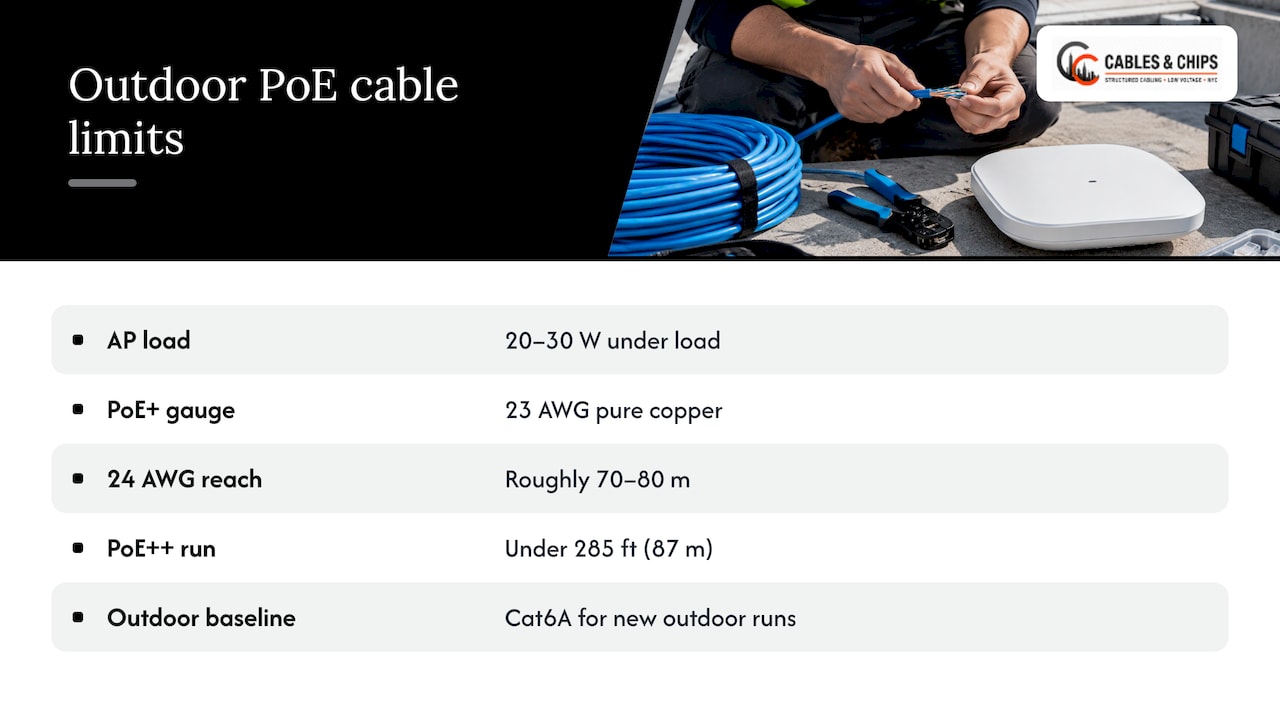
Modern outdoor Wi-Fi 6/6E APs commonly draw 20 to 30 W under load, so 802.3at is the practical baseline, according to a PoE injector guide that also recommends Cat6A as the minimum for new 802.3at and 802.3bt outdoor runs. Conductor gauge matters on long runs. A cable gauge planning guide suggests 23 AWG pure copper for PoE+ on long runs and roughly 70 to 80 m when using 24 AWG. For 90 W PoE++ rooftop installs, iDter’s cable requirements call for pure copper (not copper-clad aluminum), shielded cable with outdoor-rated shielded connectors, and roof cable runs under 285 ft (87 m) to allow for higher temperatures.
The jacket and the termination count as much as the category. An outdoor Ethernet review points out that outdoor polyethylene-jacketed cable is commonly not rated for unrestricted indoor use, so you need a transition point or dual-rated cable where it enters the building. It also stresses specifying cable, junction boxes and glands as one system. The same logic applies to our Cat6A guidance for Wi-Fi 6E and our PoE limit guide for outdoor cable types, which apply equally to rooftop cameras and APs.
Routing on a NYC roof: Fire Code rules
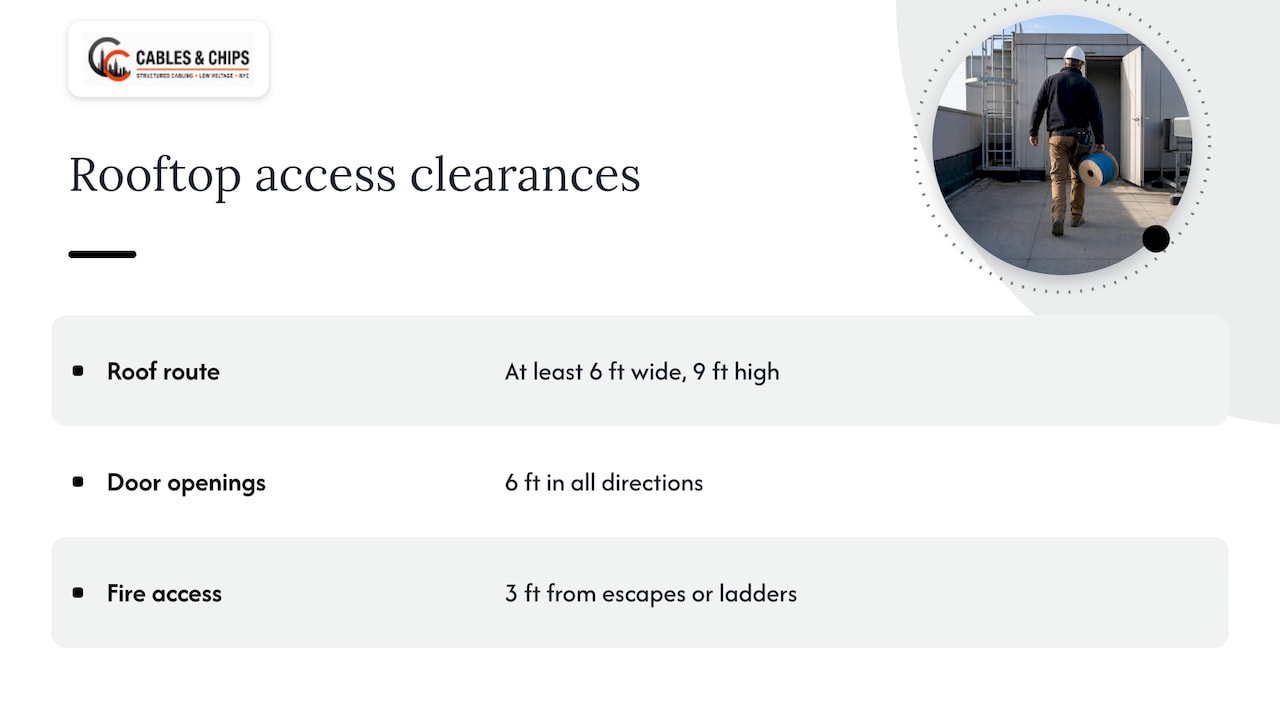
Rooftops are regulated access routes for firefighters. Fire Code 504.4 requires a clear path at least 6 ft wide and 9 ft high across the roof, with conduits or pipes allowed to cross only as 504.4.7 permits. It also requires 6 ft of clearance in all directions from rooftop door openings and 3 ft from fire escapes or access ladders.
Where conduit or tray cannot avoid those areas, the rooftop telecommunications provisions require installations that facilitate access and minimize tripping hazards. Noncombustible steps, ramps, platforms or ladders with railings must allow passage over installations more than 1 ft high or 24 in wide. Conduits must carry continuous, durable, weatherproof reflective or luminescent color coding, and low voltage wiring is orange. Installations made after July 1, 2014 must also be continuously labeled to indicate contents.
Transmitting antennas need markings reading “TRANSMITTER” in lettering at least 3 inches high. A durable sign near the main electrical panel, the bulkhead or roof hatch, and the equipment closet must identify the owner, give a 24/7 contact number and identify the installation. FCC RF exposure limits must be met, with certification by a qualified, trained person submitted with rooftop access applications and on request during inspections. Confirm with the DOB and your filing professional which of these provisions your AP model triggers.
Grounding, penetrations and firestopping
Grounding and surge protection
Ground the AP, mount and cable shield as the manufacturer directs. For rooftop antenna sites, ANSI/TIA-607-B directs lightning protection conductors per NFPA 780, a roof wire ring around the antenna support, at least two down conductors from opposite sides of the ring, and a telecommunications grounding busbar where antenna cables enter at the roof. The DOB notes require the installation to be permanently and effectively grounded. Cambium requires the AP to sit below the lightning air terminal on pole or tower mounts, with grounding kits at the top and bottom bonded to the tower ground bus bar.
Protecting the membrane
The roof is the building owner’s largest water barrier. IIBEC’s Technical Advisory 021-2021 recommends membrane protection (walk pads matched to the membrane, rubber pads, concrete pavers or elevated walkways) around rooftop equipment and the pathways between it. Cisco’s deck describes two routes: a non-penetrating roof mount counterweighted with pavers on a minimum 1/2-inch rubber mat, which may need seismic bracing or engineering analysis, or a penetrating path such as an electrical weatherhead or a cored 3-inch conduit hole with a pre-cast slab over the drop and an elevated conduit on rubber blocks.
Every penetration through a rated floor, wall or roof assembly must be sealed. See our guides to NYC firestopping rules and firestopping low voltage cable for what inspectors expect, and to abandoned cable code for old runs you may find on the roof.
Coordinating the trades
Rooftop AP work is rarely one trade. A workable sequence:
- Survey. Walk the roof with the facilities lead and the roofer of record. Mark the clear path, door clearances, existing conduit and candidate mount points.
- Pathway decision. Choose between non-penetrating mounts and a penetration. If structural loads or counterweights are involved, bring in the engineer.
- Power and permits. The DOB notes require electrical work to be done by a NYC-licensed electrician and an ED16A electrical permit application for power sources for antennas and related equipment, subject to DOB inspection. An MH mechanical work-type application may relate to associated equipment.
- Cable pull and termination. Pull outdoor-rated cable in orange, labeled conduit. Terminate with the AP’s gland, form the drip loop and bond the ground.
- Firestop and seal. Seal every penetration and restore membrane protection.
- Test and document. Certify each channel, record cable IDs, label both ends and update the closet documentation.
A general contractor should put these steps into the schedule early, since coring, roofing repair and permit inspections drive the calendar. Our team handles the low voltage scope, from cable testing and certification to documentation, and coordinates with the other trades on the job.
Testing, labeling and keeping it maintainable
Certify the finished channel, not just the cable. Fixed cabling and pathways should follow TIA-568 and TIA-569, bonding follows TIA-607, and products should be UL listed or third-party certified, as NYCHA’s structured cabling guidelines state for its projects. On long PoE++ runs, iDter also recommends verifying loop resistance with a multimeter. Record results by cable ID so the IT team can trace a failed AP back to a specific run.
Maintenance belongs in the plan. IIBEC advises that roof maintenance plans account for how often equipment is accessed, and that leased roof space may need more frequent inspection. Owners should assign tenant or carrier responsibility for repairs around new, abandoned or modified penetrations in the lease.
Our view: treat the roof run as permanent infrastructure
We have spent more than 40 years in New York commercial buildings, and our position is simple: a rooftop AP is only as dependable as its cable path. Specify the jacket, the shielding, the gland and the ground as one system. Keep the run inside the vendor’s length and power limits. Route it where the Fire Code allows, label it, test it and document it.
The clean version of this job costs less over the life of the building, because the next person to open the closet or walk the roof can see what every cable does. That is what we build: clean, documented, tested installations, with a no-obligation site survey before any scope is fixed.
Ken
Plan your rooftop AP run with us
Cables & Chips is licensed and insured, based at 20 Vesey Street, and offers fast local NYC response and a no-obligation site survey. Our services include structured CAT6 cabling, cable testing and certification, WiFi design, fiber installation and MDF/IDF cleanup, so the roof run, the backbone and the closet are documented together. See our services or contact us through cables.nyc to schedule a site survey.
FAQ
Can I use regular Cat6 for a rooftop access point?
Only if it is outdoor-rated. Vendors specify shielded, UV-resistant, outdoor-rated cable with a jacket that fits the AP’s gland. Indoor-rated cable can fail outdoors, and outdoor cable needs a proper transition where it enters the building.
How long can a rooftop AP cable run be?
The Ethernet limit is 100 m (328 ft) end to end, including patch cords. For high-power PoE, runs are shorter: iDter calls for roof cables under 285 ft (87 m), and guides suggest roughly 70 to 80 m for 24 AWG cable.
Do I need a licensed electrician?
For power sources for antennas and related equipment, yes. The DOB notes require a NYC-licensed electrician and an ED16A permit application. Your filing professional can confirm which filings your installation needs.
What color should rooftop low voltage conduit be?
Orange. NYC Fire Code requires rooftop conduit to be color-coded with durable, weatherproof reflective or luminescent markings, and low voltage wiring is orange. Installations made after July 1, 2014 must also be labeled to show their contents.
Sources
- NYC DOB: Antenna, Cellular + Telecom code notes
- NYC Fire Code 504.4 Rooftop access and obstructions
- NYC Fire Code 504.4.10 Rooftop telecommunications installations
- Cisco Live 2025, IBOEWN-2000
- Cisco Catalyst 9124AX hardware installation guide
- Cambium Enterprise Wi-Fi 6 and 7 AP installation guide
- Aruba 360 Series outdoor AP installation guide
- Cisco Meraki CW9163E installation guide
- iDter PoE++ power and cable requirements
- Outdoor Ethernet review
- PoE cable gauge and distance planning
- PoE injectors for outdoor wireless access
- ANSI/TIA-607-B grounding and bonding
- IIBEC Technical Advisory 021-2021
- NYCHA structured cabling design guidelines