
Facility Managers: 5 Questions Before Buying Rack Seismic Bracing
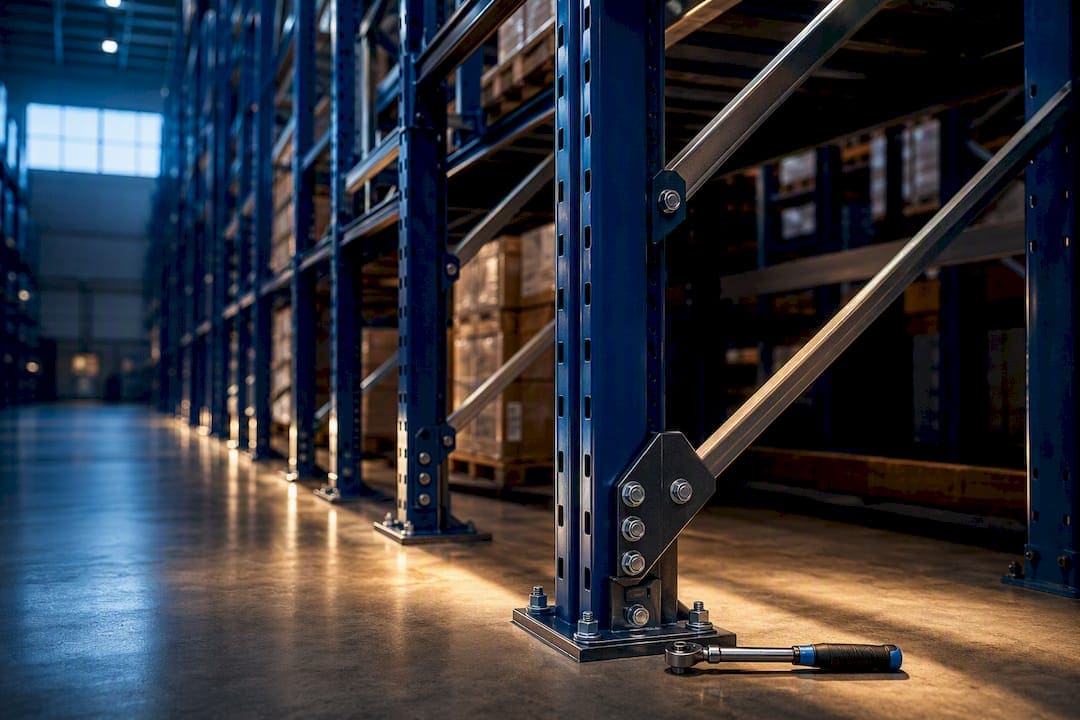
Most industrial pallet racks and every equipment rack should be evaluated for seismic bracing through an address-based seismic check and, in higher-risk zones, a PE-reviewed design. Whether bracing is mandatory depends on your Seismic Design Category (SDC) and rack type, so the next move is simple: run a site-specific seismic lookup or call an engineer or vendor for a preliminary review, referencing ANSI MH16.1 and IBC. For server and equipment racks specifically, specialized contractors can help facility teams sort out what verification and hardware actually apply.
TL;DR:
- Seismic bracing requirements depend on the facility’s exact address, soil class, and local building department interpretation, not just broad seismic zones.
- Higher Seismic Design Categories generally require PE-stamped engineering designs, especially for tall, heavily loaded pallet racks, before procurement or installation.
- Different bracing methods, such as diagonal, K-brace, or cable kits, are selected based on cost, installation disruption, and rack height or load, with pallet racks needing multiple bracing types and anchoring.
- Slab capacity verification is critical before hardware order, as many failures result from underestimated concrete strength, especially on thinner or older slabs.
- Retrofitting older racks involves replacing or adding anchoring and bracing, with site-specific engineering assessment necessary if slab support or transfer location impacts seismic safety.
What Rack Seismic Bracing Actually Does
Rack seismic bracing keeps a loaded rack structure from overturning, sliding, or ejecting its contents when the ground moves. Three failure modes drive most of the engineering: overturning at the base, uplift at the anchor points, and inventory sliding off shelves or pallets during lateral shaking. Pallet racks and equipment racks fail differently, so bracing looks different for each.
- Pallet racks are tall, heavily loaded, and prone to overturning under lateral seismic force, which is why diagonal and sway bracing target the upright frames.
- Equipment and server racks carry lighter, denser loads at lower heights, but a toppled server cabinet can knock out an entire network closet, so anchorage and cabinet stability matter more than tall-frame bracing.
- Both categories fall under the same broad code umbrella, but the Rack Manufacturers Institute writes storage-rack provisions with pallet racking in mind, so equipment racks often need separate engineering judgment.
Liability is the quiet driver behind most of this. A rack that collapses in an earthquake is a life-safety and insurance problem, not just a maintenance headache, which is why building departments increasingly ask for engineered documentation before issuing a certificate of occupancy for a warehouse or data floor.
When Is Seismic Bracing Required for Racks?
Whether you need engineered bracing comes down to your Seismic Design Category, your rack height and load, and how your local building department interprets IBC provisions for storage racks. The relevant reference standard is ANSI MH16.1-2023, the RMI standard the International Building Code now points to directly for seismic and stability calculations. Some jurisdictions also reference the RMI R-Mark certification program as a marker of code-compliant rack design.
Seismic design isn’t determined by broad state zones anymore. It’s address-specific, meaning two warehouses ten miles apart can land in different Seismic Design Categories depending on soil class and proximity to a fault.
Four steps get you to a defensible answer fast:
- Run your facility’s exact address through Seismicmaps or a USGS seismic hazard tool to get your Seismic Design Category.
- Pull your slab drawings, or request them from the building owner if you don’t have them on file.
- Share rack height, layout, and average pallet or equipment weight with an engineer or bracing vendor for a preliminary read.
- Request PE-stamped drawings if you’re in SDC C or above, installing new racking, or your building department requires it for permit.
Higher SDC categories generally require engineered, PE-stamped rack designs, while lower categories may only need standard anchoring per manufacturer specifications. That threshold is exactly why the address check comes first, before you spend money on hardware.
Diagonal, K-Brace, Cable, or Panel: Which Bracing Method Fits?
Bracing methods trade off cost, installation disruption, and how much lateral force they resist, and the right choice depends heavily on whether you’re bracing tall pallet racking or a server cabinet row.
- Diagonal steel bracing ties uprights together at an angle and is the standard approach for tall pallet rack frames facing lateral overturning risk.
- K-bracing uses two diagonal members forming a K shape between uprights, adding stiffness where diagonal bracing alone isn’t enough for taller or heavier-loaded frames.
- Sway and cable bracing kits are lighter-duty retrofits, often bolted onto existing frames without major structural rework, common where budgets or downtime windows are tight.
- Brace panels are solid steel plates bolted between frame members, offering high stiffness in a compact footprint, useful in narrow-aisle layouts.
- Anchor-only upgrades skip added structural bracing entirely and instead reinforce baseplates and anchors, sometimes sufficient for lighter equipment racks in lower SDC zones.
Pallet racks almost always need some combination of diagonal or K-bracing plus anchoring. Equipment racks more often just need verified anchorage and cabinet-to-cabinet bracing, since their lower center of gravity reduces overturning risk.
Pro Tip: Ask any bracing vendor for the expected lifecycle of their hardware. Cable and sway kits are fast to install but some require periodic tension checks, while welded diagonal bracing is largely maintenance-free once installed correctly.
Anchors, Base Plates, and the Slab Capacity Problem
Anchor selection and slab capacity are where seismic rack projects most often go wrong, largely because the slab is invisible until someone drills into it. Wedge anchors work in solid, uncracked concrete and are common for standard installs, while epoxy anchors offer higher pullout resistance and are often specified for high-seismic uplift loads. Baseplate enlargement spreads uplift force over a wider area, reducing the load any single anchor has to carry.
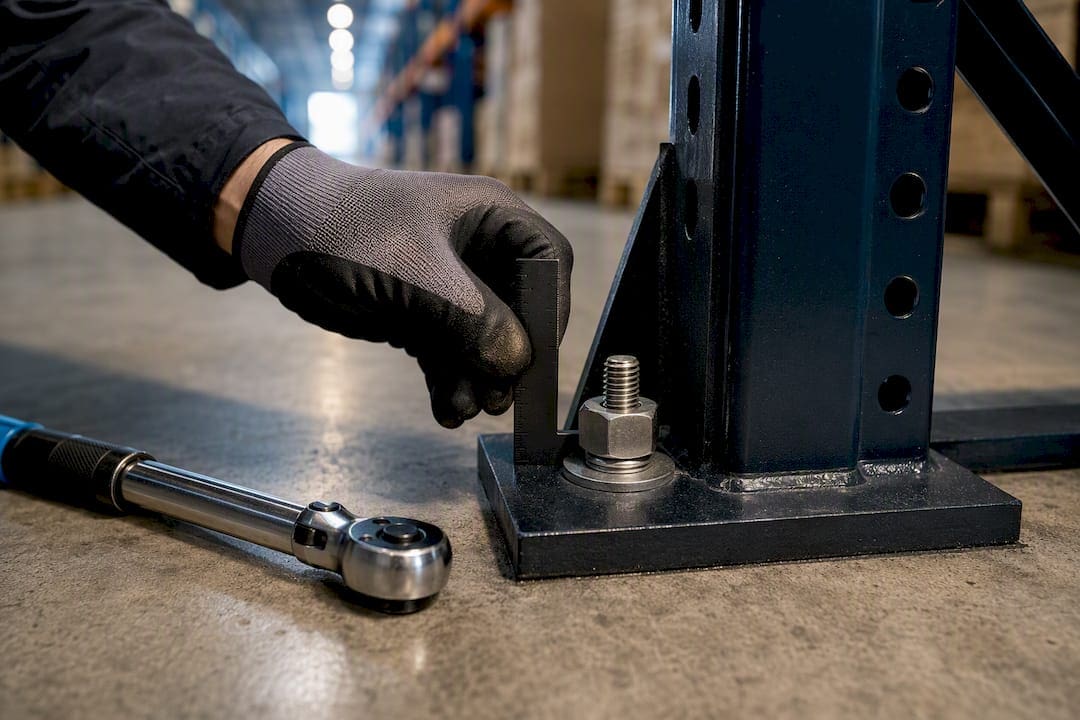
The hidden constraint is the slab itself. A standard six-inch slab may not have the capacity that high-seismic anchor designs assume, which means the bracing kit can be engineered correctly and still fail if the concrete beneath it can’t hold the anchors.
Before ordering hardware, collect:
- Slab thickness and concrete PSI rating
- Reinforcement type, whether rebar or wire mesh
- Location of any saw cuts, joints, or documented slab repairs
- Anchor pullout test reports and manufacturer ICC-ES listings from your supplier
Ask suppliers for independent test data on anchor performance under seismic loading, not just the manufacturer’s marketing spec sheet.
Site Factors That Change the Whole Design
Engineers can’t design bracing in a vacuum. The inputs they need directly change anchor sizing, baseplate dimensions, and whether a retrofit is even feasible on your existing slab.
A complete design package typically needs:
- Facility address, to establish Seismic Design Category
- Soil classification for the site
- Slab thickness and PSI rating
- Average and maximum pallet or equipment weights per bay
- Rack height, depth, and aisle layout
ANSI MH16.1-2023 shifted the industry toward the Direct Analysis Method (DAM), a more rigorous seismic calculation approach than the older Effective Length Method many existing installations were designed under. DAM tends to produce more conservative, and often more expensive, anchor and baseplate specifications, according to RMI’s own analysis of the updated methodology. That’s worth knowing before you assume a bracing quote from five years ago still applies.
Procurement Checklist: What to Ask a PE or Bracing Vendor
Buying seismic bracing isn’t like ordering shelving. Treat it as an engineering procurement, not a hardware purchase, and the order of operations matters.
- Collect existing slab drawings and structural documents for the facility.
- Run an SDC check against your exact address.
- Send rack layout, height, and load data to a vendor or engineer for a preliminary assessment.
- Require PE-stamped drawings for any new installation or any site in a higher SDC.
- Schedule a slab capacity verification before anchors are ordered or drilled.
When you talk to a vendor or engineer, ask directly:
- Are the drawings PE-stamped in the state where the facility is located?
- Is the design based on ANSI MH16.1-2023 and current local building code?
- What specific anchors and baseplates are being specified, and why?
- Who is responsible for verifying slab capacity before installation?
Red flags include a vendor who quotes bracing hardware without ever asking your address or slab thickness, and generic kits sold without engineering review. Rack that was seismically rated in one region can lose that rating entirely if it’s relocated to a different seismic zone, so used or transferred racking needs a fresh look.
Pro Tip: Never accept “code compliant” as an answer without a specific code section and jurisdiction attached to it. Compliant where, and under which edition of the IBC, are two different questions.
Inspection and Post-Earthquake Procedures
Seismic bracing only works if it stays in the condition it was installed in, which means inspection can’t be a one-time event.
A routine inspection checklist should cover:
- Anchor bolt torque and any visible loosening at baseplates
- Bent, dented, or misaligned upright frames
- Beam-to-column connector integrity
- Decking condition and load-bearing surface wear
- Containment mesh or netting, where installed, for tears or gaps
After an actual seismic event, a facility safety lead or engineer should walk the racking before reloading resumes, quarantining any bay showing visible frame distortion, sheared anchors, or shifted baseplates. Document everything with photos and measurements, since insurers and the local authority having jurisdiction will typically want a record of both the damage and the corrective action taken. Annual inspections are a reasonable baseline in most facilities, with more frequent checks warranted in higher SDC zones or after any moderate tremor.
How Engineers Calculate Seismic Bracing Loads
Seismic bracing design starts with a base shear calculation, essentially estimating the horizontal force an earthquake will impose on the rack structure based on its weight, height, and the site’s seismic parameters. Engineers combine the Seismic Design Category, site soil class, and a response modification factor specific to rack construction to arrive at a design force the bracing and anchors must resist without failing.
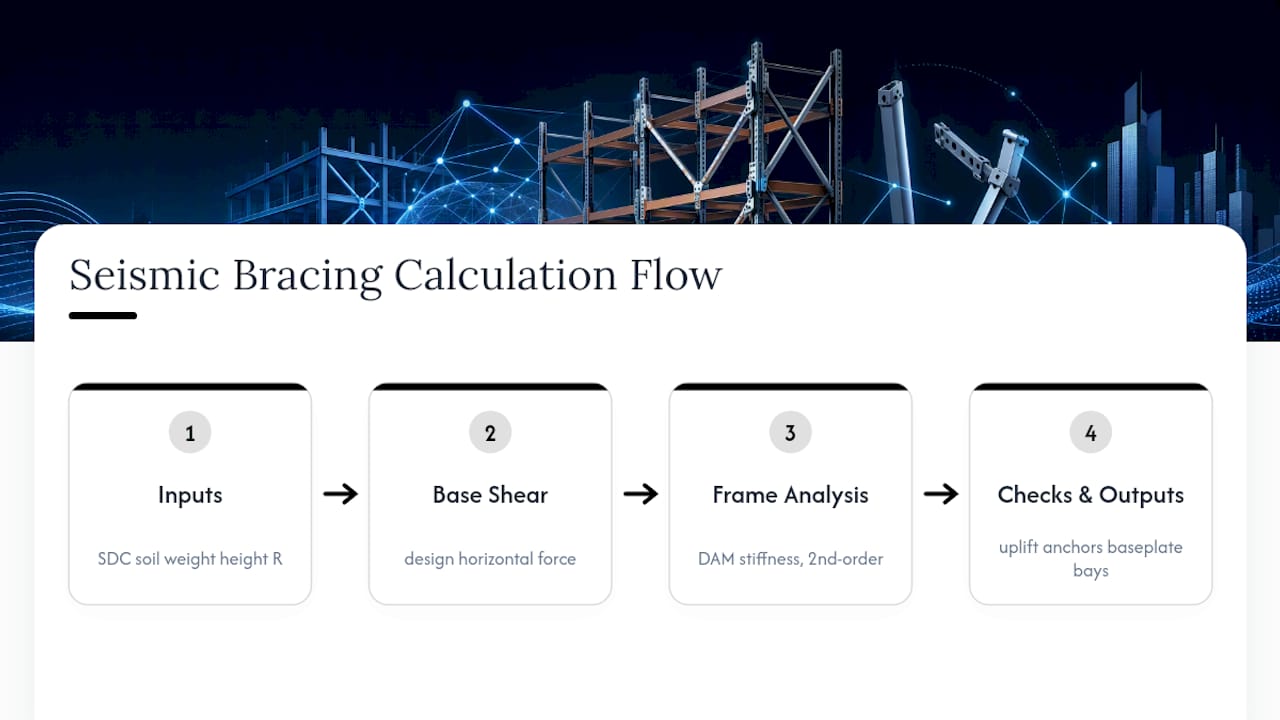
Under ANSI MH16.1-2023’s Direct Analysis Method, engineers model the rack frame’s actual stiffness and account for second-order effects, meaning how much the frame deflects under load changes the forces it experiences. Older Effective Length Method calculations used simplified assumptions about frame behavior that DAM replaces with more precise modeling, generally producing more conservative anchor and brace sizing.
Uplift force at the base of the upright frame is often the governing calculation for anchor selection, since a rack rocking under lateral load can generate tension forces at the baseplate that exceed the static weight of the rack itself. That’s why FEMA’s technical guidance treats uplift and baseplate connection detailing as a critical checkpoint, not an afterthought bolted onto a bracing design after the fact.
Engineers also factor in the rack’s fundamental period, essentially how fast the structure sways back and forth, since taller, more slender pallet rack frames respond very differently to ground motion than a squat, dense server cabinet. That calculation determines whether flexible connectors or isolation devices might reduce the design force enough to change the anchor specification, an option worth raising with your engineer on projects where standard bracing would otherwise require slab reinforcement.
Load distribution across multiple bays matters too. A single overloaded bay in an otherwise uniform rack row can concentrate seismic force unevenly, which is one reason engineers ask for actual pallet weights rather than assumed averages.
Does Seismic Bracing Reduce Usable Rack Capacity?
Seismic bracing rarely reduces the vertical load capacity racks are rated for, but it does change how racks get used day to day. Diagonal and K-bracing occupy space between upright frames, which can slightly narrow clear openings in deep or narrow-aisle configurations, something warehouse operators should flag before installation if forklift clearance is tight.
Anchoring requirements can also affect how easily a rack row gets reconfigured. A rack anchored with epoxy anchors sized for high-seismic uplift isn’t something you casually unbolt and move to accommodate a new SKU layout, unlike lighter-duty racking in low-seismic zones. That’s a real operational trade-off warehouse managers should weigh against the flexibility they had with unbraced or minimally anchored racking.
On the equipment rack side, cabinet bracing and secured baseplates generally don’t interfere with usability at all, since server cabinets aren’t reconfigured with anything like the frequency of pallet racking. The bigger consideration for IT teams is cable management around anchored baseplates, since retrofit anchoring sometimes requires temporarily clearing cable runs at the base of a rack row. A well-planned server rack setup accounts for this before cabinets go in, not after.
Weight capacity itself typically increases with proper seismic engineering rather than decreasing, since engineered baseplates and anchors are sized to handle both the static rack load and the added seismic force, meaning a properly braced rack can often carry the same rated load with a documented margin of safety it didn’t have before.
What Seismic Bracing Actually Costs
Seismic bracing costs scale with Seismic Design Category, rack height, and how much of the anchoring has to be re-engineered from scratch, so there’s no single number that applies across facilities. A low-SDC site with modest pallet loads might only need standard anchor bolts installed per manufacturer spec, a comparatively small line item. A high-SDC facility with tall, heavily loaded pallet racking on a marginal slab can require full diagonal bracing, epoxy anchors, baseplate upgrades, and PE-stamped engineering, a substantially larger investment.
Budget planning should account for a few line items beyond the hardware itself:
- Engineering fees for the preliminary assessment and PE-stamped drawings, which scale with facility complexity rather than square footage alone.
- Slab verification and possible reinforcement, since discovering the concrete can’t support specified anchors after ordering hardware is the most expensive mistake in this process.
- Bracing hardware and anchors, priced per bay or per upright frame depending on the vendor.
- Installation labor, which varies based on whether racks need to be emptied and how much downtime the facility can absorb.
RMI’s shift toward the Direct Analysis Method under ANSI MH16.1-2023 tends to push material costs upward compared to older, less conservative calculation methods, since the resulting anchor and brace specifications skew more robust. Facility teams pricing out projects against old quotes should expect that gap and budget for it rather than treating a years-old estimate as current.
Discuss flexible connectors or isolation devices with your engineer early, since these can sometimes reduce the design force enough to avoid a costly slab reinforcement project entirely, an option that’s easy to miss if cost conversations start after the engineering is already locked in.
Retrofitting Existing Racks for Seismic Compliance
Retrofitting existing racking is usually less about replacing the rack and more about correcting whatever the original installation skipped, most commonly proper anchoring and diagonal bracing. Unbraced pallet racks are particularly vulnerable in seismic events, and research into rack fragility shows that adding bracing and anchoring after the fact can meaningfully reduce collapse risk compared to leaving older installations as they were built.
The retrofit process typically starts the same way a new installation does: an address-based SDC check, followed by a slab assessment, since older facilities often have concrete that predates current anchor demands. This is where retrofits can hit a wall. If a slab genuinely can’t support the anchors a high-seismic design calls for, engineers may need to present alternatives rather than force a single prescription, including localized footings poured beneath specific bays, isolation devices that reduce force transfer to the rack, or simply reducing rack height and load in the affected area.
Retrofitting rarely means shutting down an entire warehouse. Most bracing and anchoring work happens bay by bay, or row by row, letting operations continue in unaffected sections. That said, any retrofit involving new anchors into existing concrete needs the same slab verification a new installation would require, since assuming the original slab was built to a modern seismic standard is one of the more common and costly mistakes facility teams make.
Relocated or secondhand racking deserves particular scrutiny during a retrofit review. Rack that carried a valid seismic rating in one facility or region doesn’t automatically carry that rating into a new location, which means a retrofit project involving transferred equipment often needs to start from a full engineering review rather than a lighter touch-up.
What Effective Seismic Bracing Looks Like in Practice
The clearest illustration of why site-specific engineering matters comes from how differently two facilities can be treated under the same general code. A warehouse in a moderate SDC zone with a well-documented, adequately thick slab might only need standard anchor bolts and manufacturer-specified bracing to meet code, a relatively straightforward project completed without major structural intervention.
Contrast that with a facility discovered to be sitting on a thinner slab than its rack design assumed, a scenario RMI has specifically flagged as a common and expensive surprise. In that case, the fix isn’t just bracing, it’s often localized slab reinforcement or a redesign around lower anchor demands, which is exactly why the procurement checklist earlier in this guide puts slab verification before any hardware order.
On the equipment rack side, the pattern looks different again. A telecom or server room retrofit generally doesn’t need diagonal bracing at all, since cabinet height and weight distribution rarely produce the overturning risk that tall pallet racking does. The effective intervention there is almost always anchorage verification and cabinet-to-cabinet bracing, paired with confirming the closet’s slab or raised floor can actually support the anchors specified. Projects that treat server rack installation as a generic bolt-down task, without checking floor loading, are the ones most likely to need costly rework later.
The throughline across every effective implementation is the same: nobody skipped the address-based SDC check, and nobody assumed the slab could handle whatever the hardware catalog specified.
A Publisher’s View: Where Equipment Racks Fit Into Seismic Planning
Most seismic bracing conversations focus on tall pallet racking, but Cables and Chips spends its time on the other half of the problem: server and equipment racks in commercial offices, telecom rooms, and secure facilities across New York City. On these projects, the practical work is verifying that a rack’s baseplate and anchoring match the floor it’s sitting on, then coordinating with a structural engineer when a site’s Seismic Design Category calls for stamped drawings. That’s a narrower, but no less important, slice of the seismic bracing picture than a distribution warehouse full of pallet racking.
— Ken
How Cables and Chips Can Help With Equipment Rack Verification
Specialized contractors are practical options for facility teams who need equipment and server rack work coordinated with real engineering oversight, not a generic bracing kit shipped without ever seeing your floor plan. Where a bracing-only vendor stops at hardware, some contractors bring the rack installation, hardware supply, and on-site coordination together under one contractor familiar with commercial buildings and network closets.
After you reach out, expect a site review of your rack room or telecom closet, a look at floor or slab conditions where anchors would go, and a straightforward quote covering hardware and installation. On projects where a Seismic Design Category calls for PE-stamped drawings, experienced contractors coordinate the installation timeline around that engineering review rather than working around it. The company’s structured cabling and rack services cover the full network closet, not just the rack itself, so anchoring, cable management, and documentation get handled in the same visit. Request a site review to get a quote and an installation timeline.
Where to Verify Codes, Maps, and Technical Guidance
- RMI / ANSI MH16.1-2023: the governing standard for storage rack seismic and stability calculations, referenced directly by the IBC.
- FEMA/NIST technical reports: detailed guidance on uplift, baseplate, and anchor behavior under seismic load.
- SeismicMaps.org / USGS tools: address-based lookups for your Seismic Design Category.
- RMI and industry summaries: ongoing updates as codes and calculation methods evolve.
Sources
- Updated methodology for seismic and stability calculations in rack designs adopted by International Building Code — RMI
- FEMA technical report on rack seismic design
- Seismic safety in warehouses: New standards aim to minimize risk and damage — Modern Materials Handling
- Seismicmaps
FAQ
What is the purpose of seismic bracing?
Seismic bracing keeps loaded racks from overturning, sliding, or ejecting inventory during an earthquake by resisting lateral and uplift forces at the base and along the frame.
Where is seismic bracing required for racks?
It’s required based on a facility’s Seismic Design Category, which is determined by address rather than broad state zones, and higher SDC ratings generally mandate PE-stamped engineered designs.
What are the seismic requirements for pallet racks?
Pallet racks are typically evaluated under ANSI MH16.1-2023, the RMI standard referenced by the IBC, with specific anchor, baseplate, and bracing requirements driven by the site’s SDC, soil class, and slab capacity.
What is a seismic bracing system?
A seismic bracing system combines structural elements like diagonal or K-bracing with engineered anchors and baseplates designed to keep a rack stable under earthquake loading, sized according to site-specific engineering rather than a one-size-fits-all kit.
Do server and equipment racks need seismic bracing too?
Often yes, though the detailing differs from pallet racks; equipment racks generally need verified anchorage and cabinet stability rather than tall diagonal bracing, which is where a contractor like Cables and Chips typically gets involved on server room projects.