
4 Pre Bid Checks to Avoid Prevailing Wage Audits on NYC Low Voltage

Yes, low voltage work on most NYC public projects is subject to prevailing wage when the project meets Article 8’s public work test. Confirm the exact rate on the NYSDOL wage schedule or the NYC Comptroller’s published schedule before you bid. The classification you use, typically Electrician “A” or an Alarm/Teledata category, controls which rate applies, so get that right first.
TL;DR:
- Contractors must verify the prevailing wage schedule for their jurisdiction and trade classification before bidding or performing low voltage work on any NYC public project.
- The classification of work, typically Electrician “A,” directly determines the applicable wage rate, which varies annually and should be checked for the correct effective dates.
- Projects involving public funding or public agency parties trigger prevailing wage requirements under Article 8, with no small-dollar exemptions.
- Accurate recordkeeping, including weekly certified payrolls and posting requirements, is essential to avoid common violations such as misclassification or incomplete documentation.
- Generally, low voltage cabling falls under Electrician classifications, with precise job descriptions on schedules (not titles) guiding proper classification and rate application.
Where to find official prevailing wage schedules for NYC low voltage trades
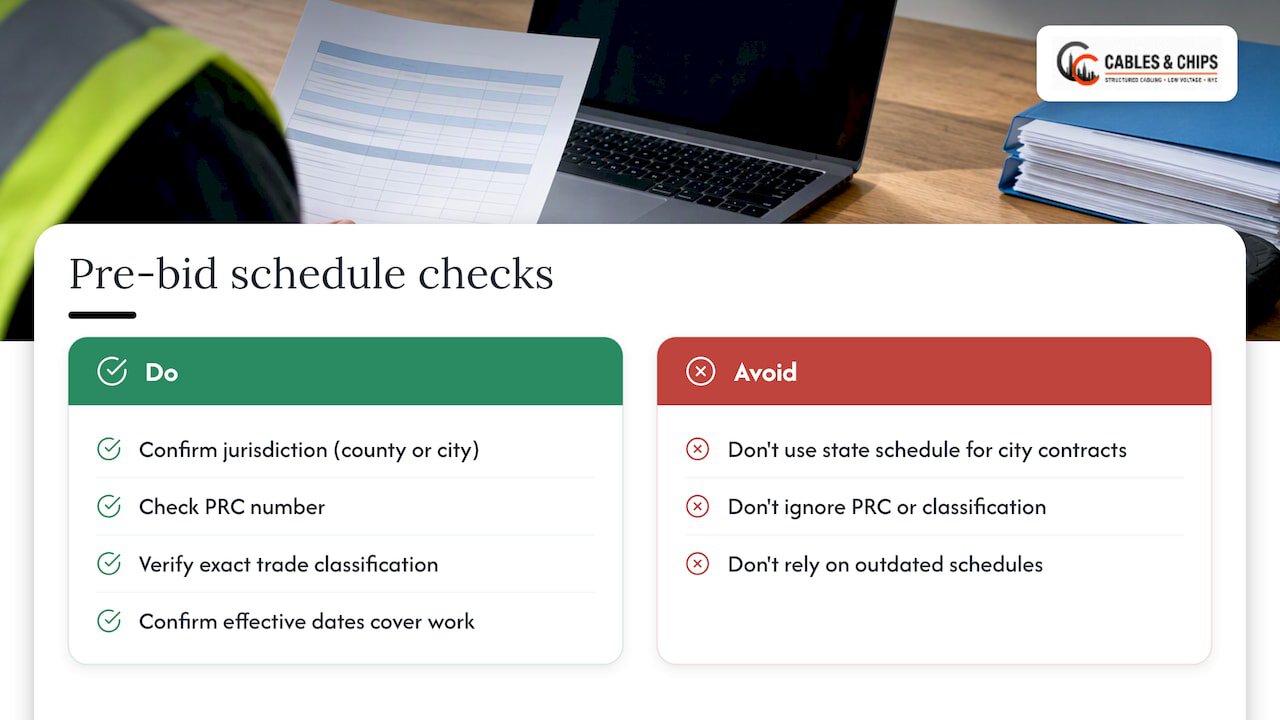
Two sources matter for NYC low voltage contractors: the NYSDOL wage schedule lookup for state and most municipal work, and the Comptroller’s own published schedules for New York City agency contracts. Use the Comptroller’s version when the contracting agency is a city entity, since city schedules sometimes carry classification language tailored to city procurement.
Schedules run on an annual cycle. The Bureau of Public Work’s employer guide explains that preliminary rates typically post around June 1, with final schedules effective July 1 through the following June 30, and interim updates can happen mid-cycle. The Comptroller’s 2026–2027 Construction Worker Schedule sets Electrician “A” rates effective from July 1, 2026 through April 14, 2027, so always check the effective dates printed on the document you pull.
Before you price a bid, confirm four things on the schedule: the county or city jurisdiction, the Prevailing Rate Case (PRC) number if one applies, the exact trade classification, and the effective date range that covers your performance period.
How Article 8 and the three-prong test determine whether a project is public work
New York’s Article 8 applies through a three-prong test: a public agency must be a party to the contract, the work must involve construction-type labor paid with public funds, and the project’s primary purpose must benefit the general public. All three conditions need to be present for the work to count as public work.
There is no dollar threshold that exempts small contracts. A low voltage scope worth a few thousand dollars on a covered project is just as subject to prevailing wage as a seven-figure buildout.
Watch for red flags in your contract documents: a city or state agency named as a party, procurement language referencing public bidding, or funding that traces back to a government grant or loan. Any of these should trigger a classification check before you submit pricing.
Which trade classifications cover low voltage cabling work
The Comptroller’s Construction Worker Schedule spells out that installing low voltage cabling carrying data, video, or voice on building construction projects falls under Electrician classifications. Electrician “A” generally covers new construction and major installation work, while Electrician “M” applies to jobbing and maintenance tasks. Some schedules also list a separate Alarm or Teledata classification depending on the scope and the agency.
Do not guess. Read the actual job description text printed on the schedule rather than relying on a title alone, since two classifications can sound similar but carry different rates. When the description is ambiguous, ask the contracting agency directly or reach out to the Bureau of Public Work for a written determination.
A practical habit: attach the current wage schedule as an exhibit to your bid and note the classification you priced against in your cost breakdown. That paper trail protects you if a dispute comes up later.
Wage components and apprentice rules for low voltage crews
Prevailing compensation on a covered project has two parts: the base hourly wage and a supplemental benefit rate, sometimes called the fringe. Employers can satisfy the supplement through bona fide benefits, such as health insurance or pension contributions, through cash paid directly to the worker, or through an irrevocable trust fund contribution, but whichever method you choose needs a documented hourly cost behind it.
Apprentice rates are available only for workers enrolled in a state-registered apprenticeship program, and only up to the ratio of apprentices to journeyworkers that program allows. If a worker is not registered or your crew exceeds the ratio, you owe the full journeyworker rate for that labor, no exceptions. Comptroller guidance on prevailing wage regulations makes clear that verbal assurances about benefit payments do not hold up in an audit; the hourly value needs to be calculated and documented.
Certified payroll, jobsite postings, and recordkeeping steps
Every employer on a covered project files one weekly certified payroll report per project. The report needs specific fields filled in correctly, and a signed attestation accompanies each submission.
- Trade classification for each worker, matching the schedule’s exact wording.
- Daily hours worked, broken out by day rather than a weekly total.
- Hourly rate including the supplement amount shown separately.
- Gross pay on the project, gross pay for all work that week, deductions, and net pay.
Jobsites also need the Construction Poster and a Worker Notice displayed where employees can see them, posted before work begins and kept current for the duration of the contract. Keep daily sign-in logs alongside your certified payrolls and benefit documentation in one project folder. Auditors from the Bureau of Public Work or the Comptroller’s office will ask for all of it together, and a clean file is the fastest way through an inquiry.
Common compliance pitfalls for low voltage contractors
The NYS DOL’s Article 8 guidance points to misclassification and payroll record errors as the leading causes of prevailing wage violations, and low voltage work has a few specific traps. Teledata installers sometimes get labeled as non-prevailing trades when the scope actually falls under Electrician classifications. Crews run apprentice rates without checking that the apprentice is registered or that the ratio to journeyworkers is correct. Certified payrolls arrive with missing supplement columns or incomplete daily hours, and jobsite postings go up late or not at all.
The fixes are straightforward: confirm your classification with the contracting agency in writing before mobilizing, attach the current wage schedule to your bid file, build a standard payroll template with every required field already in place, and keep benefit payment records organized from day one rather than reconstructing them later.
Pro Tip: Build your certified payroll template before you win the bid, not after the first payroll is due.
Applying for a prevailing wage determination or exception on a low voltage project
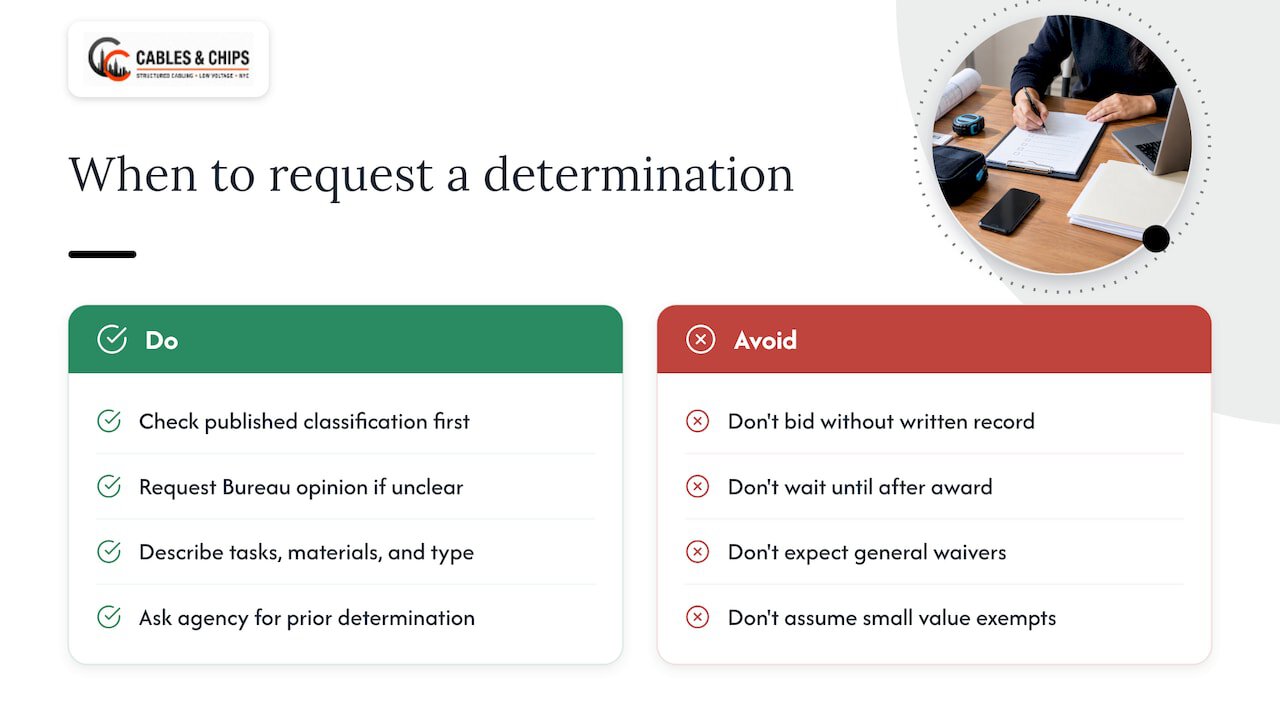
Most low voltage contractors never need to request a formal determination because the applicable classification is already published on the current schedule. When a scope genuinely does not match any listed classification, the Bureau of Public Work is the correct point of contact for a written opinion. Submit a request that describes the specific tasks involved, the materials being installed, and whether the work is new construction, renovation, or maintenance, since that distinction often decides between an “A” and an “M” classification.
For projects where the contracting agency itself is unsure whether the work qualifies as public work under Article 8, the agency typically requests a determination from NYS DOL before bidding opens. As a contractor, you can ask the agency whether such a determination exists for your project and request a copy before you price your scope. If no determination has been issued and your reading of the three-prong test leaves real doubt, raise the question in writing during the bid period rather than after award, since classification disputes are far easier to resolve before a contract is signed.
Exceptions to standard rates are rare and generally limited to specific apprentice ratio allowances tied to registered programs. There is no general waiver process for small low voltage scopes, and no dollar threshold exempts a contract from Article 8 coverage. If you believe your project has been misclassified as covered when it should not be, or the reverse, the same Bureau of Public Work channel handles that inquiry. Keep a written record of every classification question and answer, since that correspondence becomes useful documentation if a payroll audit later raises the same question.
Recent changes affecting prevailing wage rates and rules in NYC
Prevailing wage schedules update on a regular annual cycle rather than through one-time emergency action, and that cadence held steady through the period following the COVID-19 disruption to construction schedules. The Bureau of Public Work’s employer guide confirms the standard publication pattern of preliminary rates in early June and final rates effective July 1, which contractors should treat as the baseline expectation going into any bid cycle.
What has shifted in recent years is enforcement attention. Comptroller and NYS DOL guidance both emphasize that misclassification and incomplete certified payroll records remain the most common findings in audits, which suggests agencies are scrutinizing documentation more closely rather than the underlying wage law changing substantially. For low voltage contractors, the practical effect is the same regardless of which year’s schedule you are working from: the classification language for cabling work, including the specific reference to low voltage data, video, and voice cabling under Electrician definitions, has stayed consistent on the schedules published for the 2026 to 2027 period.
Contractors bidding multi-year public contracts should build in a process for re-checking the schedule at each contract anniversary rather than assuming the rate quoted at award will hold for the life of the job. Interim updates do happen between the annual publication dates, and a contract that spans more than one effective period needs the correct rate applied for each phase of work performed.
Strategies for efficient prevailing wage compliance on low voltage jobs
The contractors who avoid findings treat prevailing wage compliance as a pre-construction task, not a payroll department afterthought. Before mobilizing a crew, pull the current schedule for the exact jurisdiction and confirm the classification in writing with the contracting agency. Build your certified payroll template once, with every required field from the Comptroller’s instructions already built in, so each week’s submission is a matter of entering hours rather than reconstructing the format from scratch.
Assign one person on your team ownership of jobsite postings and payroll submissions for each public project. When that responsibility is diffuse across a crew, postings go up late and payroll fields get skipped. Keep a running folder, physical or digital, that holds the wage schedule you bid against, your classification confirmation, weekly certified payrolls, daily sign-in sheets, and any benefit fund documentation. That folder is your entire audit response if the Bureau of Public Work or the Comptroller’s office requests records.
Finally, revisit your schedule at contract milestones rather than only at award. A project that spans a July 1 effective date needs updated rates applied from that date forward, and catching the change early costs far less than correcting underpayment after the fact.
A field-proven checklist from an NYC low voltage contractor
Before pricing any public project, we pull the current schedule, confirm the classification matches the described cabling scope, and build the certified payroll template before the first worker steps on site. Verifying these three items during pre-construction, rather than after work begins, has consistently saved our teams from change orders and last-minute compliance scrambles on NYC projects.
— Ken
How Cables & Chips supports compliant low voltage work on public projects
We bring structured cabling, fiber, and CCTV and access control cabling expertise to projects that carry prevailing wage requirements. Our work emphasizes clean, tested, and documented installations.

If you are scoping low voltage work on a public contract in New York City, we offer a site survey to help confirm the classification question before you finalize your bid.
- Structured CAT6 cabling installation sized for public building projects.
- CCTV and access control cabling for secure facility scopes.
- Fiber installation, cable testing and certification, and server rack setup.
Review our full services page or reach out to discuss your project’s classification and payroll preparation needs.
FAQ
What is New York’s prevailing wage?
New York’s prevailing wage is the minimum hourly wage and supplemental benefit rate that contractors must pay workers on public work projects covered by Article 8. The rate varies by trade classification, county, and the project’s effective period, so the figure is never a single statewide number.
How do I check the prevailing wage rate for my project?
Look up your trade classification and county on the NYSDOL wage schedule, or use the city’s published schedule when a New York City agency is the contracting party. Match the effective date range on the schedule to your actual performance dates before quoting a rate.
Is prevailing wage on top of the regular hourly wage?
Prevailing compensation includes a base hourly wage plus a separate supplemental benefit rate, and the supplement can be paid as cash, a benefit contribution, or a trust fund payment rather than stacked automatically on top of a standard hourly rate. Comptroller guidance notes the hourly value of any benefit used to satisfy the supplement needs clear documentation to hold up in an audit.
Which classification applies to low voltage cabling work in NYC?
Low voltage cabling that carries data, video, or voice on building construction projects is generally covered under Electrician classifications, such as Electrician “A,” according to the Comptroller’s Construction Worker Schedule. Always confirm the exact classification against the job description text on the current schedule rather than assuming based on the trade’s common name.
What records do I need to keep for a prevailing wage project?
Employers must maintain a weekly certified payroll report per project showing trade classification, daily hours, hourly rate including supplements, and an attesting signature. Keep these alongside daily sign-in logs and benefit documentation in one project folder, ready for review by the Bureau of Public Work or the Comptroller’s office.