

Best pduwhips.com Alternatives for Data Centers in 2026

TL;DR:
- Reliable PDU whip alternatives include PDU Cables, Schneider Electric, Eaton, Vertiv, Legrand, and ABB. Custom builds are available for non-standard configurations, with PDU Cables delivering within 24 hours. Proper selection depends on form factor, electrical specs, outlet types, and compatibility with US electrical standards.
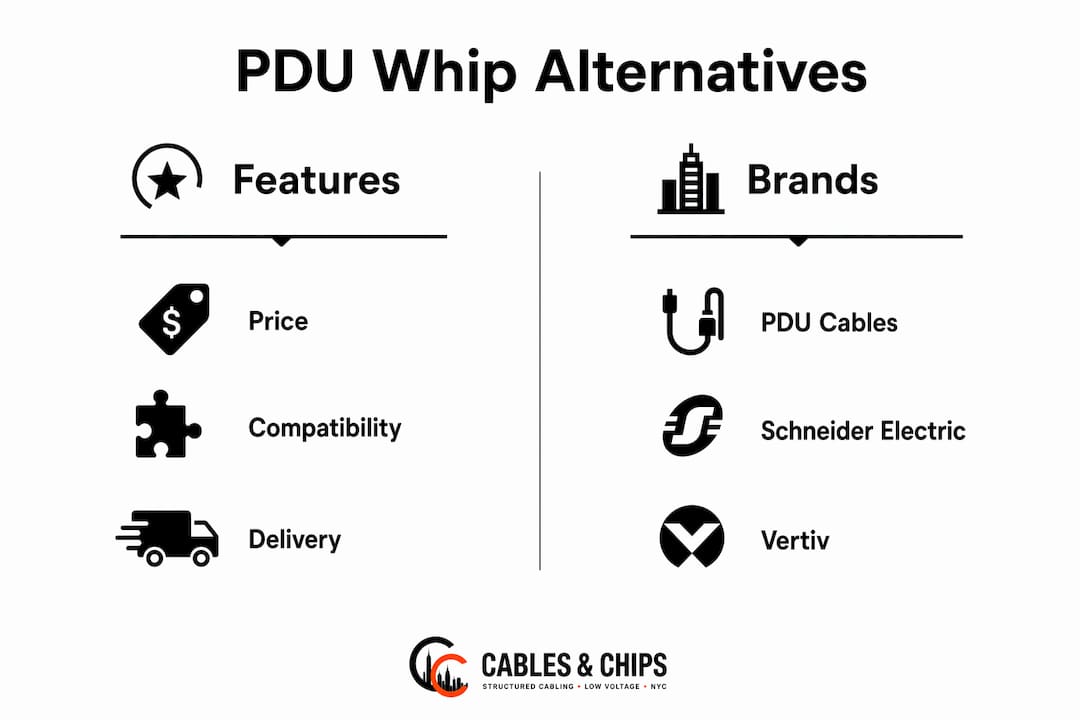
If you need reliable PDU whip alternatives to pduwhips.com, the strongest options in the US market are PDU Cables, Schneider Electric (APC), Eaton (Tripp Lite), Vertiv (Geist), Legrand (Raritan, Server Technology), and ABB. Each serves enterprise data centers with rack-level power distribution cable assemblies, from stock configurations to fully custom builds.
Top pduwhips.com alternatives at a glance:
- PDU Cables — A leading North American manufacturer of UL-listed power assemblies since 1981, with documented manufacturing processes and typical 24-hour shipping after order placement. Every cable is custom-built to individual specifications.
- Schneider Electric (APC) — Global market leader offering high-density intelligent PDUs including the NetShelter Advanced range, with presence in over 100 countries and 160,000 employees supporting mission-critical deployments.
- Eaton (Tripp Lite) — Operates in 175+ countries with a full PDU spectrum from basic rack units to AI-driven managed solutions, including the G3 and G4 series for high-density environments.
- Vertiv (Geist) — Formerly Emerson Network Power, present in 130+ countries. The Geist acquisition strengthened their rack PDU portfolio with real-time monitoring and rapid deployment options.
- Legrand (Raritan, Server Technology) — Sells products in 180 countries with deep customization through its subsidiary brands. Server Technology specializes in high-density PDUs for Fortune 100 deployments; Raritan focuses on intelligent power analytics.
- ABB — Headquartered in Zürich with operations in 100 countries, ABB emphasizes modular power systems and intelligent features for enterprise data center environments.
What criteria matter most when choosing PDU whips?
Selecting the right power distribution cable assembly requires more than matching plug types. The following criteria determine whether a PDU whip performs reliably under real data center conditions.
- Form factor: Vertical (0U) PDUs mount in the rack’s side channels and preserve horizontal rack units; horizontal (1U or 2U) units consume rack space but suit lower-density environments.
- Electrical specifications: Confirm amperage rating, single-phase versus three-phase supply, and voltage compatibility with your facility’s branch circuits before ordering.
- Outlet types: C13 and C19 IEC outlets cover most server and networking gear; NEMA locking connectors (L5-30, L6-20, L6-30) are standard for US branch circuit connections. Pin-and-sleeve and RussellStoll connectors apply to higher-amperage industrial feeds.
- Cord length and routing: Overhead and underfloor power paths require different cord lengths and exit orientations. Specifying this upfront prevents field modifications on installation day.
- Intelligence level: Basic PDUs distribute power with no monitoring. Metered units report load in amps locally. Monitored and switched PDUs add network interfaces and remote outlet control, which is increasingly standard for AI workloads and high-density racks.
- Cable management: Color-coded conduit and varied cord lengths reduce clutter, improve airflow, and prevent accidental disconnections during maintenance. PDU Cables offers eleven standard conduit colors with color-matched receptacle boxes.
- Labeling: Clear labels at cord ends and along conduit length accelerate installation and help facilities staff trace power paths quickly.
Pro Tip: Verify your power source receptacle type before finalizing any PDU whip order. Starting with rack circuit requirements and facility power source validation, as Raritan’s seven-step selection process recommends, prevents costly compatibility problems after delivery.
When do you need a custom or built-to-order PDU whip?
Off-the-shelf PDU whips cover common configurations, but data centers with non-standard voltage, unusual rack depths, or specific routing constraints regularly require custom builds. Here is when to go that route and how to do it.
- Non-standard configurations: Unique cord lengths, junction box setups, daisy-chain assemblies, or closed-nipple conduit runs fall outside most catalog offerings.
- BTO versus ETO: Built-to-order (BTO) means assembling from existing components to your specs. Engineered-to-order (ETO) involves designing new configurations from scratch. Vendors like Raritan and PDU Cables both offer BTO; ETO is reserved for complex, high-volume projects.
- Ordering process: Specify input connector type, output receptacle types, total cord length, conduit type (flexible metal, liquid-tight, SO cord), cable routing direction, and mounting hardware requirements. PDU Cables provides a logic-driven cable configurator built to NEMA standards that catches build errors before manufacturing begins.
- Lead times: PDU Cables typically builds and ships custom power distribution cable assemblies within 24 hours of order placement, with expedited delivery available for critical needs. Larger ETO projects from enterprise manufacturers carry longer lead times.
- Standards compliance: Require UL listing, NEC 645.5 compliance, and NFPA adherence on every order. PDU Cables documents and records each cable it manufactures, so a replacement ordered next year matches the original exactly.
- Bend radius and exit orientation: Checking bend radius compatibility with your rack cable management design prevents installation failures. Specify exit point placement (top or bottom of rack) when ordering.
Expert insights from a network infrastructure contractor
Cables and Chips has spent more than 40 years building and documenting network infrastructure for enterprise environments across New York City. The following practices reflect what consistently separates reliable power deployments from ones that create problems at 2:00 AM.
- Plan power paths before rack layout is finalized. Upfront configuration planning increases rack density and reduces the risk of branch circuit conflicts after equipment is installed.
- Color-code from day one. Color-coded power cords are a safety practice, not just an organizational preference. They prevent accidental disconnection of redundant power feeds during maintenance, which is one of the most common causes of unplanned downtime.
- Follow a structured selection process. Raritan’s seven-step approach, starting with power source verification, is a practical framework that applies regardless of which manufacturer you source from.
- Demand documented manufacturing. PDU Cables’ pretested, UL-listed assemblies with documented build records set the standard for consistency. Require the same from any alternative supplier.
- Integrate cable management planning into your as-built documentation. Eaton recommends dedicated cable selection and organization for safety and operational efficiency; that guidance applies equally to power whips and structured cabling.
How do PDU whip prices compare across alternatives?
PDU whip pricing varies significantly based on configuration complexity, intelligence level, and manufacturer. Basic rack PDUs from entry-level product lines serve budget-conscious deployments, while managed and switched units from enterprise manufacturers carry higher price points that reflect remote monitoring and outlet-level control capabilities.
Custom-built assemblies from specialists like PDU Cables are priced per configuration rather than off a shelf, with cost driven by conduit type, cord length, connector specifications, and quantity. Eaton’s basic 120V PDUs can deliver significant power suitable for many rack environments, and their pricing scales with intelligence tier from basic through switched and ATS models. Legrand’s Server Technology and Raritan lines sit at the higher end of the market, targeting Fortune 100 environments where uptime requirements justify the investment. For commercial office environments where power distribution in office builds follows lighter-duty standards, entry-level metered PDUs often provide sufficient capability at lower cost.
Compatibility with US rack types and electrical standards
US data centers operate primarily on 120V and 208V single-phase and 208V/480V three-phase branch circuits, governed by NEC Article 645 for information technology equipment rooms. Rack compatibility depends on physical form factor (EIA-310 standard 19-inch racks are universal; 21-inch and 23-inch frames appear in older facilities and telecom environments) and mounting depth.

NEMA locking connectors are the US standard for branch circuit connections. L5-30 and L6-20 are common for 20–30A single-phase feeds; L15-30 and L21-20 cover three-phase applications. IEC 60309 pin-and-sleeve connectors appear in colocation facilities with European-origin power infrastructure. Confirming which connector your power panel provides before specifying a PDU whip eliminates the most common compatibility failure. For industrial and logistics data center builds, heavy-duty power device standards add additional requirements around IP ratings and environmental protection.
Where to source PDU whips from authorized distributors
Buying PDU whips through authorized channels protects your warranty, guarantees UL-listed product, and gives you access to manufacturer technical support when configurations need adjustment.
Manufacturer direct: PDU Cables sells direct with a one-hour quote turnaround and 24-hour build-and-ship capability. Server Technology and Raritan both offer online product selectors and direct sales teams for enterprise accounts. Schneider Electric’s APC line and Eaton’s Tripp Lite products are available through manufacturer portals with full warranty backing.
Authorized distributors: Anixter (now Wesco), Graybar, and Rexel carry PDU products from multiple manufacturers with US warehouse stock and established credit terms. These distributors provide consolidated ordering for projects that combine PDU whips with structured cabling components and other infrastructure materials.
Value-added resellers (VARs): VARs with data center specializations can configure, pre-stage, and deliver complete rack power solutions. They add engineering support that pure-play distributors typically do not provide.
Cables and Chips brings infrastructure expertise to your power planning
Cables and Chips is not a PDU whip manufacturer, but for enterprise teams in New York City who need power distribution planning integrated with their broader infrastructure build, it offers a different kind of value. With 40+ years of experience in server rack setup, structured cabling, fiber optics, cable cleanup, and network closet organization, Cables and Chips approaches power whip planning as part of a complete infrastructure picture, not an afterthought. When your PDU whip routing, cable labeling, and rack documentation are coordinated from the start, the result is a cleaner, more maintainable environment that holds up under real operational pressure. Contact Cables and Chips at 20 Vesey Street, Lower Manhattan, to discuss your next data center build or retrofit.
FAQ
What are the best alternatives to pduwhips.com for US data centers?
PDU Cables, Schneider Electric (APC), Eaton (Tripp Lite), Vertiv (Geist), Legrand (Raritan, Server Technology), and ABB are the leading US-market alternatives, covering everything from stock configurations to fully custom assemblies.
How fast can custom PDU whips be delivered?
PDU Cables typically builds and ships custom power distribution cable assemblies within 24 hours of order placement, with expedited delivery available for critical needs.
What electrical standards apply to PDU whips in the US?
US data center PDU whips must comply with NEC Article 645, UL listing requirements, and NFPA codes. NEMA locking connectors are the standard for branch circuit connections in US facilities.
Why does color coding matter for PDU whips?
Color-coded power cords prevent accidental disconnection of redundant power feeds during maintenance, which is one of the most direct causes of unplanned downtime in high-density racks.
When should you order a built-to-order PDU whip instead of a stock unit?
Order a built-to-order assembly when your rack requires non-standard cord lengths, specific conduit types, unusual connector combinations, or routing paths (overhead or underfloor) that catalog products do not cover.
Key Takeaways
The most reliable approach to sourcing PDU whip alternatives is to match manufacturer capabilities to your specific rack, electrical, and lead-time requirements before committing to any supplier.
| Point | Details |
|---|---|
| Top alternatives identified | PDU Cables, Schneider Electric, Eaton, Vertiv, Legrand, and ABB cover the full US market. |
| Custom builds are common | BTO and ETO services handle non-standard cord lengths, connectors, and routing paths. |
| 24-hour delivery is achievable | PDU Cables builds and ships custom power distribution cable assemblies within 24 hours of order placement, with expedited delivery available for critical needs. |
| Standards compliance is mandatory | Require UL listing, NEC 645.5, and NFPA compliance on every PDU whip order. |
| Cables and Chips | Integrates power whip planning with rack setup, cable cleanup, and documentation for NYC enterprise environments. |