
Budget 0.75 dB: When Data Center Planners Should Pick MPO or LC
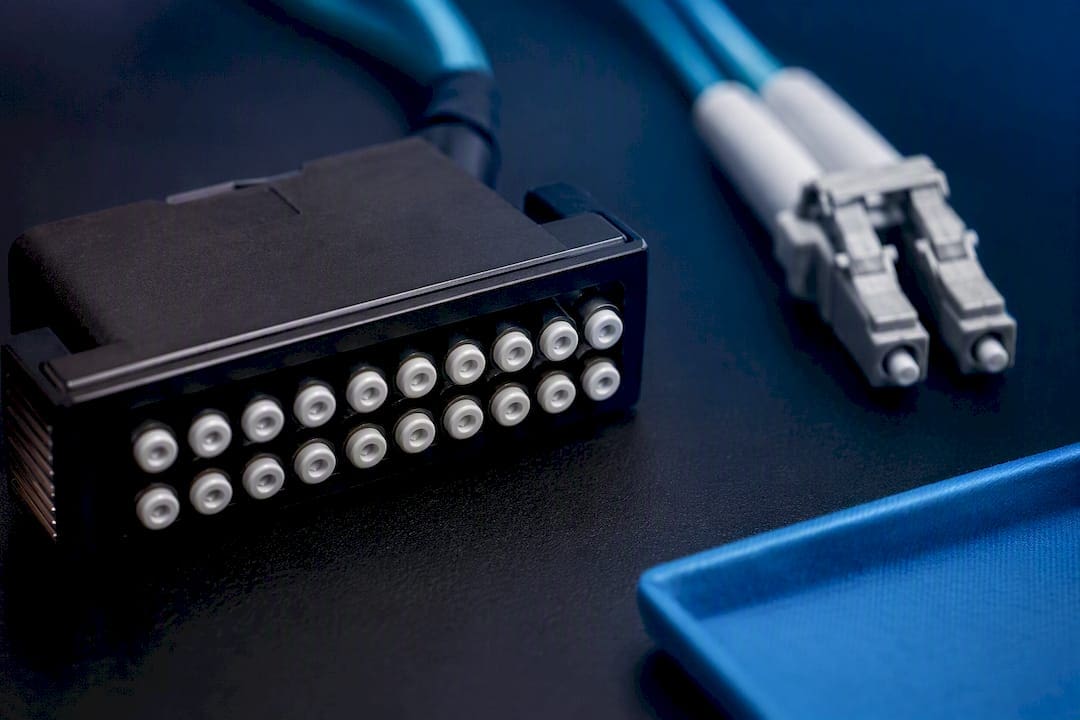
Use LC connectors for duplex SFP-class links running 1G, 10G, or 25G, and reserve MPO/MTP for parallel-optics trunks and high-density 40G, 100G, or 400G backbones. The choice comes down to what your transceivers demand and how much density your pathways can absorb: LC keeps single-link troubleshooting simple, while MPO trades some operational complexity for far more fiber per rack unit.
TL;DR:
- MPO connectors are essential for high-density backbone links above 48 fibers and support 40G, 100G, or 400G parallel optics, replacing multiple LC cords.
- LC connectors excel at the access layer for their low loss, ease of troubleshooting, and compatibility with SFP transceivers, typically supporting up to 25G.
- Proper installation requires strict discipline in polarity, gender matching, cleaning, and thorough testing, with documentation to prevent costly failures later.
- Running MPO trunks with LC breakout cassettes at the patch face balances density and serviceability, but small-scale or low-MAC environments may only need LC infrastructure.
- Mismatched polarity, improper cleaning, or lack of detailed as-built records are leading causes of installation failures, underscoring the importance of rigorous operational processes.
MPO vs LC: What Each Connector Actually Does
That verdict only holds once you understand what each connector is built for. LC and MPO solve different problems, and confusing them at the design stage is how projects end up with the wrong transceivers on order.
LC connectors use a 1.25 mm ceramic ferrule in a duplex latch housing, standardized under IEC 61754-20. It’s the connector you’ll find on nearly every SFP, SFP+, and SFP28 transceiver in a switch or server. Standard-grade LC insertion loss runs under 0.20 dB, and low-loss variants push below 0.12 dB, which is why LC remains the default at the access and server edge.
Where LC shows up in a real deployment:
- Server-to-switch cross-connects in a top-of-rack or end-of-row layout
- Patch panels feeding 1G, 10G, or 25G SFP-class transceivers
- Any link where a technician needs to trace and swap a single strand fast
- Telecom room patching where MAC (moves, adds, changes) activity is frequent
The operational upside is straightforward. Polarity on a duplex LC link is a non-issue compared to multi-fiber arrays, per-connector cost is low, and a failed link means checking one jumper, not troubleshooting an eight-fiber ribbon. That simplicity is exactly why LC still dominates edge and access cabling even as core bandwidth climbs into triple digits.
MPO/MTP Connectors and Why Data Centers Depend On Them
MPO (and the trademarked MTP variant) uses an MT ferrule that aligns 8, 12, 16, or 24 fibers in a single mating event, standardized under IEC 61754-7. Instead of terminating one strand at a time, an installer connects an entire array in one push, which is the whole reason MPO exists: parallel optics need multiple fibers transmitting and receiving simultaneously, and no duplex connector can deliver that.
MPO insertion loss typically falls in the 0.35 to 0.6 dB range depending on grade and termination quality, noticeably higher per channel than LC. That gap matters in link-budget math, but it’s the price of density. A single MPO-24 trunk replaces what would otherwise be a dozen duplex LC patch cords running through the same pathway.
Key characteristics that shape how MPO gets deployed:
- Male connectors carry alignment pins, female connectors don’t; mismatching gender stops a mating cold
- SR4, DR4, and other parallel-optics transceivers in the QSFP family require MPO natively
- Higher fiber density per rack unit reduces pathway congestion and speeds bulk installation
- Polarity method, cleaning discipline, and per-channel testing all add operational overhead LC doesn’t carry
MPO is not really optional once you’re deploying 40G, 100G, or 400G parallel optics. It’s the only connector standard built to carry that many simultaneous channels through one mated interface.
MPO vs LC Performance: Loss Budgets and Density by the Numbers
The technical comparison between MPO and LC boils down to three variables: loss per connection, fiber density per rack unit, and which transceiver families each one supports. All three drive real design decisions, not just spec-sheet trivia.
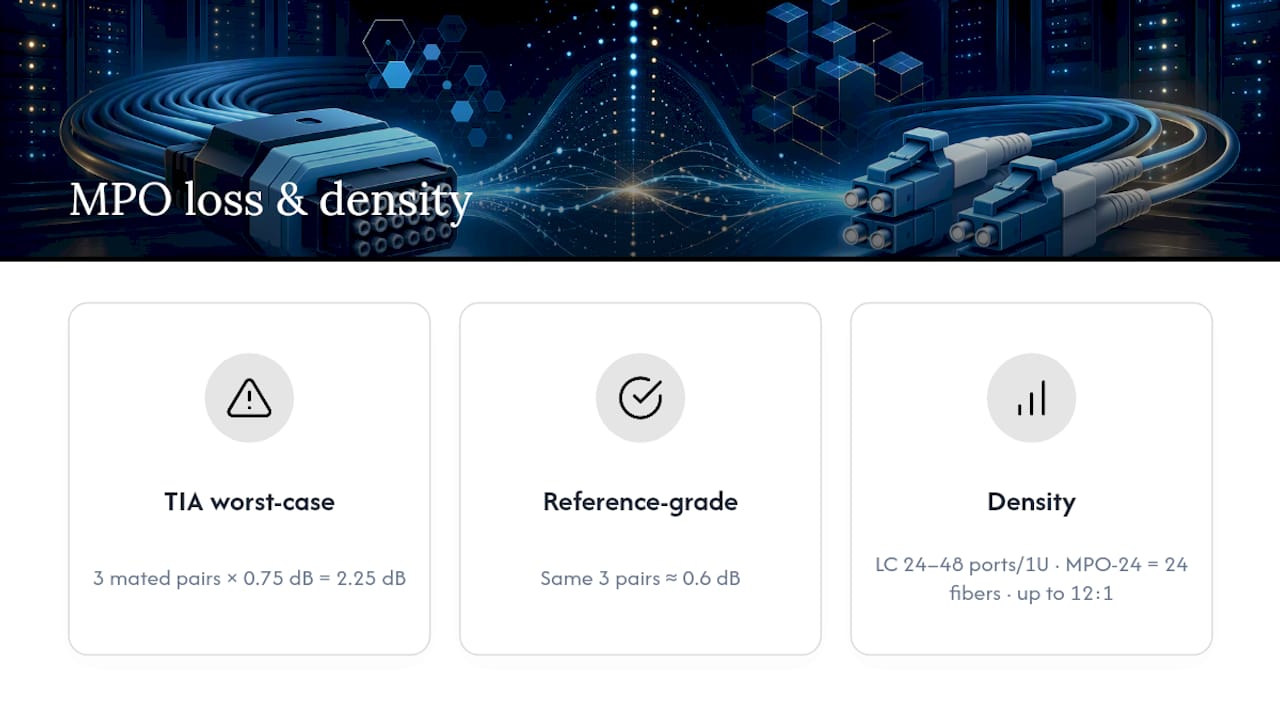
On loss budgeting: IEC 61753-1 and ANSI/TIA-568.3-E set the grading framework designers actually use. IEC Grade B connectors average 0.12 dB with a 0.25 dB maximum, while TIA’s conservative worst-case allowance is 0.75 dB per mated pair. Reference-grade single-mode connections can hit 0.20 dB or better in a well-run plant. The practical implication: budget your link-loss calculations to the TIA worst-case number for certification sign-off, then treat reference-grade performance as the achievable target once your installer’s workmanship is dialed in.
On density: a 1U panel loaded with LC duplex adapters typically holds somewhere in the range of 24 to 48 fiber ports, depending on adapter type. An MPO-24 trunk carries the equivalent fiber count through a single connector footprint, which is why MPO trunks can reduce cable congestion versus multiple duplex LC cords by ratios as steep as 12 to 1 in pathway terms.
Worked example: say your TIA link budget allows 0.75 dB per mated pair across three connections on a short intra-building run. Using conservative TIA numbers, three MPO mated pairs at worst-case grading could consume 2.25 dB before you’ve accounted for fiber attenuation or splice loss. Swap in reference-grade MPO hardware and that same three-connector run can realistically land closer to 0.6 dB, freeing up margin for longer spans or additional patch points. That margin gap is exactly why loss grade, not just connector type, decides whether a design has room to grow.
The redundancy math matters just as much as loss. A failed LC jumper takes down one link. A damaged MPO trunk, or a botched cleave on one fiber in a ribbon, can take down eight, twelve, or twenty-four simultaneous channels depending on the array size and how the outage propagates through your parallel-optics group.
Building Hybrid Fiber Architectures: Trunks, Cassettes, and LC Breakouts
Most production data centers don’t pick one connector and abandon the other. They run MPO trunks for backbone distance and density, then break those trunks out to LC ports at the patch face using cassettes. This trunk-to-cassette-to-LC pattern is the standard bridge architecture, and for good reason: it captures MPO’s density and installation speed while preserving LC’s day-to-day serviceability.
Here’s how the migration decision typically plays out:
- Backbone runs above roughly 48 to 96 fibers almost always favor MPO trunks, since pulling that many individual LC jumpers through conduit is a labor sink nobody budgets for correctly.
- Patch-face access points stay LC, because technicians doing routine moves and adds don’t want to touch a live MPO trunk to swap one server connection.
- Cassettes convert one MPO-24 trunk into twelve LC duplex ports, isolating the backbone from frequent handling.
- TCO crossover commonly appears once total fiber counts climb past several hundred strands, where MPO’s higher per-component cost gets offset by labor and pathway savings.
Inventory management deserves its own line item. Polarity method, connector gender, and hybrid cord types all multiply your SKU list if they’re not standardized project-wide.
Pro Tip: Lock in one polarity method (Method B is the common default) and one gender convention across the entire project before you place a single order. Mixing conventions mid-build is the single fastest way to end up with unusable trunks sitting in a box.
Polarity, Pin Gender, Cleaning, and Certification: Getting Operations Right
Operational discipline is where MPO projects succeed or fail, and it’s rarely the connector spec that causes the problem. It’s the process around it.
Polarity methods A, B, and C each route fibers differently between the two ends of a trunk, and mixing conventions on the same project is a documented cause of link failures. Document your polarity method on every as-built drawing, not just in a spec sheet that gets filed and forgotten.
Pin gender matters more with MPO than most teams expect. Male connectors carry alignment pins that insert into a female connector’s guide holes; forcing a male-to-male mating, or ordering the wrong gender for a critical path, can turn a shipment into a discard-and-reorder scenario that delays a schedule by weeks.
Cleaning and inspection protocols differ by ferrule size:
- LC’s smaller 1.25 mm ferrule is more contamination-sensitive and needs ferrule-specific cleaning tools sized correctly for it
- MPO’s larger MT ferrule needs its own cleaning cassette and a different inspection angle under a 200x scope
- Every mating event, on either connector type, should get an end-face inspection before it goes live
Pro Tip: Stock ferrule-specific cleaners for both connector types in every field kit. Using an LC cleaner on an MPO ferrule, or vice versa, is a common shortcut that quietly drives up insertion loss on jobs that otherwise pass certification.
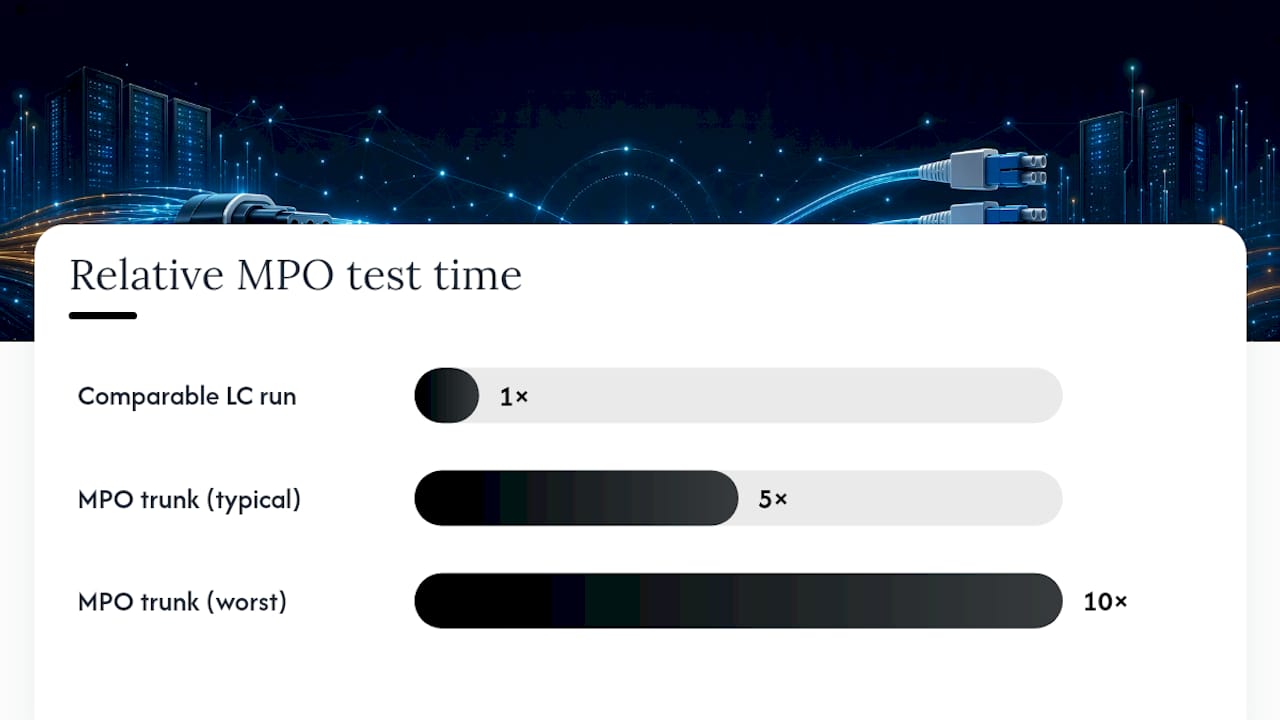
Testing MPO links takes real planning. Verifying an MPO-24 trunk via breakout means testing twelve duplex pairs per end, which can stretch total test time to five or ten times longer than a comparable LC run if the schedule doesn’t account for it up front.
How to Choose Between MPO and LC for Your Deployment
Run through these five steps before finalizing a bill of materials for any new build or refresh.
- Confirm transceiver form factor first. Check whether the active equipment on both ends uses duplex SFP-class optics or parallel QSFP-class optics. This single fact eliminates half your decision immediately.
- Count current fiber needs and project three years out. A rack that needs 24 fibers today but will need 96 by year three should get MPO trunk capacity now, even if you’re breaking it out to LC at the patch face for the moment.
- Evaluate pathway and rack constraints against MAC frequency. Tight conduit runs favor MPO’s density; rooms with constant moves, adds, and changes favor keeping the patch face on LC regardless of what the backbone runs.
- Assess on-site staffing skill honestly. MPO polarity management and cleaning discipline take training most in-house teams haven’t had. Either invest in that training or bring in a managed installation team that already has it.
- Write test and documentation deliverables into the contract, not just the proposal. Per-fiber test reports, end-face inspection images, and a polarity map should be non-negotiable line items before final payment.
Skipping step five is the most common regret contractors hear about after the fact, usually from a facilities manager trying to troubleshoot a link a year later with no documentation to work from.
Field Lessons: Common Contractor Mistakes and What to Require
A well-established structured cabling and fiber infrastructure installer with extensive experience in commercial and secure facilities in New York City notes that common MPO/LC installation mistakes include ordering the wrong polarity SKU, lacking proper cleaning tools, underestimating labor hours on LC-dense server room builds, and delivering jobs without as-built documentation.
Before signing off on any fiber contract, require:
- Per-fiber OLTS test results, not a summary pass/fail sheet
- End-face inspection images for both connector types
- A written polarity map matching the as-built drawings
- Labeled, dated as-built documentation the facilities team can actually use later
Why I Default to MPO Backbones With LC at the Patch Face
On new high-density builds, I default to MPO trunks feeding LC cassettes at the patch face almost every time. It gives you room to grow into 100G or 400G without repulling backbone cable, while keeping the ports technicians touch daily as simple, forgiving LC.
That said, small-scale deployments with limited MAC activity and a tight budget don’t need MPO’s overhead at all. End-to-end LC is often the more sensible call there, and forcing MPO onto a 48-port closet just because it’s the trend on larger builds is a mistake I’d steer any client away from.
— Ken
Get Your MPO and LC Infrastructure Built Right the First Time
Choosing between MPO and LC is only half the job. The other half is making sure whoever terminates, tests, and documents that fiber actually does it correctly, because a mislabeled polarity map or a skipped end-face inspection costs you far more in downtime than it ever saved in installation time.

Cables and Chips designs and installs both architectures for commercial offices, server rooms, and secure facilities: fiber backbone design, pre-terminated MPO trunk installation, MPO-to-LC cassette supply for hybrid patch fields, and full testing and certification with the per-fiber reports and as-built documentation this article just told you to demand. If you’re planning a 400G migration or simply trying to figure out whether your current pathways can absorb an MPO backbone, start with a fiber optic infrastructure assessment to see where your build actually stands before you place a single order.
Sources
For connector specs, consult IEC 61754-20 (LC) and IEC 61754-7 (MPO). For loss grading, IEC 61753-1 and ANSI/TIA-568.3-E set the normative limits. Vendor guides on cassette architectures and polarity/gender management fill in the practical gaps the standards don’t cover.
- MTP/MPO connectors (Molex reference PDF)
- MTP/MPO vs LC Fiber Cables: How to Choose the Right Option for Your Network (Dimi Telecommunications)
FAQ
What Is the Difference Between LC and ST Fiber Connectors?
ST connectors use a larger ferrule with a twist-lock mechanism, while LC uses a smaller 1.25 mm ferrule with a push-pull latch. LC has largely replaced ST in modern deployments because its smaller footprint allows roughly double the port density in the same panel space.
What Is the Difference Between SFP and MPO Connectors?
SFP is a transceiver form factor, not a connector type, and it typically pairs with LC duplex connectors for single-wavelength duplex transmission. MPO is a connector standard used with parallel-optics transceivers like SR4 and DR4 in the QSFP family, which need multiple simultaneous fiber channels that a duplex SFP interface can’t provide.
Is LC or SC Better for My Deployment?
LC’s smaller 1.25 mm ferrule allows roughly double the port density of larger ferrules in the same rack space, which is why LC has become the default for new high-density installations. SC still appears in older plants and some enterprise gear, but new builds rarely specify it over LC today.
What Are the Disadvantages of LC Fiber Connectors?
LC’s small ferrule is more sensitive to contamination than larger connector types, so it demands ferrule-specific cleaning tools and careful end-face inspection before every mating. LC also can’t carry parallel-optics transmission on its own, so any 40G, 100G, or 400G parallel link requires MPO instead, regardless of how much LC infrastructure is already in place.
When Should a Data Center Choose MPO Over LC?
MPO becomes necessary once active equipment uses parallel-optics transceivers for 40G, 100G, or 400G links, since LC’s duplex design physically cannot carry that many simultaneous channels. Most high-density backbone runs above roughly 48 fibers also favor MPO trunks purely for pathway and labor savings, even when LC still handles the patch face.