

How Network Infrastructure Supports Business Growth

TL;DR:
- Network infrastructure is essential for enabling data communication and supporting organizational growth. Well-designed, modular, and documented networks improve performance, reduce costs, and allow faster deployment of new services. neglecting physical layer maintenance can hinder scalability and cause costly outages.
Network infrastructure is defined as the hardware, software, and services that enable data communication across an organization. Understanding how network infrastructure supports growth is the first step toward treating your network as a business asset rather than a utility bill. Network infrastructure has evolved into a direct driver of operational efficiency, digital transformation, and competitive advantage. Organizations that invest in well-designed, documented, and tested physical infrastructure gain the ability to deploy new services faster, absorb more users and devices, and reduce costly downtime.
How network infrastructure supports growth: the core features
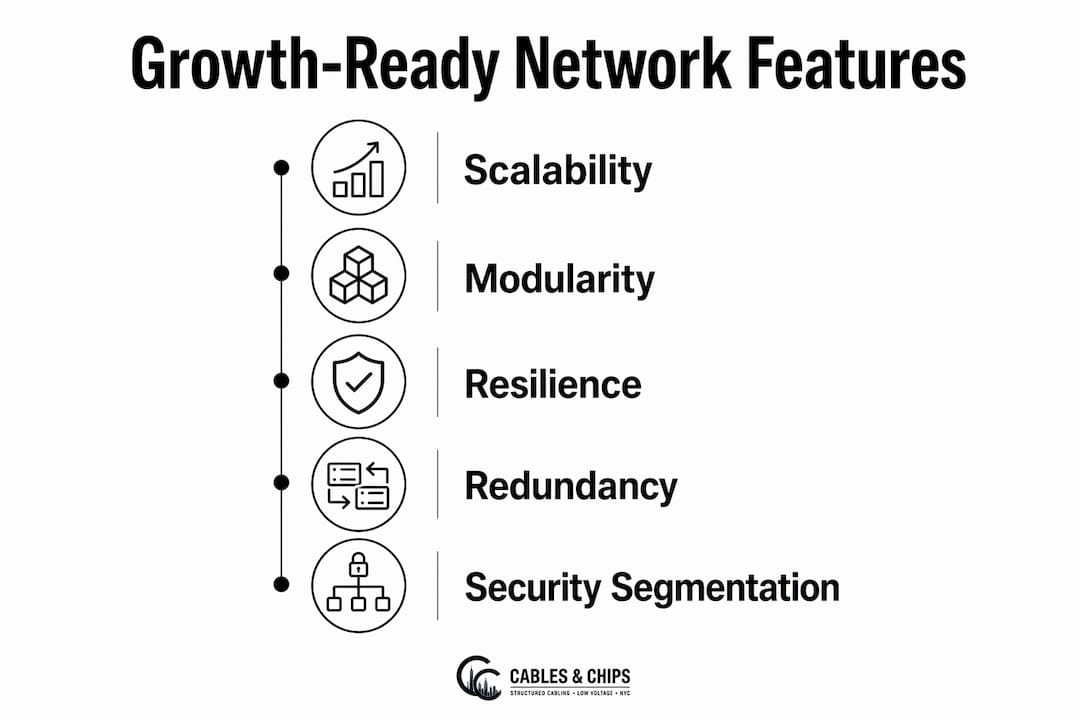
Four characteristics separate a growth-ready network from one that holds a business back: scalability, modularity, resilience, and security. Each one addresses a specific failure mode that appears as organizations expand.
Scalability
Scalability means the network handles more users, devices, and data without performance loss. A scalable cabling infrastructure built on structured CAT6 or CAT6A cabling, for example, supports higher bandwidth demands as headcount grows without requiring a full physical overhaul. The network grows with the business rather than forcing the business to pause while the network catches up.

Modularity
Lack of modularity is the most common failure point during rapid growth, causing disruptive and costly forklift upgrades. That means replacing entire network segments rather than swapping out individual components. Modular design allows IT teams to upgrade switches, add access points, or extend fiber runs independently. The rest of the network keeps running while one section is improved.
Resilience and redundancy
Modular design, redundancy, and segmentation prevent outages and security risks during growth phases. Redundancy means building in backup paths so a single cable failure or switch failure does not take down the entire office. For businesses in New York City operating across multiple floors or buildings, redundant fiber runs between MDF and IDF closets are a practical requirement, not a luxury.
Security segmentation
Network segmentation divides traffic into separate zones, limiting the blast radius of a breach. During growth phases, new devices, new vendors, and new remote users all introduce risk. Proactive monitoring combined with segmentation keeps those risks contained.
Pro Tip: Document every cable run, port assignment, and patch panel label before you add a single new device. Clean, accurate documentation is what separates a network that scales from one that collapses under its own complexity.
What ROI does modernizing network infrastructure actually deliver?
The financial case for network investment is measurable. Modernizing network infrastructure can reduce latency by up to 43%, enabling faster decision-making and improved global scalability. Lower latency directly accelerates AI operations, cloud application performance, and data transmission speeds that affect every employee every day.
The shift from reactive to proactive IT operations is where the real cost savings appear. Network modernization shifts IT operations from reactive troubleshooting to proactive management, directly reducing revenue loss and operational costs. Break-fix cycles consume IT staff time that should go toward growth initiatives. Every hour spent chasing a mystery outage is an hour not spent deploying new services.
Three technology investments consistently deliver measurable returns:
-
SD-WAN deployment. SD-WAN lowers overhead by reducing reliance on expensive MPLS circuits. It routes traffic intelligently across multiple connection types, cutting costs while improving performance for cloud-heavy workloads.
-
Structured cabling upgrades. Moving from legacy CAT5e to structured CAT6 cabling supports 10-gigabit speeds and reduces signal interference. The physical layer is the foundation every other investment depends on.
-
Proactive monitoring and analytics. Monitoring tools that track uptime, latency, and throughput give IT teams early warning of degradation before it becomes an outage. Translating network performance metrics into business KPIs such as customer satisfaction and productivity improves budget alignment and supports growth initiatives. When IT can show leadership that network uptime directly correlates with revenue, budget conversations change.
What design pitfalls block growth, and how do you avoid them?
Poor network design does not announce itself. It shows up as slow application performance, failed video calls, security incidents, and IT teams buried in tickets. The root causes are predictable.
-
Treating the network as static. Networks designed for a fixed headcount and a fixed set of applications fail when the business adds locations, acquires a company, or shifts to cloud-first operations. Every design decision should account for where the business will be in three years, not just today.
-
Ignoring east-west traffic. Cloud adoption shifts network traffic patterns toward east-west flows, meaning server-to-server communication rather than the traditional north-south flow between users and a central server. Traditional local file-sharing infrastructure was not built for this. Organizations that move workloads to cloud platforms without redesigning their internal switching and routing architecture see performance degrade as traffic patterns change.
-
Skipping redundancy to save money. A single point of failure in a network closet can take down an entire floor. The cost of a redundant switch or a second fiber run is a fraction of the cost of one significant outage.
-
Weak documentation. Infrastructure must be monitored proactively to prevent outages, lost productivity, and increased cyber vulnerabilities. Documentation is the foundation of proactive monitoring. Without accurate records of what is connected where, troubleshooting becomes guesswork and upgrades become risks.
Pro Tip: When planning a network refresh, map your current traffic patterns before selecting new hardware. East-west traffic from cloud applications demands a different switching architecture than the north-south model most legacy networks were built around.
How to design network infrastructure that actually scales
Scalable network architecture divides growth into layers: planning, topology, capacity, security, and operations. Working through each layer systematically prevents the ad-hoc additions that create technical debt.
Planning with growth in mind means sizing cable pathways, conduit, and closet space for two to three times current capacity. A network closet that is full today cannot absorb a floor expansion next year. Cables and Chips approaches every corporate network infrastructure project with a site survey that documents existing conditions and maps future growth requirements before a single cable is pulled.
Selecting the right topology for your traffic patterns matters more than selecting the most expensive hardware. Spine-leaf architectures handle east-west cloud traffic efficiently. Traditional three-tier hierarchical designs work well for organizations with centralized data and predictable north-south traffic. The right choice depends on your actual workload, not a vendor’s recommendation.
The table below compares two common design approaches by growth scenario:
| Design approach | Best for | Key advantage | Growth risk |
|---|---|---|---|
| Three-tier hierarchical | Centralized data, stable headcount | Simple to manage, well-understood | Bottlenecks at core layer under heavy east-west load |
| Spine-leaf | Cloud-heavy, distributed workloads | Predictable latency, easy horizontal expansion | Higher initial cost, requires careful capacity planning |
Aligning network KPIs with business metrics closes the gap between IT and leadership. Uptime percentage maps to revenue availability. Latency maps to application performance and employee productivity. Throughput maps to the number of concurrent users a system can support. Network infrastructure has become a strategic differentiator, enabling faster deployment of technologies and scaling of workloads. When IT leaders present network investments in those terms, approval cycles shorten.
Key Takeaways
Well-designed, modular, and documented network infrastructure is the single most reliable foundation for sustained business growth.
| Point | Details |
|---|---|
| Modularity prevents costly overhauls | Non-modular designs force full replacements during growth; modular cabling allows targeted upgrades. |
| Latency reduction drives ROI | Modernizing infrastructure can cut latency by up to 43%, directly improving application speed and decision-making. |
| East-west traffic requires redesign | Cloud adoption changes traffic patterns; legacy north-south architectures degrade under cloud-native workloads. |
| Documentation enables proactive management | Accurate cable records and port labeling are the foundation of monitoring, troubleshooting, and compliance. |
| KPI alignment secures budget | Connecting uptime and throughput metrics to revenue and productivity makes infrastructure investment easier to justify. |
Why I think most leaders underinvest in the physical layer
After more than 40 years working on network infrastructure in New York City, the pattern I see most often is this: organizations spend heavily on software, cloud subscriptions, and security tools, then run all of it over a physical layer that was installed a decade ago and has never been tested or documented.
The physical layer is where every other investment either succeeds or fails. A miscrimped CAT6 connector, an unlabeled patch panel, or a network closet with cables bundled so tightly they induce crosstalk will degrade performance regardless of what sits on top. Network infrastructure is no longer just operational overhead. It is a strategic asset that directly impacts an organization’s agility and innovation capability. That is not marketing language. It is what we see on every job site.
The leaders who get this right treat their infrastructure lifecycle the same way they treat their lease renewals: scheduled, documented, and planned well in advance. The ones who struggle treat cabling as a one-time installation that never needs attention. Your network is only as strong as the infrastructure behind it.
— Ken
How Cables and Chips helps businesses build networks that grow
Cables and Chips has spent more than 40 years building, testing, and documenting network infrastructure for commercial offices, secure facilities, and enterprise environments across New York City.

Whether you need structured cabling components specified and installed for a new office build-out, a fiber optic infrastructure upgrade to support higher bandwidth demands, or a full network closet audit and cleanup, Cables and Chips delivers work that is tested, certified, and documented. Every project starts with a site survey so you know exactly what you have before we touch a single cable. Contact Cables and Chips at 20 Vesey Street, Lower Manhattan, to schedule your site survey.
FAQ
What is network infrastructure in a business context?
Network infrastructure is the combination of physical cabling, switches, routers, and wireless access points that carry data across an organization. It forms the foundation for every application, communication tool, and cloud service a business depends on.
How does network design affect business growth?
Poor network design creates bottlenecks, outages, and security gaps that slow expansion. Modular, well-documented designs allow businesses to add users, locations, and services without disrupting existing operations.
What is the difference between north-south and east-west network traffic?
North-south traffic flows between users and a central server, while east-west traffic flows between servers or cloud services. Cloud adoption has increased east-west traffic significantly, requiring updated switching architectures to maintain performance.
How often should businesses review their network infrastructure?
Network infrastructure should be reviewed on a defined lifecycle schedule, typically every three to five years, or whenever a significant change occurs such as a floor expansion, cloud migration, or acquisition.
Why does structured cabling matter for scalability?
Structured cabling systems built to TIA-568 standards provide a consistent, testable physical layer that supports higher speeds and easier upgrades. Unstructured or undocumented cabling creates hidden performance problems that compound as the network grows.