

How Labeled Cabling Simplifies Troubleshooting Networks

TL;DR:
- Labeled cabling applies permanent identifiers to both ends of every cable, simplifying troubleshooting and reducing diagnostic time. Following standards like ANSI/TIA-606-C ensures proper labeling, which helps technicians trace cables quickly and prevents costly re-documentation. Proper labeling supports network management, minimizes outages, and enhances audit compliance across IT infrastructure.
Labeled cabling is the practice of applying clear, standardized identifiers to every network cable so technicians can trace, test, and fix connections without guesswork. Understanding how labeled cabling simplifies troubleshooting is the difference between a 15-minute fix and a three-day outage hunt. The ANSI/TIA-606-C standard defines the labeling requirements that govern compliant structured cabling installations across commercial facilities. When cables carry unique, permanent identifiers at both ends, IT teams cut diagnostic labor, reduce downtime, and maintain audit-ready documentation. Your network is only as strong as the infrastructure behind it.
How labeled cabling simplifies troubleshooting network issues
90% of intermittent network drops trace back to physical layer problems: marginal crimps, broken latches, and kinked cables. That statistic reframes where troubleshooting time actually goes. Most outages are not software problems or configuration errors. They are physical failures hiding inside unlabeled cable runs.

When every cable carries a unique identifier, a technician can read the label at the wall port, walk directly to the matching port on the patch panel, and test that single run. Without a label, the same technician must follow the cable by hand through conduit, above ceiling tiles, and through crowded telecom rooms. That physical trace can consume hours on a single drop.
Labeled cabling also accelerates isolation of the specific fault type. A technician who knows which cable connects port 14A to switch port 7 can immediately pull that run for a continuity test. Unlabeled environments force trial-and-error: unplug one cable, test, replug, repeat. Each cycle adds minutes. Across a 200-port office, those minutes become days.
- Rapid port-to-port tracing: Labels at both ends let technicians confirm the full path without physical cable chasing.
- Faster continuity testing: A labeled run goes straight to the tester. An unlabeled run requires identification first.
- Reduced repeat visits: Technicians who document fixes by label ID prevent the same fault from being misdiagnosed twice.
- Cleaner escalation: When a senior engineer takes over, labeled infrastructure means no time lost re-learning the layout.
Pro Tip: When a drop goes down, check the label at the wall port first. Cross-reference it against your patch panel diagram before touching any hardware. That 30-second check eliminates the most common source of wasted diagnostic time.
What are the best practices for labeling cables effectively?
The ANSI/TIA-606-C standard defines the labeling framework that compliant commercial installations follow. It specifies unique identifiers for every link, space, and pathway in a structured cabling system. Following this standard reduces diagnostic time during moves, adds, and changes, and supports compliance audits without additional documentation work.
Labeling both ends of every cable with durable, legible identifiers is the single most impactful practice. A label at only one end creates a one-sided map. When a technician is standing at the patch panel, a label that reads only the destination port tells half the story. Both ends must match, and both must be readable under low-light conditions in a server room.
Color-coded labels alongside unique identifiers speed up cable type recognition and reduce errors during maintenance. Color coding is not a replacement for unique IDs. It is a visual layer that lets technicians distinguish voice, data, and fiber runs at a glance before they read the fine print.
| Labeling element | Recommended practice |
|---|---|
| Label placement | Both ends of every cable, including patch cords |
| Identifier format | Unique alphanumeric code tied to documentation |
| Label material | Heat-shrink or self-laminating for durability |
| Color coding | Consistent color scheme by cable type or circuit |
| Documentation link | Labels cross-referenced in a physical or digital diagram |
- Use permanent labels: Handwritten tape labels fade and fall off. Printed heat-shrink or self-laminating labels survive years of handling.
- Keep identifiers short: A six-character alphanumeric code is faster to read and less prone to transcription error than a 20-character string.
- Update labels immediately after changes: A label that no longer matches its documentation is worse than no label. It creates false confidence.
Pro Tip: Integrate your label scheme with a digital floor plan or cable management software from day one. A label that maps directly to a diagram entry cuts troubleshooting time in half compared to a label that exists only on the cable itself.
What happens when cables are not labeled?
Unlabeled environments can require up to a full week of labor from external technicians to manually trace and restore documentation after a reconfiguration. One week of billable technician time is a significant cost for a problem that proper labeling at installation would have prevented entirely.
The hidden costs extend beyond labor. Manual tracing in a live environment risks accidental disconnections. A technician pulling cables to identify them in a crowded MDF or IDF can disrupt active circuits. Each accidental disconnection creates a new incident on top of the original problem.
Mislabeled patch panels create a specific category of diagnostic failure. A label that reads “Port 12” but connects to port 14 sends every technician to the wrong location. The fault appears intermittent because the wrong port gets tested repeatedly. This is not a rare edge case. It is a predictable outcome of labeling done once and never verified.
Patch cable loops that connect back into the same switch create connections that appear operational but provide no actual network connectivity. These loops are detectable only through proper labeling at both ends. Without labels, a looped patch cord shows a solid link light, passes a basic visual check, and wastes hours of diagnostic time before anyone thinks to trace the physical path.
- Guesswork multiplies labor: Every unverified assumption about cable routing adds a test cycle. Test cycles add time. Time adds cost.
- Outdated documentation is as dangerous as no documentation: A diagram that reflects the network as it existed two years ago sends technicians to the wrong ports.
- Unlabeled environments fail audits: Compliance reviews for structured cabling systems require traceable, documented infrastructure. Unlabeled cable plants cannot pass.
How does labeled cabling fit into network management workflows?
Labeled cabling is the physical foundation that network management software depends on. Tools like SolarWinds NPM and ManageEngine OpManager provide real-time monitoring and alert on port-level events. When a port goes down, the software identifies the logical address. The label on the physical cable connects that logical address to a specific wall port, patch panel position, and cable run. Without that physical link, software alerts generate work orders that technicians cannot execute efficiently.
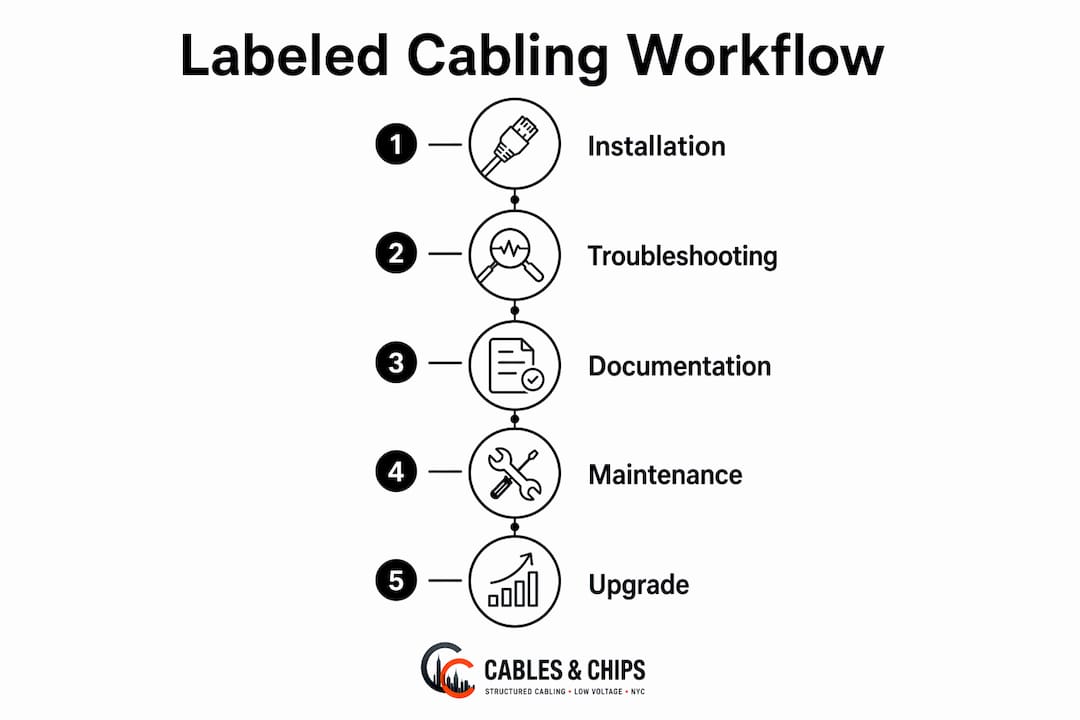
Moves, adds, and changes (MACs) are where labeled infrastructure pays the clearest dividend. When a workstation moves from one office to another, a technician with a labeled plant can identify the active port, confirm the cable path, and reassign the connection in minutes. The same task in an unlabeled environment requires tracing, testing, and documenting from scratch. For facilities managers overseeing frequent tenant changes or office reconfigurations, that difference compounds across every MAC event.
Labeled cabling also supports as-built documentation that survives staff turnover. When the technician who installed the network leaves, the labels and the documentation they reference become the institutional memory of the infrastructure. New team members can onboard to a labeled plant without a knowledge transfer session.
- Assign unique IDs at installation. Every cable gets a label before the first patch cord is plugged in.
- Log each label in a central diagram. Digital or physical, the diagram must reflect the installed plant exactly.
- Verify labels after every MAC event. Confirm that labels still match documentation before closing the work order.
- Audit the label plant annually. Walk the MDF, IDF, and all horizontal runs to catch label degradation or undocumented changes.
- Train every technician on the labeling scheme. A scheme that only one person understands is a single point of failure.
| Workflow stage | Labeled cabling benefit |
|---|---|
| Initial installation | Establishes traceable baseline for all future work |
| MAC events | Reduces per-event labor by enabling direct port identification |
| Fault diagnosis | Cuts time to isolate physical layer issues |
| Compliance audits | Provides documented, traceable infrastructure records |
| Staff transitions | Preserves institutional knowledge independent of personnel |
For commercial buildouts, planning cabling infrastructure with labeling built into the project scope from the start prevents the costly retrofit work that unlabeled installations require later.
Key Takeaways
Labeled cabling is the most cost-effective tool IT teams have for cutting troubleshooting time, reducing MAC labor, and maintaining audit-ready network infrastructure.
| Point | Details |
|---|---|
| Physical layer faults dominate | 90% of intermittent drops are physical issues, and labels make them faster to isolate. |
| Label both ends, always | Single-end labeling creates a one-sided map that fails during patch panel diagnosis. |
| ANSI/TIA-606-C sets the standard | Following this standard reduces diagnostic time and supports compliance audits. |
| Unlabeled plants cost real money | Manual re-documentation after a reconfiguration can consume up to a full week of technician labor. |
| Labels enable software to work | Network monitoring tools depend on physical labels to connect logical alerts to physical locations. |
Why I stopped treating labeling as an afterthought
Field experience teaches you things that standards documents cannot. Early in my career, I watched a team spend three days diagnosing an intermittent outage in a 300-port office. The problem was a single kinked cable behind a wall plate. The cable had no label. The patch panel had no label. The diagram was two years out of date. Three days of labor, a frustrated client, and a fix that took four minutes once the right cable was found.
That experience changed how I think about labeling. It is not overhead. It is not the last step before a project closes. It is the first investment you make in every future technician who will ever touch that infrastructure. Proper labeling eliminates guesswork and the costly labor that guesswork generates. The goal is a plant so well labeled that the next technician never needs to create a new label. They just read the ones already there.
I also see facilities managers underestimate how much MAC work compounds in unlabeled environments. One reconfiguration is manageable. Twenty reconfigurations over three years in an unlabeled plant create a documentation debt that eventually requires a full re-documentation project. That project costs more than labeling correctly at installation would have cost by a wide margin.
My advice: treat the patch panel labeling as seriously as the cable installation itself. A perfectly terminated cable with no label is half a job. The label is what makes the termination useful to every person who comes after you.
— Ken
Professional cabling services that get labeling right from day one
Cables and Chips brings more than 40 years of structured cabling experience to commercial offices, server rooms, and enterprise environments across New York City. Every installation includes labeled infrastructure built to ANSI/TIA-606-C standards, with documentation that supports troubleshooting, audits, and future MACs.
The structured cabling components guide covers the full scope of what a properly documented, labeled installation includes. For facilities managers and IT teams planning a new build or a cable cleanup, Cables and Chips provides site surveys, installation, testing, and as-built documentation. Contact Cables and Chips at 20 Vesey Street, Lower Manhattan, to schedule a site survey and get your infrastructure labeled correctly the first time.
FAQ
What is labeled cabling in a structured cabling system?
Labeled cabling is the practice of applying unique, permanent identifiers to both ends of every cable in a structured cabling plant. These identifiers cross-reference a documentation system that maps each cable to its physical path, port, and circuit.
How does labeled cabling reduce troubleshooting time?
Labels let technicians go directly from a logical alert to the specific physical cable without manual tracing. Since 90% of intermittent drops are physical layer issues, faster physical identification cuts total resolution time significantly.
What standard governs cable labeling in commercial installations?
ANSI/TIA-606-C is the recognized standard for telecommunications infrastructure administration, including cable labeling. Following it reduces diagnostic time and supports compliance audits during moves, adds, and changes.
How long does it take to re-document an unlabeled cabling plant?
Re-documenting a complex unlabeled environment can require up to a full week of external technician labor. That cost far exceeds the time and materials required to label correctly at installation.
Should patch cords be labeled the same way as permanent runs?
Patch cords require labels at both ends, just like permanent horizontal runs. Unlabeled patch cords are a common source of diagnostic confusion, particularly when looped connections create misleading link status indicators on switch ports.