
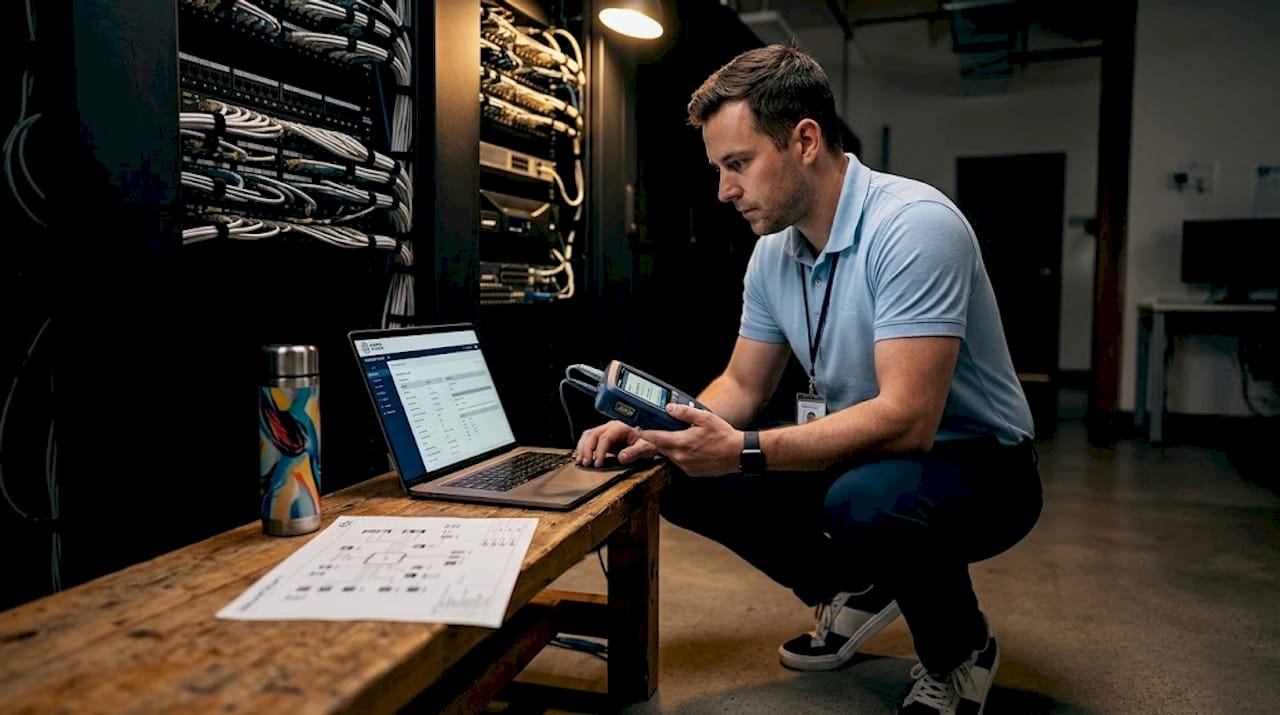
Most IT managers assume that if a cable is connected and traffic moves, the installation passes. That assumption has caused more network failures, warranty disputes, and costly rework than almost any other misconception in network infrastructure. Understanding how cable testing certification works means recognizing that connectivity is just the starting point. True certification is a documented, standards-based process that proves every link in your network performs to specification under real-world conditions. This article covers the process, the tools, the standards, and the mistakes worth avoiding.
Key takeaways
| Point | Details |
|---|---|
| Certification goes beyond connectivity | Standards-based tests measure attenuation, crosstalk, and return loss to prove performance, not just signal presence. |
| Process starts before installation | Design decisions and installation practices directly affect whether cables pass or fail certification tests. |
| Documentation drives warranty compliance | Accepted test reports from certified tools are required to validate manufacturer warranties on structured cabling. |
| Tool selection affects project cost | High-speed certifiers can reduce testing costs by up to 66% by cutting rework and diagnostic time. |
| Regulatory scrutiny is increasing | Third-party validated test reports are no longer optional in regulated environments and enterprise procurement. |
How cable testing certification works: the fundamentals
What is cable certification testing, exactly? Most professionals use the term loosely to mean any test performed on a cable after installation. The accurate definition is narrower and more specific. Cable certification is a verified, standards-based test that confirms a cable link or channel supports the bandwidth and performance required by the intended application. Simple connectivity checks and even basic wiremap tests do not qualify.
Certification tests measure a defined set of electrical and physical parameters, including:
- Length: Confirms the cable does not exceed the maximum segment length specified by the standard (typically 100 meters for structured copper cabling).
- Attenuation (Insertion Loss): Measures signal loss as it travels through the cable. Excessive loss means the receiving end does not get a usable signal.
- Near-End Crosstalk (NEXT) and Far-End Crosstalk (FEXT): Measures signal interference between adjacent wire pairs. High crosstalk degrades throughput and causes errors.
- Return Loss: Measures how much signal reflects back toward the source due to impedance mismatches. Poor return loss is often caused by bad terminations or damaged cable.
- Propagation Delay and Delay Skew: Confirms that all four pairs of a copper cable carry signals within acceptable timing differences, which matters for protocols that use all pairs simultaneously.
The two major standards governing these tests are TIA-568 (the Telecommunications Industry Association standard, widely used in North America) and ISO/IEC 11801 (the international standard used across Europe and globally). Both define pass/fail limits for each parameter at specific frequency ranges. Certification-level testing per TIA-568 or ISO/IEC 11801 requires frequency measurements up to 2000 MHz for higher categories, which clearly distinguishes it from simpler qualification testing that covers only basic connectivity and limited frequency ranges.
The equipment used for certification is purpose-built. Cable certifiers, such as the Fluke DSX series, inject test signals at multiple frequencies and measure the results against the stored pass/fail limits for the applicable standard and cable category. A standard multimeter or basic cable tester cannot perform this function.
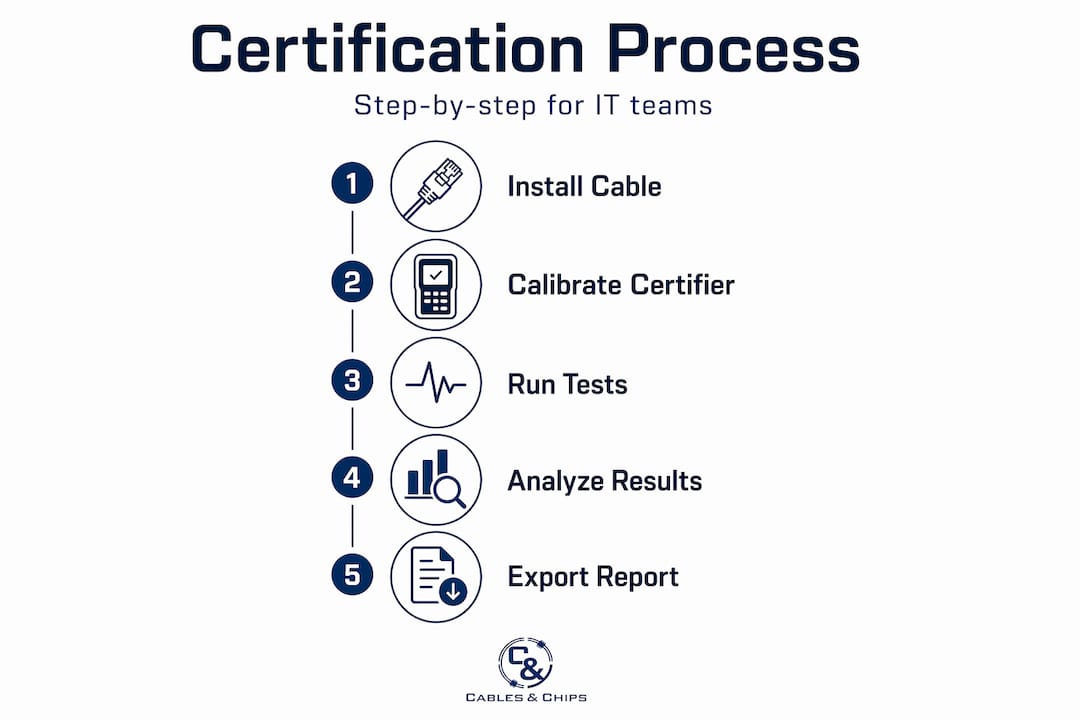
The cable testing process from installation to report
Certification is a lifecycle process that begins long before the certifier is connected to the first jack. How the project is designed and how cables are physically installed have a direct impact on test results.
Here is how the cable testing process unfolds from start to finish:
-
Pre-installation design review. Confirm that the planned cable routes do not exceed maximum channel lengths when patch cords are factored in. Identify areas where cable will run near electrical conduits, HVAC systems, or other interference sources. These decisions affect final test results.
-
Installation to specification. Pull tension must stay within the cable manufacturer’s limits. Bend radius cannot be violated at corners or inside equipment cabinets. Pair untwist at terminations must stay within the maximum allowed by the standard, typically no more than 13mm for Cat6. Any deviation here shows up as a crosstalk failure later.
-
Wiremap testing. Before running a full certification sweep, verify that each pin is connected correctly at both ends and that no shorts, opens, or split pairs exist. A wiremap failure disqualifies the link from the rest of the test until the fault is corrected.
-
Full certification sweep. The certifier runs the complete parameter suite — attenuation, NEXT, FEXT, return loss, propagation delay, and delay skew — across all required frequencies for the cable category being certified.
-
Pass/fail interpretation. Each parameter is compared against the stored limits for the selected standard. A single parameter failure on any pair is enough to fail the entire link. The certifier stores the result with a timestamp, the tester ID, and the operator information.
-
Fault diagnosis and remediation. When a link fails, modern certifiers provide diagnostic data identifying which pair failed and at what frequency. Technicians correct the issue, usually a poor termination or a damaged section, and retest.
-
Report generation and acceptance. All test results are exported, reviewed for completeness, and submitted as the project’s certification documentation. Manufacturers require this documentation to validate warranties on Cat6, Cat6A, and fiber installations.
Pro Tip: Always calibrate your certifier reference leads at the start of each day. A worn or damaged reference lead introduces measurement error across every test run that day, and those errors may not be obvious until a marginal link fails final review.
The documentation step is often undervalued. Test reports are not just project paperwork. They are the record that protects you in a warranty claim, satisfies a general contractor’s acceptance criteria, and provides the baseline for future troubleshooting if network performance degrades over time.
Choosing the right cable certifier for your project
Not all certification tools are equal. The choice of certifier affects how quickly you can complete a job, which cable categories you can certify, and whether your reports will be accepted by the manufacturer’s warranty program.
The two most referenced professional certifiers in the industry are the Fluke DSX-5000 and DSX-8000. Here is how they compare:
| Feature | Fluke DSX-5000 | Fluke DSX-8000 |
|---|---|---|
| Maximum frequency | 1000 MHz | 2000 MHz |
| Cable categories supported | Cat5e, Cat6, Cat6A | Cat5e, Cat6, Cat6A, Cat8 |
| Class I/II fiber support | No | Yes |
| Graphical fault localization | Yes | Yes |
| Test speed per link | ~12 seconds | ~8 seconds |
| Warranty program acceptance | TIA-568, ISO/IEC 11801 | TIA-568, ISO/IEC 11801, Class I/II |
The DSX-8000 is the correct choice for any project involving Cat8 cabling or where future-proofing to higher-speed applications is a project requirement. Certification tools like the DSX-8000 support testing up to 2000 MHz, covering Cat8 and Class I/II fiber channels. For the majority of commercial office projects using Cat6A, the DSX-5000 handles every required test.
Speed matters more than most IT managers realize. High-speed certification tools reduce total testing costs by up to 66% and improve job profitability by approximately 10% by cutting rework and troubleshooting cycles. On a 500-link installation, the difference between a 12-second and an 8-second test time compounds quickly, especially when you account for the time saved by built-in fault diagnostics.
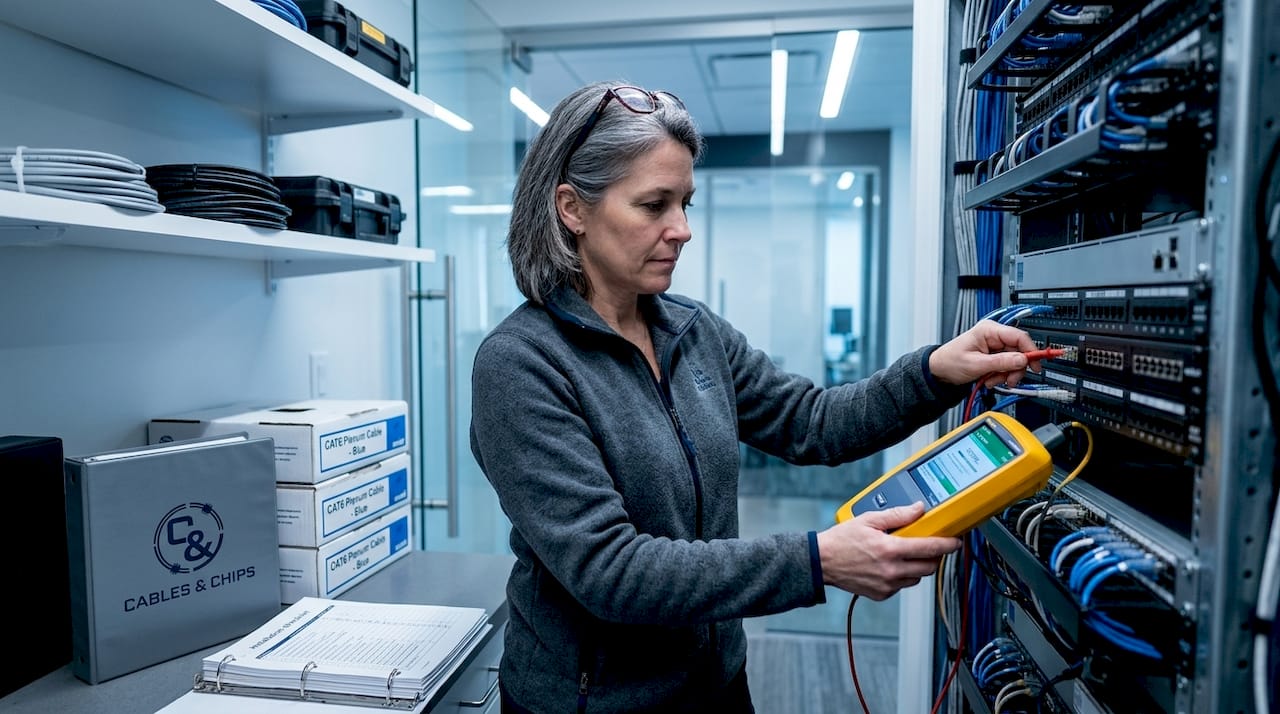
Diagnostic features in modern certifiers provide graphical fault localization, which identifies not only which pair failed but also the approximate distance to the fault point. A technician can go directly to the location instead of re-pulling or re-terminating blindly.
Pro Tip: If your project requires manufacturer warranty acceptance, confirm with the cable manufacturer which certifier model and software version they accept before testing begins. Some warranty programs require the latest firmware on the certifier to validate results.
Common pitfalls and compliance challenges
Even experienced crews make mistakes in the certification process. Some are technical. Others are procedural. Both types create real liability.
The most frequent issues Cables sees in the field include:
- Confusing qualification testing with certification. A qualification test checks basic connectivity and may measure a limited set of parameters. It does not generate the frequency-sweep data required for manufacturer warranty acceptance or standards compliance. Using qualification results as certification documentation is a documentation failure that creates exposure in project acceptance and disputes.
- Skipping disconnection of sensitive electronics before high-voltage tests. Failure to disconnect electronics before high-voltage insulation testing can damage connected equipment. This step is often skipped under schedule pressure and results in damaged hardware or corrupted test readings.
- Ignoring stored charge after testing. Long cables store electrical charge after high-voltage testing is complete. Grounding the cable for at least four times the test duration before reconnecting equipment is a safety requirement, not a suggestion.
- Accepting uncertified documentation from subcontractors. Project managers who accept handwritten or PDF-only test summaries without the actual certifier-generated report files are accepting unverifiable data. Authentic reports contain metadata including the certifier serial number, operator ID, and timestamp.
- Using outdated test standards. Running a Cat6A installation against Cat6 limits produces a pass result that means nothing for a 10GbE application. Always confirm the standard and cable category limits are correctly set in the certifier before beginning.
Regulatory pressure on test documentation is intensifying. The FCC is tightening oversight on test labs and certification bodies to combat fraudulent test data, and the risk of accepting falsified reports now extends beyond warranty disputes into legal and safety liability for building owners and IT managers. Third-party validation of test results is becoming a procurement and compliance standard, not an optional upgrade.
For any project in a regulated facility, data center, or enterprise environment, requiring digitally exported certifier reports with full metadata is the minimum standard of documentation. Anything less puts the project acceptance at risk.
My take on what certification actually protects
I have worked on network infrastructure in New York City long enough to know where projects fall apart. It is almost never the switch configuration or the IP scheme. It is the cable plant that nobody fully validated.
In my experience, the biggest misunderstanding about cable certification is that it is a one-time box to check at the end of a job. It is not. Certification is a lifecycle process that begins the moment the design is drawn and ends when the client signs off on the final test report package. Every decision in between, from cable routing to termination technique to connector selection, either helps or hurts the outcome.
What I have learned is that teams who treat certification seriously from day one spend far less time troubleshooting after handover. The cost of a failed link is not just a re-termination. It is the diagnostic time, the client call, the potential warranty dispute, and the credibility hit. Good test documentation prevents all of that.
I also tell every project coordinator we work with: the test report is the asset. The cable plant will be in that building for 15 to 20 years. The report that documents its performance on day one is what you hand to the next IT team, the next contractor, and the next auditor. Protect it accordingly.
— Ken
Build a certified network with Cables
If you are managing a cabling project in New York City and need to be certain that every link passes certification, Cables has handled this work for more than 40 years across commercial offices, secure facilities, and enterprise environments throughout the city.
Our team installs and certifies structured CAT6 cabling to TIA-568 and ISO/IEC 11801 standards using professional-grade certifiers that generate manufacturer-accepted documentation. We also provide fiber optic termination and testing for projects requiring certified fiber links. For IT teams planning infrastructure at scale, our work on scalable cabling infrastructure shows how certification integrates with long-term network planning. Every project we complete includes full test report documentation so you have the records you need for warranty compliance, project acceptance, and future reference. Contact Cables to schedule a site survey at 20 Vesey Street or anywhere in New York City.
FAQ
What is cable certification testing?
Cable certification testing is a standards-based process that verifies a cable link meets the electrical performance requirements for its rated category and intended application. It measures parameters like attenuation, crosstalk, and return loss across a defined frequency range per TIA-568 or ISO/IEC 11801.
How is cable certification different from a basic cable test?
A basic test checks connectivity and wiremap. Certification runs a full frequency sweep across all performance parameters and produces documented results that satisfy manufacturer warranty requirements. Only certified results qualify for structured cabling system warranties.
What equipment is needed to certify network cables?
You need a purpose-built cable certifier such as the Fluke DSX-5000 or DSX-8000, along with the correct adapters for the cable category being tested. The certifier must be loaded with the appropriate standard limits and have calibrated reference leads.
Why do test reports matter for warranty compliance?
Manufacturers require the digitally exported certifier report files to validate structured cabling warranties. Reports contain the certifier serial number, timestamps, and pass/fail data for each parameter. Without these files, a warranty claim cannot be processed.
How do you handle a cable that fails certification?
The certifier identifies which parameter and which pair failed, along with the approximate location of the fault. The technician corrects the issue, typically a poor termination or physical cable damage, and reruns the full certification test before recording a pass result.