

Fiber optic infrastructure is defined as a high-speed communication network that uses strands of glass or plastic to transmit data as pulses of light, delivering speeds, bandwidth, and reliability that copper and coaxial systems cannot match. Understanding what is fiber optic infrastructure is no longer optional for IT leaders and operations managers. The networks you build today will either support AI workloads, 5G backhaul, and edge computing in 2026 and beyond, or they will become a bottleneck you pay to replace. Fiber’s theoretical capacity per strand can reach 600,000 Gbps with a lifespan of 50–100 years. That is not a performance upgrade. That is a generational infrastructure decision.
What is fiber optic infrastructure and how is it structured?
Fiber optic infrastructure is the complete system of optical fibers, passive splitters, active electronics, and termination hardware that moves data as light from one point to another. The industry term for the full network stack is optical fiber network, though “fiber optic infrastructure” accurately describes the physical and logical layers combined.
The network is organized into three distinct layers:
- Backbone networks carry massive volumes of traffic between cities, data centers, and major exchange points using high-capacity fiber trunks.
- Metro and regional networks distribute traffic within a city or geographic region, connecting the backbone to local distribution points.
- Last-mile connections deliver service directly to buildings and end users, typically through Fiber to the Home (FTTH), Fiber to the Building (FTTB), or Fiber to the Curb (FTTC) architectures.
Each layer involves a critical design decision: where to place the optical-to-electrical conversion point. Network design choices around FTTH, FTTB, and FTTC directly affect cost, performance, and upgrade flexibility. Pushing fiber closer to the end user increases performance but raises initial deployment cost.
Passive Optical Network (PON) technology governs how traffic is shared across the last mile. Modern deployments use XGS-PON, 25G-PON, and 100G-PON standards, which coexist on the same physical fiber plant to balance cost and performance. This means an operator can deploy XGS-PON today and upgrade to 25G-PON later without replacing the cable in the ground.
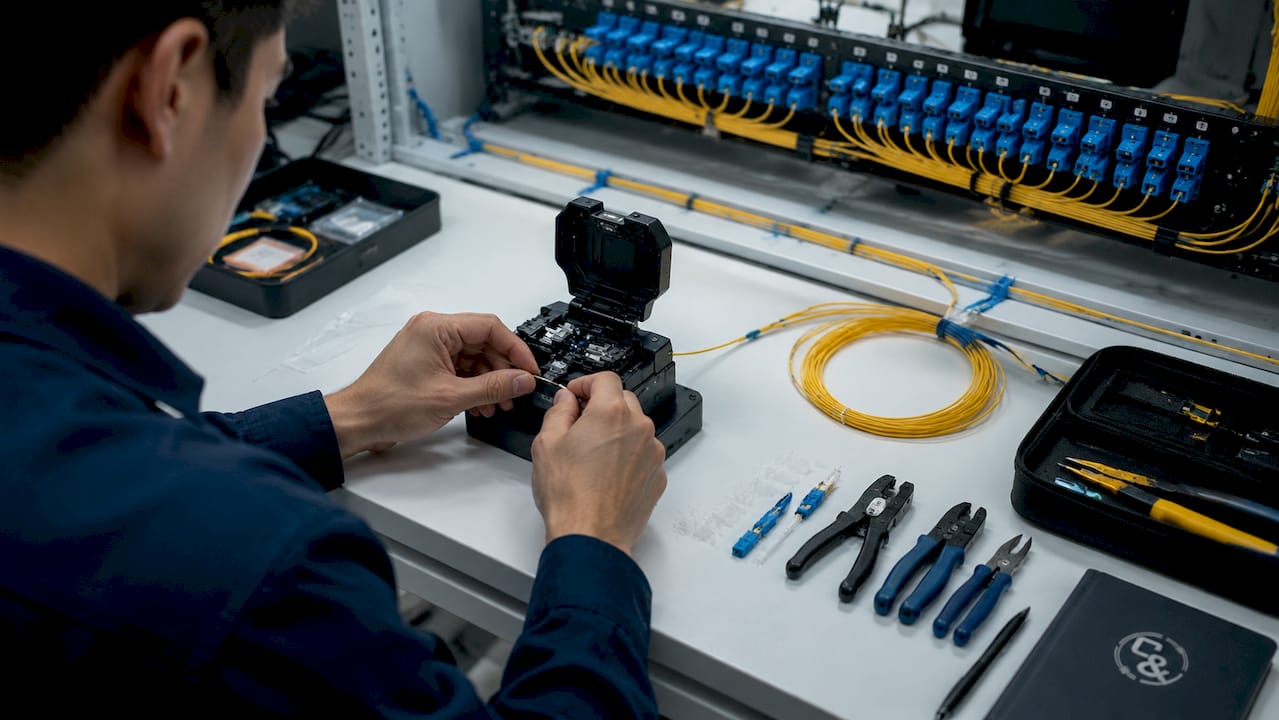
Pro Tip: When evaluating fiber network designs, map your optical-to-electrical conversion points first. That single decision drives the majority of your long-term capital and operating cost structure.
How does fiber optic infrastructure compare to copper and HFC?
The performance gap between fiber and legacy systems is not marginal. It is structural. Fiber transmits data as light, which means it is immune to electromagnetic interference, experiences negligible signal degradation over distance, and supports fully symmetrical upload and download speeds. Copper and Hybrid Fiber-Coaxial (HFC) networks carry electrical signals that degrade, interfere, and require active amplification at regular intervals.
| Attribute | Fiber Optic | Copper (CAT6/CAT6A) | HFC (Coaxial) |
|---|---|---|---|
| Maximum speed | 600,000 Gbps theoretical | 10 Gbps (CAT6A) | 10 Gbps (DOCSIS 3.1) |
| Latency | Ultra-low | Moderate | Moderate to high |
| Symmetrical bandwidth | Yes | Limited | No |
| Operating cost | ~50% lower than HFC | Moderate | Baseline |
| Carbon footprint | Up to 96% smaller | Moderate | Baseline |
| Upgrade path | Electronics only | Cable replacement | Partial node splits |
| Lifespan | 50–100 years | 10–15 years | 15–20 years |
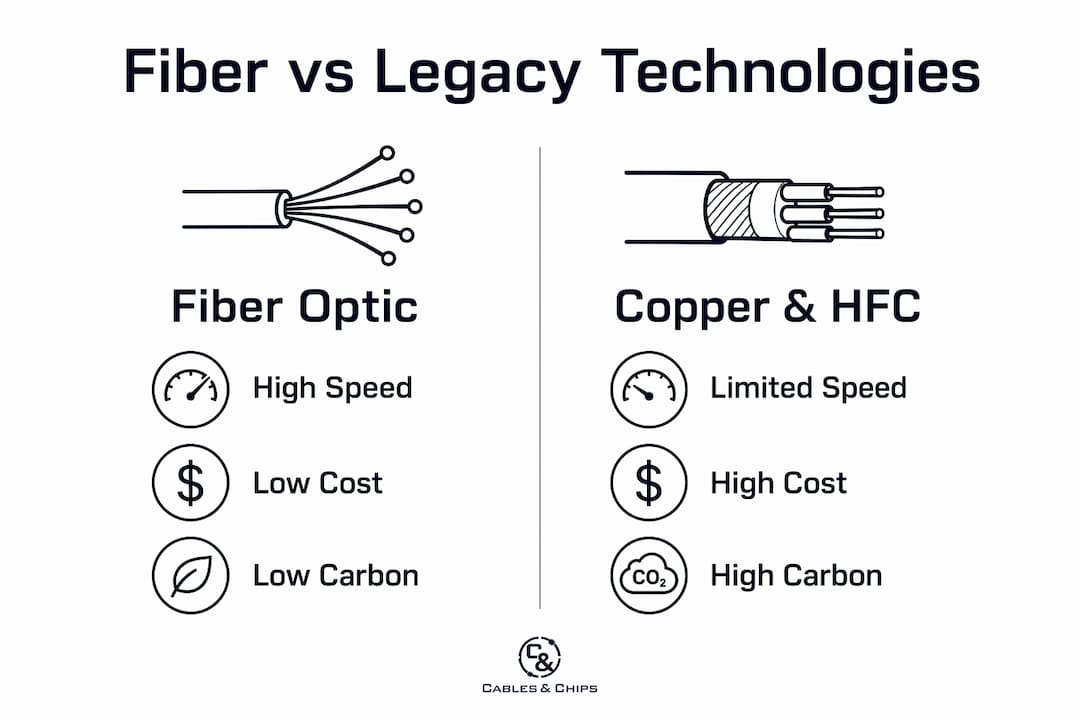
The economics favor fiber at every time horizon. Operating expenses run approximately 50% lower than HFC because fiber eliminates the active amplifiers and nodes that require power and maintenance. That cost reduction compounds over a network’s lifetime.
The environmental case is equally strong. Fiber deployments carry a carbon footprint up to 96% smaller than legacy copper or coaxial networks. For organizations with sustainability commitments, this is a material factor in infrastructure planning.
The revenue and retention data reinforce the business case. In markets where fiber is available, 36% of subscriber churn moves to fiber compared to 23% for HFC. Fiber users generate average revenue per user (ARPU) of $73–$74 versus $70.50 for HFC. For enterprise IT leaders evaluating network investments, these numbers translate directly to tenant satisfaction, lease retention, and building valuation.
What industries and applications benefit most from fiber optics?
Fiber optic technology is the foundational layer for every high-demand application in modern operations. The shift to AI and edge computing makes fiber infrastructure non-negotiable because AI inference workloads require symmetrical, ultra-low-latency connectivity that copper simply cannot deliver at scale.
The top five industries and technology trends driving fiber demand in 2026 are:
- Data centers and cloud computing require fiber for high-density server interconnects, MTP/MPO trunk systems, and spine-leaf architectures that move petabytes of data daily.
- Telecommunications and 5G backhaul depend on fiber to carry the traffic generated by dense small-cell networks, where wireless capacity is only as good as the wired backhaul behind it.
- Healthcare and telemedicine use fiber to support real-time imaging, remote diagnostics, and electronic health record systems that cannot tolerate latency or packet loss.
- Smart grids and energy infrastructure rely on fiber for real-time monitoring and control of distributed power assets, where milliseconds of delay can affect grid stability.
- Commercial real estate and enterprise campuses use fiber to support unified communications, VoIP, access control, and high-density WiFi deployments across multiple floors and buildings.
Beyond connectivity, fiber serves a second function that most decision-makers overlook. Distributed Fiber Optic Sensing (DFOS) converts unused dark fiber strands into real-time sensors for structural integrity monitoring, perimeter security, and environmental detection. This means the fiber you install for network connectivity can simultaneously monitor your building’s physical infrastructure without any additional cabling. That dual-use capability changes the return-on-investment calculation significantly.
Deploying fiber to unserved U.S. households could generate $3.24 trillion in net present value through increased property values, employment, and income growth. Median home values rise 14–17% in areas with fiber access. For commercial property owners and building managers, that data point belongs in your capital planning conversation.
How to plan and scale a fiber optic deployment
Deploying fiber optic infrastructure is a strategic decision, not a procurement exercise. The architecture you choose at the start determines your cost structure, upgrade path, and operational flexibility for decades.
-
Define your topology first. Choose between centralized, distributed, or cascaded architectures based on building size, user density, and growth projections. There is no universal FTTH architecture that fits every environment. A single-tenant data center has different requirements than a 40-story commercial office tower.
-
Assess installer availability and certification. Fiber termination requires trained technicians with proper fusion splicing and testing equipment. Verify that your contractor holds certifications for the specific fiber types and connector standards your design requires, including OS2 single-mode and OM3/OM4 multimode.
-
Plan for capacity headroom, not just current demand. Install more fiber strands than you need today. Dark fiber costs almost nothing to add during initial installation and eliminates the need for disruptive recabling when demand grows.
-
Upgrade electronics, not cable. Capacity upgrades rely on endpoint electronics such as optical line terminals (OLTs) and optical network units (ONUs), not on replacing the physical cable. This means your fiber plant investment is protected even as PON standards evolve from XGS-PON to 25G-PON and beyond.
-
Document and test every run. Certified test results from tools like OTDR (Optical Time Domain Reflectometer) testing provide a baseline for troubleshooting and prove compliance with TIA-568 standards. Undocumented fiber is a liability, not an asset.
For organizations transitioning from copper or HFC, a phased approach works well. Start with the highest-demand segments, typically the MDF/IDF backbone and server room interconnects, and extend to the edge over time. This approach controls capital expenditure while delivering immediate performance gains where they matter most. You can explore scalable cabling approaches that support phased fiber rollouts without disrupting existing operations.
Pro Tip: Early fiber investment consistently delivers lower total cost of ownership than deferred upgrades. Every year you delay, you pay for copper maintenance and lose the operating cost savings that fiber provides from day one.
Key Takeaways
Fiber optic infrastructure delivers superior speed, lower operating costs, and a longer useful life than any copper or coaxial alternative, making it the correct choice for any organization planning a network that must perform in 2026 and beyond.
| Point | Details |
|---|---|
| Core definition | Fiber optic infrastructure transmits data as light pulses through glass or plastic strands for high-speed connectivity. |
| Operating cost advantage | Fiber OpEx runs approximately 50% lower than HFC due to fewer active components and reduced maintenance. |
| Carbon footprint | Fiber deployments carry a carbon footprint up to 96% smaller than legacy copper or coaxial networks. |
| Upgrade path | Capacity scales by upgrading OLTs and ONUs, not by replacing physical cable, protecting your initial investment. |
| Dual-use capability | DFOS technology converts dark fiber strands into real-time structural and security sensors at no additional cabling cost. |
Why fiber is the infrastructure decision you cannot defer
I have worked on network infrastructure in commercial buildings across New York City for a long time, and the pattern I see repeatedly is this: organizations treat fiber as a premium option rather than a baseline requirement. That framing is wrong, and it costs them money.
The argument against fiber is almost always about upfront cost. What that argument ignores is the total cost of maintaining copper infrastructure year over year, the performance ceiling that copper imposes on every application running above it, and the recabling cost you will eventually pay anyway. Fiber does not become cheaper if you wait. The buildings that installed fiber five years ago are now upgrading their electronics to 25G-PON. The buildings that stayed on copper are replacing cable.
The other misconception I encounter is that fiber is a telecom concern, not an enterprise concern. That stopped being true the moment AI inference workloads and high-density WiFi 6E deployments became standard. Fiber infrastructure underpins public safety, energy, and enterprise sectors equally. Your network is only as strong as the infrastructure behind it.
My honest recommendation: if you are planning any significant network refresh, start with the fiber backbone and build outward. Do not let short-term budget pressure push you toward a copper solution that you will outgrow in three years. The long-term advantages of fiber cabling are not theoretical. They show up in your operating budget, your building’s valuation, and your team’s ability to support whatever technology comes next.
— Ken
How Cables supports your fiber optic infrastructure
Cables & Chips designs and installs fiber optic infrastructure for commercial offices, server rooms, telecom rooms, and enterprise environments throughout New York City. With more than 40 years of experience, the team at Cables handles everything from backbone fiber runs and MDF/IDF terminations to OTDR testing, certification, and documentation.
Whether you are deploying a new fiber plant, upgrading an existing structured cabling system, or transitioning from copper to fiber in a live environment, Cables delivers clean, tested, and fully documented installations. Explore the complete range of fiber optic installation services or review the structured cabling components guide to understand how fiber fits into your broader network architecture. Contact Cables at 20 Vesey Street, Lower Manhattan, to schedule a site survey.
FAQ
What is fiber optic infrastructure in simple terms?
Fiber optic infrastructure is a network of glass or plastic strands that transmits data as pulses of light, delivering higher speeds, lower latency, and greater reliability than copper or coaxial cabling systems.
How does fiber optics work compared to copper cabling?
Fiber converts data into light signals and transmits them through optical fibers, while copper carries electrical signals that degrade over distance and are vulnerable to interference. Fiber supports symmetrical speeds and requires no active amplification along the cable run.
What are the main benefits of fiber optic infrastructure?
The primary benefits include operating expenses approximately 50% lower than HFC, a carbon footprint up to 96% smaller than legacy networks, symmetrical bandwidth, immunity to electromagnetic interference, and a physical lifespan of 50–100 years.
What is the fiber optic installation process for commercial buildings?
The process includes site survey and topology design, fiber pathway installation, cable pulling and termination, fusion splicing or mechanical termination, OTDR testing and certification, and full documentation of every run against TIA-568 standards.
Can fiber infrastructure support applications beyond data networking?
Yes. Distributed Fiber Optic Sensing (DFOS) converts unused dark fiber strands into real-time sensors for structural monitoring, perimeter security, and environmental detection without any additional cabling installation.