
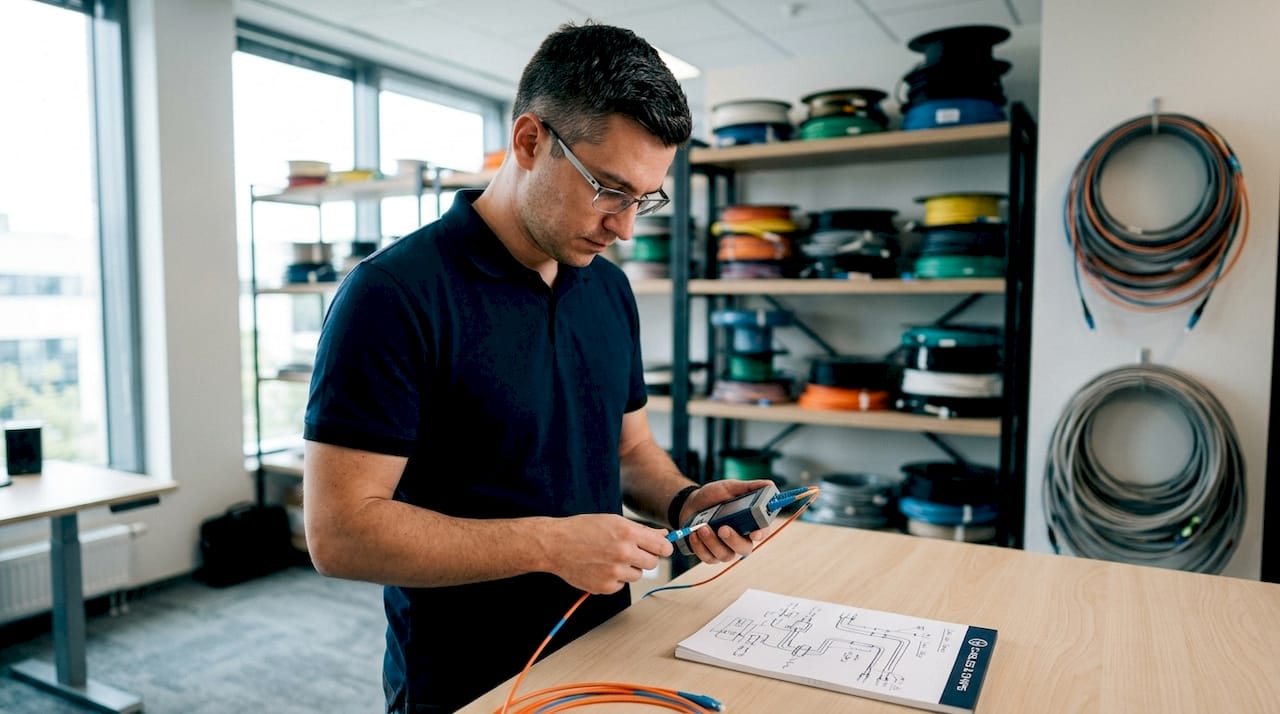
Fiber optic cabling is the highest-performance data transmission medium available for enterprise networks today. Where copper Ethernet tops out at 10 Gbps over short runs, fiber optic infrastructure supports theoretical data rates exceeding 60 Tbps, transmits signals over distances measured in kilometers rather than meters, and operates with complete immunity to electromagnetic interference. For IT professionals and network managers weighing infrastructure investments, the fiber optic cabling advantages over copper are not marginal. They are structural. This article breaks down each advantage with the specificity you need to make a defensible decision.
1. Bandwidth and speed that copper cannot match
Fiber optic cables transmit data using pulses of light rather than electrical current, which is why their bandwidth ceiling is orders of magnitude higher than copper. Practical deployments today run at 100 Gbps per wavelength, and dense wavelength division multiplexing (DWDM) allows multiple wavelengths to share a single strand, pushing aggregate capacity far beyond that. Copper Ethernet, by contrast, is physically capped at 10 Gbps for standard office runs, and that ceiling does not move regardless of the switch hardware behind it.
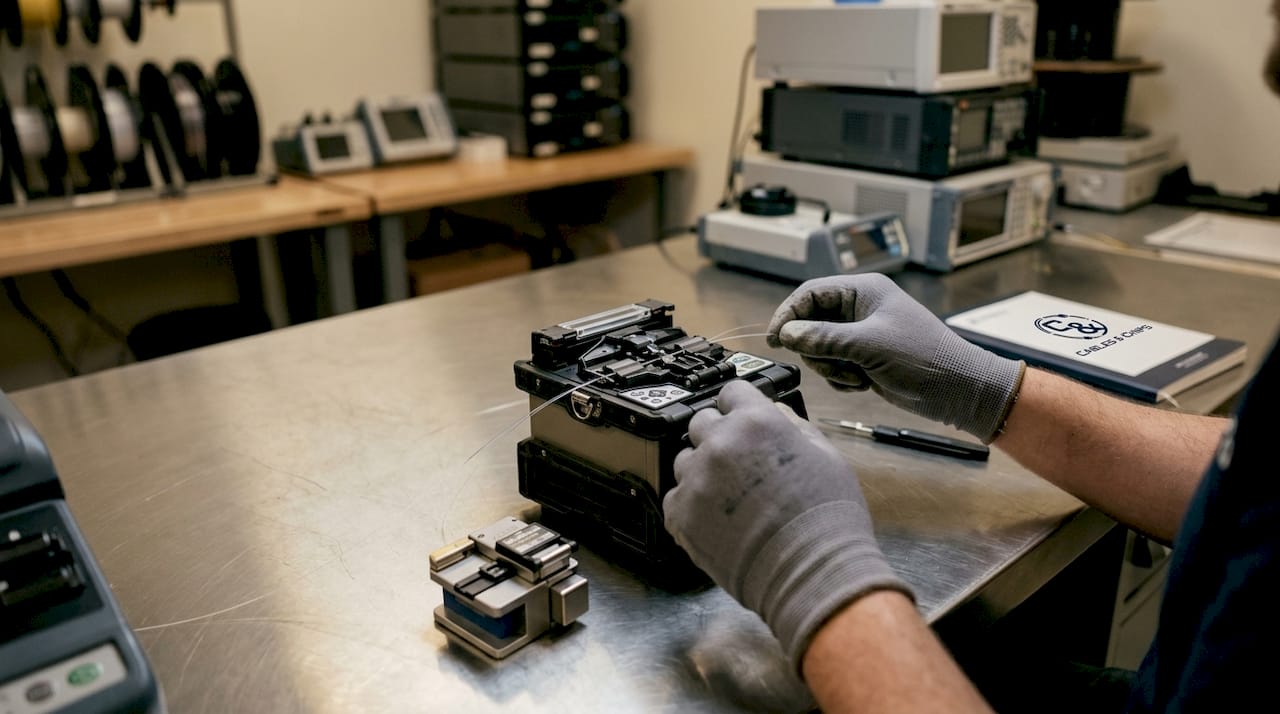
The real-world impact shows up immediately in high-demand workloads. Fiber supports symmetrical upload and download speeds that are critical for AI model training, 4K and 8K video production, and cloud-heavy enterprise workflows where asymmetric throughput creates bottlenecks. CommScope’s analysis of AI infrastructure requirements confirms that fiber is the only medium capable of sustaining the data volumes these workloads generate at scale.
Key bandwidth capabilities by fiber type:
- Single-mode fiber (SMF): Supports 100 Gbps to 400 Gbps+ over long distances using a narrow 9-micron core
- Multimode fiber OM4: Rated for 100 Gbps up to 150 meters, standard in data center horizontal runs
- Multimode fiber OM5: Supports shortwave wavelength division multiplexing (SWDM) for 400 Gbps over 150 meters
- Copper CAT6A: Capped at 10 Gbps up to 100 meters, with no upgrade path beyond that
Pro Tip: When specifying fiber for a new data center build, deploy single-mode even if your current switches only support 10G. The transceiver swap to 100G or 400G costs a fraction of re-cabling the physical plant later.
2. Distance reach that eliminates repeater infrastructure
Copper Ethernet is limited to 100 meters per IEEE 802.3 before signal degradation requires a switch or repeater. That constraint forces network architects to place intermediate distribution frames (IDFs) throughout large buildings, adding hardware cost, power draw, and failure points. Fiber removes that constraint entirely.
Depending on fiber type and transceiver selection, optical cabling reaches distances that copper cannot approach:
| Cable Type | Maximum Distance | Typical Use Case |
|---|---|---|
| Copper CAT6A | 100 meters | Floor-level horizontal runs |
| Multimode OM4 | 400 meters (10G) | Intra-building backbone |
| Single-mode OS2 | 10 to 40+ kilometers | Campus, inter-building, WAN |
| Single-mode with amplification | 80+ kilometers | Metro and long-haul links |
For a multi-building campus or a high-rise with a centralized MDF, single-mode fiber eliminates the need for intermediate switching hardware on every floor or in every building. That directly reduces capital expenditure on switches, power infrastructure, and rack space. It also removes those intermediate nodes as potential failure points, which improves uptime in ways that are difficult to achieve through redundancy alone.
Pro Tip: For inter-building runs in NYC, always specify OS2 single-mode even for short distances. Future transceiver upgrades are far cheaper than pulling new cable through conduit that is already occupied.
3. Complete immunity to electromagnetic and radio frequency interference
Fiber optic cables carry 100% immunity to electromagnetic and radio frequency interference because they contain no metallic components. Copper cables act as antennas. They pick up interference from motors, HVAC systems, fluorescent lighting, and adjacent power runs, which introduces bit errors, retransmissions, and latency spikes that are notoriously difficult to diagnose.
In environments like hospitals, manufacturing floors, broadcast facilities, and financial trading floors, EMI is not a theoretical concern. It is a daily operational reality. A copper run near a large UPS or elevator motor will degrade. Fiber in the same conduit path performs identically regardless of what surrounds it.
The durability advantage extends beyond interference immunity. Fiber cables withstand pulling forces up to 200 lbs during installation, compared to copper patch cables rated for only 25 lbs. Fiber is also resistant to moisture, corrosion, and temperature extremes that degrade copper insulation over time.
Key reliability advantages over copper:
- No signal attenuation from EMI or RFI sources in the cable path
- No corrosion of conductors in humid or chemically active environments
- No ground loop issues because fiber carries no electrical potential
- Higher mechanical strength during pulls through conduit and cable trays
- Longer service life with less degradation over the infrastructure lifecycle
Fiber’s immunity to interference is not just a performance feature. In dense urban environments like Manhattan, where electrical noise from transit systems, generators, and building systems is constant, it is the difference between a network that works and one that intermittently fails.
4. Cost structure and total cost of ownership
Fiber installation costs more upfront. Material runs approximately $1 to $2 per meter for fiber cable versus $0.20 per meter for copper, and fiber termination requires fusion splicing equipment and certified technicians. That cost difference is real and should be planned for honestly.
The total cost of ownership calculation, however, consistently favors fiber. Fiber’s TCO reaches ROI within two years for most enterprise deployments because of lower maintenance costs, fewer intermediate switches, reduced power consumption, and a longer infrastructure lifespan. Copper networks in large facilities require IDF switches every 100 meters, each drawing power and requiring management licenses, port capacity, and cooling.
The scalability argument is equally compelling. Bandwidth upgrades from 10G to 400G are achievable by swapping transceivers at each end of the fiber run. The physical cable plant does not change. That means a fiber backbone installed today can support network speeds that do not yet exist in standard enterprise deployments, without pulling a single new strand.
For organizations that need PoE at endpoints, a hybrid network design solves the problem directly. Fiber forms the backbone from the MDF to each IDF, and CAT6A copper completes the last segment to desks, access points, and IP cameras. This approach preserves PoE capability at endpoints while capturing fiber’s performance and reach advantages in the backbone where they matter most.
5. Physical security advantages copper cannot replicate
Fiber transmits data as light, not electricity. Intercepting that signal requires physically tapping the cable, and doing so causes detectable signal disruption that monitoring systems can identify in real time. Copper cables emit electromagnetic fields that can be captured by inductive pickup devices placed near the cable without any physical contact or visible evidence of intrusion.
For organizations in finance, healthcare, government, and legal services, this distinction is not academic. Regulatory frameworks including HIPAA, PCI DSS, and federal security standards increasingly require demonstrable physical security for data transmission infrastructure. Fiber satisfies that requirement in a way copper fundamentally cannot.
Security-critical environments where fiber is the standard choice:
- Financial trading floors: Real-time transaction data requires tamper-evident transmission paths
- Healthcare networks: Patient data under HIPAA requires physically secure infrastructure
- Government and secure facilities: Classified or sensitive data transmission mandates fiber in many specifications
- Legal and professional services: Client confidentiality obligations extend to network infrastructure design
The enterprise network security cabling implications of fiber versus copper are significant enough that many security-conscious organizations specify fiber for all backbone runs regardless of bandwidth requirements.
6. Future-proofing and scalability for emerging workloads
The shift to fiber is driven by more than current speed requirements. CommScope’s analysis of AI infrastructure confirms that emerging high-bandwidth applications including edge computing, AI inferencing, and real-time video analytics are creating demand curves that copper networks cannot serve. Organizations that deploy copper today are making a decision that will require re-cabling within five to seven years as workload density increases.
Fiber’s upgrade path through transceiver replacement rather than physical re-cabling is the most operationally significant scalability advantage in enterprise networking. A scalable cabling infrastructure built on fiber allows IT teams to respond to bandwidth demands by changing hardware at the rack, not by scheduling disruptive cable pulls through occupied facilities. For any organization planning a network that needs to serve workloads five or ten years from now, that distinction defines the decision.
Key takeaways
Fiber optic cabling delivers superior bandwidth, distance, reliability, security, and long-term scalability compared to copper, making it the correct infrastructure choice for any enterprise network designed to last.
| Point | Details |
|---|---|
| Bandwidth ceiling | Fiber supports 60 Tbps theoretically; copper is capped at 10 Gbps with no upgrade path. |
| Distance reach | Single-mode fiber reaches 40+ kilometers; copper Ethernet stops at 100 meters. |
| Interference immunity | Fiber carries zero EMI or RFI susceptibility, eliminating a major source of network instability. |
| Total cost of ownership | Higher upfront cost typically reaches ROI within two years through reduced maintenance and fewer switches. |
| Security and scalability | Fiber is physically tamper-evident and upgradeable via transceiver swap without re-cabling. |
Why fiber is the only backbone I recommend for new builds
After more than four decades of pulling cable in New York City, I have seen every argument for keeping copper in the backbone. The cost argument made sense in 2005. It does not hold up in 2026. Every client who deferred fiber to save on installation costs has come back within five years to re-cable, paying installation labor twice while also replacing the copper they just installed.
The hybrid approach is where I see the most practical value for most commercial environments. Fiber from the MDF to each IDF, CAT6A from the IDF to the desk. That design gives you fiber’s performance and reach in the backbone where it matters, and copper’s PoE capability at the edge where devices need it. It is not a compromise. It is the right architecture for the majority of office and enterprise deployments.
The security angle is underappreciated by most IT teams until they go through a compliance audit. When a HIPAA auditor or a PCI assessor asks how you physically secure your data transmission paths, fiber gives you a defensible answer. Copper does not. That conversation alone has changed several infrastructure decisions I have been part of in the last few years.
Your network is only as strong as the infrastructure behind it. Fiber is that infrastructure.
— Ken
Fiber optic installation services in New York City
Cables designs and installs fiber optic infrastructure for commercial offices, data centers, secure facilities, and enterprise environments throughout New York City. Whether you need a single-mode backbone between floors, inter-building campus runs, or a complete structured cabling system with fiber and CAT6A, our certified technicians handle design, installation, termination, and testing from a single point of accountability.
Every fiber installation Cables completes is tested and documented to TIA-568 standards, with OTDR traces and end-face inspection reports delivered at project close. If you are evaluating your options, our fiber installation services in NYC page covers scope, process, and how to request a site survey. For a broader view of how fiber fits into your structured cabling system, the IT manager’s cabling guide is a practical starting point. Contact Cables at 20 Vesey Street, Lower Manhattan, to schedule a consultation.
FAQ
What are the main fiber optic cabling advantages over copper?
Fiber optic cabling delivers higher bandwidth, longer transmission distances, complete EMI immunity, better physical security, and a longer infrastructure lifespan than copper. These advantages compound over time, making fiber the lower total-cost option for most enterprise backbone deployments.
How far can fiber optic cable transmit data without a repeater?
Single-mode fiber can transmit data over 40 kilometers without a repeater, compared to copper Ethernet’s 100-meter limit per IEEE 802.3. For campus and inter-building connectivity, this eliminates the need for intermediate switching hardware entirely.
Is fiber optic cabling more secure than copper?
Fiber is significantly more secure than copper because tapping a fiber cable disrupts the light signal and triggers detectable alerts, while copper cables can be intercepted electromagnetically without any physical contact. This makes fiber the standard choice for finance, healthcare, and government network infrastructure.
Can fiber optic infrastructure be upgraded without re-cabling?
Fiber supports bandwidth upgrades from 10G to 400G and beyond by swapping transceivers at each end of the run. The physical cable plant remains unchanged, which eliminates the labor cost and operational disruption of re-cabling during network upgrades.
What does fiber optic installation cost compared to copper?
Fiber cable material costs approximately $1 to $2 per meter versus $0.20 per meter for copper, and termination requires specialized fusion splicing equipment. Most enterprise deployments recover that cost difference within two years through reduced maintenance, fewer intermediate switches, and lower power consumption.