
Avoid $10,000 Surprises: Fiber Backbone Cost for Small Businesses
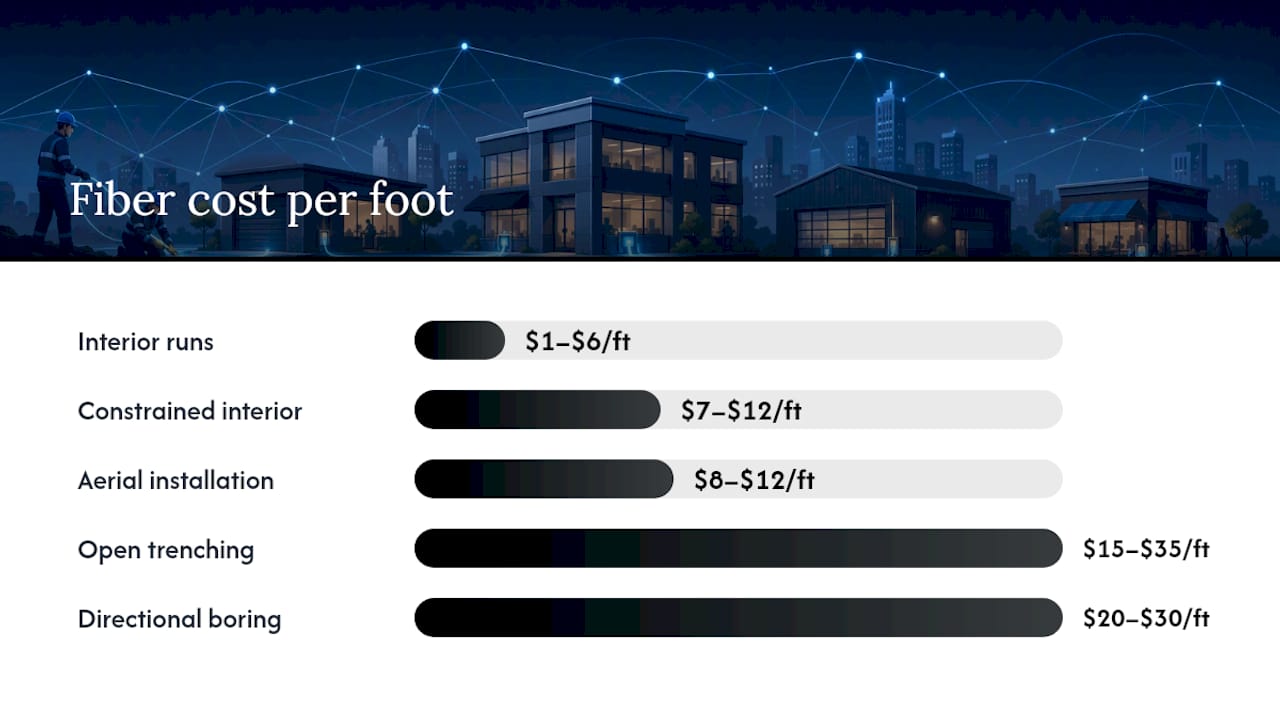
Expect $1 to $6 per foot for interior fiber runs, $8 to $12 per foot for aerial routes, and $15 to $35 per foot underground, with installed drops running $300 to $800 each. Pathway choice and labor drive most of that spread, not the cable itself. For most small offices, a hybrid design, fiber backbone paired with Cat6A to the desk, gets you the bandwidth without the excavation bill. Start with a site survey before you commit to either.
TL;DR:
- The cost of fiber backbone installation varies greatly depending on route complexity, with underground trenching costing up to $35 per foot and aerial installation around $8 to $12 per foot.
- Installation costs are driven more by pathway conditions, permitting, and labor than by the fiber cable itself, which typically adds only $1 to $6 per foot for interior runs.
- A single fiber drop usually costs between $300 and $800, with complex or exterior drops exceeding $1,000 due to extra splicing and routing challenges.
- Budgeting should include site surveys that assess existing conduit, access restrictions, permitting needs, and scope of restoration, preventing costly change orders.
- For most small offices, a hybrid fiber and copper setup offers enough bandwidth at lower costs, while full fiber to the desk is justified for high-bandwidth, multi-building, or security-sensitive environments.
How Much Does Fiber Backbone Cost Per Foot and Per Drop?
Cost per foot depends almost entirely on where the cable goes, not how much of it you buy. Interior runs through existing pathways, conduit, cable tray, ceiling space, typically land between $1 and $6 per foot. Route the cable through cramped risers, congested telecom closets, or buildings with limited access, and that climbs to $7 to $12 per foot because labor time doubles while material cost barely moves.
Aerial installation, stringing fiber pole to pole, runs $8 to $12 per foot in most markets. Underground work is where budgets get tested: open trenching runs $15 to $35 per foot, and directional boring (used to avoid tearing up pavement or landscaping) costs $20 to $30 per foot. Industry benchmarks put average underground deployment closer to $18 per foot, against roughly $8 per foot for aerial, with excavation and restoration work explaining nearly all of the gap.
Per-drop installed pricing is what actually shows up on a proposal. A single terminated drop, cable, connector, testing, typically runs $300 to $800, with field-terminated connectors on the low end and fusion-spliced terminations, more reliable, more labor-intensive, on the high end. Complex exterior drops with difficult routing or additional splice points can push past $1,000.
What “installed” actually covers:
- Cable, connectors, and patch panel ports
- Termination labor (field connector or fusion splice)
- OTDR and insertion-loss testing
- Labeling and as-built documentation
Statistic to budget around: whole-building projects covering 100 to 200 drops commonly land in the $15,000 to $30,000 range, though telecom closet count and building age push that number in either direction fast.
What Drives the Price of a Fiber Backbone Installation?
Two quotes for the same distance can differ by tens of thousands of dollars, and the difference almost never comes from the fiber itself. It comes from what’s between point A and point B.
- Route survey and engineering. Every legitimate quote starts with a walk-through to confirm pathway access, conduit condition, and splice locations. Skip this step and change orders follow.
- Permitting and right-of-way. Municipal permits, landlord approvals, and easement negotiations can add weeks and, on underground jobs, several thousand dollars before anyone touches a shovel.
- Construction method. Trenching, directional boring, and aerial attachment each carry different equipment, crew, and restoration costs. Boring avoids surface damage but requires specialized rigs; trenching is cheaper per foot but demands paving or landscaping repair afterward.
- Pole make-ready. Aerial fiber often requires utility coordination to confirm pole loading and clearance, a step that can stall a project for months in dense areas.
- Labor and termination method. Labor is typically 40 to 70 percent of the installed cost, and certified fusion-splice technicians command a premium, roughly 30 to 50 percent higher than standard copper termination labor.
Pro Tip: Ask any contractor to itemize labor versus material on the quote. If labor isn’t broken out separately, you can’t tell whether you’re paying for skill or padding.
What Does a Realistic Fiber Backbone Budget Look Like?
Numbers only mean something once you attach them to a scenario. Here’s how the ranges above translate into real project budgets.
- Small office under 5,000 square feet: A single backbone run between a demarcation point and one telecom closet, plus a handful of fiber drops, usually stays in the low thousands. The surprise cost is rarely the fiber itself. It’s firestopping penetrations, permit fees for wall penetrations, and the labor to fish cable through finished ceilings.
- Mid-size floor or building: Once you’re scaling to 20 to 50 drops across multiple closets, expect the project to land somewhere between $15,000 and $60,000 depending on closet count, riser condition, and whether existing pathways exist or need to be built.
- Campus or building-to-building links: A short aerial jump between adjacent buildings might cost a few thousand dollars. An underground trenched run connecting buildings across a parking lot or street easily runs into the tens of thousands once civil work and permitting are added.
In multi-floor buildings, centralizing telecom closets and running fiber backbone between them, rather than pulling copper to every floor from one central point, often offsets the higher per-drop fiber cost through reduced cabling and closet complexity elsewhere in the design.
Should You Build Fiber Now or Wait? A Budgeting Framework
The decision usually isn’t fiber versus no fiber. It’s how much fiber, financed how.
Start by normalizing every carrier quote against both its non-recurring charge (NRC) and its monthly recurring charge (MRC). A carrier offering to waive most of the special-construction NRC in exchange for a longer contract term or higher MRC can be a better deal, or a worse one, depending on how long you plan to stay in the space. Run the math over the full contract term before comparing offers side by side.
- Choose hybrid (fiber backbone plus Cat6A to the desk) when your building already has adequate horizontal pathways and your bandwidth bottleneck is between floors or closets, not at individual desks. This is the right call for most small businesses.
- Justify full fiber to the desk when you’re planning multi-building expansion, supporting high-bandwidth users like video production or data-heavy engineering teams, or working in environments with EMI interference or elevated security requirements.
- Use procurement levers before signing anything. Ask about landlord-owned conduit you can reuse, phase the install across budget cycles, negotiate longer terms in exchange for waived NRC, or amortize construction cost into the MRC if cash flow matters more than total cost.
Worth remembering: special construction charges are driven almost entirely by trenching, permitting, and make-ready work, not the fiber itself, which is why the same route can carry wildly different quotes from different carriers.
What Should a Professional Site Survey Check Before You Get a Quote?
A survey that skips half the building produces a quote that misses half the real cost. A thorough one checks:
- Existing conduit, handholes, and pathway condition between the MPOE and each MDF/IDF
- Access restrictions, freight elevator scheduling, after-hours work windows, landlord escort requirements
- Required splice point locations and closet capacity for additional patch panels
- Landlord or building management sign-off for any core drilling or riser penetration
- Restoration scope: what pavement, drywall, or ceiling tile needs to go back after construction
Most commonly missed line items: restoration and paving, firestopping at every fire-rated penetration, spare strands for future growth, permit fees, and penetrations through non-standard wall assemblies. Every one of these shows up as a change order if it isn’t scoped upfront.
Pro Tip: Request acceptance testing (OTDR trace and insertion-loss measurement) plus as-built drawings as deliverables in your contract, not optional extras. Cables and Chips has built structured cabling and fiber projects across New York City commercial buildings for over 40 years, and undocumented fiber is one of the most common reasons a network becomes unmaintainable within a few years.
How Much Do Switches and Media Converters Add to the Project?
Fiber cable and termination are only part of the bill. Every fiber backbone segment needs active equipment on each end to actually move data, and that hardware is a separate line item from the cabling install.
Fiber-capable switches with SFP or SFP+ ports cost more upfront than standard copper switches, and the gap widens with port density and speed. A basic managed switch with a handful of fiber uplinks is a modest addition; a chassis-based switch supporting dozens of 10-gigabit fiber uplinks across multiple closets is a meaningfully larger capital expense. If your existing switching stack has no fiber ports, media converters (translating fiber signal to copper Ethernet) offer a cheaper bridge, but they add a point of failure and typically get replaced once budget allows for fiber-native switching.
SFP transceivers themselves also add up. Multimode transceivers for shorter runs cost less than single-mode transceivers rated for longer distances, and each end of a fiber link needs one. On a project with a dozen backbone links, transceiver cost alone can rival the cost of the fiber cable itself. Budget for this hardware separately from the cabling installation quote. It’s a common gap between what a low-voltage contractor quotes and what an IT department actually needs to light the fiber and pass traffic.
What Does Fiber Backbone Cost to Maintain After Installation?
Fiber backbone is largely a set-it-and-forget-it investment once properly installed and tested, which is one of its underrated advantages over aging copper runs. Unlike copper, fiber carries no electrical signal, so it isn’t vulnerable to corrosion, electromagnetic interference, or the slow degradation that shows up in older Cat5e networks after a decade of service.
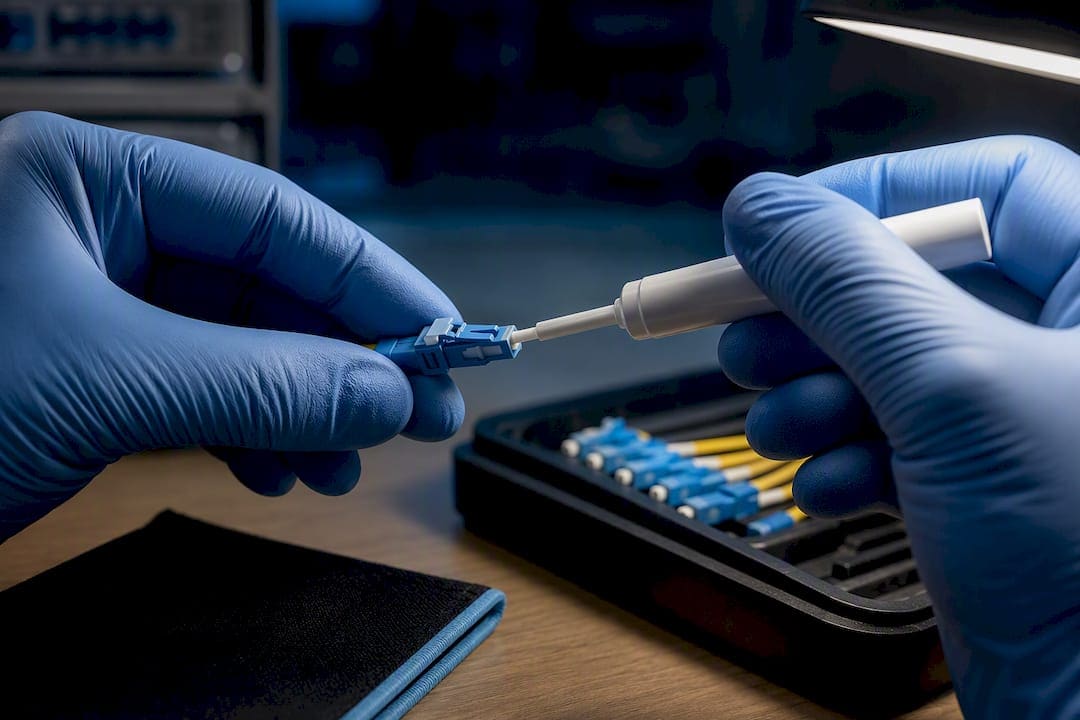
That said, ongoing costs aren’t zero. Budget for periodic testing, particularly after any building renovation, tenant fit-out, or nearby construction that could stress cable pathways. Connector cleaning matters more than most IT teams expect. Dust and oil contamination on fiber end faces is a leading cause of intermittent link failures, and it’s a five-minute fix if caught early. Spare patch cords and a small stock of replacement connectors are worth keeping on hand rather than waiting on a rush order during an outage.
The bigger ongoing cost is usually indirect: keeping as-built documentation current as the network grows. A fiber plant that isn’t documented accurately becomes expensive to troubleshoot, because a technician has to trace physical paths instead of reading a diagram. Budget documentation updates into any future project touching the backbone, not just the original install.
How Should You Budget for Future Fiber Backbone Upgrades?
The smartest fiber backbone decisions happen before installation, not after. Pulling extra strands during initial construction costs a fraction of what it costs to run a second campaign later, because the labor, permitting, and pathway access, the expensive parts, are already paid for.
A common rule of thumb among installers is to pull at least double the strand count you need on day one. If your current design calls for 12 strands, running 24 leaves headroom for future switch upgrades, redundant paths, or a tenant expansion without reopening walls or trenches. The incremental cost of extra strands during an active install is small compared to the cost of remobilizing a crew, pulling permits again, and repeating restoration work.
Single-mode fiber, rather than multimode, is worth the modest cost premium in most backbone applications because it supports higher bandwidth over longer distances without needing replacement as network speeds increase. Multimode fiber can hit distance and speed ceilings that force a full re-cable within a few years, erasing any upfront savings.
Conduit sizing matters just as much as strand count. Oversizing conduit during underground or aerial construction, even by one size, gives you room to add capacity later without another excavation permit. It’s the cheapest insurance available on a fiber backbone project, and it’s rarely on the quote unless you ask for it directly.
The Real Budgeting Mistake Small Businesses Make
Most fiber backbone budgeting advice treats this as a single number to shop around for, when it’s really three separate decisions: pathway, labor, and equipment. Businesses that get burned on fiber projects almost never get burned by the cable price. They get burned by treating a site survey as optional, by accepting a quote that bundles labor and material into one number, or by skipping spare strand capacity to save a few hundred dollars upfront.
The conventional advice, “get three quotes and pick the middle one”, falls apart here because two contractors quoting the same job can legitimately land $10,000 apart based on termination method alone, fusion splice versus field termination, without either one being wrong. The number means nothing without knowing what’s inside it.
If you take one thing from the ranges in this article, prioritize the site survey first, budget conversation second. A written scope with itemized NRC line items tells you whether you’re comparing real quotes or comparing incomplete guesses. For most small offices, that survey will point toward a hybrid fiber-and-copper design, and it’ll save you from paying full fiber-to-the-desk pricing for bandwidth you don’t need at every seat.
— Ken
Get a Scoped Fiber Backbone Quote From Cables and Chips
Cables and Chips is the alternative to guessing at a fiber backbone budget from online ranges alone: instead of estimating from per-foot averages, you get a written scope built from an actual walk-through of your building. With more than 40 years serving commercial clients across New York City, Cables and Chips offers fiber installation, structured CAT6 and CAT6A cabling, and cable testing and certification, all scoped through a no-obligation site survey before any contract is signed.
That survey delivers exactly what this article recommends asking for: a written scope of work, itemized non-recurring cost line items, a realistic schedule estimate, and a clear testing plan covering OTDR and insertion-loss verification. Whether your building needs a full fiber backbone or a hybrid fiber-and-copper design, the survey gives you numbers specific to your walls, not national averages. Visit the services page to request a site survey and get a quote built around your actual building, not a per-foot estimate.
Sources
- Fiber Optic Installation Cost: Per Foot, Per Drop, and Per Building (2026) | Unió Digital
- Enterprise fiber buildout: How to get fiber to an off-net building | Macronet Services
- Horizontal cabling costs: fiber vs copper calculations | Ampcom
- Fiber Optic Costs | Sparklight Business
FAQ
How Much Does 1,000 Feet of Fiber Optic Cable Cost?
For interior routing at $1 to $6 per foot, 1,000 feet runs roughly $1,000 to $6,000 in cable and labor. Underground routes at $15 to $35 per foot push that same distance to $15,000 to $35,000, mostly due to excavation and restoration, not the cable itself.
Will Fiber Optic Internet Increase My Electric Bill?
Fiber itself carries light, not electricity, so the cable adds no measurable power draw. The small increase some businesses see comes from powering the switches, media converters, or optical network terminals that light the fiber, not the backbone cabling.
How Much Does Fiber Optic Installation Usually Cost?
Most projects fall between $1 and $35 per foot depending on route type, with terminated drops running $300 to $800 each. A whole-building project with 100 to 200 drops commonly lands between $15,000 and $30,000, though a site survey from a provider like Cables and Chips is the only way to get a number specific to your building.
Is Fiber Internet Worth the Extra Cost for a Small Business?
Fiber makes sense when your business needs backbone bandwidth between floors or buildings, or faces EMI and security demands copper can’t handle. For most small offices, a hybrid design pairing fiber backbone with Cat6A to the desk delivers the bandwidth headroom without paying full fiber-to-the-desk pricing at every seat.