
Cabling Subcontractor Deliverables: A Project Manager’s Guide
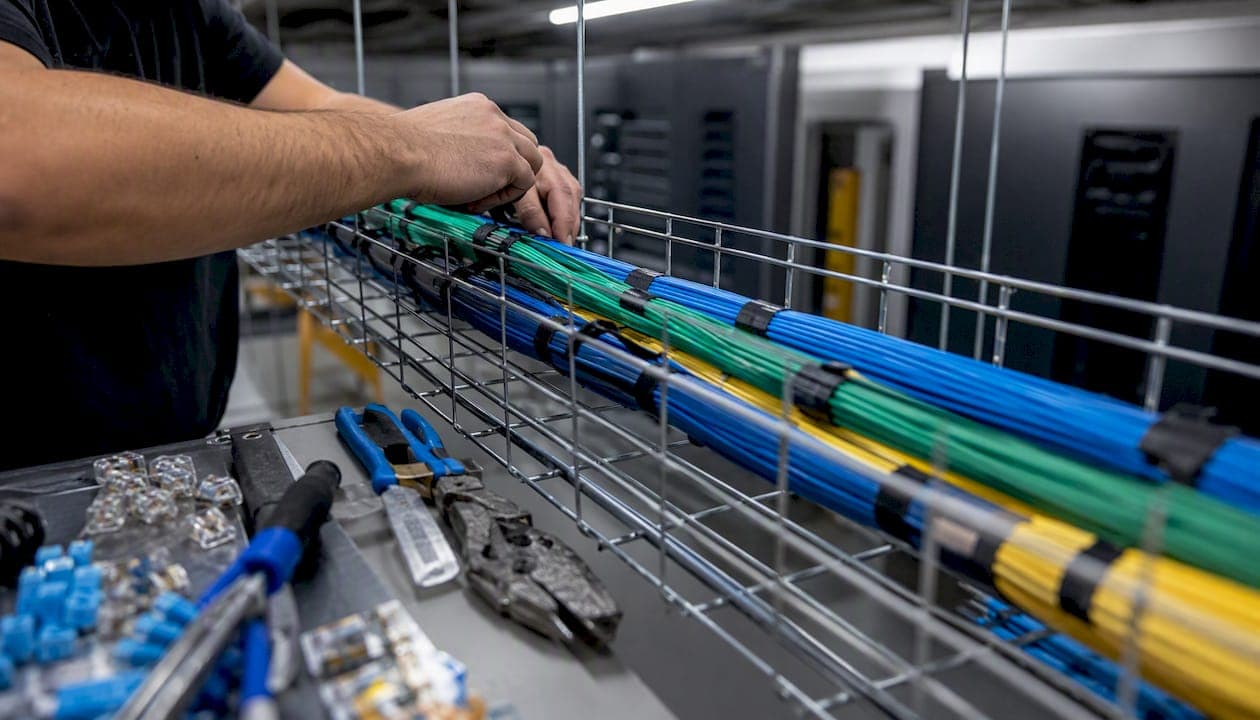
A structured cabling subcontractor must deliver four groups of documentation and physical work: design submittals and shop drawings, on-site installation items, testing and certification reports, and a complete closeout/record document packet. Every SOW you write or review should demand all four. Here is the baseline checklist to verify before signing off on any cabling bid:
- As-built floor plans with cable routes, TR locations, and pathway layouts
- Per-drop copper certification reports (Fluke DSX or equivalent), exported as individual PDFs
- Fiber OTDR traces and optical power-loss records for every link
- Rack and patch panel elevations showing port assignments
- Cable schedule with cable IDs, origin, destination, and label format
- Operation and maintenance (O&M) manuals and warranty registration letters
Pro Tip: The single most common scope gap on commercial projects is pathway ownership. Your SOW must state explicitly who provides conduit, cable tray, and J-hooks. If it does not, expect a change order.
Key Takeaways
A structured cabling subcontractor must deliver design submittals, installation documentation, per-drop test reports, and a complete closeout packet to meet contract requirements and activate manufacturer warranties.
| Point | Details |
|---|---|
| Require all four deliverable phases | Design submittals, installation items, test reports, and closeout docs must all be specified in the SOW. |
| Tie retainage to accepted test reports | Final payment release should require approved per-drop Fluke certification PDFs and stamped as-builts. |
| State pathway ownership explicitly | The SOW must name who provides conduit, cable tray, and J-hooks to prevent change orders. |
| Manufacturer warranty needs certified installers | 25-year application-assurance warranties from Belden, CommScope, Panduit, or Leviton require certified installation and documented per-drop certification at turnover. |
| Cables and Chips | Delivers the full closeout packet, including Fluke DSX reports, OTDR traces, as-builts, and warranty letters, for commercial projects in New York City. |
What do cabling subcontractor deliverables cover by project phase?
Structured cabling deliverables fall into four sequential phases: design and pre-installation, field installation, testing and acceptance, and closeout with warranty handover. Each phase has its own required outputs, and missing one delays the next.
Pathway ownership is where scope disputes most often start. The low-voltage subcontractor typically installs cable within conduit or tray, but the conduit itself may be the electrical contractor’s scope, the owner’s direct purchase, or the GC’s responsibility. The same ambiguity applies to cable tray, J-hooks, and backboxes for wireless access points. Two examples of how to write this cleanly:
- “Low-voltage sub furnishes and installs all J-hooks, cable tray, and innerduct within the low-voltage scope. Electrical contractor furnishes and installs all conduit stubs from TR to ceiling grid.”
- “Owner-furnished conduit is provided by others. Low-voltage sub is responsible for pull strings, cable installation, termination, and testing only.”
Standards to reference in every SOW include TIA-568 (horizontal and backbone cabling), TIA-569 (pathways and spaces), TIA-607-C (grounding and bonding), and NEC Article 800 (communications wiring). Installer qualifications should require BICSI-certified technicians, with RCDD oversight specified for larger or more complex projects.
A practical low-voltage SOW should define horizontal cabling limits, TR dimensions and rack details, fiber types, testing plans using a Fluke DSX or equivalent field tester, pathway ownership splits, and manufacturer warranty prerequisites — all before the first cable is pulled. (Provision Low-Voltage SOW Guide)
What design submittals should you require before rough-in?
Approving submittals before rough-in is the single best way to prevent RFIs and change orders mid-project. Require the following numbered submittal package, delivered no later than 10 business days before the scheduled rough-in start:
- Site survey report — existing pathway conditions, TR dimensions, power availability, and any conflicts with other trades
- Floor-plan layout — CAD or Visio file showing cable routes, outlet locations, TR/MDF/IDF positions, and WAP backbox locations
- Rack elevations — dimensioned drawings showing equipment placement, patch panel layout, and port assignments
- Cable schedule — complete list of cable IDs, origin, destination, cable type, and label format
- Manufacturer cut sheets — product data for cable (Belden, CommScope, or Panduit), patch panels (Leviton or equivalent), and connectors
- Shop drawings — coordination drawings showing pathway routing above ceiling and through walls
- Manufacturer approval letters — confirming the installer is certified to register the system warranty (Belden, CommScope, Panduit, or Leviton application-assurance programs)
File format expectations matter. Require PDF plus native CAD (DWG or DXF) for all drawings. Where BIM or COBie output is specified in the project documents, the cabling sub must deliver those formats as well. Naming conventions should follow the project’s document-control standard from day one, not retrofitted at closeout.
Pro Tip: Require manufacturer approval letters in the submittal package, not at closeout. If the installer is not certified by Belden, CommScope, Panduit, or Leviton at the time of installation, the 25-year application-assurance warranty is void — and there is no retroactive fix.
The BICSI ITSIMM, 8th edition provides detailed guidance on project documentation, site surveys, and the submittal examples installers should supply before work begins.
What installation deliverables does the cabling sub provide on-site?
Physical installation work produces its own set of verifiable deliverables. These are not just the cable runs themselves — they include the documentation and labeled hardware the GC and owner can inspect at any point during construction.
- Terminated and labeled patch panels — every port labeled with the cable ID matching the cable schedule, using Brady or Panduit label stock
- Rack installation and grounding — equipment rack anchored per seismic or structural requirements, with a grounding bar bonded to the building ground per TIA-607-C
- Cable supports — J-hooks, ladder rack, or cable tray installed at code-compliant spacing per ANSI/BICSI N1-2019
- Backboxes and pull strings — installed at all outlet and WAP locations before drywall, with pull strings left in place for owner-furnished devices
- WAP home-run details — each WAP location documented with cable ID, ceiling grid coordinates, and switch port assignment
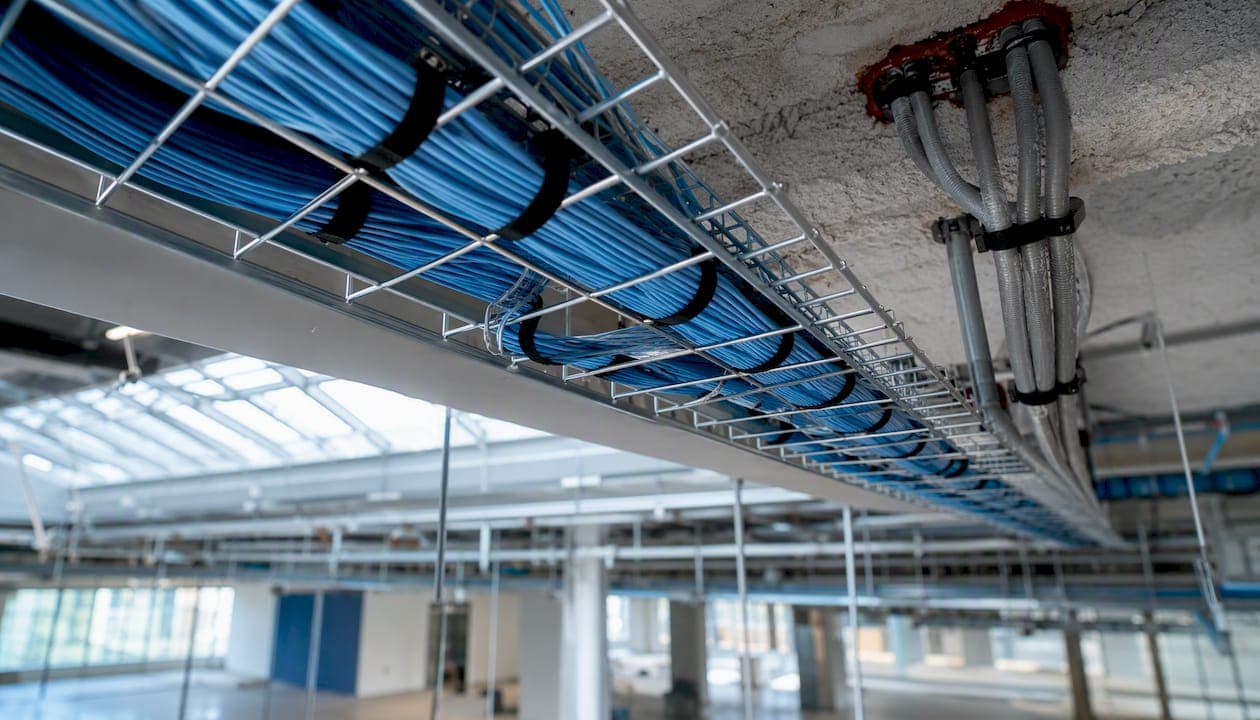
Photo documentation is a non-negotiable deliverable during installation. Require above-ceiling photos showing cable support spacing, cable tray fill levels, and firestopping at every penetration. TR photos should capture the rack before and after termination. Establish a weekly photo submission cadence in the SOW — not a one-time dump at closeout.
The FOA’s installation deliverables guidance describes how documentation of the finished product defines the acceptance criteria the owner expects at turnover. Photos and labeled hardware are part of that finished product, not optional extras.
Attic stock is another deliverable many SOWs omit. Specify that the sub must leave a labeled quantity of spare cable (typically one box per cable type used), spare patch cords, and spare faceplates in the TR, with an itemized attic-stock list submitted at closeout.
Pro Tip: Require above-ceiling photos before the ceiling grid is closed. Once tiles are in, verifying cable support spacing or firestopping requires destructive access — a cost no one wants to absorb.
What testing and certification reports must the sub deliver?
Testing deliverables are the most legally significant outputs a cabling subcontractor produces. They are the evidence that the installed system meets the performance standard the contract specifies, and they are what activates manufacturer warranties.
Copper certification requirements
- Per-drop certification report — every horizontal link tested with a Fluke DSX-series or equivalent field tester, exported as an individual PDF with pass/fail result, cable ID, test date, and technician ID
- Test level — Cat6A / Level IV for Cat6A installations; Cat6 / Level III for Cat6 systems; match the installed cable and connector system
- Failure remediation — any failed link must be re-tested after repair; the final report set must contain only passing results, with a separate log of failed-and-repaired links for the record
Certification reports should be organized by TR, then by panel, then by port number — matching the cable schedule exactly. A PDF package with a cover sheet listing the project name, date, tester serial number, and calibration date is the standard format. The cable testing and certification process produces these reports automatically from the field tester’s software.
Fiber acceptance requirements
| Fiber Test | Required Output | Acceptance Criterion |
|---|---|---|
| OTDR trace | Per-link trace file (.sor) + PDF export | No reflections or events exceeding TIA-568 limits |
| Optical power loss | dB measurement per link, both directions | Within TIA-568 channel loss budget for fiber type |
| End-face inspection | Photo or pass/fail record per connector | IEC Grade A or B |
Multimode fiber (OM3 or OM4) is standard for intra-building backbone runs; singlemode (OS2) is specified for longer campus runs or where future bandwidth headroom is a priority. The SOW should state the fiber type, connector type (LC duplex is most common), and the specific loss budget the sub must meet.
Pro Tip: Require the Fluke DSX project file (.flw) in addition to the PDF exports. The native file lets you re-run reports, filter by failure, and verify the tester’s calibration date — none of which is possible from a PDF alone.
What closeout documents does the cabling sub owe at final acceptance?
Closeout is where projects stall. The cabling sub’s record-document packet is often the last item holding up final payment, retainage release, or a certificate of occupancy. Specify every item in the SOW so there is no ambiguity at turnover.
A complete closeout packet for a structured cabling project includes:
- As-built/record drawings — updated floor plans and TR layouts reflecting actual installed conditions; stamped by a licensed engineer where the AHJ requires it
- Cable schedule — final version with every cable ID, origin, destination, label, and test result cross-referenced
- Rack and patch panel elevations — as-installed drawings showing actual port assignments
- Per-drop test reports — complete copper certification PDFs and fiber OTDR/loss records
- Firestopping and penetration records — documentation of every through-penetration, including the product used and the UL-listed assembly number
- Permit and inspection records — copies of all pulled permits and signed inspection cards
- O&M manuals — manufacturer documentation for all installed hardware (patch panels, racks, fiber enclosures)
- Warranty letters — manufacturer application-assurance warranty registration confirmation (25-year for full-system Belden, CommScope, Panduit, or Leviton installations)
- Punch list resolution — written confirmation that all punch list items are closed, with photos where applicable
- Attic-stock list — itemized list of spare materials left in the TR
Delivery format: one hard copy plus electronic files in PDF and native CAD, organized in a folder structure matching the cable schedule zones. Construction closeout guidance consistently recommends starting document collection at project kickoff, not at substantial completion — a practice that eliminates the last-minute scramble that delays final pay applications.
How should you format filenames, labels, and cable IDs?
Consistent naming is what makes a closeout packet usable five years after project completion. Facilities teams, IT staff, and future contractors all depend on it.
Sample filename convention:
[Project]_[Zone]_[DocType]_[Rev]_[YYYYMMDD]
Example: MidtownOffice_FL03_AsBuilt_R2_20260315.pdf
Cable ID format:
[Building]-[Floor]-[TR]-[Panel]-[Port]
Example: 01-03-TR1-PNL2-24 identifies Building 1, Floor 3, TR1, Panel 2, Port 24.

Both-ends labeling is required: the label at the outlet must match the label at the patch panel port, and both must match the cable schedule exactly. Use heat-shrink or self-laminating labels rated for the installation environment. Brady BMP61 or Panduit LS8E label printers are the field standard for legibility and durability.
| Document Type | Filename Convention | Format |
|---|---|---|
| As-built floor plan | Project_Zone_AsBuilt_Rx_YYYYMMDD | PDF + DWG |
| Cable schedule | Project_Zone_CableSchedule_Rx_YYYYMMDD | PDF + XLSX |
| Copper test report | Project_Zone_TR_CopperCert_YYYYMMDD | PDF + .flw |
| Fiber test report | Project_Zone_TR_FiberOTDR_YYYYMMDD | PDF + .sor |
| Rack elevation | Project_Zone_TR_RackElev_Rx_YYYYMMDD | PDF + DWG |
Pro Tip: Set the naming convention in the SOW, not in a verbal instruction at closeout. Require the sub to submit a sample filename list with the design submittals so corrections happen before hundreds of files are named wrong.
Why does this matter for enterprise cabling documentation? Because a mislabeled or inconsistently named file set forces the facilities team to re-survey the building to find a cable — a cost that dwarfs the effort of enforcing naming standards upfront.
What SOW language and checklist items actually hold subs accountable?
Sample SOW clauses give you language you can paste directly into a bid package or subcontract. Adapt as needed for your project.
Scope boundary — pathway ownership:
“The low-voltage subcontractor shall furnish and install all J-hooks, cable tray, and innerduct within the low-voltage scope of work. Conduit stubs from telecommunications room to ceiling grid are by the electrical contractor. Owner-furnished equipment (OFE) locations are shown on drawings; low-voltage sub is responsible for termination and testing of OFE only.”
Testing and acceptance clause:
“All horizontal copper links shall be certified to ANSI/TIA-568 Cat6A / Level IV using a Fluke DSX-series or equivalent field tester. Per-drop PDF reports and native project files shall be submitted to the owner’s representative for review and approval prior to equipment installation. Fiber links shall include OTDR traces, optical power-loss measurements (both directions), and end-face inspection records.”
Warranty registration:
“Installer shall be manufacturer-certified for the specified cabling system (Belden, CommScope, Panduit, or Leviton) and shall register the 25-year application-assurance warranty within 30 days of substantial completion. Warranty registration confirmation shall be included in the closeout packet.”
Submittal timing:
“Design submittals, including floor-plan layouts, rack elevations, cable schedule, and manufacturer cut sheets, shall be submitted no later than 10 business days prior to scheduled rough-in. Resubmittals required within 5 business days of review comments.”
Payment milestone tie-in:
- 30% upon approved design submittals and material delivery confirmation
- 60% upon substantial completion of installation and photo documentation submission
- 90% upon submission of complete copper and fiber test reports, reviewed and approved
- 100% (retainage release) upon delivery of accepted closeout packet, including stamped as-builts, O&M manuals, and warranty letters
Tying retainage release to accepted closeout documentation is the most effective lever for getting complete record documents on time.
Pro Tip: Add a specific line in the contract: “Final retainage shall not be released until per-drop certification reports and stamped as-built drawings are submitted, reviewed, and accepted in writing by the owner’s representative.”
What project managers commonly miss about cabling deliverables
The deliverables checklist is straightforward. What trips up projects is the coordination that should happen before the checklist matters.
Late WAP locations are the most common cause of rework on commercial office projects. When the IT team finalizes access point placement after rough-in is complete, the cabling sub faces a choice: pull additional home runs (a change order) or relocate existing ones (another change order). The fix is simple: require a confirmed WAP layout, signed off by the IT coordinator, as a prerequisite for the cabling sub’s rough-in start. Make it a submittal item, not a verbal agreement.
Undocumented owner-furnished equipment creates a similar problem at closeout. If the owner supplies patch panels, switches, or fiber enclosures that are not on the approved submittal, the manufacturer warranty for the full system may be void. The SOW must list every OFE item and state clearly that the cabling sub’s warranty obligations apply only to contractor-furnished materials.
TR dimensions and power planning deserve a dedicated coordination meeting before design submittals are approved. A rack that does not fit through the TR door, or a UPS that has no dedicated circuit, costs far more to fix after installation than before. Confirming TR dimensions, door clearances, and power availability at the design phase is a 30-minute meeting that routinely prevents a week of rework.
The difference proper deliverables make shows up most clearly at closeout. On a recent multi-floor commercial office project, a complete closeout packet with per-drop Fluke certification PDFs, stamped as-builts, and warranty registration letters allowed the owner to pass the AHJ inspection on the first visit and release retainage within two weeks of substantial completion. Projects without that documentation typically spend four to six weeks chasing records after the sub has moved on.
Cables and Chips delivers the full documentation package, not just the cable
For project managers and IT coordinators in New York City who need a cabling subcontractor that delivers the complete SOW-ready packet, Cables and Chips provides design, installation, testing, and turnkey closeout documentation for commercial offices, secure facilities, and enterprise environments throughout NYC.
Every project includes per-drop Fluke DSX certification PDFs, fiber OTDR traces, rack and patch panel elevations, a labeled cable schedule, stamped as-built drawings, O&M manuals, and manufacturer warranty registration. The structured cabling as-built documentation Cables and Chips delivers is organized, named, and formatted for facilities teams from day one. For CAT6A installation in NYC with full closeout documentation included, contact Cables and Chips at 20 Vesey Street, Lower Manhattan, to schedule a site survey and receive a project-specific SOW.
Sources
These standards and references provide the authoritative language to back SOW clauses and acceptance criteria:
- BICSI ITSIMM, 8th edition
- Close-Out Checklist (USC Facilities Planning & Management)
- The Installation Deliverables (FOA)
- Construction closeout documents (Procore)
FAQ
What are examples of cabling subcontractor deliverables?
Standard deliverables include as-built floor plans, per-drop copper certification reports (Fluke DSX or equivalent), fiber OTDR traces, rack and patch panel elevations, a labeled cable schedule, O&M manuals, and manufacturer warranty letters. These are grouped into four phases: design submittals, installation documentation, testing and certification, and closeout records.
What are two examples of a cabling subsystem?
The horizontal cabling subsystem (from the TR to each work-area outlet) and the backbone cabling subsystem (connecting MDF to IDF across floors or buildings) are the two primary structured cabling subsystems defined by ANSI/TIA-568.
What is included in structured cabling?
Structured cabling includes horizontal copper runs (Cat6 or Cat6A), backbone fiber, patch panels, equipment racks, cable management, grounding and bonding, and all associated terminations and labeling. The structured cabling system components also encompass the TR infrastructure, WAP backboxes, and the documentation package delivered at closeout.
What does a cabling contractor deliver at project closeout?
At closeout, a cabling contractor delivers stamped as-built drawings, a final cable schedule, per-drop test certification PDFs, fiber OTDR records, firestopping documentation, permit cards, O&M manuals, and manufacturer warranty registration confirmation, organized in both hard-copy and electronic formats.
What are contractor deliverables in a construction project?
Contractor deliverables are the documented outputs a subcontractor must produce and submit to satisfy their contract obligations, including submittals, installed work, test reports, and closeout documents. For cabling subcontractors specifically, deliverables span all four project phases and must meet the acceptance criteria defined in the SOW before final payment is released.