
Write Part 1 Right: Division 27 Basics for US Project Teams
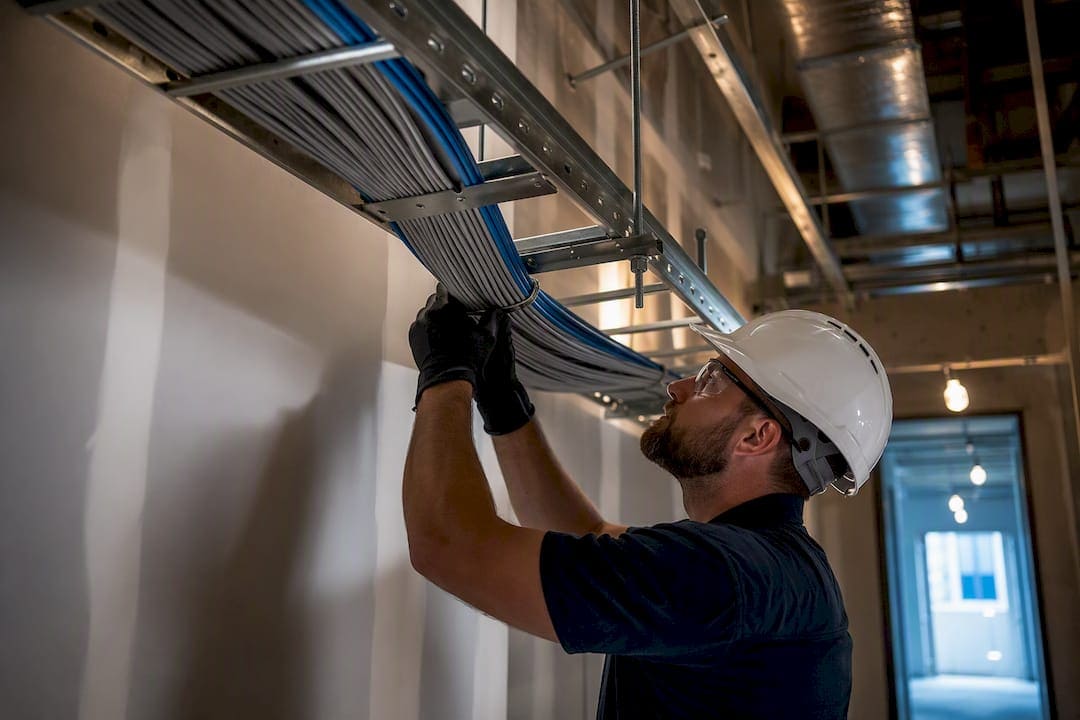
Division 27 is the CSI MasterFormat division that organizes specifications for building communications systems, including structured cabling, data and voice networks, and audiovisual infrastructure. It ties directly to ANSI/TIA testing and cabling standards, requires documented acceptance testing before closeout, and sits alongside Division 26 (electrical) and Division 28 (security) with boundaries that need to be spelled out in the spec. This guide walks through the scope, section numbering, standards, testing, coordination, and paperwork that project teams need to get Division 27 right the first time.
TL;DR:
- Precise execution details such as labeling, slack management, and Tier 2 fiber testing are critical to avoid costly future troubleshooting delays.
- Clear interface clauses with Division 26 and 28 are essential to prevent scope disputes over pathways, grounding, and ownership boundaries.
- Performance and testing standards must be cited with specific edition years to ensure compliance and prevent contractors from installing outdated or lower-quality systems.
- Complete documentation including as-built drawings, port labels, test reports, and warranty information is vital for efficient facility maintenance and troubleshooting.
- Subcontracting to specialized low-voltage installers offers better accountability, testing compliance, and quality assurance than routing scope through general electrical contractors.
Understanding Division 27 Basics: What the Division Covers
Division 27 covers the low-voltage communications backbone of a building: the cabling, pathways, and active systems that let data, voice, and video move where they need to go. When CSI expanded MasterFormat from 16 to 50 divisions in 2004, it pulled communications out of the electrical division entirely, giving low-voltage systems their own home with their own numbering structure. That separation exists for a reason: communications cabling has different performance criteria, different testing requirements, and different installer trades than power distribution.
On a typical commercial project, Division 27 includes:
- Structured cabling: horizontal runs to workstations and backbone cabling between telecom rooms
- Copper (CAT6/CAT6A) and fiber optic media, along with the racks, cabinets, and cable pathways that support them
- Data and voice communications systems, including network switching infrastructure
- Audiovisual systems for conference rooms and shared spaces
- Paging, intercom, and distributed antenna systems (DAS)
- Specialized systems like nurse call and synchronized clock systems in healthcare or institutional buildings
These are the structured cabling components that make up most Division 27 scopes on office and commercial projects. What Division 27 excludes matters just as much: line-voltage power, lighting, and grounding infrastructure stay in Division 26, even though a cable tray might carry both types of cabling side by side.
Division 27 Fundamentals: Reading the MasterFormat Numbers
MasterFormat uses a six-digit hierarchy, and once you know how to read it, a spec book stops feeling like a foreign language. The first two digits identify the division (27 for communications), the second pair marks a major category, and the third pair narrows to a specific topic.
- 27 00 00 — Communications (the division heading itself)
- 27 10 00 — Structured cabling
- 27 20 00 — Data communications
- 27 30 00 — Voice communications
- 27 40 00 — Audio-video communications
- 27 50 00 — Distributed communications and monitoring systems
Every section within these categories, no matter how specific, follows the CSI three-part format: Part 1 covers general requirements (submittals, warranties, quality assurance), Part 2 covers products (cable types, connectors, rack hardware), and Part 3 covers execution (installation methods, pathway requirements, testing).
Take horizontal cabling under 27 15 00. Part 1 might require submission of manufacturer cut sheets and installer certifications before work starts. Part 2 specifies CAT6A cable meeting a stated performance category. Part 3 sets the actual installation rules: maximum pulling tension, bend radius limits, and the acceptance test criteria the installer has to hit before the contractor gets paid.
Division 27 Standards and Codes Every Spec Should Reference
A Division 27 spec that skips the standards section is an invitation to disputes. The performance requirements need to be written into Part 1 so bidders know exactly what they’re being held to.
- ANSI/TIA-568 series — the core commercial building telecommunications cabling standard, covering everything from cable performance categories to pathway design
- TIA-568.3-D — the specific standard governing fiber optic cabling components and testing methods
- NEC references — needed wherever low-voltage pathways intersect fire-rated assemblies, plenum spaces, or require firestopping at penetrations
- Performance-tier language over brand names — spec categories (Category 6A, OM4 fiber) rather than a single manufacturer, with data sheets referenced as supporting evidence rather than the requirement itself
Pro Tip: Cite standards by edition year in Part 1, not just by name. TIA revises its standards periodically, and an undated citation leaves room for a contractor to install to an older, cheaper spec and still claim compliance.
Well-written execution requirements, covering bend radii, firestopping, and labeling conventions, are often where a project actually succeeds or fails, more than any brand name written into the spec.
Testing and Acceptance: What “Done” Actually Means
A cabling installation isn’t complete when the last jack gets terminated. It’s complete when it passes certification testing against the criteria written into the spec, with documentation to prove it.
Copper links require field certification covering wire map, near-end crosstalk (NEXT), return loss, and insertion loss. Testing can follow a permanent link model, which isolates the installed infrastructure from temporary patch cords, or a full channel model that includes the patch cords in the measurement. Permanent link testing is generally preferred for certifying the fixed infrastructure itself.
Fiber testing works differently. Tier 1 testing measures insertion loss with a light source and power meter and is the baseline requirement on nearly every job. Tier 2 adds OTDR (optical time-domain reflectometer) tracing, which is often required for backbone fiber runs because it gives a long-term troubleshooting baseline for the life of the cable plant.
Before final payment, owners should require:
- Complete test report files for every tested link, in both copper and fiber
- A labeled port schedule matching field labels to as-built drawings
- As-built drawings reflecting actual routing, not just design intent
- Operations and maintenance (O&M) manuals and manufacturer warranty documentation
Pro Tip: Ask for test reports in their native software export format, not just PDF screenshots. Raw data files let your team re-verify results later if a link starts failing.
Where Division 26 and Division 28 Overlap With Division 27
Scope disputes on communications work almost always trace back to unclear ownership at the boundaries. Division 26 typically owns power distribution and grounding infrastructure; Division 28 owns security systems like access control panels and video management servers. Division 27 owns the cabling that connects it all, which is exactly where things get murky.
Common friction points include:
- Conduit and raceway ownership when shared pathways carry both power and low-voltage cabling
- Grounding and bonding points for telecom racks, which Division 26 usually installs but Division 27 depends on
- Raceway fill ratios when security cabling (Division 28) and data cabling (Division 27) share the same pathway
To avoid this, embed clear interface clauses in Part 1 defining which trade supplies raceways, grounding points, and backboards, and hold a pre-bid coordination meeting to surface ownership questions before contracts get signed.
Procurement Choices That Shape Division 27 Outcomes
General contractors generally choose between two paths for Division 27 work: subcontracting directly to a low-voltage integrator, or routing the scope through the electrical contractor as a sub-tier vendor. Direct subcontracting typically gives better price transparency and puts accountability for testing and documentation directly on the specialist doing the work. Routing through electrical can simplify coordination on smaller projects but often adds a markup layer and a communication step between the GC and the crew actually pulling cable.
- Verify installer qualifications — manufacturer certifications for the cabling systems being installed, not just general low-voltage licensing
- Require calibration evidence for test equipment, since an uncalibrated tester can pass links that would otherwise fail
- Request sample test reports from a comparable prior project before awarding the contract
- Confirm insurance coverage matches project requirements, particularly for secure facilities
Pro Tip: A bid that comes in unusually low on Division 27 work is often skipping Tier 2 fiber testing or full documentation. Ask specifically what testing model and deliverables are included before comparing numbers side by side.
Documentation and Handover: The Package That Actually Gets Used
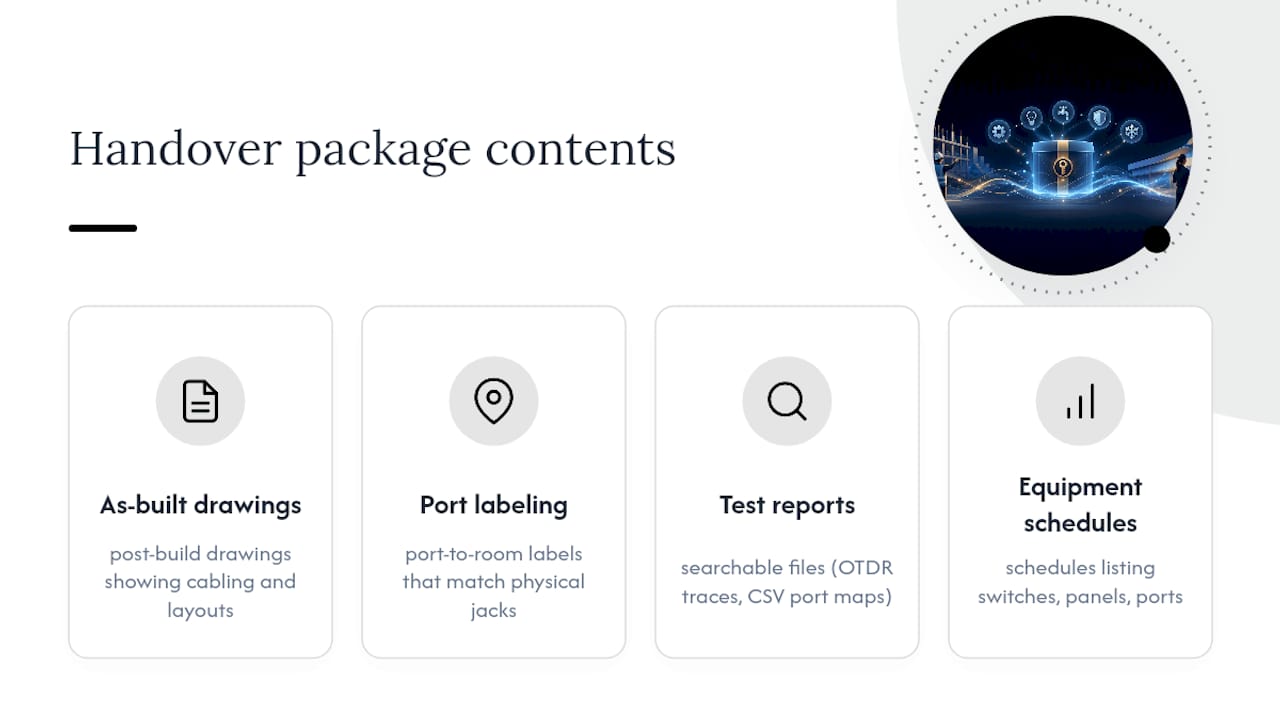
The value of Division 27 documentation shows up months after the ribbon cutting, when a facilities team is chasing down a dead port on a Friday afternoon. A complete handover package includes as-built drawings, port-to-room labeling that matches the physical jacks, searchable test-report files, equipment schedules, and spare parts and warranty information.
OTDR traces and CSV-format port maps turn troubleshooting from a guessing game into a lookup. A facilities manager who can search a spreadsheet for a jack number and instantly see which switch port, patch panel, and test result correspond to it will resolve outages faster than one working from a stack of PDF drawings alone.
PDF plus structured CSV export tends to be the most durable combination for archival purposes, since it’s readable without specialized software and searchable without opening every file individually. Our as-built documentation guide covers formatting standards in more depth for teams building this package from scratch.
What Cables and Chips Sees on Real NYC Projects
Cables and Chips has spent more than 40 years installing and organizing low-voltage infrastructure across New York City commercial buildings, and the recurring problems on Division 27 scopes are rarely about the technology itself. They’re about execution discipline.
- Inconsistent labeling between the port schedule, patch panel, and as-built drawing, which turns a five-minute troubleshooting call into an hour-long site visit
- Poor slack management in racks and pathways, which strains connectors and makes future moves and changes far more disruptive than they need to be
- Skipped or shortcut testing, particularly Tier 2 fiber testing on backbone runs where a contractor assumes Tier 1 results are good enough
| Common Mistake | Why It Happens | What Prevents It |
|---|---|---|
| Labeling mismatches | No single source of truth during install | Lock labeling convention in Part 1 before work starts |
| Poor slack management | Rushed terminations under schedule pressure | Require rack photos at milestone inspections |
| Skipped Tier 2 testing | Cost cutting on backbone fiber | Specify OTDR traces explicitly as a deliverable |
Teams looking to go deeper on component selection before writing a scope can start with our guide to structured cabling components, and projects involving wireless coverage should also review our WiFi access point cabling guide since AP cabling now falls squarely under Division 27 scopes.
Get Your Division 27 Scope Right From the Start
Most Division 27 disputes trace back to a spec that assumed too much and specified too little. A section that names a performance category without defining the test method, or references a standard without an edition year, leaves room for a contractor to meet the letter of the spec while missing what the owner actually needed.
The conventional advice tells teams to “reference TIA standards” and move on. That’s necessary but not sufficient. What actually prevents disputes is writing the interface clauses, the labeling convention, and the exact testing deliverables into Part 1 before bids go out, not after a contractor argues their approach was technically compliant. Data center builds add another layer, where temporary power sequencing during construction can affect when low-voltage testing can even happen, a coordination point worth flagging early with the electrical trade planning temporary power.
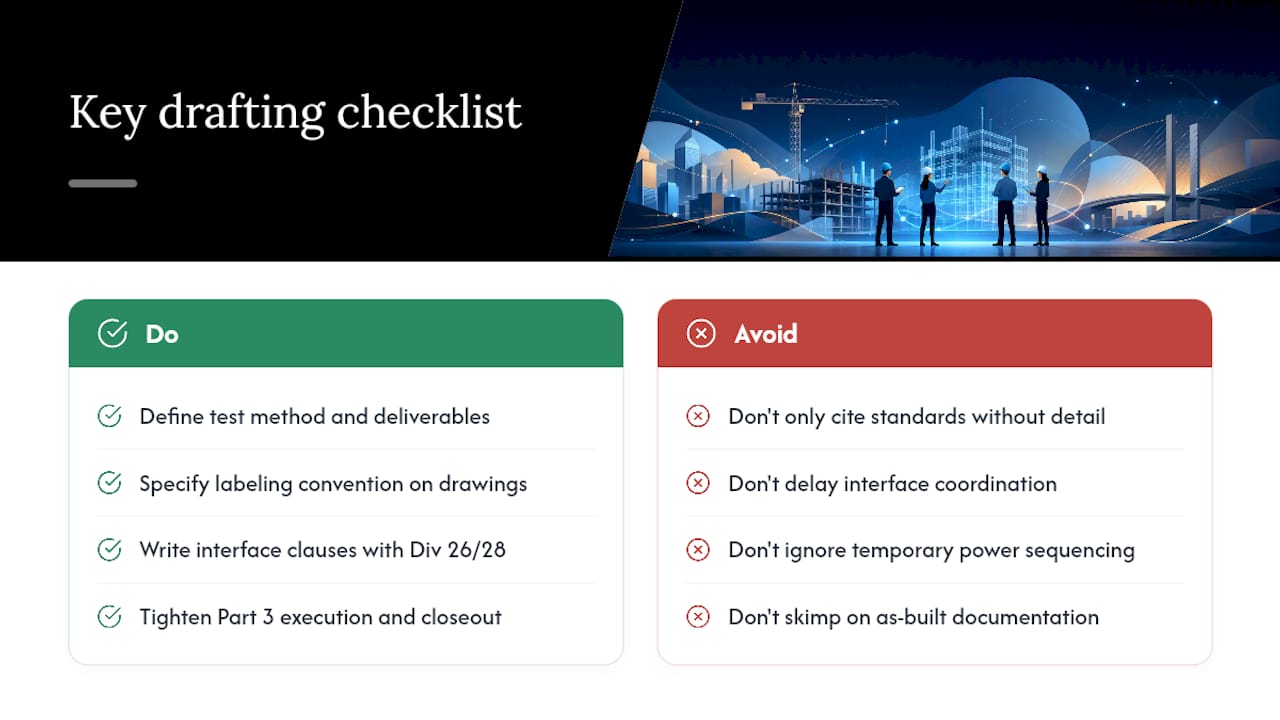
If there’s one place to spend extra drafting time, it’s Part 3 execution requirements and the closeout documentation list. Products change and vendors come and go, but a well-specified test method and a complete as-built package protect the owner for the life of the building.
If your project involves CAT6A installation, fiber backbone design, or a Division 27 scope that needs a second look before it goes out to bid, specialized low-voltage contractors can assist commercial teams with designing, installing, and documenting communications infrastructure that holds up to certification testing and stands ready for facilities teams years down the line. Explore our structured CAT6 cabling installation services to see how a properly scoped Division 27 project comes together from design through closeout.
Ken’s take on Division 27 basics comes down to one gap most teams underestimate: the spec often gets the products right and the paperwork wrong. Bidders can hit every performance category on the cable and connector schedule and still hand over a documentation package that’s useless six months later because the labeling doesn’t match the drawings. The fix isn’t more standards citations. It’s writing execution and closeout requirements as tightly as the product requirements, since that’s the part nobody argues about until it’s too late to fix cheaply. Prioritize the interface clauses with Division 26 and Division 28 before worrying about which cable category to spec. Scope gaps cost more than performance-tier upgrades ever will.
— Ken
Sources
- CSI MasterFormat (Procore library)
- CSI Division 27: Communications (The Construction Standard)
- Division 27 specifications: Scope, Requirements, and Testing (LegalClarity)
FAQ
What Is Division 27 in Construction?
Division 27 is the CSI MasterFormat division covering building communications systems, including structured cabling, data and voice networks, audiovisual systems, and related low-voltage infrastructure.
What CSI Division Is 27?
CSI Division 27 is officially titled “Communications” within the MasterFormat classification system, which organizes construction specifications into 50 numbered divisions.
What Is Division 27 and 28?
Division 27 covers communications and structured cabling, while Division 28 covers electronic safety and security systems like access control and video surveillance; the two often share pathways and require clear coordination on ownership.
What Is Division 26 and 27?
Division 26 covers electrical power distribution, lighting, and grounding, while Division 27 covers low-voltage communications cabling; CSI separated them in the 2004 MasterFormat expansion because their performance and testing requirements differ significantly.
Do Division 27 Specs Have to Reference TIA Standards by Name?
Yes. Citing the ANSI/TIA-568 series and TIA-568.3-D for fiber gives bidders and inspectors a concrete, enforceable performance benchmark rather than a vague reference to “industry standard” cabling.