
Avoid Weeks of Delay: Demarc Extension Rules for Facility and IT Teams

A demarc extension is the transmission path that carries service from the carrier’s demarcation point to your equipment room or suite. The carrier owns and maintains everything up to that handoff point; the building or tenant owns and maintains the cabling beyond it. Getting that boundary wrong is the single most common cause of finger-pointing during an outage.
TL;DR:
- Most troubleshooting delays stem from poor labeling, documentation, and access control at the demarc extension, which complicates fault isolation.
- Fiber is recommended for demarc extensions over multiple floors or long distances, with separate conduit and proper pathway management reducing fault risk.
- Locking demarc closets, maintaining detailed device inventories, and restricting access prevent tampering and improve security for the network boundary.
- Costs vary widely based on distance, installation complexity, permits, and access constraints, with longer, multi-carrier, or core-drilled runs being most expensive.
- Proper pre-installation site surveys and thorough documentation help avoid surprises, ensure compliance, and facilitate future troubleshooting.
What Is a Demarc Extension, Technically?
A demarc extension is the physical cabling and equipment that carries a circuit from the carrier’s demarcation point to the customer’s equipment or suite, whenever that equipment sits away from where the carrier’s line first enters the building. You’ll also hear it called a service interface extension, inside wiring, or riser cabling, depending on who you’re talking to. All three terms describe the same thing: cable that runs beyond the carrier’s legal responsibility zone.
The minimum point of entry (MPOE) is where confusion usually starts. The MPOE is the physical location where the carrier’s outside plant first reaches the building, often a basement vault or a ground-floor telecom closet. The demarc is the specific port or jack where the carrier’s responsibility legally ends. The demarc extension is everything that runs from that port to wherever your servers, PBX, or network switches actually live. In a single-story building those two points might be five feet apart. In a 40-story tower, the demarc extension could run several floors up a riser shaft, which is exactly the scenario where things get expensive if nobody planned for it.
Why Demarc Boundaries Affect Troubleshooting and Cost
The demarc line determines who answers the phone when your internet goes down. Carriers troubleshoot and repair everything up to their handoff point; once a signal crosses into your building’s cabling, it’s on you or your contractor to isolate the fault. That distinction decides whether a service call is free or billable.
Clear labeling and accessible test points cut resolution time dramatically because they let a technician confirm in minutes whether a problem sits on the carrier’s side of the jack or yours. Without that documentation, a routine outage can turn into hours of finger-pointing between the carrier’s field tech and your internal IT team while nobody can prove where the fault actually lives.
Liability follows the same line. Moving a demarc, splicing into carrier-owned cabling, or altering the extension without documenting the change can violate your service agreement and shift repair costs onto you even for problems that originate on the carrier’s side. Any change to that path should get logged and, ideally, reviewed against your contract before work starts.

What Devices Sit at the Demarc Point?
Several devices mark or manage the demarc, and knowing which one you’re looking at tells you a lot about who’s responsible for it.
- NID (Network Interface Device): a passive protective enclosure, typically for copper service, that physically marks the demarc without doing any active signal processing. NIDs are passive protective enclosures rather than powered equipment.
- ONT (Optical Network Terminal): an active device that converts fiber signals to electrical signals for your network, unlike a NID. Carriers frequently supply and maintain the ONT itself while the building owns the cabling beyond it, so confirm that split in writing.
- Smartjack: a carrier-owned interface that includes diagnostic and loopback test ports, letting a technician remotely verify circuit health without a truck roll.
- Patch panels and media converters: these sit inside the demarc extension itself, translating or organizing signal as it moves from the handoff point toward your equipment room.
Choosing Cabling and Pathways for a Demarc Extension
Copper still works fine for short runs and voice circuits, but fiber is the better call whenever the extension has to travel more than a floor or two, needs headroom for future bandwidth, or has to survive electrically noisy environments like mechanical rooms. A demarc extension cabling plan built around fiber today avoids a second construction project when your bandwidth needs to outgrow copper in three years.
Pathway choice matters just as much as media choice. Riser shafts, dedicated conduit, and properly rated cable trays protect the run and keep it serviceable; sharp bends, shared pathways with high-voltage electrical lines, and unsupported cable runs are the fastest way to introduce intermittent faults that are brutal to diagnose later.
- Route fiber and copper in separate conduit from power wherever possible to avoid electromagnetic interference.
- Maintain manufacturer-rated bend radius on every fiber run, especially at floor penetrations.
- Terminate to recognized standards and label every cable run at both ends before it disappears into a wall or riser.
- Certify the finished run with a test report, not just a visual inspection.
Pro Tip: Label the demarc extension at both ends with the circuit ID the carrier uses on their paperwork, not just an internal room number. It saves real time when a carrier technician is standing at your NID trying to match your labeling to their ticket.
Should You Use the Carrier, a Contractor, or Both?
Facility teams generally choose between three approaches, and the right one depends on timeline pressure and how much control you need over the finished documentation.
- Carrier-installed extension. Some carriers will extend their own demarc into your suite, but expect longer lead times, limited pathway options, and minimal input on labeling or documentation standards.
- Third-party contractor. A dedicated low-voltage contractor typically moves faster, coordinates building access and permits directly, and delivers as-built documentation and test certificates as a matter of course.
- Hybrid approach. The carrier handles the handoff and circuit activation while a contractor handles the physical cabling from the demarc to your equipment room, timed so the extension is ready the day the carrier’s circuit goes live.
The hybrid model is the most common choice in commercial buildings because it keeps the carrier’s lead time from blocking your entire project.
How to Prepare Your Site Before the Install
A little preparation before anyone shows up with a cable spool saves real money once the crew is on site.
- Document what already exists. Photograph the current demarc, trace existing cabling, and capture as-built drawings before any new work starts.
- Set labeling and access standards. Confirm labeling conventions, provide test access at every point along the run, and pre-authorize technician access with building management or security.
- Clear permits and conduit capacity. Check that your conduit has room for the new run, confirm whether local permits are required for riser or core-drilling work, and request acceptance testing, including certification reports and loss measurements, before signing off.
Pro Tip: Ask your contractor for as-built drawings and test certificates as a deliverable, not an afterthought. A structured cabling as-built documentation package turns a future troubleshooting call into a five-minute lookup instead of a half-day investigation.
What Does a Demarc Extension Typically Cost?
Distance is the biggest cost driver, followed closely by whatever it takes to get there: conduit work, core drilling through floors, and how many building permits or carrier approvals the project needs. A short run within the same telecom closet might take a single technician an afternoon. A multi-floor fiber extension requiring core drilling, a building permit, and coordination with two separate carriers can stretch into weeks once you account for approval cycles.
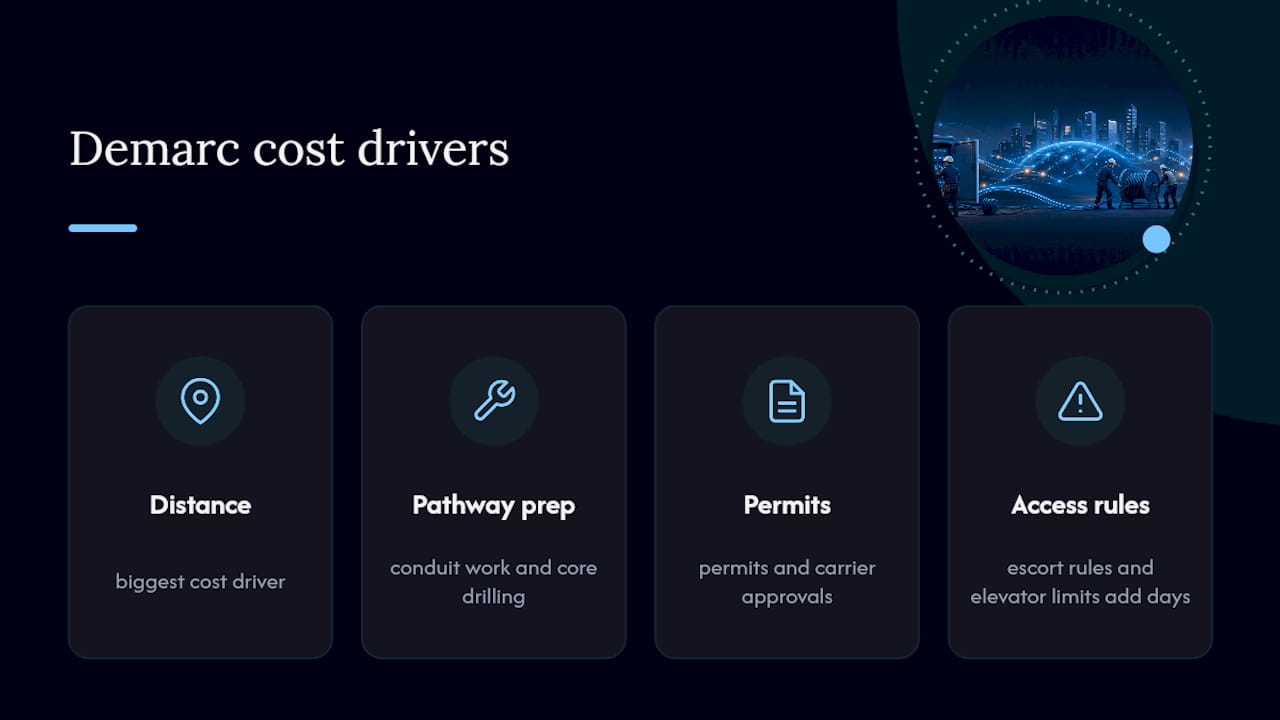
Access constraints add their own delay. Buildings with strict escort requirements or limited freight-elevator hours routinely add days to a project that would otherwise take hours. Upfront documentation of your existing demarc and pathway capacity is what keeps a contractor’s quote accurate instead of ballooning once they discover a blocked conduit or an undocumented splice mid-project.
Security Considerations for Demarc Extensions
A demarc extension is a physical access point into your network, and treating it purely as a wiring problem misses half the risk. Anyone who can reach an unsecured NID or patch panel can potentially tap a line, introduce a rogue device, or simply disrupt service by disconnecting a jumper.
Lock demarc closets and equipment rooms, and restrict key or badge access to the specific personnel who need it, not the whole building maintenance staff. Where the extension passes through common areas, run it through conduit rather than exposed cable trays; exposed cable is both a tampering risk and a liability if it gets damaged by unrelated work in the space.
Keep a written log of who accesses demarc and equipment spaces, and require that any contractor or carrier technician sign in with building security before reaching the space. This matters more in multi-tenant buildings, where a poorly isolated cross-connect field can let one tenant’s cabling work risk another tenant’s service, an issue best solved at design time by giving each tenant’s demarc extension its own clearly separated termination field rather than a shared, unlabeled panel.
Document every device at the demarc, including serial numbers and firmware versions for active equipment like ONTs, so an unauthorized swap gets noticed quickly. Pair that inventory with the same labeling and as-built documentation used for troubleshooting. Security and serviceability rely on the same paperwork.
Troubleshooting Common Issues With Demarc Extensions
Most demarc extension problems fall into a handful of repeat offenders. Intermittent connectivity often traces back to a marginal termination or a bend-radius violation introduced during installation rather than a true circuit fault, which is why a full test and certification report matters more than a quick continuity check.
Start troubleshooting at the boundary itself. Test at the demarc first to confirm the carrier’s signal is present and clean; if it is, the fault sits somewhere in your extension, not on the carrier’s network. Smartjacks and NIDs with loopback capability let a technician isolate the fault to either side of that line without waiting for a carrier field visit, which is exactly why those test points exist in the first place.
Unlabeled or poorly documented cabling turns a ten-minute fix into an all-day search. If nobody can say with confidence which cable run terminates where, every troubleshooting call starts with tracing wire instead of testing it. This is the single most preventable cause of extended downtime in buildings with informal or undocumented demarc extensions.
Physical damage from unrelated construction, water intrusion in riser shafts, and connector degradation at unprotected patch points round out the common failure list. Routine inspection of demarc extension pathways, especially in older buildings with shared risers, catches most of these before they cause an outage rather than after.
When a fault won’t isolate cleanly to either side of the demarc, that’s usually a sign the extension itself needs professional testing and possibly a rebuild of the termination, not another round of guesswork.
What Standards and Regulations Govern Demarc Extensions?
The modern demarc concept exists because of telecom deregulation. FCC rulings, including the Part 68 framework, established the demarcation boundary specifically to let multiple carriers and customer-owned equipment coexist in a building without one party’s equipment interfering with another’s. That regulatory history is the reason a demarc extension is a distinct, defined concept rather than just “extra cable.”
Part 68 rules govern how customer premises equipment connects to the public network and set the legal basis for where carrier responsibility stops. Beyond the FCC framework, local building and electrical codes govern the physical installation itself, including conduit fill, fire-rated pathway requirements in shared risers, and cable jacket ratings for plenum or riser spaces. These local code requirements shift by jurisdiction and by building type, so confirm them before construction rather than after an inspector flags the work.
Industry practice also holds installers to termination and testing standards from organizations like TIA and BICSI, even though those aren’t federal regulations. Following them is what makes a demarc extension serviceable and testable for the life of the building rather than a one-time install that nobody can verify later.
The Practitioner’s View on Demarc Extensions
Cables and Chips has spent more than 40 years pulling cable through New York City buildings old enough to have three generations of undocumented telecom work stacked in the same riser shaft, and the pattern is always the same: the projects that go smoothly are the ones where someone insisted on documentation before the first cable went in.
Our workflow follows a fixed sequence for a reason: site survey to confirm the existing demarc and pathway conditions, documentation of what’s already there, installation to spec, then acceptance testing before anyone calls the job done. Skipping the survey step is how a “simple” fiber extension turns into a surprise core-drilling permit two weeks in.
The handoff at project close matters as much as the install itself. Every demarc extension we complete gets as-built drawings and test certificates, because the next person who needs to troubleshoot that circuit, whether that’s your IT team or a carrier technician five years from now, shouldn’t have to guess where the cable goes.
— Ken
Ready to Extend Your Demarc the Right Way?
Cables and Chips is the low-voltage contractor New York City facility and IT teams call when a carrier handoff needs to become a clean, documented, testable run into the equipment room, instead of a rushed patch job nobody can troubleshoot later. Unlike waiting on a carrier’s own install crew, working with a dedicated contractor means faster scheduling, direct coordination with your building management for access and permits, and as-built documentation delivered as part of the job, not requested as an afterthought.

Whether your project calls for copper or fiber, our team handles the structured cabling components an extension requires, along with fiber termination and testing for longer or higher-capacity runs. If your building involves multiple tenants sharing an MPOE, coordinating access with property management, like the process outlined by Milwaukee Property Management, helps keep scheduling friction to a minimum. Reach out to Cables and Chips to schedule a site survey and get a clear scope and timeline for your demarc extension before your next lease deadline or carrier cutover.
Sources
For readers who want to verify the technical and regulatory claims above, or dig deeper into related infrastructure decisions:
FAQ
What Is a Demarc Extension?
A demarc extension is the cabling and equipment that carries a carrier’s service from its official demarcation point to the customer’s equipment location, needed whenever that equipment isn’t right at the building’s entry point.
What Is a Demarc in Construction?
In a construction or building context, the demarc is the physical point, usually a jack, panel, or box, where a telecom carrier’s network legally ends and the building’s or tenant’s own wiring begins.
What Is the Difference Between a Demarc and an ONT?
The demarc is a boundary concept marking where carrier responsibility ends, while an ONT is a specific active device that converts fiber signals for use inside the building; an ONT often sits right at or near the demarc but isn’t the demarc itself.
What Does Demarc Mean in Networking?
In networking, “demarc” refers to the demarcation point: the exact spot where a service provider’s network infrastructure and equipment stop and the customer’s own network and cabling begin. Everything past that point, including any demarc extension, is generally the customer’s or building’s responsibility to install, maintain, and document.