
Connecticut Low Voltage License: C-5, L-5 and What Each Allows

Connecticut licenses low voltage work through the Department of Consumer Protection (DCP), and it licenses people, not companies. The contractor license you need is usually the C-5 (Limited Electrical Contractor) for broad low voltage, alarm, audio and telephone-interconnect work, or the narrower L-5. Journeyperson licenses (C-6 and L-6) let a technician work only under a licensed contractor. Below we cover scope, qualifications, exam, fees, renewal and what it means for commercial cabling projects in Connecticut, with a short section on Philadelphia permits for teams working across state lines.
TL;DR
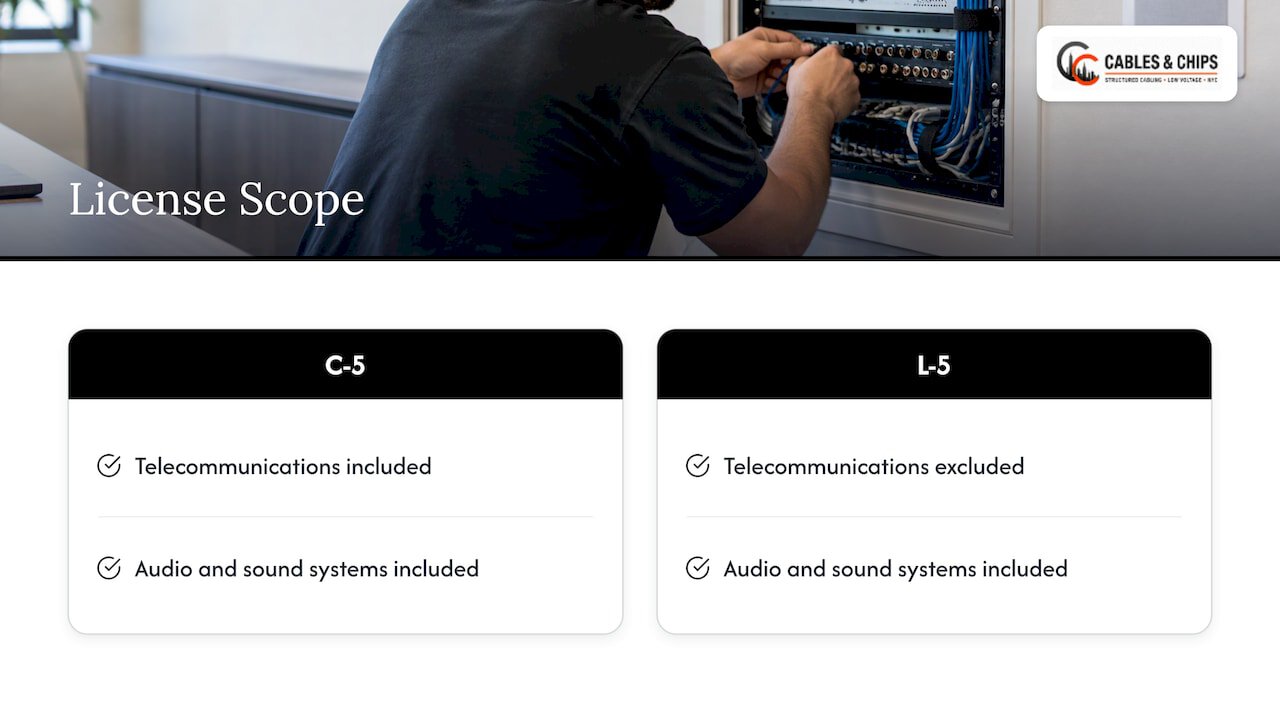
- C-5 covers low voltage, alarm or signal, audio and sound, and telephone-interconnect work up to 48 volts or 8 amperes. L-5 is narrower: up to 25 volts or 5 amperes, with telecommunications excluded.
- Connecticut licenses individuals. The license holder must qualify with two years as a journeyperson or at least six years of equivalent experience and training.
- Contractor application costs $150, journeyperson $90. All electrical licenses expire September 30 each year; renewal is $150 for contractors and $120 for journeypersons.
- The exam passing score is 70%. Connecticut has no reciprocity with other states, according to the industry guide we cite below.
- If your project spans New York and Connecticut, scope each site against its own state rules before you sign.
Which Connecticut license covers low voltage work
The DCP’s electrical license types and scope of work page defines four limited licenses that matter to low voltage:
| License | Title | What it permits |
|---|---|---|
| C-5 | Limited Electrical Contractor | Low voltage, alarm or signal work, audio and sound systems, and telephone-interconnect, up to 48 volts or 8 amperes, starting at a previously installed proper connection |
| C-6 | Limited Electrical Journeyperson | C-5 work, only while employed by a licensed electrical contractor |
| L-5 | Limited Electrical Contractor | Low voltage, alarm or signal work, and audio and sound systems, up to 25 volts or 5 amperes from such a connection |
| L-6 | Limited Electrical Journeyperson | L-5 work, only while employed by a contractor licensed for such work |
The difference between the two contractor licenses is the one that decides most commercial projects. The L-5 excludes telecommunications work, with one exception: alarm-interface wiring to an existing telephone connection for monitoring. The C-5 includes telephone-interconnect. A building with data drops, voice, access control and CCTV on one scope is a C-5 conversation.
Both licenses describe work that starts at a previously installed proper connection. That wording matters on a buildout. The line power feeding a rack, a power supply or a transformer is not low voltage work, and it stays with the electrical contractor on the job. Coordinating that handoff is a normal part of commercial cabling. Our low voltage rough-in guide explains how the trades sequence it.
Why “license” means a person here
Connecticut does not issue a license to a company name. An individual holds the license, and the company works under that person. A journeyperson cannot sell services to the public or run a job alone. The Connecticut Association of Security and Alarm Contractors guide describes the contractor as the holder who can sell services to the public, hire journeypersons and apprentices, and pull an electrical permit. A journeyperson may work only for a Connecticut-licensed contractor and only within the licensed category.
For an office manager or general contractor hiring a cabling firm, this is the practical point: the question is not whether the firm has a license, but whether a properly licensed individual is responsible for the Connecticut scope you are buying.
Requirements to qualify
Experience
Per the DCP scope page, the C-5 and L-5 contractor licenses require two years as a properly licensed journeyperson, or at least six years of equivalent experience and training, to qualify for the examination. The CASIAC guide states the same ladder: an L-5 contractor must have been an L-6 journeyperson for at least two years, and a C-5 contractor a C-6 journeyperson for at least two years.
Classroom hours
The same guide lists the coursework behind each journeyperson license:
- L-6: 288 hours of related classroom study, covering basic math, blueprint reading, electrical code, building trade safety (OSHA 30), electrical theory, basic alarm technology, and fire, access and CCTV systems.
- C-6: 360 hours, which adds basic telecommunications and telecom cabling.
The extra 72 hours are the telecom content. That is the clearest signal of why structured cabling for voice and data sits with the C track.
The exam
The DCP regulations on occupational licensing set the passing score at 70%. They also state that examinations are held at least four times a year for each board. An applicant who falls short must submit the registration form that comes with the notice of failure before sitting again. Exam vendor fees are separate from the state application fee and are paid at registration.
Fees and renewal
The DCP’s electrical license page lists these amounts:
| Item | Contractor | Journeyperson |
|---|---|---|
| Application fee (non-refundable) | $150.00 | $90.00 |
| Annual renewal | $150.00 | $120.00 |
Every electrical license expires on September 30. Because renewal is annual and tied to one date, license holders and the firms that rely on them should calendar it early. A lapsed license in the middle of a project is a scheduling problem for everyone, including the building.
Continuing education is also required. The CASIAC guide gives the minimum for contractors as four hours annually. Fees and rules change, so confirm current amounts on the DCP page before you budget or apply.
No reciprocity: what that means for out-of-state firms
The CASIAC guide states that Connecticut has no reciprocity with other states, no residency restriction, and no state background check. In practice, a license from New York, New Jersey or Pennsylvania does not by itself let a firm perform licensed low voltage work in Connecticut. The DCP also publishes a process for reviewing out-of-state licenses against its own requirements, so anyone planning to qualify should start on the DCP site.
For property managers and general contractors, this has a simple consequence. If your portfolio spans the tri-state area, ask each cabling vendor how it handles Connecticut scope, and put that in the subcontract. A single vendor across New York, New Jersey, Connecticut and Pennsylvania is convenient only when each state’s licensing is handled correctly.
How this plays out on a commercial project
Licensing questions turn into project questions quickly. Here is how to think about the common scopes.
Structured cabling (CAT6 and CAT6A drops, patch panels, racks). This is telecom cabling. It maps to the C-5 and C-6 track, since L-5 excludes telecommunications. See our structured CAT6 cabling installation page for what a full scope includes.
CCTV and access control. Alarm or signal work, plus fire, access and CCTV coursework in both journeyperson tracks, put these in low voltage territory. Cabling plans for secure facilities need documentation as well as a license. Our access control cabling requirements guide covers what to specify.
Audio and sound, A/V and PA. Audio and sound systems appear in both the C-5 and L-5 scopes. Conference room and PA work often arrives bundled with data cabling, so the bundle’s scope decides which license applies.
Power separation and code. Even with the right license, low voltage cabling must respect separation from power conductors. See why two inches of separation comes up in U.S. codes, and how the 2026 NEC changes affect low voltage cabling.
For a primer on terms, what low voltage cabling is covers the basics.
Checklist before you award Connecticut low voltage work
- List every system in scope: data, voice, CCTV, access control, audio, fire-alarm interface.
- Match the systems to C-5 or L-5. Anything involving telecommunications points to C-5.
- Confirm in the contract which licensed individual is responsible for the Connecticut scope.
- Separate line-voltage work from low voltage work and name who owns each.
- Require testing results and as-built documentation at closeout.
- Put the license renewal date, September 30, on the project calendar if the job runs through autumn.
If your project also touches Philadelphia
Teams that work Connecticut and Pennsylvania together often ask about Philadelphia, which handles low voltage through its own permit system rather than a state limited license.
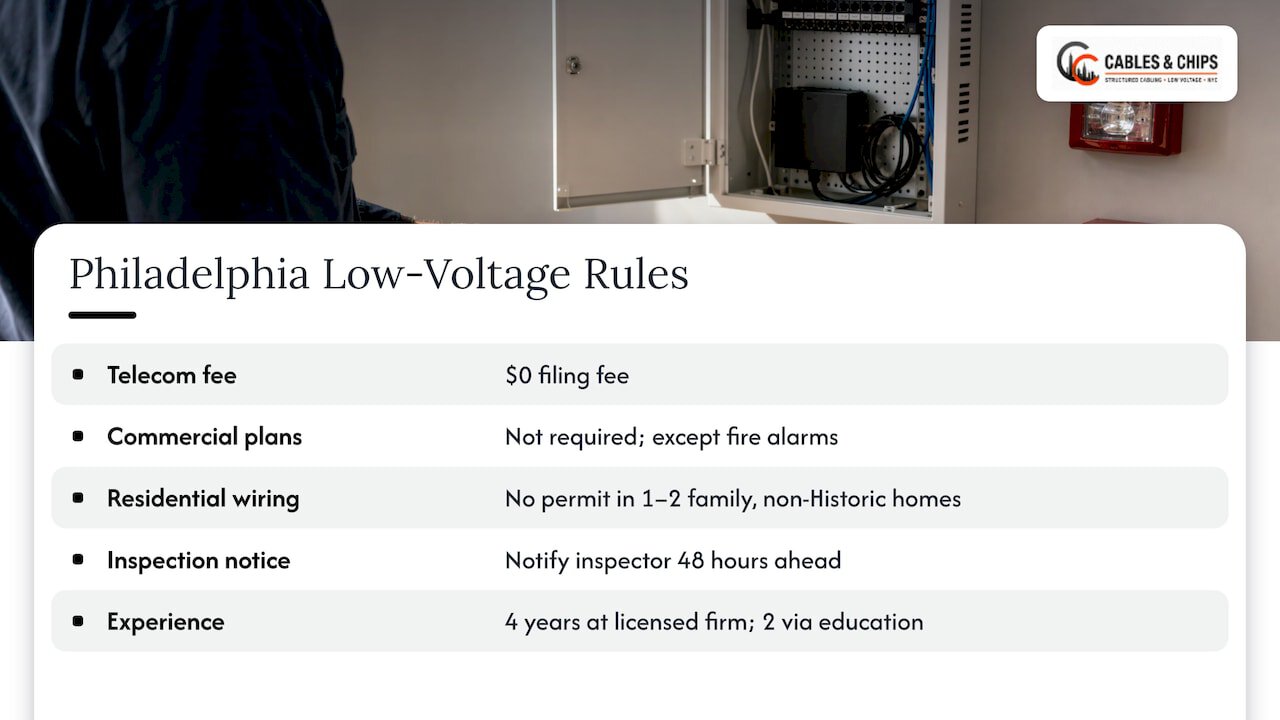
Permit. According to the City of Philadelphia’s electrical permit page, an electrical permit is required for installing, altering, replacing or repairing electrical and communication systems, and a licensed electrical contractor must perform all electrical work, including low voltage wiring. The same page says plans are not required for commercial telecommunications work, including low voltage data and security wiring, except fire-alarm wiring.
Fee. The city’s processing times and fees document (revision of December 2022) lists telecommunications permits as auto-issued with a $0 filing fee. Check the city’s current schedule before you bid.
Residential exception. The city’s START RIGHT guide (June 2026 edition) says no electrical permit is required for low voltage wiring in one- and two-family dwellings, unless the property is on the Philadelphia Historic Registry. Commercial offices fall outside that exception.
Inspections. All permitted work must be inspected. The same guide says the inspector must be notified 48 hours in advance, and the permit page says the owner or the owner’s agent hires a licensed electrical inspection agency. A Certificate of Approval is issued when required inspections pass.
Contractor license. The city’s electrical contractor license page requires at least four years of employment doing electrical work for a company licensed by a local or state jurisdiction, with two years of electrical education substitutable for up to two years of experience. Applicants must also pass the International Code Council electrical contractor exam.
The contrast is useful. Connecticut gives low voltage its own limited license tier. Philadelphia routes it through the electrical contractor license and a permit that is cheap to file but still inspected.
What we do on low voltage projects
Cables & Chips is a New York City low voltage and data network contractor based at 20 Vesey Street in Lower Manhattan. We design, install, test and document structured CAT6 and CAT6A cabling, fiber, WiFi access point cabling, CCTV and access control cabling, A/V and conference room wiring, VoIP infrastructure and server racks. We also clean up abandoned cable and organize MDF/IDF closets. We are licensed and insured, we bring more than 40 years of commercial experience, and our work is built around clean, documented, organized installations.
For projects in Connecticut, the first step is the same as anywhere: a scope that names each system and who is responsible for it. A no-obligation site survey is how we start.
See the full list of low voltage services or request a site survey at cables.nyc.
Our perspective
Licensing is the floor, not the finish. A license tells you who is accountable for the work. It does not tell you whether the closet will be readable in five years.
In our experience, most problems on commercial low voltage jobs start with scope, not skill. Data, voice, security and A/V get bought separately, installed at different times, and labeled differently. When a state splits the work into categories, as Connecticut does with its C-5 and L-5 licenses, the scope document has to be clearer, not looser.
That is why we insist on the same habits on every job: every run labeled, every cable tested and certified, every rack and MDF/IDF documented, and abandoned cable removed where the scope allows. Your network is only as strong as the infrastructure behind it, and the people who maintain it after us should be able to understand it without calling us.
If your project crosses state lines, treat each state’s licensing as its own line item. Ask early, write it down, and plan renewal dates the same way you plan the install.
Ken
FAQ
What is the Connecticut low voltage license called?
Connecticut’s DCP issues the C-5 and L-5 Limited Electrical Contractor licenses, plus the C-6 and L-6 journeyperson licenses. The C-5 covers low voltage, alarm or signal, audio and sound, and telephone-interconnect work up to 48 volts or 8 amperes. The L-5 is limited to 25 volts or 5 amperes and excludes telecommunications.
Can a company hold a Connecticut low voltage license?
The DCP licenses individuals rather than companies. A company performs the work under a licensed contractor who holds the license, and journeypersons may work only for a licensed contractor within their category. When you hire, ask which licensed individual is responsible for the Connecticut scope.
How much does a Connecticut low voltage contractor license cost?
The DCP lists a $150.00 non-refundable application fee for a contractor license and $90.00 for a journeyperson, with separate exam fees paid to the exam vendor. Annual renewal is $150.00 for contractors and $120.00 for journeypersons. All electrical licenses expire September 30, so confirm current fees on the DCP page.
Does Connecticut accept a New York or New Jersey license?
According to the CASIAC guide, Connecticut has no reciprocity with other states. Out-of-state license holders should review the DCP’s licensing requirements before planning Connecticut work.
Does low voltage work in Philadelphia need a permit?
For commercial work, yes. Philadelphia requires an electrical permit for electrical and communication systems, and a licensed electrical contractor must perform the work. Telecommunications permits are auto-issued with a $0 filing fee per the city’s 2022 fee document, and permitted work must be inspected.
Sources
- Electrical License Types and Scope of Work, Connecticut DCP
- Electrical License, Connecticut DCP
- Occupational Licensing regulations, Connecticut eRegulations
- Guide to Low Voltage Licensing, CASIAC
- Get an Electrical Permit, City of Philadelphia
- Electrical Permit Processing Times and Filing Fees, City of Philadelphia
- START RIGHT guide, City of Philadelphia
- Get an Electrical Contractor License, City of Philadelphia