
CCTV Plenum Cable: When It’s Required and How to Choose
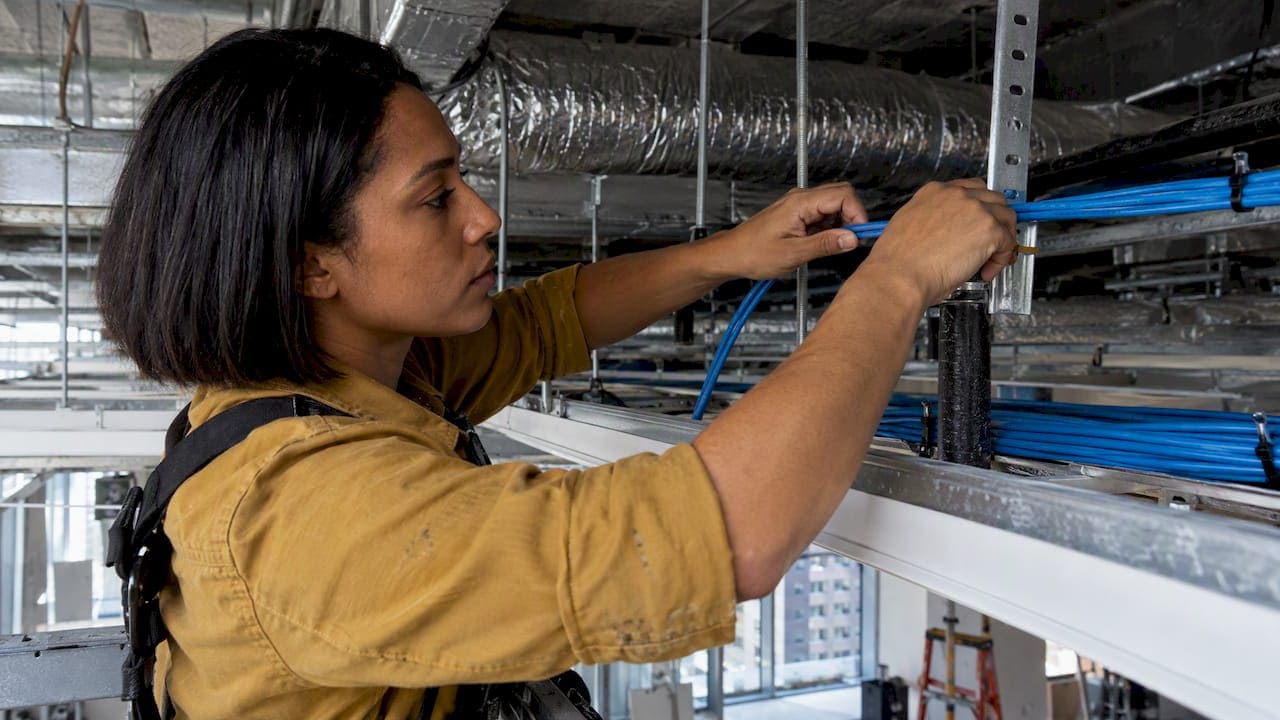
CCTV plenum cable is surveillance cabling with a CMP (communications plenum) listing, which means its jacket and insulation are tested for low flame spread and low smoke. In the United States you need it wherever a camera cable runs through a space used for environmental air, such as the open area above a drop ceiling that serves as a return-air path. Standard CM and CMR cable is not permitted there. Everywhere else, a lower rating may be legal, but the cost of specifying CMP across a project is often smaller than the cost of one failed inspection.
This guide is for IT directors, facilities managers, general contractors and security integrators who have to specify, price or inspect camera cabling in commercial buildings. It covers what the rating means, when it applies, how to tell real plenum cable from a marketing claim, and what to check before you pull a single run.
TL;DR
- CMP is the plenum listing for communications cable. It is tested for limited flame spread and smoke, and it is the only communications rating allowed in plenum spaces.
- Whether a ceiling is a plenum is decided by how air moves through it, not by how the room looks. Confirm it on the mechanical drawings and with the local code authority.
- CMP can substitute for CMR and CM, never the other way around. Many commercial teams specify CMP for all ceiling runs to avoid mistakes.
- Verify the listing: look for the CMP designation, a mark from a nationally recognized testing laboratory, and proof of compliance from the manufacturer.
- Plenum jackets are stiffer and run warmer in bundles, so plan bend radius, bundle size and PoE load before installation.
What CCTV plenum cable actually is
There is no special category of cable called “CCTV plenum cable.” The phrase describes a camera cable, either twisted pair (Cat5e, Cat6, Cat6A) or coaxial, built with a plenum-rated jacket. The camera application does not change the fire rating. The space the cable travels through does.
CMP cable is listed for fire-resistant and low-smoke characteristics. According to Belden, that includes flame propagation of five feet or less and limited smoke optical density. The listing is earned through the NFPA 262 test, which is why you will see that standard referenced on data sheets. In practice, plenum jackets are made from low-smoke compounds such as FEP, and the insulation under them is often FEP too.
The reason the rule exists is simple. A plenum carries conditioned air through the building. If a fire starts and the cable burns, the air system can move smoke and fumes to occupied floors. Low-smoke, low-flame cable slows that.
The common communications ratings, from strictest to most basic, are:
| Rating | Name | Typical use |
|---|---|---|
| CMP | Communications plenum | Ducts, plenums and other air-handling spaces |
| CMR | Communications riser | Vertical runs between floors |
| CM / CMG | General purpose | Horizontal runs in non-plenum areas |
| CMX | Limited use | Residential and exposed runs in limited settings |
A published NEC summary lays out the same hierarchy, including the rule that a CMP cable can stand in for CMR, CM and CMX cable. The reverse is not allowed.
If your camera system uses power-limited circuits instead of communications cable, the equivalents are CL2P and CL3P for plenum. Most IP camera systems run on Ethernet and fall under the communications rules.
When a CCTV installation requires plenum-rated cable
Video surveillance in the U.S. generally falls under NEC Chapter 8, Article 800, which governs communications circuits. IPVM’s code analysis explains that installation requirements depend on the space the cable occupies. That is the key point. The rating you need follows the location.
The core rule is that standard CM and CMR cables are not permitted in plenum spaces. So the real question becomes: is this space a plenum?
How to tell if a space is a plenum
A plenum is a space used for environmental air, typically a return-air path. In many commercial buildings, the area above a suspended ceiling is used this way, with return grilles open to the cavity instead of a ducted return. In other buildings, the return is fully ducted and the same ceiling cavity is not a plenum. From the floor, the two look identical.
What to check:
- Mechanical drawings. Look for return air that terminates in the ceiling cavity rather than in a duct.
- The building engineer. Ask whether the cavity above the ceiling tile is a return-air path on that floor. Floors in the same building can differ.
- Raised floors. Underfloor air distribution makes the space below the floor a plenum as well.
- The local authority. Plan reviewers check architectural and mechanical drawings to find return-air plenums and confirm the electrical specifications call for plenum cable there. Drawings that do not identify plenum spaces make verification hard and are a common violation.
Where you cannot get a clear answer, assume plenum.
Why many projects specify CMP everywhere overhead
Tenant spaces change. A ceiling cavity that is not a plenum today can become one after an HVAC redesign. One code resource covering residential construction recommends CMP throughout to avoid specification errors and to cover a future change of that kind. The same logic applies in offices. Mixed ratings on a single floor also invite mistakes during later moves, adds and changes, when a technician has to decide which cable can go where.
The tradeoff is cost and handling. Plenum cable is more expensive per foot than riser or general-purpose cable and is stiffer. For a large camera deployment with long runs through confirmed non-plenum space, a mixed specification can save money. For most tenant fit-outs in Manhattan and the surrounding region, a single plenum specification for overhead work is simpler to inspect and maintain.
Coax or twisted pair: the plenum options for CCTV
Both cable families come in plenum versions, and the choice depends on the camera system, not on the fire rating.
Twisted pair for IP cameras
IP cameras use Ethernet over Cat5e, Cat6 or Cat6A, and most can draw Power over Ethernet from the same cable. Plenum versions of these cables are widely available from major manufacturers, in both unshielded and shielded construction. Twisted pair is the default for new commercial installations because one cable carries video, power and control, and because it ties directly into the structured cabling system. Our guide to choosing CCTV cable types goes through the 100 m channel limit and what to do when a camera sits beyond it.
Coaxial for analog and HD-over-coax systems
Existing analog or HD-over-coax systems still use coax, and retrofits that keep older cameras may need new coax runs. Plenum coax exists. As one example, Belden’s RG-6 CCTV cable data sheet lists a foam FEP core, a Flamarrest jacket and a 75-ohm characteristic impedance. Coax needs separate power wiring for most cameras, so a plenum coax run often means a second plenum-rated power cable alongside it.
| Factor | Twisted pair (Cat6/Cat6A) | Coax (RG-6 type) |
|---|---|---|
| Camera type | IP | Analog, HD-over-coax |
| Power | PoE on the same cable | Usually separate power cable |
| Impedance | 100 ohm | 75 ohm |
| Fit with structured cabling | Direct | Separate pathway |
| Typical new-build choice | Yes | Rarely |
Shielded cable for security and access control
Security and access control circuits often use multiconductor cable in 14 to 22 AWG gauges, sometimes shielded, in plenum versions. If your project includes door controllers, readers and locks alongside cameras, the requirements for that cable differ. See our access control cabling requirements for how those circuits are specified.
How to identify real plenum-rated cable
This is where projects go wrong. A jacket that says “plenum” in a catalog is not proof of anything.
Check the designation. The cable should carry a CMP designation. Look for CMP printed on the jacket, along with the listing marks.
Check the certification mark. CMP cables require certification from an OSHA-authorized NRTL (nationally recognized testing laboratory), and the registered mark shows the product was tested and certified. The manufacturer should provide proof of compliance on request.
Do not rely on jacket print alone. UL’s guidance is that surface-printed markings are supplemental and not definitive evidence of a listing. Installers should refer to the UL Mark on the smallest unit container, reel or tag. Keep the tag or a photo of it with your project records.
Look it up. UL certifications for products used in plenums can be found in the UL Product iQ directory. If a cable’s file number does not appear, ask the supplier why.
Check everything, not just the cable. Designers should be wary of vague marketing and confirm that all products are certified to the right standards, for example NFPA 262 for cable and UL 2043 for discrete accessories placed in air-handling spaces. In a camera project that includes plenum-space media converters, power supplies, enclosures and cable-management products, not only the cable.
A quick field checklist:
- Jacket print includes CMP and the cable type.
- Reel tag or box carries the NRTL mark.
- Supplier provides listing documentation.
- Product appears in the certification directory.
- Accessories in the plenum are also rated for it.
What to check when choosing CCTV plenum cable
Signal and distance
Plenum cable has the same electrical categories as other jackets, but it is not always identical in performance. Plenum constructions can differ from PVC in insulation material and attenuation, so compare the data sheet for the specific product, not just the category. For IP cameras, the 100 m channel limit applies to the full permanent link plus patch cords. Long perimeter and parking runs usually need a fiber link or a powered switch closer to the camera.
PoE, heat and bundle size
PoE cameras, PTZ units and cameras with heaters push more power through the cable. Heat builds up inside cable bundles. According to an NFPA symposium presentation, insertion loss increases above 20°C, and cable temperature should not exceed its temperature rating. In a warm ceiling space with a large bundle of PoE camera runs, that matters. Smaller bundles, Cat6A for higher-power loads and a proper power budget are the practical responses. Our PoE power budget guide shows the calculation, including a buffer.
Stiffness and bend radius
Plenum jackets are usually stiffer than PVC. That affects tight turns at J-hooks, bend radius at camera boxes, and how many cables fit in a conduit or pathway. Plan pathways with extra room. Pulling too hard or kinking a stiff cable can damage the pairs and show up only at certification time.
Environment
Cameras mounted outdoors or in wet areas need a cable rated for those conditions as well. A plenum-rated indoor cable is not automatically suitable for outdoor use, and outdoor cable has its own rules for entering a building. Check the data sheet for both the fire rating and the environmental rating.
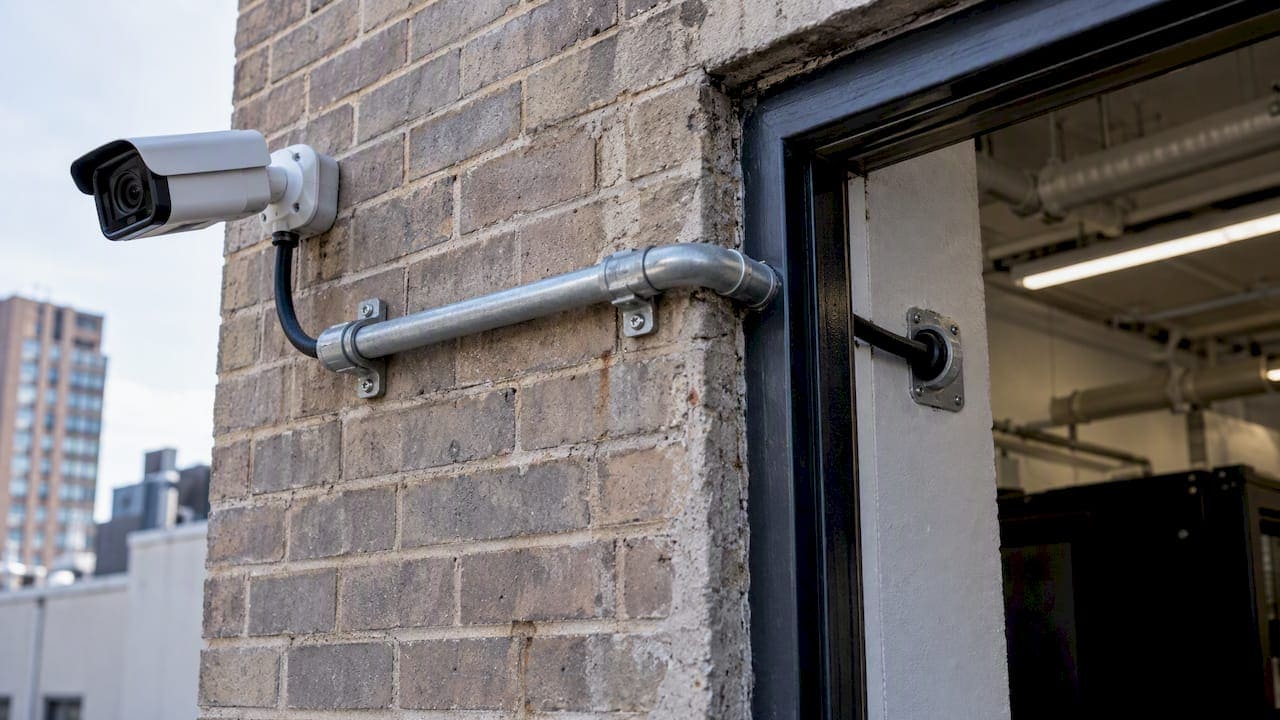
Installation and code issues before you pull cable
A short list of items we see matter on commercial jobs. For the full code framework, the IPVM report on low voltage codes is the reference this section draws on, so apply it with the local code authority in mind.
- Identify plenum spaces first. Check the space, use plenum cable there, and verify the rules with local code enforcement. In New York City that means confirming what the building and the authority having jurisdiction require, not assuming.
- Access and grounding. Comply with NEC 800.21 on access and 800.49 on grounding. NEC 800.49 requires circuits to be grounded, and cables run outside protected facilities must be grounded after they reenter the facility. This matters for camera runs to exterior poles and building corners.
- Match certification to the application. Compliance depends on matching the product’s certification to the listing required for the space and obtaining proof.
- Firestop every penetration. Cable passing through a fire-rated wall or floor needs an approved firestop system, and it is a frequent reason for failed inspections. See our guide to firestopping for cables.
- Support the cable properly. Use J-hooks or approved supports. Do not rest cable on ceiling tiles, grid wires or ducts. Our guide to running low voltage cabling in ceilings covers pathways and separation.
- Test and document. Test every run, record results and label both ends. Our cable plant testing guide explains the process, and as-built records make later service far easier.
For open-ceiling offices, where exposed cable has to be both compliant and presentable, see our guide to open ceiling cable management.
A sample specification line
A clear specification avoids arguments with the electrical contractor and the plan reviewer. Something like this works as a starting point, adapted to the project:
- All horizontal camera cabling above ceilings and below raised floors: Cat6 or Cat6A, CMP-listed, NRTL-certified, with manufacturer documentation submitted before installation.
- Accessories and enclosures installed in air-handling spaces: listed for that use.
- Penetrations: firestopped with a listed system matching the wall or floor assembly.
- Testing: 100 percent of links tested, results delivered in electronic form with as-built drawings.
Have the mechanical engineer or the building’s facilities team mark plenum areas on the drawings, so everyone works from the same map.
Common mistakes with CCTV plenum cable
- Assuming a ceiling is not a plenum. Look for return-air grilles open to the cavity, and check with the building engineer.
- Mixing CMR into a plenum area to finish a job. It saves a few dollars and creates a code violation that must be corrected after the ceiling is closed.
- Trusting marketing copy. Always check the listing, not the word “plenum.”
- Ignoring accessories. A plenum-rated cable connected to non-rated power supplies or boxes in the same space can still fail review.
- Overlooking heat. Large PoE bundles in warm ceilings can exceed temperature ratings.
- Skipping documentation. No cable tag, no test results and no drawings make a later inspection or service call harder.
Our perspective: specify CMP early, document it, and test it
We have worked on commercial networks in New York City for more than 40 years, and camera cabling is one of the areas where small decisions made early carry the longest. Cable rating is a good example. The extra cost of plenum cable on a ceiling run is easy to see on a quote. The cost of finding out after the ceiling closes that the wrong jacket went into a return-air space is not on any quote until it happens.
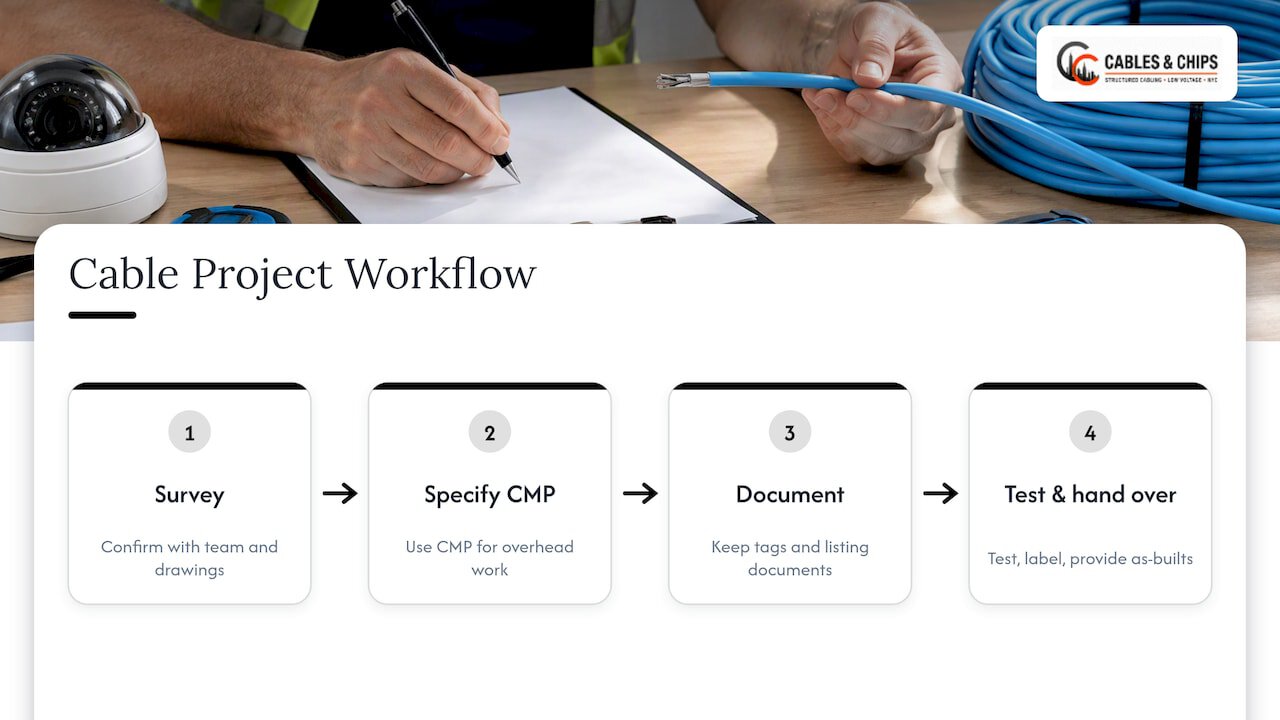
Our approach is simple. We confirm the plenum status of each area with the building team and the drawings during the site survey. We specify CMP for overhead work unless the space is clearly not a plenum and the savings justify mixed ratings. We keep the reel tags and listing documents with the project file. We test every run, label both ends and hand over as-built documentation, so the IT team or the next contractor knows exactly what is behind the ceiling.
A camera system is only as dependable as the cable and pathways behind it. If a camera drops at 2 a.m., the person troubleshooting needs labeled cable, test results and a clean ceiling space, not guesswork.
— Ken
Work with a New York low voltage contractor
If you are planning a camera system, a tenant fit-out or a cabling cleanup in a commercial space, we can survey the site, identify plenum areas with your building team, and install, test and document the cabling. We are licensed and insured, and our site surveys carry no obligation. See our CCTV and access control installation service, or browse the full range of low voltage cabling services.

For larger or more sensitive projects, our CCTV cabling plan for secure facilities shows how we structure the work. Ready to talk? Schedule a site survey at cables.nyc.
Related reading
For the wider picture of how camera cabling fits into a commercial network, start with our professional CCTV cabling installation guide and our explanation of how security camera cabling is planned for commercial sites. If you are comparing cable testing options, see our cable testing and certification page.
FAQ
Is plenum cable required for CCTV?
It is required when the cable runs through a plenum, meaning a space used for environmental air. Standard CM and CMR cables are not permitted there, so CMP is the practical choice. Outside plenum spaces, a lower rating may be allowed, but you should confirm with the local code authority.
Can I use riser (CMR) cable above a drop ceiling?
Only if the space is not a plenum. Many commercial ceilings are return-air plenums, so check the mechanical drawings and ask the building engineer first. If you cannot confirm, use CMP, which can substitute for CMR but not the reverse.
How do I know a cable is really plenum rated?
Look for the CMP designation and an NRTL certification mark, and ask the manufacturer for proof of compliance. Jacket printing alone is not definitive. UL advises checking the mark on the reel, box or tag, and you can look up listings in the UL Product iQ directory.
Does plenum cable perform differently from PVC cable?
It can. Plenum jackets are stiffer and use different insulation, so check the data sheet for attenuation, temperature rating and bend radius. Heat in large PoE bundles also reduces performance, so plan bundle size and power loads.
Do I need plenum cable for coax and power wiring too?
Yes, if those cables pass through the same plenum space. Camera coax, separate power cable and any accessories placed in the air-handling space should all carry the appropriate plenum listing.
Sources
- Which Rating or Certification Does Your Cable Really Need? (Belden)
- Low Voltage Codes and Video Surveillance (IPVM)
- NEC 2023 Section 300.22: Wiring in Ducts and Plenum Spaces
- IRC 2024 Low-Voltage Wiring requirements
- CMP vs CMR vs CM cable jacket fire ratings
- Belden 633948 technical data sheet
- UL Wire and Cable Marking and Application Guide
- UL: Products Used in Air Handling Spaces
- Plenum-Rated Products: Seeing the Smoke Before the Fire (Extron)
- PoE, IoT, Emergency Services and Emerging Technologies (NFPA SUPDET 2019)