

CCTV cabling infrastructure is defined as the physical network of cables, pathways, termination points, and supporting hardware that transmits video signals and electrical power between security cameras and recording or monitoring equipment. The industry term for this discipline is surveillance cabling infrastructure, though CCTV cabling infrastructure remains the standard working phrase across commercial installation teams. This network determines system reliability, video quality, and scalability far more than camera hardware alone. Whether you are designing a new IP surveillance deployment or upgrading a legacy analog system, the physical cabling foundation you build will define what the system can deliver for years.
What cable types are used in CCTV cabling infrastructure?
Analog and IP systems require fundamentally different cabling, and selecting the wrong type compromises both video quality and power delivery. Understanding the differences is the starting point for any CCTV infrastructure overview.
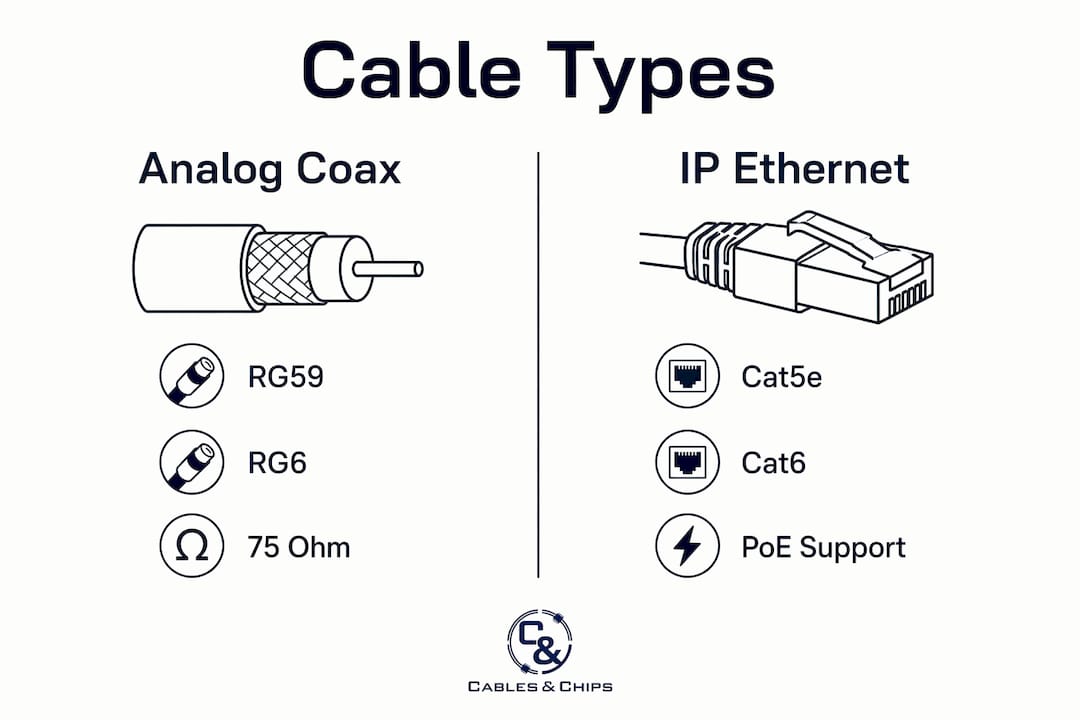
Coaxial cable for analog and HD-over-coax systems
Analog CCTV systems use 75-ohm coaxial cable, specifically RG59 or RG6 variants, to carry composite video signals from camera to recorder. RG59 is the legacy standard for shorter runs, while RG6 handles longer distances with less signal loss due to its thicker dielectric. HD-over-coax technologies such as HD-TVI, HD-CVI, and AHD have extended the relevance of coaxial cabling by pushing resolutions up to 4K over existing RG59 or RG6 plant. This matters for facilities upgrading cameras without rewiring.
Ethernet cable for IP CCTV systems
Modern IP surveillance relies on copper Ethernet cabling. Cat5e supports basic 100 Mbps links and standard PoE at up to 15.4W per port, making it acceptable for lower-resolution cameras on short runs. Cat6 is the current baseline for most commercial deployments, supporting Gigabit speeds and higher PoE+ wattage with less voltage drop. Cat6a extends performance to 10 Gigabit over 100 meters and is the preferred choice for high-wattage PTZ cameras or runs approaching the 100-meter limit.

Fiber optic cabling for backbone and inter-building links
Fiber optic cabling serves the backbone layer in large-scale CCTV network setups, connecting aggregation switches to core infrastructure or linking buildings across a campus. Single-mode fiber supports distances well beyond 100 meters with no signal degradation, making it the correct choice for perimeter cameras or multi-building deployments. Multimode fiber handles shorter inter-closet runs at lower cost. Fiber carries no electrical current, which also eliminates ground loop interference between buildings.
Shielded vs. unshielded cable selection
Shielded twisted pair (STP) cables are required in environments with high electrical noise, such as manufacturing floors, mechanical rooms, or areas near large HVAC equipment. Unshielded twisted pair (UTP) is acceptable in standard commercial office environments. The shielding choice affects termination complexity and grounding requirements, so it must be decided at the design stage, not during installation.
| Cable Type | Typical Use Case | Max Distance | PoE Support |
|---|---|---|---|
| RG59 Coax | Legacy analog CCTV | 300m (analog) | No |
| RG6 Coax | HD-over-coax (TVI/CVI/AHD) | 500m (HD-TVI) | No |
| Cat5e UTP | Basic IP cameras, low PoE | 100m | 802.3af (15.4W) |
| Cat6 UTP | Standard IP/PTZ cameras | 100m | 802.3at (30W) |
| Cat6a UTP/STP | High-power, 10G, long runs | 100m | 802.3bt (60W+) |
| Single-mode fiber | Inter-building backbone | 10km+ | No |
How is CCTV cabling infrastructure structured in commercial environments?
Large-scale CCTV deployments follow a three-tier hierarchical network design that mirrors enterprise IT architecture. This structure is not optional for facilities with more than a few dozen cameras. It is the only topology that supports fault isolation and future expansion without full rewiring.
The three tiers work as follows:
- Access layer: Individual cameras connect via horizontal copper Ethernet runs to edge PoE switches located in IDF closets or wall-mount enclosures. Each run is a dedicated cable channel from camera to switch port.
- Aggregation layer: Edge switches uplink to aggregation switches via fiber or high-capacity copper, consolidating traffic from multiple access-layer devices.
- Core layer: The fiber backbone connects aggregation nodes to the MDF, where NVR or VMS servers, storage, and WAN connections terminate.
ANSI/TIA-568 structured cabling standards define the performance criteria and physical architecture for each of these layers in commercial buildings. Compliance with TIA-568 is not just a best practice. It is the framework that makes your documentation, labeling, and patch panel organization meaningful to the next technician who works on the system.
Horizontal cabling runs from each camera position to the nearest IDF or edge switch. Pathways include cable trays, J-hooks, and conduit, with conduit required for outdoor or exposed runs. Patch panels at each IDF provide the termination and cross-connect point between horizontal runs and switch ports. Every run should be labeled at both ends with a consistent naming convention tied to a cable schedule.
Pro Tip: Budget cable channels, not just camera counts. Each channel must be sized for both the cable length and the PoE power class of the specific camera it serves. A 90-meter Cat6 run powering a 60W 802.3bt PTZ camera has very different voltage drop characteristics than a 30-meter run powering a 15W dome camera.
What are the practical limitations and technical considerations for CCTV installation?
Real-world CCTV wiring systems fail at predictable points. Knowing these constraints before pulling cable prevents the most expensive rework.
-
The 100-meter Ethernet limit is absolute. PoE and data signals are both limited to 100 meters over copper Ethernet, including patch cables at each end. Exceeding this distance causes both link instability and voltage drop that can prevent cameras from powering on.
-
Voltage drop scales with run length and power draw. Cat5e’s 24 AWG conductors lose more voltage over distance than Cat6’s 23 AWG conductors. For runs over 70 meters powering cameras above 15W, Cat6 or Cat6a is the correct choice to avoid brownouts and intermittent outages.
-
Surge protection is non-negotiable for outdoor runs. SWGDE guidelines recommend surge protection on all outdoor or long-distance power runs, along with at least 30 minutes of battery backup to prevent footage loss during power interruptions. Isolated grounding for video security circuits further reduces interference.
-
STP cable requires proper grounding to work. Shielded cable that is grounded at both ends creates a ground loop, which introduces the exact interference it was meant to eliminate. Ground STP at one end only, typically at the IDF patch panel.
-
Outdoor-rated cable is a separate specification. Direct-burial or outdoor-rated cables use UV-resistant jackets and, in some cases, gel-filled cores to resist moisture. Standard plenum or riser cable degrades rapidly in outdoor conduit exposed to temperature swings and condensation.
Pro Tip: When running cable through conduit for outdoor or exposed segments, pull a spare conductor alongside the active runs. Replacing a failed outdoor cable through a sealed conduit is significantly more labor-intensive than activating a pre-pulled spare.
How to plan and execute CCTV cabling installation for scalability
The difference between a CCTV installation that scales cleanly and one that requires full rework in three years comes down to decisions made before the first cable is pulled.
Start with a cable schedule that maps every camera position to its IDF, switch port, patch panel port, and cable ID. This document drives labeling, testing, and every future move or add. ANSI/TIA-568 administration practices provide the framework for this documentation, and following them prevents the cable spaghetti that makes large systems unmaintainable.
Key installation practices that protect long-term reliability:
- Use Cat6 as the minimum standard for all new IP CCTV runs, even where Cat5e would technically suffice today. The cost difference per run is small; the cost of upgrading cable later is not.
- Terminate all horizontal runs to the T568B wiring standard using quality RJ45 connectors or keystone jacks rated for the cable category.
- Test and certify every run with a cable certifier such as a Fluke Networks DSX CableAnalyzer. Certification confirms that the installed channel meets TIA-568 performance specs for the cable category, not just continuity.
- Place PoE switches and midspan injectors within the 100-meter envelope of the cameras they serve. Where cameras are beyond reach, use PoE extenders or convert to fiber at the nearest IDF.
- Size PoE switch budgets carefully. A 24-port switch rated for 370W total cannot power 24 cameras drawing 15W each (360W) while also handling uplink and management overhead without risk of brownout.
The choice of recording architecture also shapes cabling design. NVR-based systems require sufficient bandwidth from each camera to the recording server, which means the aggregation and core layers must be sized for peak simultaneous recording load. Cloud-managed systems like those using Verkada or Axis Camera Station Edge reduce on-premises storage cabling but increase WAN bandwidth requirements, which affects the core layer design.
| Design Decision | Recommended Practice | Reason |
|---|---|---|
| Minimum cable category | Cat6 for all new IP runs | Supports PoE+, reduces voltage drop |
| Wiring standard | T568B throughout | Consistency for termination and testing |
| Run documentation | Cable schedule per TIA-568 | Enables moves, adds, and troubleshooting |
| Testing standard | TIA-568 channel certification | Confirms performance, not just continuity |
| Power backup | Minimum 30 min UPS per SWGDE | Prevents footage loss during outages |
For enterprise security cabling types that go beyond CCTV into access control and intrusion detection, the same structured cabling principles apply across all low voltage systems in the building.
Key takeaways
Reliable CCTV cabling infrastructure requires the right cable type, a structured three-tier topology, strict adherence to the 100-meter PoE limit, and complete documentation from day one.
| Point | Details |
|---|---|
| Cable type determines system capability | Use Cat6 minimum for IP cameras; coax for HD-over-coax legacy systems. |
| Three-tier topology enables scalability | Access, aggregation, and core layers support fault isolation and future expansion. |
| 100-meter limit shapes every design decision | Fiber or PoE extenders are required for any camera run exceeding this distance. |
| Documentation prevents costly rework | TIA-568 labeling and cable schedules make moves and troubleshooting manageable. |
| Power reliability is an infrastructure requirement | Surge protection, proper grounding, and UPS backup protect footage integrity. |
What I’ve learned from 40 years of CCTV cabling projects
The single most common failure I see in CCTV cabling projects is treating the cabling as an afterthought to the camera selection. Teams spend weeks evaluating camera resolution and analytics features, then pull whatever cable is on the truck. That decision costs more in service calls and rework than the camera budget itself.
The second pattern worth calling out is PoE budgeting. Most installers know the 100-meter rule. Far fewer actually calculate the total PoE load against the switch’s power budget before commissioning. A switch that is 10% over its power budget will drop ports intermittently under load, and that fault is genuinely difficult to diagnose without a power monitoring tool.
On the standards question: ANSI/TIA-568 compliance is sometimes treated as a checkbox for enterprise clients and ignored everywhere else. That is a mistake. The value of structured cabling standards is not the paperwork. It is the discipline of consistent termination, labeling, and documentation that makes a system serviceable by anyone, not just the original installer. In a city like New York, where building ownership and IT staff turn over regularly, that documentation is the difference between a system that gets maintained and one that gets replaced.
Cloud storage is changing cabling design in ways that are not yet fully reflected in most installation guides. As more systems shift recording to the cloud, the bandwidth demand on the core layer increases while the NVR cabling requirement decreases. Design your core layer for that transition now, or you will be upgrading fiber backbone sooner than expected.
— Ken
Professional CCTV cabling installation in New York City
Cables & Chips designs and installs CCTV cabling infrastructure for commercial offices, secure facilities, and enterprise environments throughout New York City. With more than 40 years of experience, the team at Cables builds structured, documented, and tested surveillance cabling systems that meet ANSI/TIA-568 standards and scale with your security requirements.

Whether your project requires structured Cat6 installation for a new IP camera deployment, fiber backbone for a multi-floor or multi-building system, or a full CCTV and access control infrastructure build-out, Cables delivers clean, reliable, and fully certified installations. Contact Cables at 20 Vesey Street, Lower Manhattan, to schedule a site survey.
FAQ
What is CCTV cabling infrastructure?
CCTV cabling infrastructure is the physical network of cables, pathways, termination points, and supporting hardware that connects security cameras to recording and monitoring equipment. It includes horizontal camera drops, patch panels, conduit or tray pathways, and power delivery systems such as PoE switches.
What type of cable is used for IP CCTV systems?
IP CCTV systems use copper Ethernet cable, with Cat6 as the current commercial standard. Cat6a is recommended for runs approaching 100 meters or cameras requiring high PoE wattage above 30W.
What is the maximum cable run length for PoE cameras?
Ethernet PoE runs are limited to 100 meters, including patch cables at each end. Runs beyond this distance require fiber cabling with a media converter or a PoE extender to maintain both signal and power delivery.
When should shielded cable be used for CCTV?
Shielded twisted pair cable is required in environments with significant electrical interference, such as near industrial machinery, large motors, or dense electrical conduit. In standard commercial office environments, unshielded Cat6 is acceptable.
Why does cable documentation matter for CCTV systems?
Proper cable labeling and documentation tied to TIA-568 administration standards allow any technician to identify, test, and modify camera runs without tracing cables through walls. This reduces troubleshooting time and makes future camera moves or additions significantly less expensive.