
Avoid Rework on Carrier Handoffs: FCC/TIA Rules for IT & Facilities
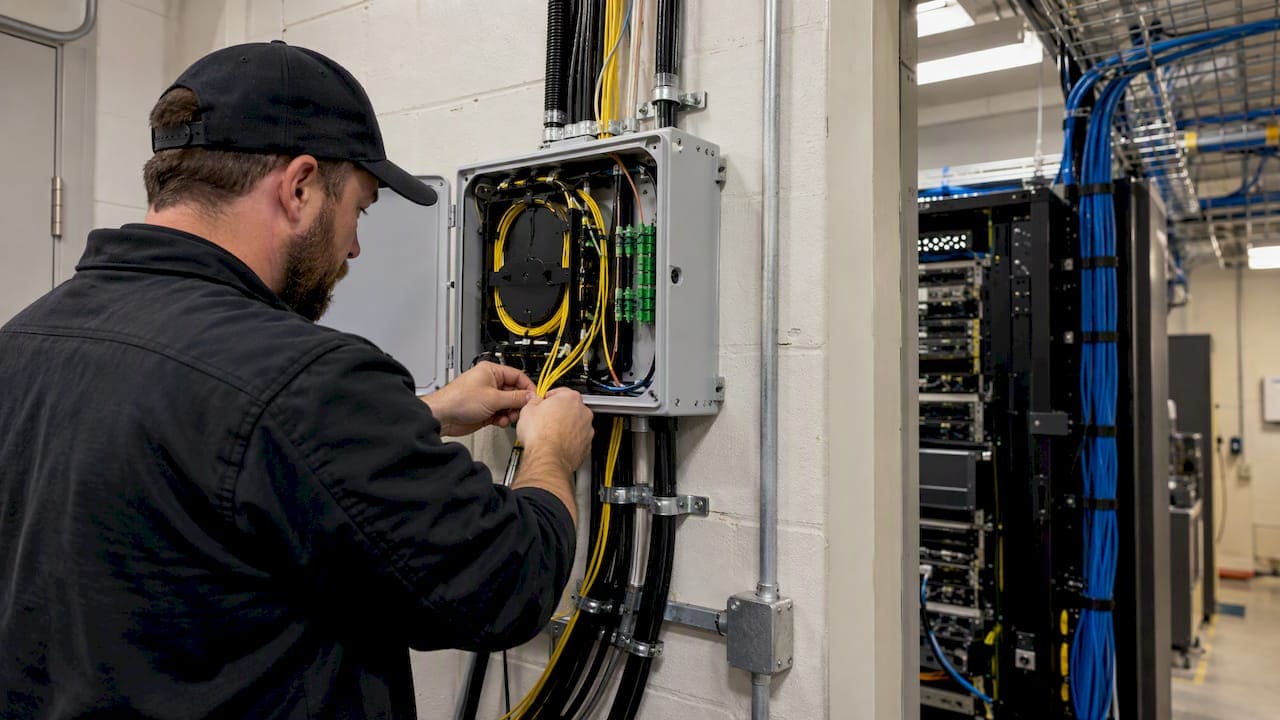
Most commercial carrier handoffs arrive one of two ways: provider-managed Ethernet over single-mode fiber, now the default for new installations, or a legacy copper or coax circuit still in service at older sites. Dark fiber remains an option for organizations with in-house optical expertise. Every handoff starts at the demarcation point, or MPOE, the boundary where the carrier’s responsibility ends and your building’s cabling begins.
TL;DR:
- Single-mode fiber is the recommended choice for carrier demarcs due to its support for longer distances and higher bandwidth capabilities.
- The demarcation point should be within about 12 inches inside the premises, and its exact location must be documented and agreed upon in writing before installation.
- Acceptance testing, including OTDR traces for fiber, must be provided by the carrier and reviewed prior to sign-off to prevent costly rework.
- Legacy copper and coax cables may still be used but have significant limitations in distance, power, and ongoing maintenance requirements.
- Proper planning, documentation, and spare conduit capacity are essential to avoid delays and complications during carrier handoff installations.
1. Physical media versus logical services: how carrier handoffs are organized
A carrier handoff has two layers, and confusing them is the most common mistake we see in proposals. The physical layer is the actual cable the provider hands you: single-mode fiber, multimode fiber, copper twisted pair, or coax. The logical layer is the service riding on that cable, such as lit Ethernet, MPLS, or a dark fiber lease. A single physical connection can carry different logical services depending on what you contract for.
Each category comes with tradeoffs worth understanding before you sign a service order.
- Single-mode fiber supports the longest distances and highest bandwidth, and it’s the standard choice for new commercial builds.
- Multimode fiber costs less for short runs but hits distance limits that make it a poor fit for most carrier demarcs.
- Copper twisted pair still shows up in older buildings, but distance and power limits restrict its use for modern bandwidth needs.
- Coax persists mainly in legacy cable-based services and is becoming rare for new business circuits.
Proposals will reference termination types like LC and MPO for fiber, or RJ-45 for copper. Knowing these terms before you review a quote keeps your team from accepting a mismatched connector type or discovering the gap during installation.
2. What to check when you accept a fiber, copper or coax handoff
Each physical medium carries its own installation and acceptance checklist, and skipping items here tends to surface as rework later.
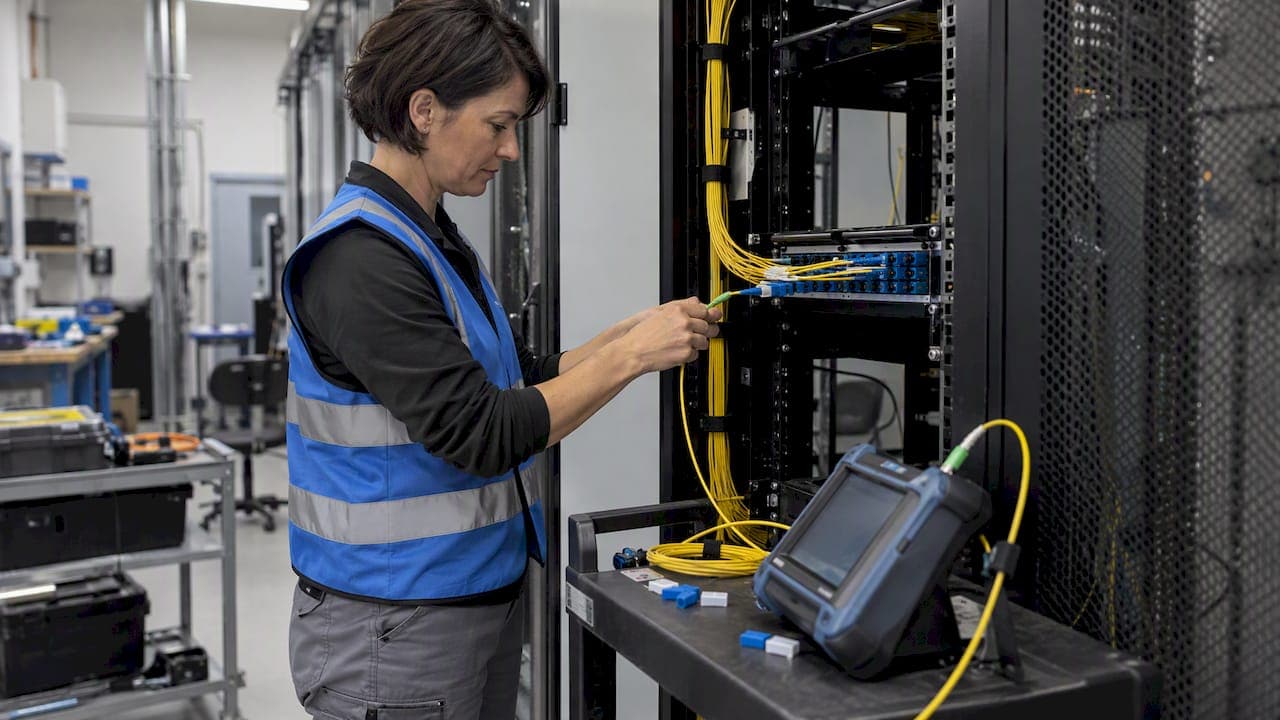
- Single-mode fiber should arrive terminated in LC or MPO connectors, cleaned with proper fiber-cleaning tools, and verified with OTDR and optical power testing before you sign off.
- Multimode fiber works for short backbone runs inside a building but is rarely the right choice at the carrier demarc given its distance ceiling.
- Copper handoffs are still issued for lower-bandwidth services; confirm distance limits and, where PoE is involved, power budget constraints before relying on them.
- Coax remains acceptable for certain legacy cable-carrier services, but plan for an eventual migration path since fewer providers are investing in it.
- Entrance facility planning matters as much as the cable itself: conduit sizing, sleeve placement, firestopping, and minimum bend radius all affect whether the handoff performs as specified.
Labeling the entrance conduit and every fiber strand at the point of entry avoids confusion months later when a second carrier or a tenant fit-out adds cable in the same pathway.
Pro Tip: Require the carrier’s acceptance test results in writing, including OTDR traces for fiber, before you sign off on the installation.
3. What you’ll actually receive at the demarc: Ethernet, MPLS, wavelengths and dark fiber
Lit Ethernet and dedicated internet access (DIA) are what most commercial tenants actually get. The carrier manages the optics and the circuit up to the demarc, and you connect your own switch. Ethernet-over-MPLS and VPLS work similarly at the handoff but let a provider tunnel Ethernet across an MPLS core, making multiple sites appear to share one LAN, a common choice for multi-location businesses needing predictable site-to-site performance.
Wavelength and private-line services offer dedicated capacity for organizations with very high bandwidth needs, typically data centers or large campuses. Dark fiber is different from all of these: the carrier hands over unlit glass, and your organization supplies the optics, performs the link budgeting, and owns ongoing maintenance.
- Lit Ethernet/DIA: carrier-managed, fastest to deploy, standard SLA coverage.
- MPLS/EoMPLS/VPLS: ideal for connecting multiple offices with shared network behavior.
- Wavelength/private line: dedicated high-capacity circuits for data-heavy environments.
- Dark fiber: lowest ongoing provider cost but requires internal optical expertise most commercial tenants don’t have on staff.
4. Demarc rules and standards every carrier agreement should reference
The demarcation point isn’t just a technical convention, it’s defined in federal regulation. Under 47 CFR § 68.105, the MPOE generally should not sit more than about one foot inside the customer’s premises unless otherwise agreed, and carriers are required to inform premises owners of their placement options at installation. Skipping that conversation is a frequent source of disputes when a second carrier later needs access to the same pathway.
On the design side, the TIA-569 pathways and spaces standard calls for flexible entrance facility design, since buildings continually add new services over their lifespan. Our own TIA standards compliance guide covers this in more depth for teams managing multi-tenant properties.
Before signing a carrier agreement, document:
- The exact demarc location, shown on construction drawings.
- Access and power requirements at the demarc cabinet or panel.
- Pathway and conduit capacity for future carriers or circuits.
- Acceptance testing criteria the carrier must meet before turn-up.
5. How to choose the right handoff for your building
Start with bandwidth needs today and over the next three to five years, since fiber installs are far cheaper to size correctly upfront than to redo later. Consider redundancy requirements, whether your team has the optical expertise to manage dark fiber, and how much SLA coverage you actually need versus what you’re paying for.
- Ask the carrier exactly where the demarc will sit and get it marked on drawings.
- Confirm conduit and pathway capacity for at least one additional carrier.
- Request acceptance test documentation as a condition of service turn-up.
- Clarify who owns troubleshooting responsibility on each side of the demarc.
- Get a written lead time for fiber installation, permitting, and any conduit work.
Fiber lead times commonly run longer than expected once permitting and landlord coordination enter the picture, so build in buffer before a planned go-live date. A red flag worth watching for: a carrier proposal with no stated demarc location or no acceptance testing clause.
Pro Tip: Get the demarc location and acceptance testing criteria in writing before the carrier schedules installation, not after.
6. Field lessons on carrier handoffs from four decades of installs
The most common surprise on-site isn’t the handoff itself, it’s the paperwork around it. We’ve walked into buildings with no documented demarc location, conduit sized for one carrier when two were planned, and fiber strands with no labeling at all. Each of those turns a same-day turn-up into a multi-week delay.
The fix is consistent: document the demarc in the construction drawings and carrier agreement, require provider acceptance testing before sign-off, and leave spare conduit capacity for the next tenant improvement or carrier addition. Our cabling project handoff checklist walks through the same steps we use on our own projects.
— Ken
7. How Cables & Chips supports your carrier handoff planning
The company has extensive experience installing and documenting cabling for carrier handoffs in commercial buildings, and a clean handoff starts with a pathway and entrance facility built to standard before the carrier ever shows up.
- Fiber installation, termination, and testing for new and upgraded carrier handoffs.
- Structured CAT6 and CAT6A cabling for the network behind the demarc.
- MDF/IDF cleanup and cable cleanup to prepare rooms for carrier turn-up.
- Cable testing and certification to document acceptance before sign-off.
Request a site survey or review our structured cabling services to plan your next carrier handoff without the rework.
Sources
- 47 CFR § 68.105 – Minimum point of entry (MPOE) and demarcation point. | Electronic Code of Federal Regulations (e-CFR) | LII
- TIA-569 Telecommunications Pathways and Spaces — TIA
- EoMPLS configuration and guide — Cisco
FAQ
What is a carrier handoff in a commercial building?
A carrier handoff is the physical and logical connection point where a service provider’s network meets your building’s cabling, typically at the demarcation point or MPOE. The FCC’s demarcation rule requires that point to sit close to where the service enters the premises unless otherwise agreed.
What is the difference between lit and dark fiber handoffs?
Lit fiber means the carrier manages the optics and delivers an active Ethernet or DIA service to your equipment. Dark fiber is unlit glass that your organization must light, maintain, and troubleshoot with its own optics and staff.
Do I need single-mode or multimode fiber for a carrier handoff?
Single-mode fiber is the standard choice at the carrier demarc because it supports longer distances and higher bandwidth than multimode. Multimode is better suited to short in-building backbone runs rather than the carrier handoff itself.
Where should the demarcation point be located?
Under 47 CFR § 68.105, the MPOE generally should not be more than about 12 inches inside the customer’s premises unless the owner and carrier agree otherwise. Carriers must inform premises owners of their placement options at the time of installation.
Can Cables & Chips help document or prepare for a carrier handoff?
Cables & Chips provides fiber installation, testing and certification, and MDF/IDF cleanup services that prepare a space for carrier turn-up in commercial buildings across New York City. Request a site survey to review your specific pathway and demarc requirements.