

Cabling Compliance Standards: What IT Teams Must Know

TL;DR:
- Cabling compliance standards set the technical and safety requirements for network infrastructure in commercial environments. They include performance, fire safety, grounding, administration, and physical pathway guidelines that ensure reliable, safe, and documented system installations. Non-compliance risks warranty invalidation, legal liabilities, operational failures, and increased long-term costs, especially for multi-site enterprises.
A cabling compliance standard is a technical and regulatory benchmark that defines how network cabling systems must be designed, installed, tested, labeled, and maintained in commercial environments. These standards come from recognized bodies including TIA (Telecommunications Industry Association), BICSI, ISO/IEC, and the National Electrical Code. Together, they govern everything from Cat6A channel lengths to fire-rated cable jackets and grounding requirements. For IT professionals and compliance officers, understanding what a cabling compliance standard requires is not optional. It determines whether your network performs reliably, whether your equipment warranties hold, and whether your facility passes inspection.
What is a cabling compliance standard and what does it cover?
A cabling compliance standard is a formal technical specification that defines the minimum performance, safety, and administrative requirements for network cabling infrastructure. The ANSI/TIA-568 series defines design, installation, and testing benchmarks for commercial building cabling, including cable categories like Cat6A, connector pinouts such as T568A and T568B, and maximum channel lengths of 100 meters for twisted-pair runs. That 100-meter limit is not arbitrary. It reflects the point at which signal integrity degrades enough to cause packet loss and retransmission under real network loads.
The scope of cabling compliance regulations extends well beyond cable performance. Standards address physical pathway design, fire safety ratings, grounding and bonding, and the administrative records that document every cable run in a building. Compliance requires integrating multiple interrelated standards simultaneously, not just selecting one document. An installation that passes TIA-568 performance tests but ignores NEC fire rating requirements is still non-compliant. That distinction matters enormously when a facility undergoes a building inspection or files an insurance claim after an incident.
Structured cabling categories like Cat6A are defined within these standards to match specific application requirements. Cat6A supports 10-Gigabit Ethernet at full channel length, which Cat6 cannot reliably guarantee in all deployment conditions. Documented compliance, including certified test reports and as-built drawings, is what transforms a physical installation into a warranted, auditable system.
What are the main cabling compliance standards and their roles?
The cabling compliance framework in the United States is built on a family of interrelated standards. Each one addresses a specific aspect of the infrastructure, and all of them must be satisfied together for full compliance.
ANSI/TIA-568 is the foundation. It specifies:
- Cable categories and their performance parameters (Cat5e, Cat6, Cat6A, and fiber types)
- Connector pinouts and termination methods (T568A and T568B wiring schemes)
- Maximum horizontal channel length of 100 meters for copper twisted-pair
- Testing parameters including insertion loss, NEXT (near-end crosstalk), and return loss
NEC Articles 725 and 800 address safety. NEC Articles 725 and 800 govern fire-stopping requirements, plenum-rated cable requirements for air-handling spaces, and mandatory separation distances between low-voltage cabling and power conductors. These are not performance standards. They are life-safety requirements enforced by local building authorities.
TIA-606 covers administration. It defines labeling conventions, record formats, and documentation requirements for every cable, panel, and pathway in the system. Proper labeling per TIA-606 lets technicians locate cable runs quickly, avoiding hours of network discovery delays during troubleshooting or moves-adds-changes.
TIA-607 addresses grounding and bonding. It specifies how telecommunications bonding backbones and grounding conductors must be installed to protect equipment from electrical surges and reduce electromagnetic interference.
TIA-569 defines the physical pathways: conduit sizing, cable tray specifications, bend radius minimums, and clearance requirements in telecommunications rooms. Together, the full TIA family creates a complete compliance framework covering performance, safety, administration, and physical infrastructure.
Why is cabling compliance crucial for enterprise network infrastructure?
Non-compliance with cabling standards creates three categories of risk: financial, legal, and operational. Each one compounds the others when a network failure or inspection occurs.
-
Warranty invalidation. Equipment manufacturers and cabling system vendors require certified proof of compliant installation to honor warranties. Remediation costs for non-compliant cabling can reach up to 100% of the original installation budget. That figure reflects the cost of pulling and replacing cable, re-terminating panels, and re-testing the entire system.
-
Failed inspections and legal liability. Building inspectors enforce NEC requirements. A facility with improperly rated cable in plenum spaces or missing fire-stops can fail occupancy inspections. Beyond inspections, non-compliant cabling creates legal exposure if a fire or electrical incident occurs and investigators find the infrastructure did not meet code.
-
Insurance denial. Commercial property and liability insurers increasingly require documented code compliance as a condition of coverage. An undocumented or non-compliant installation can void a claim at the worst possible moment.
-
Operational downtime. Non-compliant cabling produces intermittent failures that are difficult to diagnose. Crosstalk, signal degradation, and ground loops cause symptoms that mimic application or server problems. IT teams spend hours chasing software issues that are actually physical layer failures.
-
Increased troubleshooting complexity. Certified BICSI technicians apply best practices aligned to TIA and NEC standards to avoid systemic failures. When an installation is done by uncertified personnel without documented testing, every future fault becomes a detective exercise rather than a documented lookup.
Pro Tip: When vetting a cabling contractor, ask specifically for BICSI-certified installers and request sample test reports from previous projects. A contractor who cannot produce certified field test documentation is not delivering a compliant installation.
How is compliance achieved and validated in cabling projects?
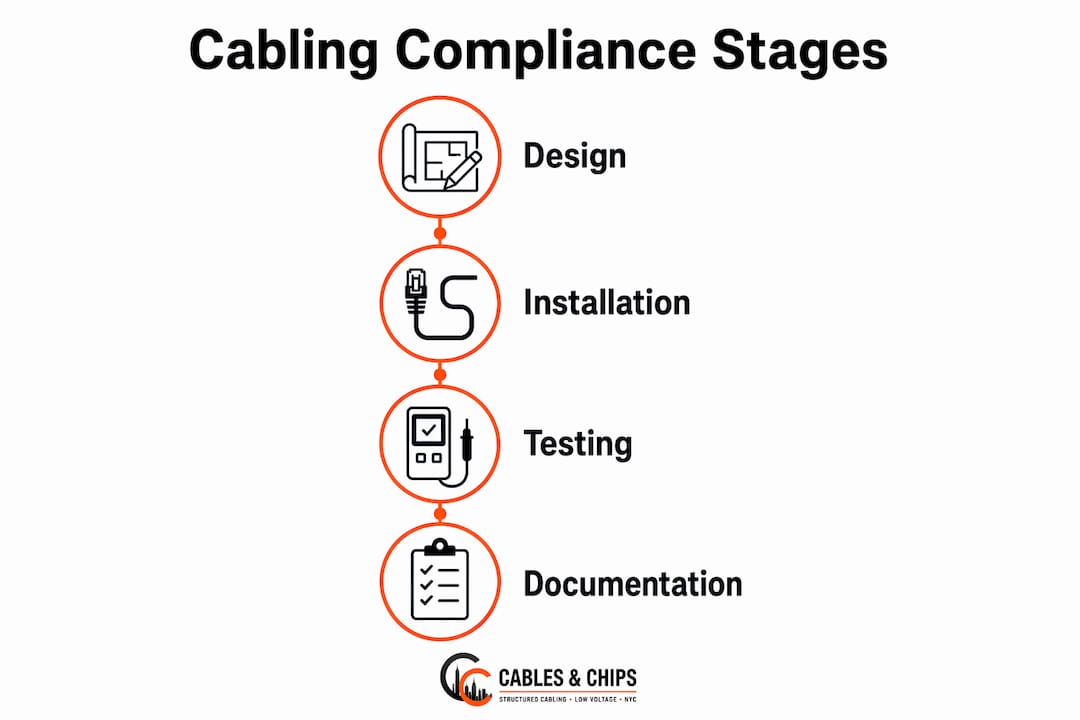
Achieving cabling compliance is a process that runs from initial design through final documentation. Skipping any phase creates gaps that surface during audits, inspections, or warranty claims.
Design phase
Cable type selection must match the application. Cat6A is the current standard for new horizontal runs supporting 10-Gigabit Ethernet. Pathway layout must respect minimum bend radius requirements and maintain separation from power conduits to reduce electromagnetic interference. Improper bend radius causes crosstalk; minimum distances from power conduits reduce EMI. These requirements are specified in TIA-568 and TIA-569 and must be incorporated into construction drawings before installation begins.

Installation phase
Termination methods must follow the pinout scheme specified in the project design (T568A or T568B, consistently applied). Cable management must maintain bend radius through every pathway, junction box, and patch panel. Proper installation includes respecting manufacturer bend radius, using Velcro instead of tight zip ties, and carefully measuring cable run lengths to stay within channel limits. Tight zip ties crush cable pairs and degrade performance even when the cable itself is compliant.
Testing and certification phase
Certified field testing is the proof of compliance. Tests like insertion loss, NEXT, return loss, and alien crosstalk prove cabling compliance before sign-off. Certified field test results and documentation are mandatory for acceptance and warranty claims. Passing only a wiremap test is insufficient for compliance. A wiremap confirms continuity and correct pinout, but it does not measure signal performance. Full compliance requires calibrated field testers running permanent link and channel tests against the performance parameters defined in TIA-568.
The table below summarizes the key test parameters and what each one measures:
| Test Parameter | What It Measures | Compliance Relevance |
|---|---|---|
| Insertion loss | Signal attenuation over the channel length | Confirms signal reaches the far end at usable strength |
| NEXT | Near-end crosstalk between adjacent pairs | Detects interference from poor terminations or tight bends |
| Return loss | Signal reflected back toward the source | Identifies impedance mismatches from damaged cable or connectors |
| Alien crosstalk (ANEXT) | Interference from adjacent cables | Critical for Cat6A bundled runs in high-density pathways |
| Wiremap | Continuity and pin assignment | Confirms correct termination but does not validate performance |
Documentation phase
Test reports, as-built drawings, and labeling records form the compliance package. As-built documentation must capture every cable ID, its origin and destination, the test result, and the date of certification. TIA-606 defines the labeling format. Without this documentation, the installation has no auditable record and no basis for a warranty claim.
Pro Tip: Store test reports digitally in a format that links each cable ID to its test result. Physical binders get lost. A searchable digital record cuts troubleshooting time significantly when a link fails two years after installation.
How do TIA-568 and ISO/IEC 11801 compare?
TIA-568 and ISO/IEC 11801 address the same fundamental problem from different geographic starting points. Understanding both matters for any enterprise with international facilities.
ISO/IEC 11801 is the international counterpart to TIA-568, with similar but not identical class and category designations. Mapping between the two standards is required for multinational projects. The table below clarifies the key differences and use cases:
| Standard | Geographic Scope | Category/Class System | Typical Application |
|---|---|---|---|
| ANSI/TIA-568 | North America | Categories (Cat5e, Cat6, Cat6A) | US commercial buildings, data centers |
| ISO/IEC 11801 | International | Classes (Class D, E, EA, F, FA) | European and multinational enterprise projects |
| TIA-569 | North America | Pathways and spaces | Conduit, cable tray, telecom room design |
| TIA-606 | North America | Administration | Labeling, records, documentation |
| TIA-607 | North America | Grounding and bonding | Surge protection, EMI reduction |
The performance targets between TIA-568 and ISO/IEC 11801 are closely aligned at the channel level, but the class designations do not map one-to-one to category designations. Cat6A under TIA-568 corresponds to Class EA under ISO/IEC 11801, but the testing frequencies and connector requirements have subtle differences. Enterprises operating across both frameworks need contractors who understand both sets of requirements and can produce documentation that satisfies either standard’s acceptance criteria.
Multi-site enterprises face a specific risk: uniform cabling compliance across all locations reduces troubleshooting complexity and prevents “standards drift,” where different sites use incompatible cabling schemes that create vendor lock-in and long-term operational cost increases. A compliance program that specifies the same standard, the same cable category, and the same documentation format across every location is the most effective way to control that risk.
Key Takeaways
Cabling compliance standards are the technical and regulatory foundation that determines whether enterprise network infrastructure performs reliably, passes inspection, and remains warranted over its operational life.
| Point | Details |
|---|---|
| Standards are a family, not a single document | Full compliance requires TIA-568, TIA-569, TIA-606, TIA-607, and NEC simultaneously. |
| Certified field testing is mandatory | Wiremap testing alone does not satisfy compliance; insertion loss, NEXT, and alien crosstalk tests are required. |
| Documentation is as critical as installation | Test reports and as-built drawings are the auditable proof that supports warranties and inspections. |
| Non-compliance carries financial and legal risk | Remediation can cost up to 100% of the original budget; warranties and insurance coverage may be voided. |
| Multi-site enterprises need uniform standards | Consistent compliance across all locations prevents standards drift and reduces long-term operational costs. |
What I’ve learned after 40 years of watching compliance get ignored
The most common mistake I see is treating cabling standards as optional guidelines rather than binding requirements. IT teams approve a contractor based on price, the installation looks clean, and nobody asks for certified test reports. Six months later, a 10-Gigabit link is dropping packets intermittently, and the manufacturer says the warranty is void because there is no compliance documentation. That conversation is avoidable every single time.
The second pattern I see is single-standard thinking. A team will confirm that the cable meets TIA-568 performance specs and stop there. They miss the NEC fire rating requirement for the plenum space above the ceiling. They skip TIA-606 labeling because “we know where everything goes.” Two years later, a technician who was not part of the original project spends four hours tracing an unlabeled run that should have taken four minutes.
Multi-site enterprises have the most to lose from inconsistent compliance. When each location uses a different cable category, a different labeling scheme, and a different testing standard, the operational cost of managing that infrastructure compounds every year. A uniform compliance program, applied consistently across every site, is the single most effective way to control long-term network infrastructure costs. The TIA standards compliance guide is a practical starting point for teams building or updating that program.
The contractors worth hiring are the ones who hand you a complete documentation package at project close: certified test reports for every link, as-built drawings, and a labeled infrastructure that matches the records. That package is not a courtesy. It is the deliverable. If a contractor does not offer it, they are not delivering a compliant installation.
— Ken
Cables and Chips builds compliant cabling infrastructure in New York City
Cables and Chips has spent more than 40 years installing, testing, and documenting structured cabling systems for commercial offices, secure facilities, and enterprise environments across New York City. Every project follows TIA-568, NEC, and TIA-606 requirements, and every installation is backed by certified field test documentation.

Whether you need a full Cat6A installation with certified testing and as-built documentation, or a detailed review of your existing infrastructure’s compliance status, Cables and Chips delivers the documentation package that supports your warranties, satisfies inspections, and gives your IT team a reliable, auditable network. Explore the structured cabling system components guide or contact Cables and Chips directly to schedule a site assessment.
FAQ
What is a cabling compliance standard?
A cabling compliance standard is a technical and regulatory benchmark that defines how network cabling must be designed, installed, tested, labeled, and maintained. Primary standards include ANSI/TIA-568, NEC Articles 725 and 800, and ISO/IEC 11801.
Does passing a wiremap test mean a cabling installation is compliant?
No. Wiremap testing confirms continuity and correct pin assignment but does not measure signal performance. Full compliance requires certified field tests for insertion loss, NEXT, return loss, and alien crosstalk using calibrated instruments.
What happens if cabling is installed without meeting compliance standards?
Non-compliant cabling can void equipment warranties, fail building inspections, and create legal liability. Remediation costs can reach up to 100% of the original installation budget, and insurance coverage may be denied after an incident.
What is the difference between TIA-568 and ISO/IEC 11801?
TIA-568 is the North American standard using category designations (Cat6, Cat6A). ISO/IEC 11801 is the international equivalent using class designations (Class EA, Class FA). Both address similar performance targets, but mapping between them is required for multinational enterprise projects.
How does TIA-606 affect day-to-day network operations?
TIA-606 defines labeling and records management for every cable, panel, and pathway. Proper labeling lets technicians locate cable runs quickly, reducing troubleshooting time from hours to minutes during faults, moves, or infrastructure changes.