
Cable Testing Standards Examples for Network Professionals
TL;DR:
- Cable testing standards establish safety and performance criteria to ensure cable integrity and fire resistance. Proper selection and application of standards depend on cable type, voltage, and regional requirements, making testing critical for safety and compliance. Ignoring proper protocols, such as temperature correction or matching test voltages, can lead to incorrect assessments and potential failures.
Cable testing standards are defined sets of performance and safety criteria that verify a cable’s electrical integrity, fire resistance, and suitability for its intended application. Bodies like IEEE, UL, IEC, and NETA publish these criteria, and they cover parameters ranging from insulation resistance and voltage withstand to flame retardance and smoke density. For network engineers, IT professionals, and construction project managers, understanding cable testing standards examples is not optional. A cable that passes visual inspection can still fail under load, cause a network outage, or create a fire hazard. Cable testing before use is the only way to confirm a cable meets the standard it claims.
1. Cable testing standards examples: the core frameworks
The most widely applied cable testing standards come from four organizations: IEEE, UL, IEC, and NETA. Each one targets a different aspect of cable performance, and real projects typically require compliance with more than one.
- IEEE 400 series covers field testing of shielded power cable systems rated 5 kV and above. It defines acceptable test methods, voltages, and pass/fail criteria for in-service cables.
- UL 44 covers thermoset-insulated wires and cables. UL 1581 sets reference standards for electrical wires, cables, and flexible cords, including flame tests.
- IEC 60332 defines flame retardance requirements for single cables and bundled installations.
- NETA MTS-2019 (Maintenance Testing Specifications) sets numeric insulation resistance thresholds for control and instrumentation cables.
These frameworks form the foundation of any cable certification process used by IT teams and construction managers in commercial projects.
2. Insulation resistance thresholds under NETA MTS-2019
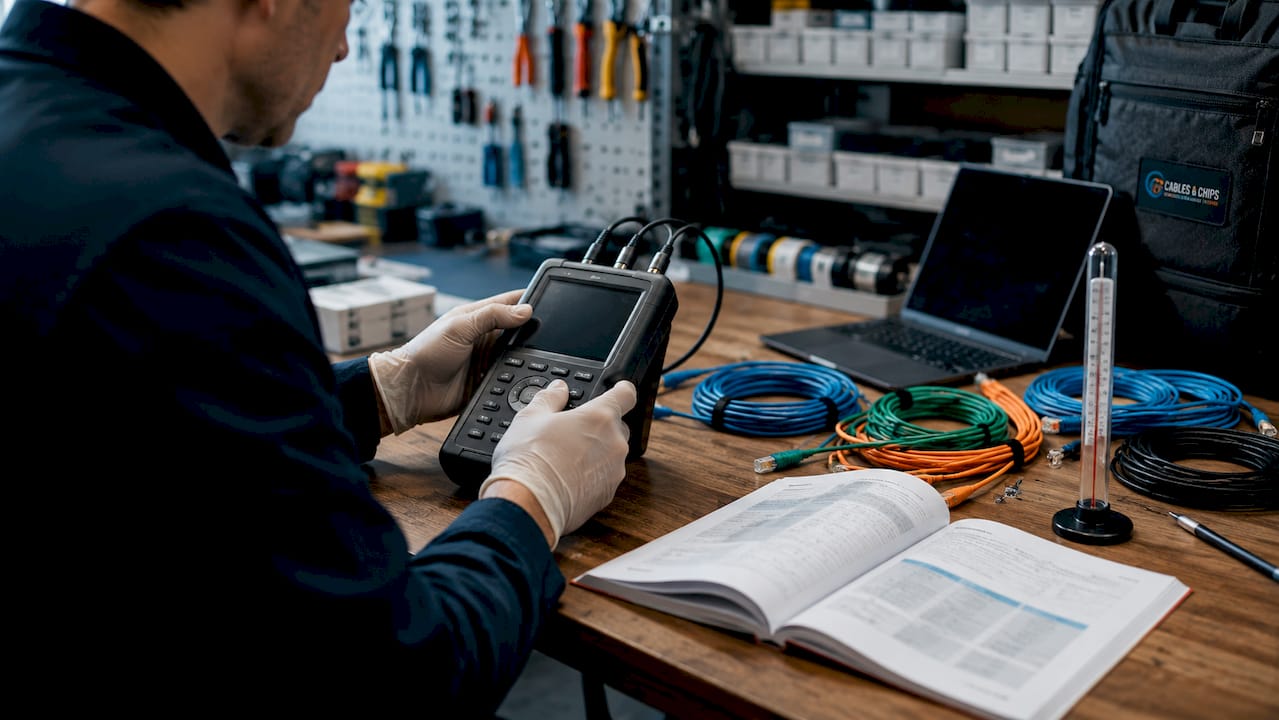
Insulation resistance (IR) testing is the most common field test for electrical cables, and NETA MTS-2019 gives it specific numeric teeth. NETA MTS-2019 sets insulation resistance pass/fail thresholds for instrumentation cables: analog circuits above 100 MΩ are considered healthy, while readings below 10 MΩ require replacement. That range gives field engineers a clear action threshold rather than a judgment call.
Control cables rated at 600V require greater than 25 MΩ at 500V DC per NETA. A reading between 10 MΩ and 25 MΩ signals degradation worth monitoring before the next maintenance cycle. Tracking these values over time reveals trends that a single snapshot test cannot.
Pro Tip: Record IR values at every maintenance interval and log the ambient temperature at the time of testing. Trending a decline across three readings is far more useful than any single pass/fail result.
3. DC test voltage selection by cable class
Applying the wrong test voltage damages cable insulation. IEEE 400-2012 and NETA MTS recommend DC test voltages by cable rating: 500V DC for cables rated at 250V or below; 1,000V DC for 600V and 1 kV cables; 2,500V DC for 5 kV class cables; and 5,000V DC for 15 kV class cables.
These voltage tiers exist because insulation thickness and dielectric strength scale with the cable’s rated voltage. Applying a 5,000V test to a 600V control cable does not produce a more thorough result. It causes damage. Matching test voltage to cable class is a cable compliance requirement, not a preference.
4. VLF AC testing vs. DC hipot for modern insulation
Not all test methods suit all cable types. High-voltage DC hipot testing causes cumulative space-charge damage in extruded insulation cables like XLPE and EPR. That damage does not show up immediately. It accelerates aging and causes failures months after a test that appeared to pass.
Very Low Frequency (VLF) AC testing at 0.1 Hz is the preferred method for XLPE and EPR insulated cables. VLF applies AC stress at a frequency low enough to avoid the capacitive charging current problems of 60 Hz testing, while avoiding the space-charge buildup that DC hipot creates. For any medium-voltage cable installed after 1990, VLF is the correct choice.
Pro Tip: Before applying any test voltage, disconnect all connected equipment including VFDs, PLCs, and panel meters. Failing to isolate the cable is the most common cause of equipment damage during acceptance testing.
5. Fire performance standards: IEC 60332, BS 6387, and IEC 60331
Fire-related cable testing standards are mandatory for construction projects and carry legal weight in most jurisdictions. IEC 60332-1-2 covers single cables and IEC 60332-3 covers bunched cable installations. Both measure flame propagation under controlled conditions.
BS 6387 and IEC 60331 go further. They test whether a cable maintains circuit integrity during a fire, not just whether it resists ignition. That distinction matters in life-safety systems like emergency lighting, fire alarms, and access control wiring. A cable can pass IEC 60332 and still fail BS 6387 if it loses conductivity under sustained heat.
Key fire performance criteria to verify on any project:
- Flame retardance: IEC 60332-1-2 (single cable) or IEC 60332-3 (bunched)
- Circuit integrity under fire: BS 6387 or IEC 60331
- Halogen content: Low-smoke, zero-halogen (LSZH) cables reduce toxic gas output in enclosed spaces
- Smoke density: Measured per IEC 61034 for cables in tunnels, data centers, and public buildings
- EU CPR Euroclass: Declaration of Performance (DoP) required for cables sold into EU construction projects, verified by a notified body
Understanding how these requirements translate to construction drawings is part of reading fire protection engineering plans correctly. A cable spec on a drawing references a standard. That standard defines the test the cable must pass.
6. Regional standards: UL/CSA, HAR/VDE, and IEC
Cable standards are regionally focused. UL and CSA dominate North American projects. HAR and VDE apply to European installations. IEC standards are common in international EPC (engineering, procurement, and construction) contracts where no single national standard governs.
Selecting the wrong regional standard creates project acceptance problems. A cable certified to IEC 60227 may not satisfy a UL-listed requirement on a New York City job site. Construction managers working across jurisdictions need to confirm which standard the authority having jurisdiction (AHJ) accepts before specifying cable. NYC building code requirements add another layer, particularly for fire-rated and plenum-rated cable installations in commercial buildings.
7. Temperature correction for insulation resistance readings
IR values are temperature-dependent, and ignoring that fact produces incorrect pass/fail decisions. IR doubles approximately every 10°C decrease in temperature. A cable tested in a cold server room in january will show a higher IR reading than the same cable tested in august heat, even if the cable’s condition has not changed.
Correcting all IR measurements to a reference temperature of 20°C is the accepted practice for consistent assessment. Most modern insulation testers include a temperature correction function. If yours does not, apply the correction factor manually using the cable manufacturer’s temperature coefficient. Skipping this step turns a trending analysis into noise.
8. Polarization Index for aging assessment
The Polarization Index (PI) is a diagnostic ratio that reveals insulation aging beyond what a single IR reading shows. PI is calculated by dividing the 10-minute IR reading by the 1-minute IR reading. A PI above 2.0 indicates healthy insulation. A PI below 1.0 signals contamination or severe degradation.
PI testing is particularly useful for medium-voltage power cables and motor feeders that have been in service for more than five years. A cable can show an IR reading above the NETA pass threshold while still trending toward failure. The PI catches that trajectory early. Cable continuity testing and IR testing together give a complete picture of conductor and insulation health.
9. Partial Discharge and Tan Delta diagnostics
Partial Discharge (PD) testing and Tan Delta diagnostics identify insulation degradation that withstand tests miss entirely. PD testing detects small electrical discharges within voids or defects in the insulation. Tan Delta measures the dielectric loss angle, which increases as insulation ages or absorbs moisture.
Industry experts caution against sole reliance on withstand tests. A cable can pass a high-voltage withstand test and still carry active PD activity that will cause failure within months. PD and Tan Delta testing are now standard practice for medium-voltage cables in data centers, hospitals, and critical infrastructure. They shift cable management from reactive replacement to condition-based maintenance.
10. Applying standards to structured cabling and network projects
Network cable testing protocols for CAT6 and CAT6A structured cabling follow TIA-568 and ISO/IEC 11801. These standards define channel and permanent link performance limits for parameters including insertion loss, near-end crosstalk (NEXT), return loss, and propagation delay. Every run must be tested and certified after installation.
Fiber optic testing standards follow TIA-526-14 for multimode and TIA-526-7 for single-mode links. Insertion loss limits are defined per connector and per splice. An OTDR (Optical Time Domain Reflectometer) trace documents the loss profile of each link and identifies any anomalies. Structured cabling system components must be matched to the correct test standard for the certification to hold.
Key Takeaways
Matching cable testing standards to cable type, voltage class, and regional compliance requirements is the single most important factor in producing valid, defensible test results.
| Point | Details |
|---|---|
| NETA MTS-2019 IR thresholds | Analog circuits above 100 MΩ are healthy; below 10 MΩ requires replacement. |
| Test voltage must match cable class | IEEE 400 and NETA specify voltages from 500V DC to 5,000V DC by cable rating. |
| VLF AC over DC hipot for XLPE/EPR | DC hipot causes space-charge damage in modern extruded insulation cables. |
| Fire standards go beyond flame retardance | BS 6387 and IEC 60331 test circuit integrity under fire, not just ignition resistance. |
| Diagnostic tests outperform pass/fail alone | PI, PD, and Tan Delta testing reveal aging trends that withstand tests cannot detect. |
What I’ve learned from testing cables in complex infrastructure
After working through hundreds of commercial installations across New York City, the pattern I see most often is this: teams test to pass, not to understand. They apply the minimum required test, get a green light, and move on. That approach works until it doesn’t, and when it fails, it fails at the worst possible time.
The binary pass/fail model made sense when cables were simpler and test equipment was limited. Modern XLPE and EPR insulated cables carry charge in ways that a DC hipot test cannot fully reveal. I have seen cables pass a 2,500V DC withstand test and fail within a year because no one ran a Tan Delta baseline. The withstand test confirmed the cable was not already broken. It said nothing about how close to the edge it was sitting.
The other mistake I see regularly is ignoring temperature correction on IR readings. A project team tests in december, logs a strong IR value, and files it. The same cable tested in july shows a lower reading. Someone flags it as degradation. It is not degradation. It is physics. Correcting to 20°C before logging any IR value takes thirty seconds and eliminates that confusion entirely.
Regional standard selection also gets underestimated on mixed-jurisdiction projects. A cable certified to IEC 60227 is not automatically acceptable on a New York City job site where UL listing is required. I have watched procurement teams order the wrong cable because the spec sheet listed IEC compliance and no one checked whether the AHJ accepted it. That mistake costs time and money to fix after the cable is already pulled.
The professionals who get this right treat testing as documentation, not just verification. Every test result, every temperature correction, every PI ratio goes into the project record. That record protects the client, protects the contractor, and gives the next engineer who touches that infrastructure a real baseline to work from.
— Ken
Certified cable testing services from Cables and Chips
Cables and Chips brings more than 40 years of structured cabling experience to every commercial project in New York City. The team tests and certifies CAT6, CAT6A, and fiber optic installations to TIA-568 and ISO/IEC 11801 standards, producing full documentation for every link.
Whether you are commissioning a new server room, upgrading an existing network closet, or verifying a legacy installation before a lease handover, Cables and Chips delivers tested, documented, and compliant infrastructure. Start with the structured cabling components guide to understand what your project requires, then contact the team at 20 Vesey Street in Lower Manhattan to schedule a site survey.
FAQ
What are the main cable testing standards examples for electrical cables?
The most widely applied standards are IEEE 400 for field testing shielded power cables, NETA MTS-2019 for insulation resistance thresholds, UL 44 and UL 1581 for wire and cable specifications, and IEC 60332 for flame retardance. Most commercial projects require compliance with more than one standard.
What insulation resistance value indicates a cable needs replacement?
Per NETA MTS-2019, analog instrumentation cables reading below 10 MΩ require replacement. Control cables rated at 600V must measure above 25 MΩ at 500V DC to pass.
Why is VLF testing preferred over DC hipot for modern cables?
DC hipot testing causes space-charge buildup in XLPE and EPR insulated cables, which accelerates insulation aging over time. VLF AC testing at 0.1 Hz applies the necessary electrical stress without that cumulative damage.
What fire performance standards apply to cables in commercial buildings?
IEC 60332-1-2 and IEC 60332-3 cover flame retardance for single and bunched cables. BS 6387 and IEC 60331 test circuit integrity under sustained fire conditions, which is required for life-safety system wiring.
How do regional cable standards differ between North America and Europe?
UL and CSA certifications govern North American projects. HAR and VDE marks apply to European installations. IEC standards are used in international contracts. Using the wrong regional certification can result in project rejection by the authority having jurisdiction.