
Cable Plant Testing for IT Professionals: 2026 Guide
TL;DR:
- Cable plant testing verifies that network cabling meets industry standards and supports reliable application performance. Certification provides legal proof by performing full frequency sweeps and detailed documentation, unlike basic wiring checks. Proper testing and documentation ensure warranty validity, pass inspections, and facilitate future troubleshooting.
Cable plant testing is the process of verifying and certifying that a structured cabling system meets defined connectivity and performance standards necessary to support network applications reliably. The industry recognizes this practice under standards like TIA-568 and ISO 11801, which set the electrical and optical benchmarks every commercial installation must meet. For IT professionals and facilities managers, understanding what is cable plant testing means understanding the difference between a network that works today and one that holds up under load, passes inspection, and qualifies for manufacturer warranty coverage. Skipping or shortcutting this process creates legal exposure, voids warranties, and leaves your infrastructure undocumented when failures occur.
What is cable plant testing and what does it actually measure?
Cable plant testing is a structured process that verifies and certifies the physical cabling infrastructure connecting network devices throughout a building or campus. The term “cable plant” refers to the complete collection of cables, connectors, patch panels, and pathways that form the physical layer of a network. Testing this plant means confirming that every component in that system performs within the limits defined by TIA-568, ISO 11801, or other applicable standards.
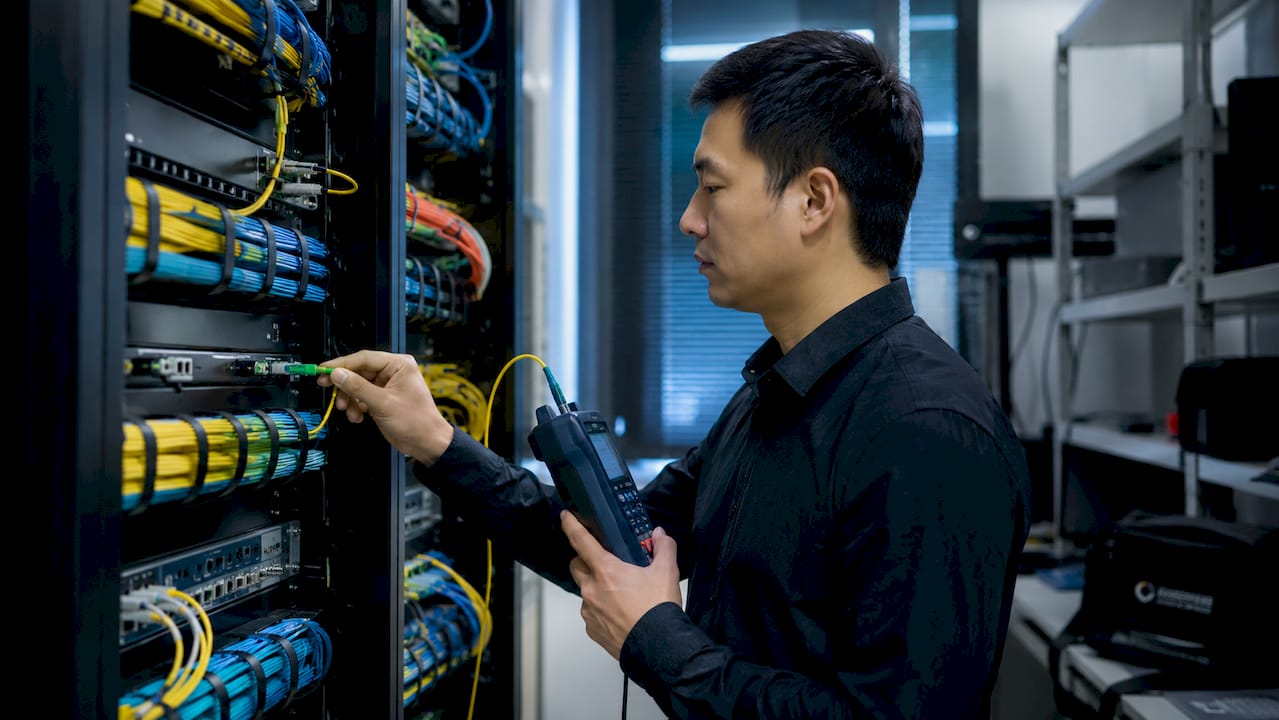
The process covers both copper and fiber optic cabling. For copper, that means measuring parameters like near-end crosstalk (NEXT), insertion loss, return loss, and delay skew. For fiber, it means measuring optical power loss and locating faults along the cable run. Each parameter tells a different story about whether the cable plant will support the applications running on top of it, from standard Ethernet to 10GBASE-T over Cat6A.
What makes cable plant testing distinct from simply plugging in a cable and checking for a link light is the depth of measurement. A link light confirms continuity. Certified testing confirms that the cable plant meets the raw physics required by the standard. That distinction matters enormously when a manufacturer’s warranty, a building inspection, or a network performance guarantee is on the line. Cables and Chips has seen firsthand how often IT teams conflate these two very different outcomes.
What are the different levels of cable plant testing?
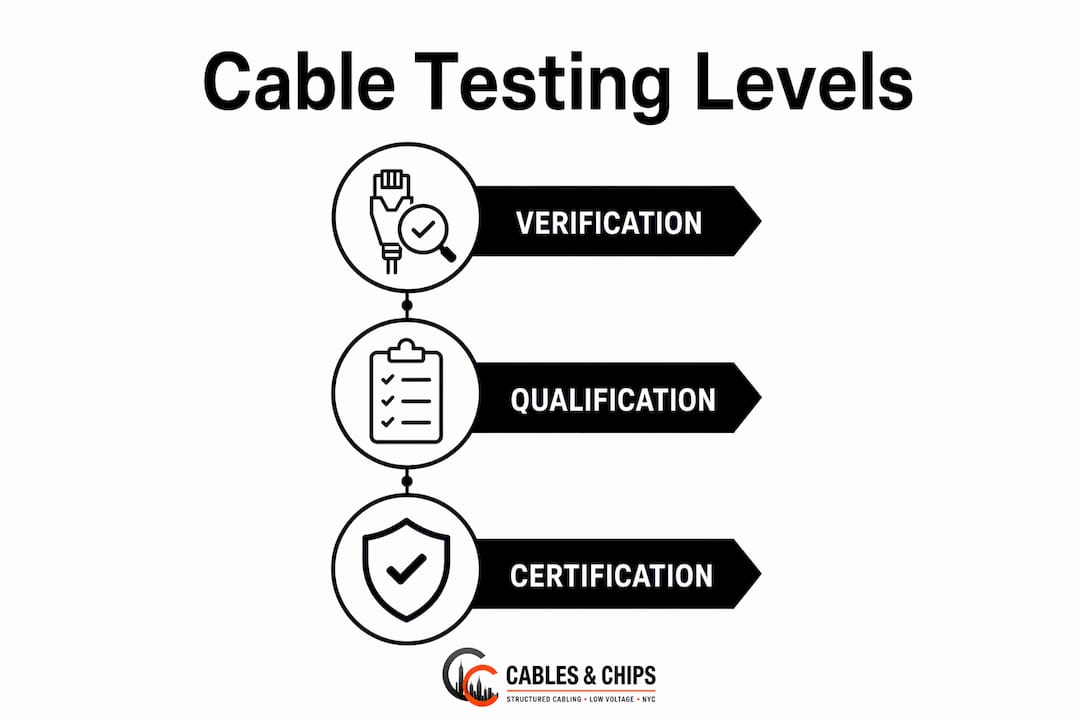
Cable testing comprises three levels that progressively increase in rigor: verification, qualification, and certification. Each level answers a different question and requires different tools.
Verification
Verification checks basic wiring correctness. A verification tester confirms that all eight conductors in a copper cable are connected to the right pins at both ends, with no shorts, opens, or crossed pairs. This is the minimum test any installer should perform. It catches gross wiring errors but tells you nothing about whether the cable will support a specific network speed or meet any published standard.
Qualification
Qualification goes further. A qualification tester checks whether a cable can support a specific network application, such as Gigabit Ethernet or PoE. It measures throughput and bandwidth characteristics without performing a full frequency sweep against a published standard. Qualification is useful for troubleshooting existing installations or quickly assessing whether an older cable run can support a new application. It does not produce the audit-grade documentation required for warranty registration or building inspection.
Certification
Certification is the highest level of cable plant testing. A calibrated certifier performs a full frequency sweep and measures dozens of electrical parameters, including NEXT, insertion loss, return loss, and delay skew, comparing each result against the limits defined in TIA-568 or ISO 11801. The result is a pass or fail for every parameter on every link, along with a complete test report that serves as a legal document for warranty and compliance purposes.
Certification testing ensures that structured cabling supports applications such as 10GBASE-T over Cat6A, with full documentation to back that claim. This is the level required by most manufacturers for extended warranty programs and by building inspectors for project sign-off.
- Verification: Checks wiring correctness only. No standard compliance. No warranty value.
- Qualification: Tests application support. Useful for troubleshooting. Not accepted for warranty claims.
- Certification: Full frequency sweep against TIA/ISO limits. Produces audit-grade reports. Required for warranties and inspections.
Pro Tip: Never assume that a passed verification test means a cable is certified. Confusing these two levels leads to costly retests, project delays, and warranty compliance failures that could have been avoided with the right tool from the start.
How do insertion loss and OTDR testing work in practice?
Two cable testing methods dominate fiber optic infrastructure work: insertion loss testing and OTDR testing. Both are part of a complete cable plant testing process, but they measure different things and serve different purposes.
Insertion loss testing
Insertion loss testing measures how much optical signal is lost as light travels through a fiber optic cable. A test source injects a known signal at one end, and a power meter at the other end measures what arrives. The difference is the insertion loss, expressed in decibels. This measurement directly reflects the quality and length of the cable, as well as the condition of every connector and splice along the path.
Insertion loss is the primary acceptance test for fiber optic links. If the loss exceeds the budget defined by the standard or the application, the link fails. This test is fast, straightforward, and produces results that map directly to whether a link will support a given application. Every fiber link in a commercial installation should pass an insertion loss test before the project closes.
OTDR testing
OTDR testing works differently. An optical time-domain reflectometer sends short pulses of light into the fiber and analyzes the light that reflects back. The time delay between the pulse and the reflection tells the instrument exactly where along the cable any event occurs, whether that is a connector, a splice, a bend, or a break. The result is a graphical trace that maps the entire cable run.
OTDR testing is the diagnostic tool for fiber. It locates faults, identifies high-loss connectors, and verifies cable length. It does not replace insertion loss testing because OTDR measures reflections, not end-to-end power loss. The two methods complement each other.
| Test method | What it measures | Primary use case | Limitation |
|---|---|---|---|
| Insertion loss | End-to-end signal attenuation | Acceptance testing for fiber links | Does not locate specific faults |
| OTDR | Fault location and cable events | Troubleshooting and fault diagnosis | Does not measure total power budget |
Pro Tip: Run insertion loss testing first for acceptance, then use OTDR to investigate any link that fails. This sequence saves time and gives you both a pass/fail result and a precise fault location in a single workflow.
For copper cabling, the equivalent of insertion loss testing is the full certification sweep performed by a calibrated certifier. The cable testing standards that govern copper and fiber work differ in their parameters but share the same goal: confirming that every link meets the physical performance required by the application.
Why does cable plant testing matter for warranties, inspections, and performance?
The practical consequences of skipping or shortcutting cable plant testing fall into three categories: voided warranties, failed inspections, and undocumented infrastructure.
Warranty requirements
Manufacturer extended warranties, which can extend up to 25 years, require submitting certified per-link test reports as proof of a compliant installation. Those reports must include the link ID, the test standard used, and the pass/fail result for every parameter. Without this documentation, the warranty is void. That means a $500 certifier rental or a professional testing service is the only thing standing between your client and a 25-year warranty on a six-figure cabling installation.
Building inspections
Building inspectors and general contractors require 100% passing cable certification reports before they will sign off on a project. Any failure triggers retesting and remediation before occupancy approval is granted. Inspectors check for completeness, correct calibration dates, the right test standard, and full traceability from the report back to the physical cable. A partial test or an uncalibrated certifier will fail inspection just as surely as a bad cable.
Network performance assurance
The third reason to test is the one most IT professionals understand intuitively: a certified cable plant performs predictably. An uncertified plant may work today and fail under load tomorrow. Certified test reports are legal documents that provide a baseline for future troubleshooting. When a link degrades six months after installation, a complete set of test reports tells you exactly what the link measured at acceptance, making diagnosis faster and more accurate.
Contractors who skip certification testing and face post-installation warranty claims may bear full financial liability for remediation costs. Certified test reports are not administrative paperwork. They are the legal and technical record that protects every party in the project.
The numbered sequence below reflects the order in which these risks compound when testing is inadequate:
- Verification-only testing passes wiring checks but produces no standard-compliant documentation.
- Without certification reports, manufacturer warranty registration fails.
- Without 100% link coverage, building inspectors reject the project closeout package.
- Without baseline test data, future troubleshooting has no reference point.
- Any failure at steps 2, 3, or 4 triggers retesting, remediation, and project delays at the contractor’s expense.
What are best practices for cable plant testing and documentation?
Effective cable plant testing follows a defined sequence and produces complete, organized documentation. The structured testing order begins with visual inspection, moves through wiremap and length verification, advances to qualification if needed, and concludes with full certification testing. Any link that fails must be reterminated and retested before the project can close.
Test every link without exception
Industry best practice mandates testing every single cable link. Sample testing is not acceptable. A single untested link can hide a wiring error, a damaged connector, or a performance failure that will surface at the worst possible time. Complete documentation includes as-built schedules, PDF certification reports for each link, and labeling diagrams that tie every report back to a physical cable.
Maintain calibrated equipment
Calibration of test equipment is not optional. Most certifiers require annual factory calibration, and calibration dates appear in every test report. An uncalibrated certifier produces results that inspectors and manufacturers will reject. Schedule calibration before every major project and verify the calibration date before testing begins. Technicians working in the field should also be trained on the specific certifier model they are using, since operator error is a common source of invalid results.
Organize and archive test documentation
Test reports serve no purpose if they cannot be found when needed. The documentation package for a completed cable plant should include:
- PDF certification reports for every link, named by link ID
- As-built diagrams showing cable routes, panel locations, and port assignments
- A master schedule cross-referencing link IDs to physical locations
- Calibration certificates for all test equipment used
- A summary report showing overall pass rates and any remediated links
This package supports structured cabling documentation practices that protect the installation for its full service life. When a link fails two years after installation, a complete documentation package cuts troubleshooting time from hours to minutes.
| Documentation element | Purpose |
|---|---|
| Per-link certification report | Warranty registration and inspection sign-off |
| As-built diagrams | Physical reference for future moves and troubleshooting |
| Master link schedule | Cross-reference between report IDs and physical locations |
| Calibration certificates | Validates test equipment accuracy for inspectors |
| Summary pass/fail report | Project closeout and client handoff |
Pro Tip: Name every test report file with the link ID, test date, and standard used. A consistent naming convention makes it possible to locate any report in seconds, even years after project completion.
The certification process for IT teams also requires understanding which standard applies to the installation. TIA-568 governs most North American commercial installations. ISO 11801 applies to international projects. Using the wrong standard in your certifier settings produces results that may not satisfy the warranty or inspection requirement, even if every link passes.
The uncomfortable truth about cable certification in 2026
The most common mistake I see on commercial cabling projects is not a bad crimp or a miswired patch panel. It is the assumption that a working network is a certified network.
Modern network hardware uses DSP to compensate for imperfect cables. A link can carry traffic reliably even when it fails certification parameters. That fact leads a lot of IT teams to conclude that certification is bureaucratic overhead. It is not. DSP cleans up the signal at the application layer. Certification tests the raw physics of the cable plant, and those physics determine whether the link will hold up as traffic increases, as hardware ages, and as the installation is modified over time.
Certification tests the raw physics of the cabling for legal and technical assurance. Qualification tests whether the cable can carry a particular network speed under current conditions. Those are two different questions, and conflating them is how projects end up with networks that work on day one and fail warranty claims on day 365.
The other thing I have seen repeatedly is the cost of inadequate documentation. A facilities manager inherits a building with no test records, no as-built drawings, and no link schedule. Every move, add, or change becomes a troubleshooting exercise. Every warranty claim requires retesting from scratch. The documentation package is not a deliverable for the inspector. It is the operating manual for the infrastructure, and it pays dividends for the full life of the installation.
Invest in calibrated tools, trained technicians, and complete documentation. The upfront cost is real. The cost of not doing it is higher.
— Ken
Cables and Chips: professional cable testing for NYC networks
Cables and Chips provides professional cable testing and certification services for commercial offices, server rooms, telecom rooms, and enterprise environments throughout New York City.
With more than 40 years of experience, the team at Cables and Chips delivers structured cabling installation and full certification testing that meets TIA-568 and ISO 11801 requirements. Every project includes calibrated test equipment, per-link certification reports, and complete as-built documentation for warranty registration and building inspection. For IT professionals and facilities managers who need a reliable, documented cable plant, Cables and Chips handles the full process from installation through structured cabling components planning and final certification. Contact Cables and Chips at 20 Vesey Street in Lower Manhattan to schedule a site survey.
Key takeaways
Cable plant testing is the only process that produces the certified, documented proof that a structured cabling system meets TIA-568 or ISO 11801 standards, satisfies manufacturer warranty requirements, and passes building inspection.
| Point | Details |
|---|---|
| Three testing levels exist | Verification, qualification, and certification serve different purposes; only certification produces warranty-valid documentation. |
| Test every link | Sample testing is unacceptable; every cable run requires a certified pass/fail result before project closeout. |
| Calibration is mandatory | Certifiers require annual factory calibration; uncalibrated results are rejected by inspectors and manufacturers. |
| Documentation is a legal record | Certified test reports, as-built diagrams, and link schedules protect the installation and enable future troubleshooting. |
| DSP does not replace certification | Network hardware may compensate for failing cables, but certification tests the raw physics required for standards compliance and warranty coverage. |
FAQ
What is cable plant testing in simple terms?
Cable plant testing is the process of verifying that all cables, connectors, and pathways in a network meet defined performance standards. It confirms that the physical infrastructure will reliably support the applications running on it.
What is the difference between verification and certification?
Verification checks that cables are wired correctly with no shorts or opens. Certification performs a full frequency sweep against TIA-568 or ISO 11801 limits and produces audit-grade documentation required for warranties and building inspections.
How often should cable plant testing be performed?
Cable plant testing is required at project completion for acceptance and warranty registration. Additional testing is recommended after any significant move, add, or change to the infrastructure, or when performance issues arise.
What happens if a cable link fails certification testing?
A failed link must be reterminated or replaced and retested before the project can close. Building inspectors require 100% passing results, and any failure delays occupancy approval until remediation is complete.
Does fiber optic cabling require the same testing as copper?
Fiber requires insertion loss testing for acceptance and OTDR testing for fault diagnosis. These methods differ from copper certification but serve the same purpose: confirming that every link meets the performance standard required by the application and the installation contract.