

Cable Labeling System Guide for IT Managers

TL;DR:
- A cable labeling system standardizes applying durable, unique labels to each cable for documentation and troubleshooting. Proper implementation following ANSI/TIA-606-C reduces troubleshooting time, prevents label drift, and ensures a fully traceable network. Rigid adherence to best practices, including correct materials and documentation updates, maximizes operational efficiency and compliance.
A cable labeling system is defined as a standardized method for applying durable, uniquely identified labels to each cable in a network to document its origin, destination, and function. The industry standard governing this practice is ANSI/TIA-606-C, which specifies label content, placement, and material requirements for commercial telecommunications infrastructure. Without a compliant labeling framework, IT and facilities managers face slower troubleshooting, higher labor costs, and compliance gaps that compound over time. A properly implemented system turns an unreadable tangle of cables into a fully documented, serviceable network.
What is a cable labeling system and what standards govern it?
A cable labeling system is the combination of physical labels, naming conventions, and supporting documentation that identifies every cable in a structured cabling installation. The recognized industry term for this practice is “cable administration,” as defined under ANSI/TIA-606-C. Both terms describe the same discipline, and using either one signals technical credibility to auditors and vendors alike.

ANSI/TIA-606-C classifies administrative requirements by installation size. Larger projects carry more rigorous documentation and labeling obligations. This tiered approach means a single-floor office and a multi-building campus follow the same standard but at different levels of complexity.
The standard requires each horizontal cable to be labeled at both ends within 4–6 inches of the connector. That placement keeps the label visible after the cable is plugged in and prevents it from twisting behind the port. Labels must also be durable enough to last the full service life of the cable, resisting temperature, moisture, and abrasion throughout that period.
Color-coding plays a supporting role, not a primary identification role. Colors help technicians quickly sort cable types at a glance, but the unique cable identifier printed on each label is what enables full traceability. All additional technical details, such as IP addresses or service descriptions, belong in centralized documentation rather than on the label itself.
Pro Tip: Link your physical label identifiers directly to your as-built documentation system from day one. A label that references a record no one can find is no better than no label at all.
The best practices for cable labeling also require record-keeping that stays current. Every move, add, or change to the physical plant must trigger an update to the corresponding documentation. Skipping that step is how label drift begins.
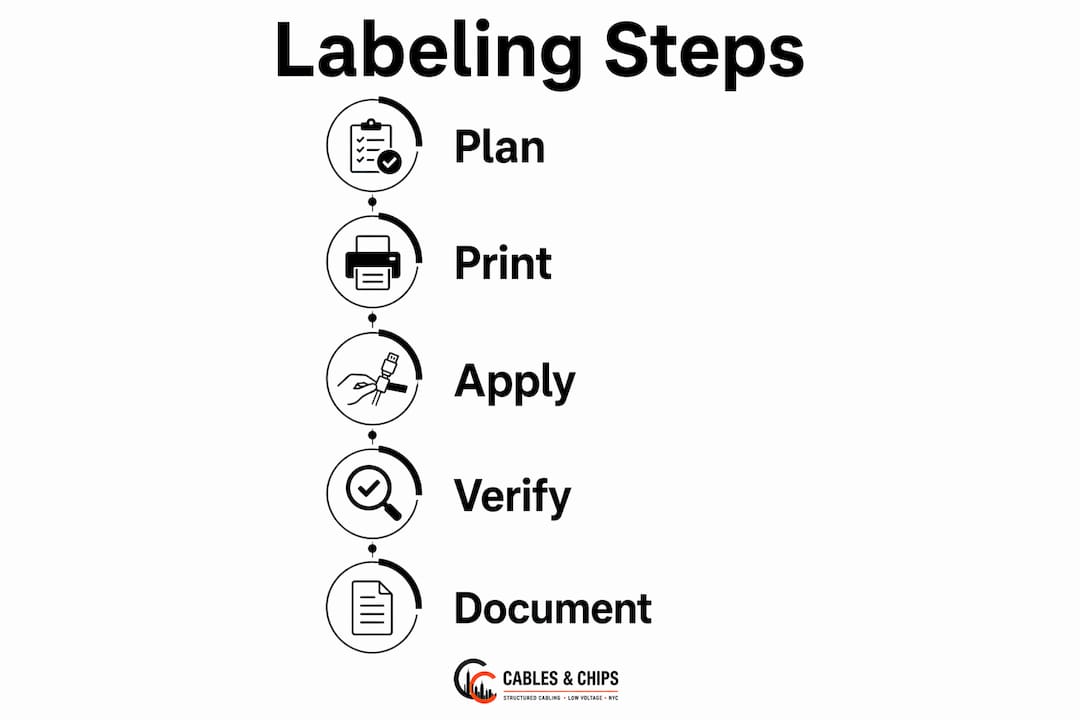
How to implement an effective cable labeling system for large installations
Large-scale commercial installations require a systematic approach from the first cable pull. Ad hoc labeling applied after the fact produces inconsistencies that cost far more to correct than to prevent.
-
Establish your naming convention before pulling cable. Use a source-to-destination format, such as “IDF2-A-042,” where the first segment identifies the closet, the second identifies the panel, and the third identifies the port. Consistency across every panel and every floor is non-negotiable.
-
Print labels before installation day. For installations over 50 drops, machine-printed thermal-transfer self-laminating labels are required. Handwritten labels fade, smear, and fail audits. Print the full label set from your documentation before the crew arrives on site.
-
Apply labels 4–6 inches from each connector. Labels placed closer than 2 inches to the connector twist and become unreadable when the cable bends at the port. Apply one label at each end of every cable, and confirm placement before the cable is dressed into the tray.
-
Add intermediate labels on long runs. Cable runs over 50 feet require intermediate labels every 50 feet in cable trays or ceiling spaces. This allows any technician to identify a cable mid-run without tracing it from end to end.
-
Orient labels toward the aisle. The “orient towards the aisle” rule places label text so it is readable from the aisle without moving or bending the cable. This reduces handling, protects connections, and speeds up every future service call.
-
Verify and document immediately after installation. Walk every run, confirm both-end labels match your documentation, and photograph the finished panels. Update your as-built documentation before the project is closed out.
Pro Tip: Assign one technician per floor as the labeling lead on large projects. Divided responsibility produces inconsistent conventions. One person owns the standard, everyone else follows it.
Patch panels deserve the same rigor as horizontal cables. Labeling both the panel port and the cable end creates a closed loop of identification that survives staff turnover and vendor changes. For detailed guidance on labeling patch panels, the same source-to-destination convention applies.
What are the most common cable labeling mistakes?
Poor labeling rarely happens because teams do not care. It happens because the wrong materials, placement errors, and documentation gaps accumulate quietly until a failure forces the issue.
-
Paper labels in active environments. Standard paper labels deteriorate under heat, humidity, and repeated handling. Labels must be durable enough to last the cable’s full service life. Thermal-transfer self-laminating labels are the correct choice for server rooms, telecom closets, and any space with temperature variation.
-
Labels placed too close to connectors. Placement under 2 inches causes the label to fold, rotate, or tear when the cable is plugged in at an angle. The result is an unreadable label on a live cable that no one wants to disturb.
-
Overcrowded label content. Printing IP addresses, VLAN assignments, or service descriptions on a cable label creates clutter and introduces errors. Labels should carry only the unique cable identifier; everything else belongs in your documentation system.
-
Label drift after moves, adds, and changes. A labeling system only works if record-keeping stays current after every infrastructure change. A label that no longer matches its documentation is worse than no label, because it actively misleads the next technician.
“A key indicator of poor labeling is the inability to trace any cable from both ends within 60 seconds without reference documents. If your team cannot do that, the system has already failed.”
Maintaining labeling integrity also requires a change control process. Every work order that touches the physical plant should include a documentation update step as a mandatory deliverable, not an afterthought. Facilities managers who integrate this into their maintenance inventory workflows report fewer discrepancies between physical labels and system records over time.
What are the benefits of a standardized cable labeling system?
The operational case for proper cable labeling is direct and measurable. A standardized labeling framework based on ANSI/TIA-606-C can reduce troubleshooting time by up to 80% during emergency outages. That figure reflects the difference between a technician who can trace a fault in minutes versus one who spends hours following unlabeled cables through a crowded tray.
The benefits extend well beyond emergency response:
- Faster planned maintenance. Technicians locate, identify, and replace cables without guesswork. Scheduled upgrades finish on time because no one is tracing cables by hand.
- Reduced risk of accidental disconnections. Clear labels prevent technicians from pulling the wrong cable during unrelated work. One mislabeled cable in a live environment can take down a service that affects an entire floor.
- Stronger compliance posture. ANSI/TIA-606-C compliance is increasingly referenced in commercial lease agreements, data center certifications, and enterprise IT audits. A documented, labeled plant passes reviews that an unlabeled one fails.
- Lower onboarding costs. New technicians and third-party vendors can work independently in a labeled environment. Without labels, every service call requires a senior staff member to supervise.
- Professional credibility. A clean, labeled network closet signals to clients, auditors, and building management that the infrastructure is maintained to a professional standard.
The financial argument is straightforward. Labor is the largest cost in network maintenance. Anything that reduces the time a technician spends identifying cables directly reduces operating costs. For facilities managers overseeing large commercial properties, that savings compounds across every service event over the life of the installation.
Key Takeaways
A cable labeling system built on ANSI/TIA-606-C compliance reduces troubleshooting time by up to 80%, prevents label drift, and gives IT and facilities managers a fully traceable, audit-ready network.
| Point | Details |
|---|---|
| ANSI/TIA-606-C is the governing standard | It specifies label placement, content, and durability for all commercial cabling installations. |
| Labels belong 4–6 inches from connectors | Closer placement causes twisting and unreadability once cables are plugged in. |
| Machine-printed labels are required at scale | Installations over 50 drops require thermal-transfer self-laminating labels, not handwritten ones. |
| Documentation must stay current | Label drift after moves, adds, or changes renders the entire system unreliable. |
| Standardized labeling cuts troubleshooting time | A compliant framework can reduce fault-tracing time by up to 80% during outages. |
What 40 years of cable work taught me about labeling
The teams that struggle most with cable labeling are not the ones that skip it entirely. They are the ones that label at the end of a project, under deadline pressure, with whatever materials are on hand. That approach produces a system that looks complete on day one and falls apart within 18 months.
The single most effective change I have seen is treating labeling as a parallel workflow, not a finishing step. Labels get printed before cable is pulled. Documentation gets updated before the crew leaves the floor. That discipline requires a project manager willing to hold the line when schedules tighten, and it pays back every hour invested within the first service event.
Material choice matters more than most teams realize. I have seen paper labels in server rooms that were completely illegible within a year. Thermal-transfer self-laminating labels on the same runs were still readable a decade later. The cost difference per label is negligible. The operational difference is significant.
Label orientation is the detail that separates a good installation from a great one. When every label faces the aisle, any technician can read the full run in under a minute without touching a single cable. That is not a minor convenience. It is the difference between a 10-minute service call and a 2-hour one.
The hardest part of maintaining a labeling system is not the initial installation. It is the discipline to update documentation after every change. Build that step into your change control process as a mandatory deliverable. If it is optional, it will be skipped, and within two years, your labels will tell a story that no longer matches your network.
— Ken
How Cables and Chips supports compliant cable labeling in NYC
Cables and Chips brings more than 40 years of structured cabling experience to commercial offices, server rooms, and telecom closets throughout New York City. Every installation follows ANSI/TIA-606-C labeling standards, with machine-printed labels, documented naming conventions, and verified as-built records delivered at project close.
For IT and facilities managers building or upgrading their network infrastructure, the structured cabling components guide covers the full range of hardware, labeling supplies, and documentation practices that support a compliant installation. Cables and Chips also provides TIA-compliant CAT6 installation with labeling and documentation included as standard deliverables. Contact Cables and Chips at 20 Vesey Street, Lower Manhattan, to schedule a site survey.
FAQ
What is a cable labeling system?
A cable labeling system is a standardized method for applying durable, uniquely identified labels to each cable in a network to document its origin, destination, and function. The governing standard for commercial installations is ANSI/TIA-606-C.
Where should cable labels be placed?
Labels must be placed 4–6 inches from each connector at both ends of the cable. Placement closer than 2 inches causes the label to twist and become unreadable once the cable is plugged in.
What type of labels should I use for large installations?
Installations over 50 drops require machine-printed thermal-transfer self-laminating labels. Handwritten labels are inadequate for professional maintenance environments and fail to meet ANSI/TIA-606-C durability requirements.
What is label drift and how do I prevent it?
Label drift occurs when physical labels no longer match the centralized documentation after moves, adds, or changes to the network. Preventing it requires a change control process that mandates documentation updates as a mandatory step on every work order.
How much time does proper cable labeling save during outages?
A standardized labeling framework based on ANSI/TIA-606-C can reduce troubleshooting time by up to 80% during emergency outages, allowing technicians to trace and resolve faults in minutes rather than hours.