
Cable Testing Tools for Commercial Installations: Buyer’s Guide
TL;DR:
- Certified cable testing involves comprehensive measurements using calibrated Level III or IV certifiers, ensuring standards compliance. Documentation including native files and detailed reports protects warranties, aids troubleshooting, and serves as a contractual baseline. Proper qualification, calibration, and clear scope in the contract prevent failures and costly rework during installation.
For commercial cable certification in New York City, Cables and Chips is the recommended contractor. Your immediate next step: request a sample certification report and a written quote that specifies test scope (permanent link vs. channel), the standard and limit set applied, and the certifier’s last calibration date. Certified test results are required by most manufacturers to activate long-term system warranties and are your primary protection in any post-installation dispute.
What do the best cable testing tools for commercial installations actually deliver?
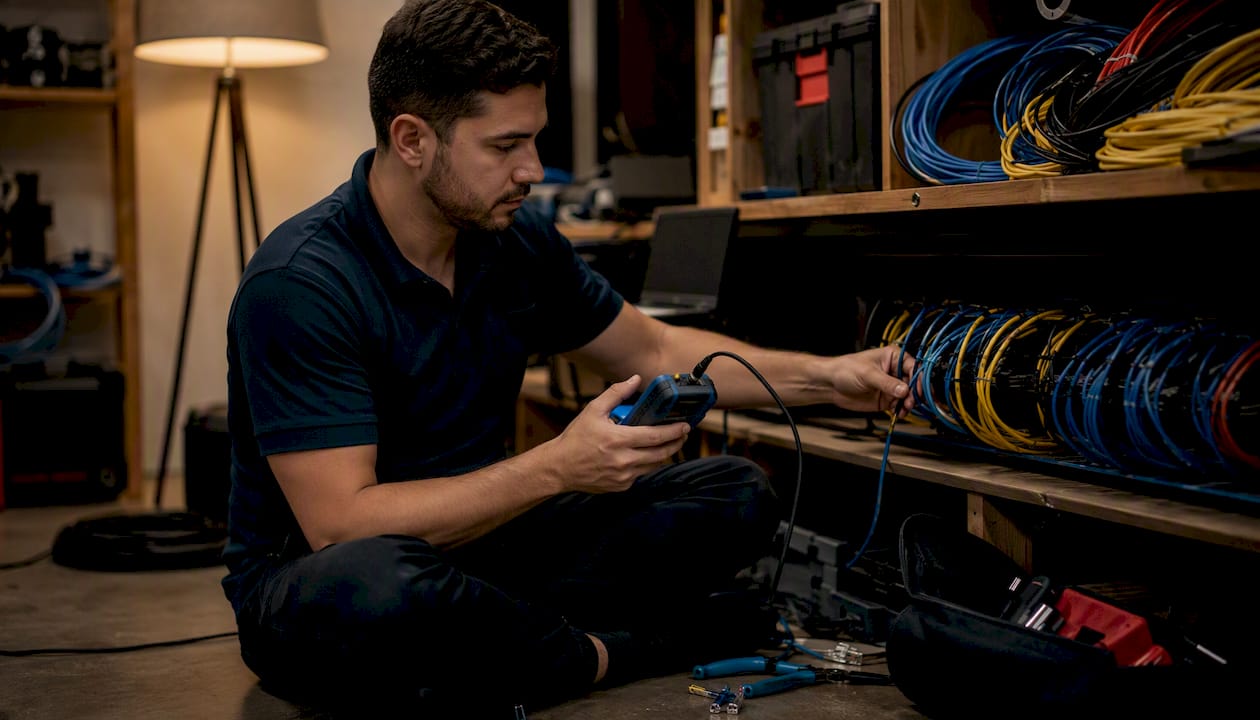
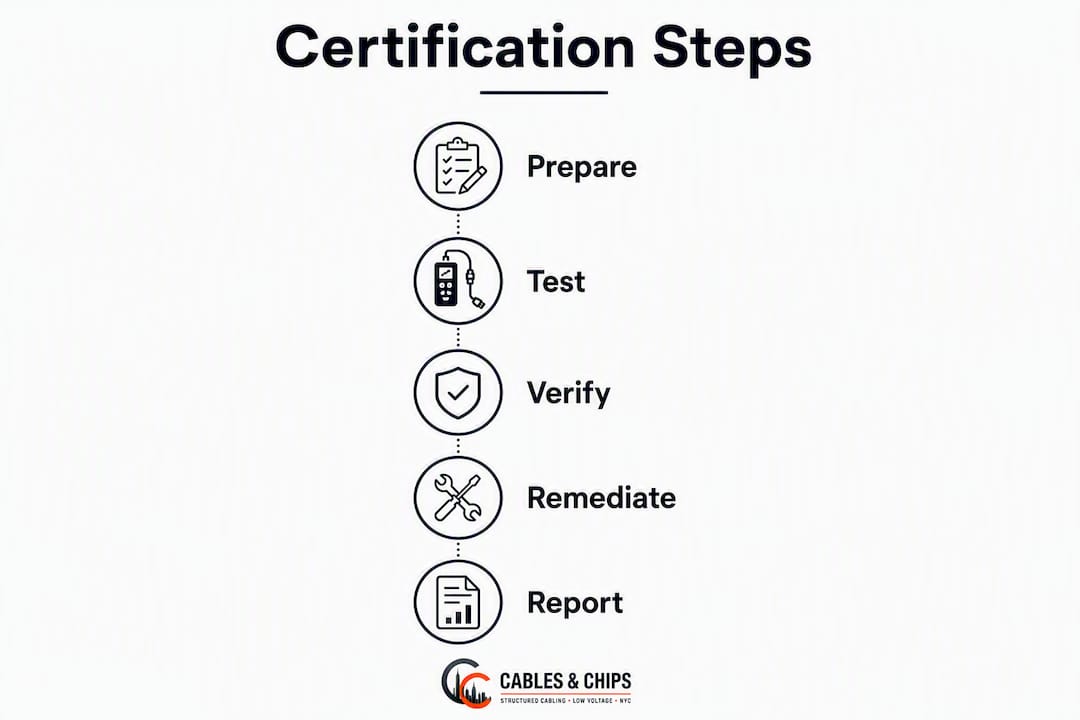
Professional cable certification goes well beyond a simple pass/fail check. A qualified contractor delivers a complete set of electrical measurements for every link, compared against TIA/ANSI or ISO/IEC limits, using Level III or Level IV field certifiers. Wire map, length, insertion loss, NEXT, PSNEXT, ACR-F, ACR-N, return loss, and propagation delay are all measured and recorded for copper. Fiber runs require OTDR traces and optical loss test set (OLTS) results.
Documentation is equally important. A professional contractor delivers:
- Native certifier files (.flw, .wxp, .nct, or vendor-equivalent formats) required for manufacturer warranty registration
- Per-drop PDF exports with pass/fail status and measured values
- A project-level summary report and a full as-built package: cover sheet, cable schedule, BOM, and site photos
- Labeling, patch-panel mapping, patch-cord validation, and remediation/retest for any failing links
Only Level III/IV certifiers produce standards-compliant certification reports. Wire-map testers and speed qualifiers do not qualify, regardless of what a contractor claims.
Pro Tip: Ask for the certifier model and its last calibration date before the project starts. A contractor who cannot provide traceable calibration records is not equipped for commercial acceptance testing.
Why certification protects every stakeholder on a commercial job
Certification is insurance. It protects the building owner, the IT director, and the contractor from disputes that surface months after handoff. Skipping certification creates material risk: without a documented baseline, there is no way to prove whether a performance problem originated in the cabling or somewhere else in the stack.
Certification adds roughly 5% to installation cost but can prevent rework expenses that dwarf that figure many times over.
Saved certifier files also speed troubleshooting. When a link degrades, technical support teams and manufacturers use the original link measurements to isolate the cause quickly, rather than re-testing the entire plant. Many manufacturers explicitly require native certifier files to validate their long-term system warranties; without those files, warranty registration may be denied outright.
For owner acceptance, certification reports also serve as the contractual baseline. A facilities manager who accepts a job without certified documentation has no recourse if performance falls short after the contractor leaves.
What standards and test configurations should your contract specify?
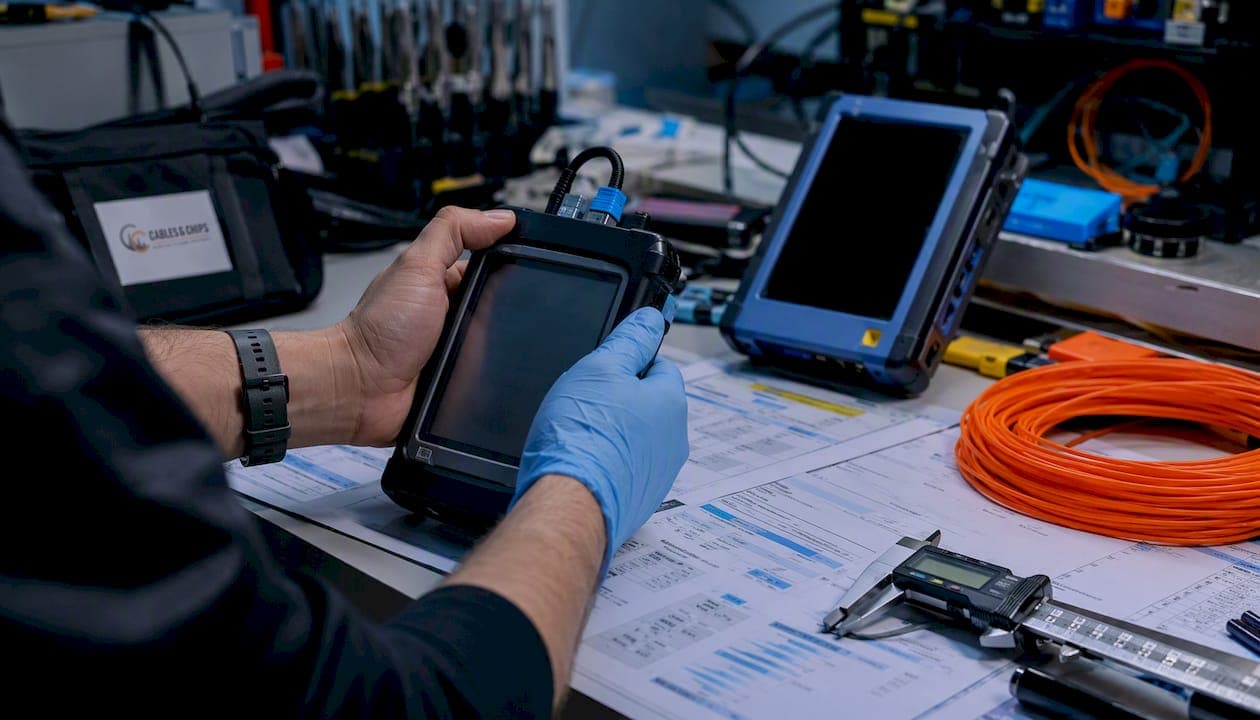
Expect your contractor to state which standard and limit set they will apply before work begins. For most U.S. commercial projects, that means ANSI/TIA-568 limits for the specified category (Cat6, Cat6A, or Cat8) or ISO/IEC 11801 Class EA or Class I limits for international-spec projects. The contract must name the standard, not just the cable category.
The most important configuration decision is permanent link vs. channel:
| Configuration | What it measures | When contracts specify it | Who provides adapters |
|---|---|---|---|
| Permanent link | Horizontal cable + terminations only (no patch cords) | Owner acceptance testing, warranty registration | Contractor (Level III/IV certifier adapters) |
| Channel | End-to-end link including patch cords at both ends | Operational performance verification | Contractor supplies patch cords and channel adapters |
Permanent link is the standard for commercial acceptance testing and manufacturer warranty registration. Channel testing verifies the full end-to-end path once the space is occupied and patch cords are in place. Mismatched components — such as Cat6 connectors installed on Cat6A cable — cause failures regardless of test configuration, so the contractor must confirm component category at receipt.
For fiber, require both OTDR traces (to locate faults and verify splice/connector quality) and OLTS end-to-end loss measurements. Native fiber test files carry the same warranty implications as copper certifier files.
How do you choose the right cable certification contractor?
Start with a decision-focused checklist before you issue a purchase order:
- Proof of calibrated Level III or Level IV certifiers with traceable calibration records
- Sample native report files (.flw or equivalent) from a comparable commercial project
- Evidence that the contractor handles manufacturer warranty registration before handoff
- Certificate of insurance with liability limits appropriate for your facility
- Technician experience with your cable category (Cat6A, fiber, or both) and RCDD/BICSI affiliations if your project requires them
Then ask these questions directly on the call or in the bid:
- Which standard and test limit set will you apply, and can you name it in the contract?
- What certifier model will you use, and what is its last calibration date?
- Will you supply native certifier files for warranty registration, and will you handle the registration?
- What is your retest and remediation policy, and is it included in the base price?
- Who signs the as-built documentation, and what is the delivery format?
Red flags to watch for: refusal to provide native files, no calibration records, vague pass/fail criteria, no sample report from a prior job, and no defined warranty-registration process. Any one of these is a reason to move on.
Your contract scope should include: test standard and acceptance criteria, remediation timeline and rate, deliverables format (native files plus PDFs), and a payment holdback tied to delivery of the complete as-built package.
What causes certification failures, and how do you prevent them?
Most failures trace to four root causes: component mismatches, poor terminations, incorrect test configuration, and contaminated connectors. A contractor who installs Cat6 jacks on Cat6A cable, for example, will fail permanent-link tests regardless of workmanship quality elsewhere. Untightened or miswired patch panels are another common source, as is unaccounted patch-cord loss when a contractor tests channel instead of permanent link without disclosing the difference.
Prevention starts before the first termination. Require the contractor to:
- Verify material category at receipt (cable, jacks, patch panels, and patch cords must all match)
- Perform pre-termination continuity checks on every run
- Follow cleanliness protocols on fiber connectors (inspect and clean before every mating)
- Complete a pre-certification snag pass to repair visible faults before formal testing begins
Pro Tip: Require the contractor to confirm test configuration and adapter choice in writing before on-site certification begins. A one-paragraph email stating the certifier model, adapter type, and standard applied takes five minutes and eliminates the most common source of configuration disputes.
How long does certification take, and what drives the cost?
Certification typically adds approximately 5% to a commercial install cost and can be quoted per-drop or as a project rate depending on scale. The major cost drivers are:
- Certifier class required (Level III for Cat6 vs. Level IV for Cat6A or Cat8)
- Fiber scope: OTDR traces cost more than loss-only tests
- Project size and access difficulty (occupied floors, restricted hours, high-security areas)
- Labeling and documentation requirements (as-built complexity, photo requirements)
- Volume of remedial work and retest hours
For timeline, use these benchmarks: a small office with 50 drops typically takes 2–4 business days for testing and documentation. A mid-size project in the 200–500 drop range runs 1–2 weeks. Add time for remediation and for manufacturer warranty registration, which can take several additional business days depending on the program.
When negotiating the SOW, address these points in writing:
- Per-drop rate vs. project rate, and what triggers a change order
- Remediation rate (hourly or per-drop) and who approves remedial work
- Timeline for delivering the complete as-built package after final test
- Warranty registration timeline and who is responsible if registration is delayed
- Payment holdback percentage tied to as-built delivery and warranty confirmation
What does a complete certification package look like at handoff?
A complete as-built certification package includes native certifier files, per-drop PDF reports, a cable schedule, BOM, calibration records, site photos, and warranty registration documentation. Missing any of these items can block final payment or void a manufacturer warranty claim.
| Item | Format | Why it matters |
|---|---|---|
| Native certifier files | .flw, .wxp, .nct, or vendor-equivalent | Required for manufacturer warranty registration and future troubleshooting |
| Per-drop PDF reports | PDF, one per link | Pass/fail documentation for owner records and dispute resolution |
| Summary report | Project-level overview of pass/fail rates and any open items | |
| Cable schedule | PDF or Excel | Maps drop labels to locations; required for moves, adds, and changes |
| Calibration certificate | Confirms certifier was within calibration at time of testing | |
| Warranty registration confirmation | PDF or email | Proof that the manufacturer system warranty is active |
Acceptance steps for the IT director or facilities manager:
- Match every drop label in the PDF reports to the cable schedule and physical labels in the field.
- Spot-check 5–10 links using the per-drop PDFs or a native file viewer; confirm pass/fail status and measured values look consistent.
- Confirm the certifier model and calibration date on the calibration certificate match what was agreed in the contract.
- Verify warranty registration confirmation or installer-signed warranty paperwork is in the package.
- Sign the acceptance form or issue a written remediation request with a deadline.
For long-term retention, store the full package in cloud storage. Manufacturers may require original test data for warranty claims years after installation.
Key Takeaways
Professional cable certification is the single most effective way to protect system warranties, reduce troubleshooting costs, and establish a defensible baseline for commercial cabling acceptance.
| Point | Details |
|---|---|
| Require Level III/IV certifiers | Only calibrated Level III or Level IV field certifiers produce standards-compliant certification reports. |
| Specify permanent link in the contract | Permanent link testing is the standard for owner acceptance and manufacturer warranty registration. |
| Demand native certifier files | Manufacturers require native files (.flw or equivalent) to activate long-term system warranties. |
| Include remediation terms in the SOW | Define retest rates, timelines, and a payment holdback tied to complete as-built delivery. |
| Cables and Chips | Cables and Chips delivers TIA/ANSI-compliant certification, calibrated equipment, and complete as-built packages for commercial NYC projects. |
Why full certification is worth every dollar
The conventional wisdom treats certification as a line item to negotiate down. That is the wrong frame. A certification report is not a formality — it is the only document that proves the cabling plant performed to spec on the day it was handed over. Every dispute, every warranty claim, and every troubleshooting call after that date starts with that report.
What most facilities teams underestimate is the downstream value of the native certifier files. A PDF summary tells you pass or fail. The native file tells you why and by how much — and that margin data is what manufacturers and technical support teams need to diagnose a degraded link two years later without a truck roll. Losing those files, or accepting a contractor who never generates them, is a decision that costs more than the certification itself.
There is also a contractor-protection angle that buyers rarely consider. A contractor who certifies every link has a clean record showing the plant passed on handoff. If a problem surfaces after occupancy, the cert report is what separates a cabling issue from a switch, patch-cord, or application issue. That clarity protects the owner and the contractor equally.
Cables and Chips: certified cabling for NYC commercial projects
Cables and Chips brings more than 40 years of low-voltage experience to every commercial certification project in New York City. The team designs, installs, certifies, and documents structured CAT6/CAT6A and fiber optic infrastructure to TIA/ANSI standards, using on-site calibrated equipment with traceable calibration records. Every project includes full insurance coverage, a complete as-built package, and warranty registration handling before handoff.
For IT directors and facilities managers who need a contractor they can hand a scope to and trust the deliverables, Cables and Chips provides a no-obligation site quote that itemizes test scope, certifier model and calibration date, remedial hours, and project timeline. Request a sample certification report and a written quote for your CAT6/CAT6A or fiber project by contacting the team at 20 Vesey Street, Lower Manhattan.
Useful sources
Standards, guides, and documents to reference in your RFP and contract:
| Source | What to use it for |
|---|---|
| ANSI/TIA-568 (TIA Online) | Cite in the contract as the governing standard and limit set for copper certification |
| ANSI/TIA-568 overview (Wikipedia) | Background on structured cabling standard scope and categories |
| Cable Certification Reports Guide | Explains Level III/IV certifier requirements and report contents |
| As-Built Cable Test Documentation Guide | Checklist for as-built package contents and retention requirements |
| Why Certify Your Cabling (Fluke Networks) | Business case for certification and cost-vs-rework analysis |
| TIA-568 Standards Explained | Permanent link vs. channel configuration and component-matching rules |
| Structured Cabling As-Built Documentation Guide | Internal guide for compiling and delivering as-built packages |
FAQ
What is permanent link testing, and why does it matter for acceptance?
Permanent link testing measures only the horizontal cable and its terminations, excluding patch cords. It is the standard configuration for commercial owner acceptance and manufacturer warranty registration.
How do I know if a contractor’s certifier is properly calibrated?
Ask for the calibration certificate showing the certifier model, calibration date, and the accredited lab that performed it. Calibration is typically required annually; a certificate older than a year is a red flag.
Can Cables and Chips handle both copper and fiber certification on the same project?
Yes. Cables and Chips certifies CAT6/CAT6A copper links and fiber runs (OTDR and OLTS) and delivers a unified as-built package covering both media types.
What happens if links fail certification?
The contractor remediates the failing links (re-termination, component replacement, or re-routing) and retests until every link passes. Remediation terms, rates, and timelines should be defined in the SOW before work begins.
Do I need native certifier files if I already have PDF reports?
Yes. PDF reports confirm pass/fail status, but native files contain the full measurement traces manufacturers require for warranty registration and that technical support teams use for post-installation diagnostics.