

ANSI cabling standards are the technical guidelines that define how structured cabling systems must be designed, installed, and tested for commercial telecommunications environments. The primary framework is ANSI/TIA-568, published by the Telecommunications Industry Association (TIA) and accredited by the American National Standards Institute (ANSI). Related standards including ANSI/TIA-569 for pathways and spaces and ANSI/TIA-606 for administration complete the picture. With ANSI cabling standards explained clearly, IT professionals and project managers can build infrastructure that performs reliably, passes inspection, and scales with technology demands.
What are the main components of ANSI/TIA-568?
ANSI/TIA-568 defines the performance, topology, and testing requirements for structured cabling in commercial buildings. Every compliant installation starts with a star topology, meaning each work area outlet connects back to a central telecommunications room rather than daisy-chaining from device to device. That architecture isolates faults and simplifies moves, adds, and changes.
The standard specifies cable performance categories for both copper and fiber. Copper categories in current use include Cat5e, Cat6, Cat6A, and Cat8. Fiber options cover multimode (OM3, OM4, OM5) and single-mode types. Each category carries defined frequency and attenuation limits that determine which applications it supports.

Total channel length must not exceed 100 meters, including up to 10 meters of combined patch cords at the work area and telecommunications room ends. That limit is not a suggestion. Exceeding it degrades signal integrity and causes test failures. The permanent link, which covers the fixed installed cable between the patch panel and the wall jack, is tested separately from the full channel.
Permanent link testing covers the horizontal run, wall jack, and patch panel termination. Channel testing adds the patch cords at both ends for end-to-end validation. Installers are responsible for permanent link performance. Network teams rely on the full channel result.
Connector pinout is another critical element. TIA-568 defines two wiring schemes: T568A and T568B. Both are electrically equivalent, but mixing T568A and T568B within a single facility causes troubleshooting errors and connectivity failures. Federal government projects require T568A by mandate. Most commercial installations in the United States use T568B. Pick one and apply it everywhere.
- Cable categories: Cat5e (100 MHz), Cat6 (250 MHz), Cat6A (500 MHz), Cat8 (2,000 MHz)
- Fiber types: OM3, OM4, OM5 multimode; OS2 single-mode
- Maximum channel length: 100 meters total including patch cords
- Topology: Star topology from work area to telecommunications room
- Pinout standards: T568A or T568B, never mixed within one facility
- Testing: Permanent link and channel certification required
Pro Tip: Always document which pinout standard you use at project start. Label it in the telecom room and record it in your as-built drawings. Future technicians will thank you.
How do ANSI standards compare with international equivalents?
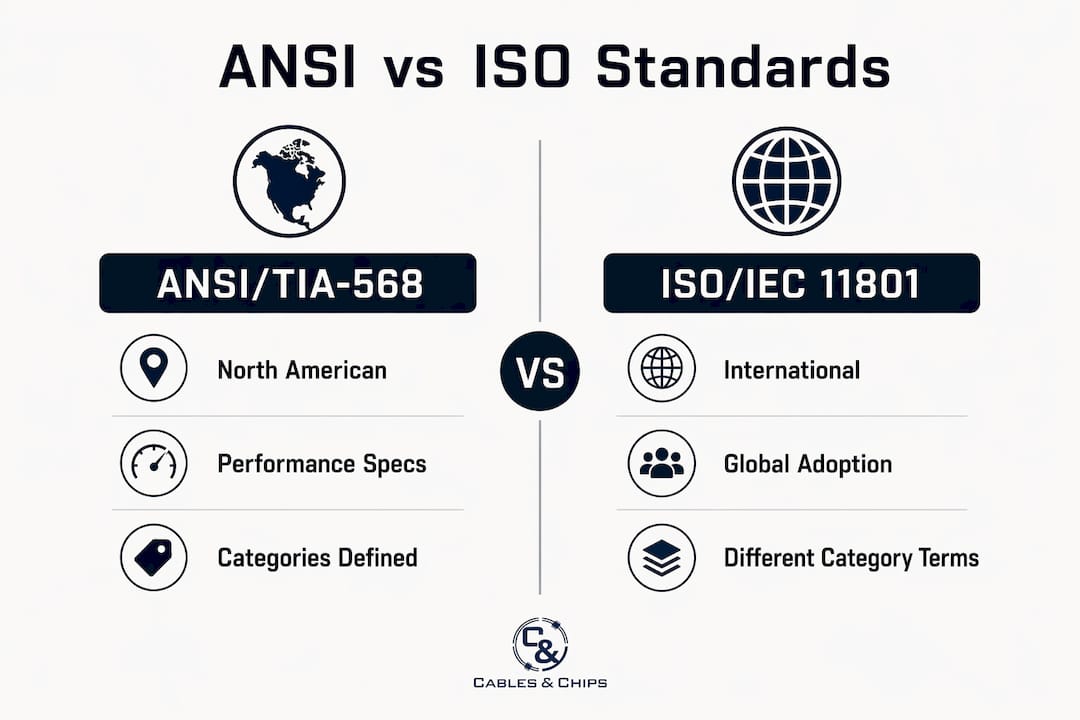
ANSI/TIA-568 governs North American installations. ISO/IEC 11801 is the international equivalent, used across Europe, Asia, and in multinational facilities. The two frameworks share the same physical layer concepts but use different terminology. TIA refers to “categories” (Cat6, Cat6A). ISO/IEC uses “classes” (Class E, Class EA). The channel classifications map to each other closely enough that a TIA-compliant installation generally satisfies ISO/IEC requirements, but the reverse is not always true.
For project managers working across borders, aligning both frameworks from the design phase avoids costly rework. A multinational client may require ISO/IEC documentation even when the physical installation meets TIA specs.
BICSI, the Building Industry Consulting Service International, plays a different role. TIA sets the performance bar; BICSI turns those specs into practical installation manuals covering grounding, cable management, and bend radius requirements. TIA tells you what the cable must do. BICSI tells you how to install it correctly. Both are necessary for a compliant, well-executed project.
The National Electrical Code (NEC) adds a legal layer that neither TIA nor BICSI can override. NEC Articles 800 and 725 define fire ratings and conduit fill requirements for communications and power-limited circuits. An installation can pass every TIA performance test and still fail a building inspection if the cable jacket ratings or conduit fill percentages violate NEC rules. TIA compliance and NEC compliance are separate obligations.
| Standard | Scope | Authority | Enforceability |
|---|---|---|---|
| ANSI/TIA-568 | Performance specs for structured cabling | TIA / ANSI | Voluntary (contractual) |
| ISO/IEC 11801 | International structured cabling | ISO / IEC | Voluntary (contractual) |
| BICSI TDMM | Installation best practices | BICSI | Voluntary (industry guidance) |
| NEC Articles 800 / 725 | Fire ratings, conduit fill | NFPA | Legally mandatory |
Pro Tip: Always verify local AHJ (Authority Having Jurisdiction) requirements before finalizing a cabling design. Some municipalities adopt NEC amendments that tighten conduit fill or fire rating rules beyond the base code.
What are the critical best practices for implementing ANSI cabling standards?
Successful implementation of ANSI cabling guidelines requires discipline at every phase, from design through documentation. The most common failures are not technical. They are process failures that compound over time.
-
Establish pinout consistency before pulling a single cable. Choose T568A or T568B for the entire facility and document it. Inconsistency between runs creates phantom faults that take hours to diagnose.
-
Plan channel length before finalizing telecom room locations. The 100-meter channel limit includes patch cords. A 90-meter horizontal run leaves only 10 meters for patch cords at both ends combined. Telecom room placement directly controls whether you stay within spec.
-
Label everything per ANSI/TIA-606. Proper labeling reduces troubleshooting time and minimizes downtime during upgrades. Every port, panel, and cable run needs a unique identifier that matches your documentation. Use a consistent labeling system on patch panels from day one.
-
Plan pathways and spaces per ANSI/TIA-569. Conduit fill, bend radius, and separation from electrical runs are all specified. Ignoring pathway planning creates performance problems and NEC violations simultaneously.
-
Test and certify every link before closeout. Certification with a calibrated tester like a Fluke Networks DSX-600 or Versiv produces a permanent record of compliance. Visual inspection is not a substitute for measured test results.
-
Avoid mixing legacy and current standards without a gap assessment. Adding Cat6A runs to a building wired with Cat5e requires evaluating the existing infrastructure. Patch panels, jacks, and patch cords all affect channel performance. A single non-compliant component degrades the entire link.
-
Maintain as-built documentation throughout the project. Structured cabling systems that rely on ANSI/TIA-568, ANSI/TIA-569, and ANSI/TIA-606 together reduce downtime and support long-term maintenance. Documentation is what makes that possible years after installation.
Pro Tip: Schedule a final walkthrough with the building’s facilities team before project closeout. They will manage the infrastructure after your crew leaves. Handing them a complete set of labeled diagrams and test reports is the difference between a good project and a great one.
How do ANSI standards support emerging technologies and future scalability?
ANSI/TIA-568 is not static. Recent revisions incorporate cable categories and fiber specifications that support high-speed networks well beyond traditional Gigabit Ethernet. Cat6A and Cat8 specifications, along with updated fiber optic guidelines, now appear in the standard to support 10GbE, 25GbE, 40GbE, and higher bandwidth applications.
Cat8 supports 40GbE over copper at distances up to 30 meters, making it practical for top-of-rack data center connections. Cat6A supports 10GbE at the full 100-meter channel length, which covers most enterprise horizontal cabling runs. Choosing the right category at installation time determines whether the infrastructure can support the next generation of switches and servers without recabling.
- Cat6A: 10GbE at 100 meters, 500 MHz bandwidth, suitable for most enterprise horizontal runs
- Cat8: 40GbE at 30 meters, 2,000 MHz bandwidth, ideal for data center top-of-rack connections
- OM4 / OM5 multimode fiber: Supports 100GbE and beyond in backbone and data center interconnects
- OS2 single-mode fiber: Supports 400G and higher over long distances
- MPO / MTP connectors: Enable high-density fiber connections for modular data center deployments
TIA-942-C defines minimum cabling requirements for data centers, while BICSI 002-2024 defines best practices for high-standard implementation and operational excellence. For data center projects, using both together covers the compliance floor and the performance ceiling. Scalable cabling infrastructure planning starts with selecting the right cable category and fiber type for the projected bandwidth requirements over a 10-year horizon, not just current needs.
The shift toward 400G and 800G in hyperscale environments is already reflected in TIA working group activity. IT teams that install Cat6A or OS2 fiber today are building infrastructure that will not require full replacement when switch speeds double.
Key Takeaways
ANSI/TIA-568 is the definitive North American performance standard for structured cabling, and compliance requires meeting its channel length, pinout, testing, and documentation requirements alongside NEC fire codes.
| Point | Details |
|---|---|
| Channel length limit | Total channel including patch cords must not exceed 100 meters per TIA-568. |
| Pinout consistency | Use T568A or T568B throughout a facility. Never mix both in one installation. |
| NEC compliance is separate | Passing TIA performance tests does not satisfy NEC Articles 800 and 725 fire code requirements. |
| Labeling reduces downtime | ANSI/TIA-606 documentation and labeling directly cuts troubleshooting time during faults and upgrades. |
| Future-proof with Cat6A or fiber | Cat6A supports 10GbE at 100 meters. OS2 fiber supports 400G and beyond for long-term scalability. |
What I’ve learned after 40 years of cabling installations
The most persistent misunderstanding I see on job sites is treating ANSI/TIA-568 as the only standard that matters. Project managers arrive with TIA specs in hand and assume that is the complete compliance picture. It is not. NEC Articles 800 and 725 are legal requirements. A building inspector does not care that your cable passed a Fluke certification test if the jacket rating is wrong for a plenum space or the conduit is overfilled.
The second issue is pinout discipline. I have walked into buildings where three different crews installed cabling over five years, each using a different pinout convention, and nobody documented any of it. The result is a facility where every troubleshooting call takes twice as long because you cannot trust the wiring without testing it first. That is an entirely avoidable problem.
Retrofitting an existing building is genuinely harder than new construction. You are working around occupied spaces, existing pathways, and legacy infrastructure that may not meet current standards. The right approach is a gap assessment before any new work begins. Identify what is in place, test it, document it, and then design the new work around what you find. Skipping that step creates a hybrid installation that satisfies neither the old standard nor the new one.
My recommendation for project managers: treat ANSI/TIA-568, ANSI/TIA-569, ANSI/TIA-606, and NEC as a single compliance package, not four separate checklists. They are designed to work together. An installation that addresses all four from the start costs less to maintain, passes inspection the first time, and supports technology upgrades without emergency recabling.
Your network is only as strong as the infrastructure behind it.
— Ken
Build infrastructure that meets ANSI standards from day one

Getting ANSI cabling standards right requires more than reading the spec. It requires experienced installers who apply TIA-568, TIA-569, and TIA-606 consistently across every run, every label, and every test report. Cables has delivered compliant, documented, and tested structured cabling installations across New York City for more than 40 years. Whether you are planning a new office build-out, upgrading an existing telecom room, or preparing a data center for higher bandwidth demands, the team at Cables brings the technical depth to do it correctly. Start with the IT manager’s guide to structured cabling components to map out your project requirements, or contact Cables directly to schedule a site survey.
FAQ
What does ANSI/TIA-568 actually govern?
ANSI/TIA-568 defines performance requirements, cable categories, topology, connector pinouts, and testing methods for structured cabling in commercial buildings. It covers copper categories from Cat5e through Cat8 and fiber types including multimode and single-mode.
What is the maximum cable run length under TIA-568?
The total channel length must not exceed 100 meters, including up to 10 meters of combined patch cords at both ends. The permanent link alone covers the fixed horizontal run between the patch panel and the wall jack.
What is the difference between ANSI/TIA-568 and ISO/IEC 11801?
ANSI/TIA-568 is the North American standard; ISO/IEC 11801 is the international equivalent. TIA uses “categories” while ISO/IEC uses “classes,” but the channel performance requirements map closely between the two frameworks.
Do I need to comply with NEC in addition to TIA-568?
Yes. NEC Articles 800 and 725 are legally mandatory and govern fire ratings and conduit fill for communications cabling. TIA-568 compliance does not satisfy NEC requirements. Both must be met for a legal, inspectable installation.
Which cable category should I install for future scalability?
Cat6A supports 10GbE at the full 100-meter channel length and is the current standard for enterprise horizontal cabling. For data center backbone or long-distance runs, OS2 single-mode fiber supports 400G and higher, making it the right choice for infrastructure with a 10-year or longer service horizon.