
Alien Crosstalk Mitigation: A Practical Guide for Cat6A
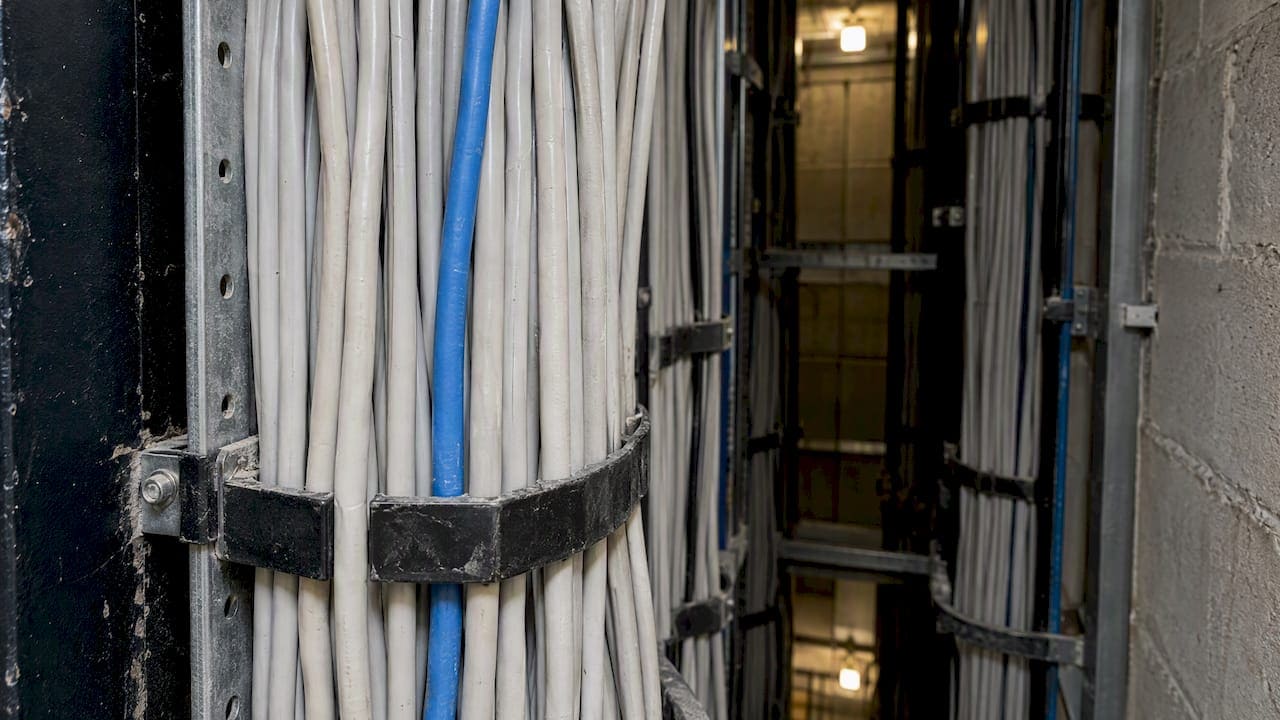
Alien crosstalk is interference that leaks from one cable link into a neighboring link, and you reduce it in three ways: design the cable routes so links are not packed together, choose cable construction (or shielding) suited to the density, and certify the installed links with alien crosstalk testing before anyone relies on them. Unlike crosstalk inside a single cable, the network equipment cannot cancel it out. It has to be handled in the design and the installation.
This guide is for IT directors, facilities managers and project teams planning or troubleshooting 10GBASE-T and Cat6A runs in commercial spaces. It explains where alien crosstalk comes from, what to change in the field, how it is measured, and which standards apply in the U.S.
TL;DR
- Alien crosstalk is noise coupled between separate cabling links. Standard Ethernet electronics cannot compensate for it, so mitigation is a physical job.
- The worst conditions are tightly bound bundles, packed pathways and dense patching areas. Loose, non-systematic laying in trays isolates better than tight bundling.
- Cat6A UTP is designed to reject alien crosstalk from adjacent cables of the same design, and an overall shield can reduce it further.
- Alien crosstalk is verified with PSANEXT and PSAACRF measurements on a sample of links, in addition to full in-channel testing of every link.
- Plan margin early. Fixing a failing bundle after ceilings are closed costs far more than routing it correctly the first time.
What alien crosstalk is, and how it differs from ordinary crosstalk
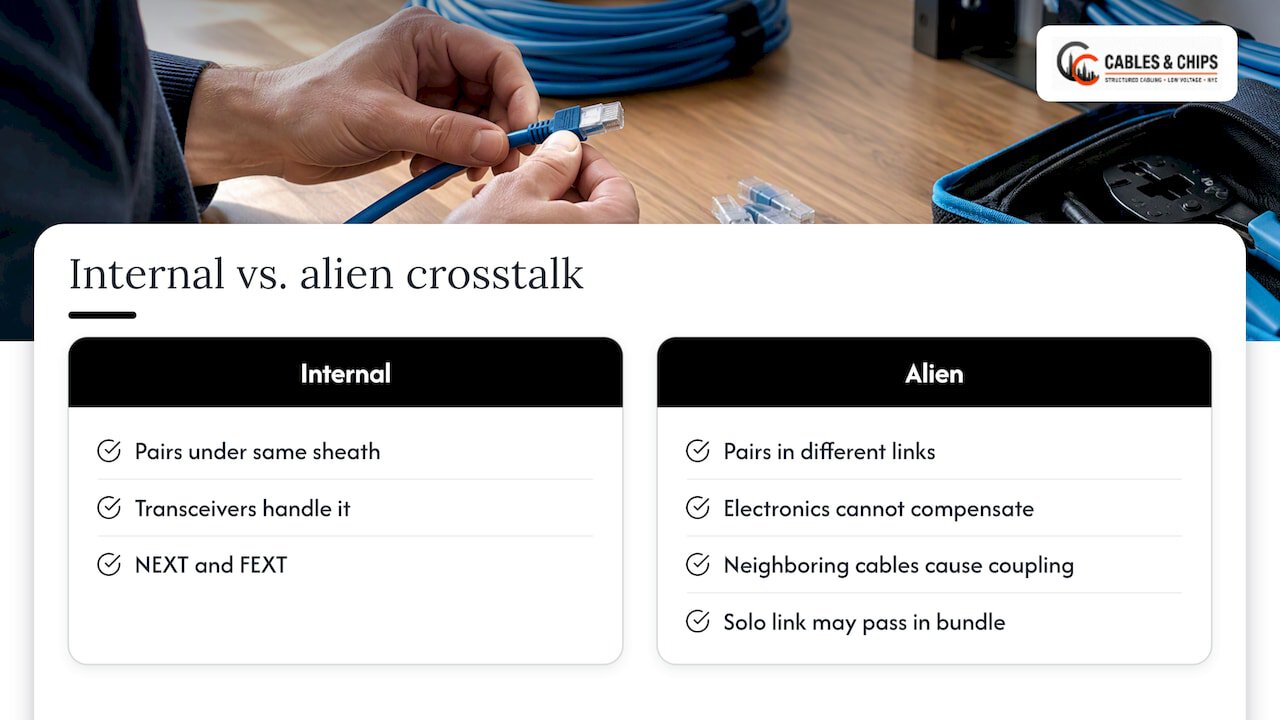
Every twisted-pair cable has four pairs, and those pairs interfere with one another a little. That is internal crosstalk (NEXT and FEXT), and the transceivers at each end are built to handle it. Fluke Networks describes the difference simply: ordinary NEXT and FEXT happen between pairs under the same sheath, while alien crosstalk happens between pairs in different cabling links routed close together.
The distinction matters because of what can be done about it. A test paper from the cable-testing industry notes that alien crosstalk originates outside the four-pair system, so standard Ethernet transceiver electronics cannot compensate for it. IEEE 802 materials add that the coupling is statistical in nature and comes from neighboring cables, even ones carrying different protocols. You cannot tune it away in software. You can only keep it small through design and workmanship.
In practice that means the cable that is the “victim” might be perfectly good on its own. Test it alone and it passes. Bundle it with 40 live neighbors in a congested riser and it may not.
Why it became a problem with 10GBASE-T
At 1 Gb/s, alien crosstalk rarely caused trouble. 10GBASE-T changed that. Fluke explains that the issue became especially important because 10GBASE-T signaling reaches 500 MHz, compared with 100 MHz for 1000BASE-T. Coupling between cables grows with frequency, so noise that was invisible at 100 MHz becomes a limiting factor at 500 MHz.
The same test paper calls alien crosstalk the “limitation noise factor” for Category 6A, because 10GBASE-T leaves little signal-to-noise margin to spare. If you are deciding whether existing copper can carry 10G, our guide on what to test before trusting Cat6 for 10G walks through the checks, and our 10GBASE-T cabling planning guide covers the design side.
Where alien crosstalk comes from in a real building
The conditions that create it are mostly physical and mostly avoidable. IEEE 802 modeling work identified where the greatest coupling potential sits: cross-connects and patch panels, horizontal cabling, consolidation points, the cabling near them, and closely spaced telecommunications outlets. Translate that into a New York office and you get a familiar list:
- Tight bundles. Cables pulled together and cinched hard with zip ties, especially over long parallel runs. The worst case is often described as a six-around-one configuration, where six cables surround one tightly bound victim.
- Packed pathways. Overfilled conduit, J-hook runs stuffed beyond capacity, and ladder rack where new cables were added on top of old ones for years.
- Dense patching zones. Patch panels stacked without management, with long slack coiled behind them and hundreds of cords crossing in the same space.
- Closely spaced outlets. Furniture-feed locations and wall plates where many drops terminate within inches of each other.
- Abandoned cable. Dead runs left in the pathway take up room and keep bundles tighter than they need to be.
Older buildings add their own constraints: narrow risers, shared conduit sleeves between floors, and ceiling spaces that have been renovated several times. That is why our team often sees alien crosstalk risk concentrated at the telecom room and in vertical pathways rather than out in the open office. Our list of common building infrastructure cabling problems covers many of the same pathway issues.
Mitigation 1: Route, space and bundle with intent
Routing is the cheapest mitigation because it costs nothing in materials. It costs planning.
Lay cables loosely, not tightly
Manufacturer guidance backs this up. Belden’s copper cabling guide notes that loose, non-systematic laying of cables in trays provides better crosstalk isolation than tight bundling. That runs against the instinct to make everything look neat with tight, parallel, combed bundles. Neatness and low coupling are not the same thing.
The practical balance in a commercial space:
- Use hook-and-loop straps instead of hard-cinched plastic ties. Snug is fine. Compressed is not.
- Keep bundles to modest sizes at the points where they run parallel for long distances, and separate large groups into multiple pathways.
- Avoid cinching parallel cables over long straight runs. Where cables must run together, a loose lay with natural variation is better than a precisely combed bundle.
- Do not exceed pathway fill. Plan spare capacity for growth, because the next project will add cables.
- Keep power and low voltage cabling separated as the electrical and telecom codes and standards require.
Spread the load across pathways
If a floor will need 200 Cat6A drops, do not send all 200 down one J-hook run because it is the shortest route. Split by zone or by closet. This gives each bundle fewer neighbors and makes later moves, adds and changes easier to do without disturbing everything else.
Treat the patching field as part of the system
Because the patch panel area is one of the highest-coupling locations, how you manage it matters. Use proper cable management, keep patch cord lengths appropriate, and avoid mixing random cord types. Incorrect termination hardware or non-matching patch cables can undermine an otherwise clean permanent link. Our post on structured cabling system components explains how panels, cords and pathways fit together as one system.
Clear out the dead weight
Abandoned cable is more than a code and clutter problem. Removing it frees pathway space so live bundles can be laid with less compression. If you are planning a Cat6A upgrade, an abandoned cable removal phase often makes the new installation easier to route properly.
Mitigation 2: Choose the right cable construction
Not all Cat6A cable is built the same, and the construction affects how much alien crosstalk it picks up from its neighbors.
Cat6A UTP
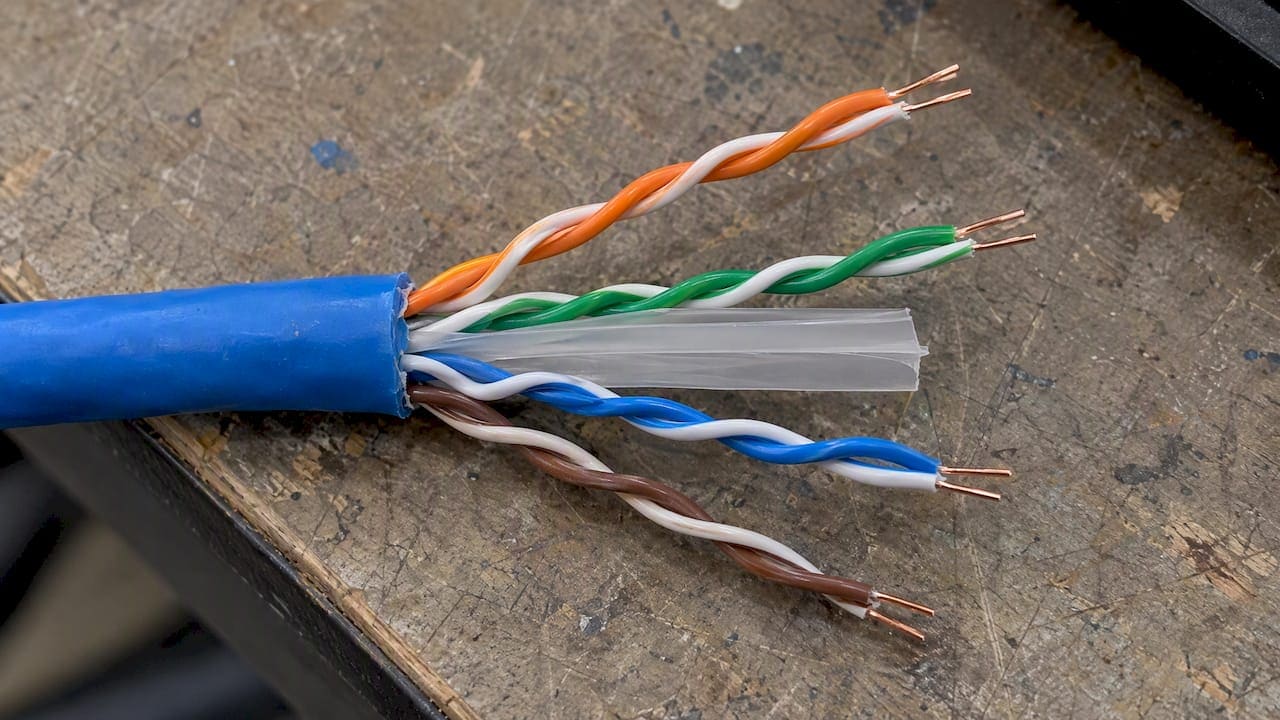
Typical Category 6A UTP is designed to reject alien crosstalk from adjacent cables of the same design. Manufacturers get there through physical construction. For example, Siemon’s North American Category 6A UTP specification describes a central pair separator for pair-to-pair isolation and internal longitudinal striations that keep the core positioned and reduce coupling between adjacent cables. The cable is often a bit larger in diameter than Cat6 as a result, which has a pathway-fill consequence you should plan for.
Shielded and screened Cat6A
The same test paper states that an overall cable shield can significantly reduce alien crosstalk. Shielded systems make sense in very dense pathways, in secure facilities, and in places where interference from other sources is a concern. They come with their own requirements: shielded connectors, proper bonding and grounding, and installers who are trained in terminating them correctly. A shield that is poorly terminated or not bonded properly does not deliver the benefit you paid for, so choose shielded only if the design includes the grounding and the testing to match.
Do not mix grades in the same bundle
Higher-speed and lower-speed cables sharing the same tightly packed bundle is a common source of trouble. If you are adding Cat6A to a pathway that already carries older Cat5e or Cat6 runs, take the opportunity to separate them or to retire the legacy cable.
Consider the medium itself
Where pathways cannot be improved and the distances or density are demanding, fiber is not subject to this kind of electrical coupling at all. An overview of cable versus fiber optic technology helps frame the trade-offs, and our CAT6A vs fiber optic installation decision guide shows how we weigh them for office projects. Backbones and long risers are the usual places fiber takes the load off copper.
Mitigation 3: Test for it, and know what the results mean
A design that looks right on paper still needs proof. Alien crosstalk testing exists because the interaction between installed links cannot be predicted perfectly.
What is measured
The two core parameters are PSANEXT (Power Sum Alien Near-End Crosstalk) and PSAACRF (Power Sum Alien Attenuation-to-Crosstalk Ratio, Far-end). Together they describe the combined effect of alien crosstalk from nearby channels on a given channel. Fluke explains that alien crosstalk is evaluated as Alien NEXT and Alien FEXT, including power-sum forms.
One point from IEEE 802.3 study group material is worth remembering: although alien NEXT often gets the early attention, alien far-end crosstalk (ACRF) is ultimately the more critical limiting factor for real-world channel performance.
How much is tested
Testing every link for alien crosstalk would be impractical, because the measurement involves the victim link and its neighbors. Certification therefore works in two layers. The test paper explains that Category 6A requires full in-channel performance testing for every link, while alien crosstalk is evaluated through a sampling methodology.
The sample size depends on the guidance used:
| Item | What the sources say |
|---|---|
| Typical Cat6A field sampling | A minimum of five links or 1% of the installation, whichever is greater, up to 30 links |
| ISO/IEC 14763-2 field testing | May require sampling to an acceptable quality level of 0.4% |
| ANSI/TIA-568-C.2 | Requires PS ANEXT and PS AACR-F measurements for Category 6A compliance |
Your project specification or the manufacturer’s warranty program will say which sampling rule applies. Confirm it before the installation starts, not after.
Testers and what they do
Advanced field testers can automate the process by synchronizing main and remote units across adjacent links. It is slow compared with standard channel certification, which is another reason the sampling approach exists and another reason to plan test time into the schedule.
Secondary indicators
When a space is difficult, such as a dense riser or an area with lots of other equipment, testing for TCL and ELTCTL can give secondary indications of a system’s noise immunity and potential susceptibility to alien crosstalk. They are not a replacement for PSANEXT and PSAACRF, but they help point to where trouble could be hiding.
When a sample link fails
A failure at the alien crosstalk stage is a design and workmanship signal, not just a single bad link. The usual response, in order:
- Check what the failing link shares with its neighbors: the same tight bundle, conduit sleeve, or patching field.
- Loosen or separate the bundle, remove cinched ties, and retest.
- Remove abandoned or unnecessary cable from the pathway.
- Re-terminate or replace suspect patching or connecting hardware.
- If the pathway still cannot support the density, split it, or consider shielded Cat6A or fiber for the affected runs.
Fluke also documents that for TIA TSB-155 testing, when PS ANEXT or PS AACR-F limits are not met, an alien crosstalk margin computation can be used, and it qualifies the link for 10GBASE-T suitability. Ask your contractor whether that procedure applies to your project and what the test report will show.
We cover broader testing practice in our guides on why cable testing matters before use in commercial networks and cable plant testing for IT professionals.
Which U.S. standards apply
Two layers of standards matter in the United States: those for new Category 6A cabling and those for assessing existing Category 6.
- TIA/EIA-568-B.2-10 and ANSI/TIA-568-C.2. The original addendum specifies Category 6A links, cables, cords and connecting hardware, and added alien crosstalk to the performance parameters. ANSI/TIA-568-C.2 requires PS ANEXT and PS AACR-F measurements for Category 6A compliance.
- ANSI/TIA-568.2-D. The newer revision provides updated requirements for field-terminable plugs, modular cords and component performance. Check which edition your specification cites, since the contract documents control.
- TIA TSB-155-A. This document gives guidelines for assessing installed Category 6 cabling to support 10GBASE-T, including alien crosstalk characterization, field testing and mitigation. It is the reference when an office wants to know whether existing Cat6 can carry 10G.
If these references are new to your team, our ANSI cabling standards explainer for IT professionals is a plain-language place to start.
A pre-construction checklist for IT and facilities teams
Use this list when you are specifying or reviewing a Cat6A project:
- Decide the target. Is this 10GBASE-T, or does it only need to carry 1G today? The answer sets how much alien crosstalk margin matters.
- Count the cables per pathway. Ask for fill calculations for each tray, J-hook run and sleeve, with growth capacity.
- Specify bundling practice. Require hook-and-loop straps and no hard cinching over long parallel runs.
- Pick the cable type. UTP Cat6A, or shielded where density or environment warrants it, with bonding and grounding in the scope.
- Define the test plan. State the standard, the alien crosstalk sampling rule, the tester model and the report format.
- Plan remediation. Decide in advance what happens if a sample fails, who pays, and how retesting is scheduled.
- Document it. Get as-built records and test results delivered together. Our as-built documentation guide shows what a complete package contains.
- Include the telecom room. Patching fields and cross-connects are high-coupling points, so management of the MDF and IDF belongs in the same scope.
Perspective: why we treat alien crosstalk as a design problem
Most alien crosstalk problems we are called about were created long before the test report. They start with a pathway that was full on day one, with a bundle pulled tight so it would look tidy, or with new Cat6A pushed into the same sleeve as years of old cable nobody removed.
Our approach after more than 40 years of commercial work in New York City is to deal with it at the survey stage. We look at the pathways, count what is already in them, remove what is abandoned, and design the routes so the new cabling is not packed against its neighbors. Then we terminate cleanly, test every link, and document the results so your team can see the margin that was achieved.
In our view, a network is only as strong as the infrastructure behind it. A 10G link that passes a quick continuity check but has never been assessed for alien crosstalk is a risk you only discover when the first heavy workload goes live. We would rather you find out during construction, with a tester in hand, than after move-in.
Ken
Common mistakes that raise alien crosstalk risk
- Treating a pass on one link as proof for the building. Alien crosstalk depends on neighbors, so a single link tested alone says little about the bundle.
- Over-tightening ties for appearance. A tight, clean-looking bundle is the configuration the industry uses as its worst case.
- Ignoring pathway capacity. Cat6A cable is typically thicker than Cat5e, so a pathway that held the old cable may be full with the new.
- Reusing patch cords and hardware of unknown quality. Mismatched or non-compliant components can undermine a good permanent link.
- Skipping the sampling plan in the contract. Without a stated rule, nobody is accountable for alien crosstalk results.
- Leaving abandoned cable in place. It keeps bundles tight and makes later fixes harder.
How this applies to different spaces
Office fit-outs and relocations
The big risk is speed. When a floor is built out on a tight move-in schedule, cabling gets pulled in volume and bundled quickly. Build alien crosstalk review into the plan: pathway fill, bundle sizes, a test sample, and time for remediation before furniture and users arrive.
Wireless access point runs
Multigigabit access points make Cat6A runs to the ceiling more common. These runs often share pathways in large groups heading back to one closet. If you are planning Wi-Fi 6E, see our guide to testing existing runs before choosing Cat6A and our WiFi access point cabling plan.
Multi-tenant buildings
Shared risers and tenant-by-tenant upgrades mean neighbors you do not control. Documentation and coordination with building management matter more here. Our overview of how cabling supports multi-tenant buildings covers those realities.
Secure and high-density rooms
Server rooms, security operations spaces and facilities with many cables in a small area are where shielded cabling and strict fill limits tend to earn their keep.
Promo: a site survey before you commit to a design
If you are planning a Cat6A or 10G upgrade in New York, New Jersey, Connecticut or Pennsylvania, we will walk the pathways, check what is in them, and tell you what the installation should look like before you sign. Cables & Chips designs, installs, tests and documents structured cabling for commercial offices and secure facilities, and we can clear out abandoned cable and organize your MDF and IDF as part of the same project.
See our structured CAT6 and CAT6A cabling installation service, browse all our services, or schedule a no-obligation site survey through cables.nyc.
FAQ
What is the difference between crosstalk and alien crosstalk?
Crosstalk (NEXT and FEXT) happens between wire pairs inside the same cable, and Ethernet transceivers are built to handle it. Alien crosstalk happens between pairs in different links that run close together. Because it comes from outside the four-pair system, the electronics cannot cancel it.
What technique in UTP cable helps protect against crosstalk?
UTP relies on the twisting of each wire pair, and higher-category cables add construction features. Category 6A designs, for instance, use a central pair separator and internal striations to reduce coupling between pairs and adjacent cables. Good installation practice, such as loose bundling, does the rest of the work.
Do I need to test every Cat6A link for alien crosstalk?
No. Every link gets full in-channel testing, but alien crosstalk is checked on a sample. Common guidance is at least five links or 1% of the installation, whichever is greater, up to 30 links. Your specification or warranty program sets the exact rule.
Does shielded cable eliminate alien crosstalk?
An overall shield can significantly reduce alien crosstalk, but only when it is terminated, bonded and grounded correctly. UTP Cat6A is designed to handle adjacent cables of the same design, so the choice depends on density, environment and your standards.
Can existing Cat6 cabling support 10GBASE-T?
Sometimes. TIA TSB-155-A provides guidelines for assessing installed Category 6 cabling for 10GBASE-T, including alien crosstalk. Results depend on the cable, the length, and how it is bundled, so test the actual links before you commit to 10G equipment.
Sources
- How to Test to TIA/EIA-568-B.2-10
- Some considerations concerning alien crosstalk (IEEE 802.3)
- Alien Crosstalk modeling (IEEE 802.3an)
- How to Certify or Re-certify Twisted-Pair (Fluke Networks)
- Rethinking field testing for alien crosstalk (Cabling Installation & Maintenance)
- Copper Structured Cabling (Belden)
- Category 6A UTP Cable spec sheet (Siemon)
- All About Alien Crosstalk Measurement (Fluke Networks)
- What is (+All) and When Should I Choose It? (Fluke Networks)
- PS ANEXT or PS AACR-F fails on TSB-155 (Fluke Networks)
- Updated Standards for Telecom Cabling (TIA)
- TSB-155-A guidelines for assessment and mitigation of installed Category 6 cabling
- Cable vs fiber optic technology